New posts coming soon! [EDIT: maybe…]

Note:  As it just so happens, the PC here in Spare Oom has decided to have some serious issues in booting up this morning.  This has been an ongoing issue over the last few months, and I’ve been hoping it would be minor, but today seems to be the worst–as of 11am PT it’s still running a Startup Repair, so I’m not entirely sure if it’s stuck in a purgatory loop or if it’s actually fixing itself.  Either way…looks like it’s high time for me to do some PC shopping soon.  I’ll try to keep to my expected schedule as mentioned below while using my laptop, hopefully it won’t be much of a problem.  If it does end up screwing with my posting schedule, I’ll let you all know.

Sorry about that… 😦

–JPC 5/14/13 


Hi all, I apologize for the delay in updating.  It seems that I finished up the major revision of the first novel in my sf/f series, A Division of Souls, a bit sooner than I’d expected, and have been using this time to get the manuscript (and its few extra bits) all nice and tidy for when I submit it to an agent.  I hope to submit it within the next few weeks, so that takes precedence.

In the meantime, not to worry, I have not forgotten to update the Blogging the Beatles posts, nor have I forgotten to do some Walk in Silence music posts either, I just have not had the time. I’m looking forward to a lot of these music posts, as they’re going to be covering quite a few great alternative albums from the 80s.  As soon as I have something new up, I will post the links over at Twitter and LJ as well.  I should hopefully have something up by midweek the earliest, or next weekend the latest.

Also, thought you’d like to know that A. and I will be going to Outside Lands again this year, so sometime in August I will be posting pictures from it like I did last year.  There are a lot of great bands playing this year, so I’m really looking forward to it.

I do apologize for not letting y’all know sooner, and will definitely do better at keeping everyone updated when there’s going to be a delay.

Thanks for following along! 🙂

Walk in Silence: Finding New Music, Immediacy in Availability

I know that I’m the rare music collector–I’m one who will download music, but also still head over to Amoeba on Haight Street and pick stuff up on a semi-regular basis.  I did that yesterday as part of my slow-but-ongoing plan to weed out most of our cd collection, having gotten a good ninety dollars’ store credit out of a pile of titles that have been gathering dust in a closet the last few years.  In the process, I spent a good hour or so digging through equally dusty clearance bins and making out pretty well.  The dollar bins are my friends, because a lot of the time I can find stuff that I want that isn’t available digitally.  As always, the time frame of the titles there are about ten to fifteen years ago (with the occasional exception–for some reason there were a lot of copies of Morning Parade’s album from last year in there), which means it aligns with a lot of the titles I remember seeing during my tenure at HMV and during my weekly jaunts to Newbury Comics back when it was in Amherst.  In the process I also picked up a few new titles that we’d been looking for.  In addition to this, I’ve been ordering a few import cds online lately–the recent and excellent reissues of We’ve Got a Fuzzbox and We’re Gonna Use It!!’s two albums from 1986 and 1989 being the latest–again, because they’re not available digitally.

I’m also an obsessive when it comes to listening.  I’m not sure how rare or how prevalent that is with others, but I’ve always got some music going on in the background wherever I am.  Roadtrips?  Got the local stations on the car radio.  Work?  Streaming something online.  Working out at the gym?  Listening to my mp3 player.  Writing?  Playing something from my digital collection.  Not at my desk?  If we’re not watching something, we’ve got one of the Sirius stations on.  I’m not always focusing on the music, but I’ve always got it playing when I can.  I’ve been that way since I was a young kid in the early 80s.

In the past, I would find new music by listening to the radio–more to the point, once I became obsessed with indie rock, I started paying attention to new things and their release dates.  Again, this really came to the fore once I started working at HMV, previewing them in the stock room before I brought them out onto the floor on Tuesdays.  Even more so when I had my weekly Wednesday comic book/music purchase run in Amherst during the early 00’s.  I fell out of the habit in 2005 when I had couple of major life changes, and I didn’t really get back into it until a good couple of years later.  This would probably explain that gap in 2005-2007 where I kind of remember some indie music, but it doesn’t really stick with me unless I really look at the chronology.  I got back into the habit around 2010-ish when I found Save Alternative, and later started actively looking for college and radio stations on the internet, and even more recently when my wife and I started listening to AOL Music’s Spinner.  Interestingly, I rarely pick up new information from music magazines or websites other than release dates.  I don’t have much against them, but while their coverage is similar to my tastes, they don’t converge enough for me to actually benefit.

I say all this because lately I’ve been listening to college radio again.  I’ve been listening to it for awhile now, but more so than in the last few years.  Because nothing beats getting it from the source.

I wish I could say I’ve got the Jonzbox plugged in and I’m taping stuff as it’s being played, but alas that isn’t true.  I do still have a handful of blank tapes that my sister found lying around, and the Jonzbox still works, albeit just barely, but those days are over.  As much as I’d love to tape radio shows again like I did so many years ago, a handful of the college stations I listen to are well out of range–some of them being on the other side of the country.  That’s the beauty of the internet for me in this respect.  I love being able to listen to WZBC out of Boston College one moment, and KSCU out of Santa Clara U. here in California the next.  There’s also the fact that I can listen to any college station and not really know or expect what they’re going to play next, because for the most part they’re still freeform after all these years, bound only by their show’s theme.

And despite not being able to record these shows, it does occur to me that I can do the next best thing–if I’m interested in a song, I can do what my wife and I have been doing whenever we listen to Sirius XMU and Alt Nation:  write the songs down on Post-Its for further checking out and possible downloading.  I just did that this morning, actually…while listening to a great set on KSCU, I wrote down a small handful of songs I liked and realized I could just as easily zip over to Amazon and download the mp3s whenever I wanted.  While I miss out on recording the semi-professionalism and occassional silliness that goes on with student-run stations, it’s a small price to pay when I can instead buy the music immediately if I so choose, instead of waiting for the weekend/when I get paid to go to the local record store.  And as I’ve mentioned earlier, most of my trips to Amoeba as of late have been for back catalogue.

Still, I do like the idea of listening to the radio again, especially when it’s to listen on certain days for a specific deejay’s show.  It’s a refreshing change from the daily (and sometimes hourly) repeat of the same sounds, and there’s a much higher chance of something new and unknown being played that will catch my attention.  And by listening online, I also get to savor the sounds of different cities.  Northern California’s college radio is a bit more lively and odd than New England’s laid back autumnal sound, for instance.  It’s a pleasant reminder that just when I’m in the mood for a specific sound, or sick of the same music being played, there’s a hell of a lot more always out there that I haven’t tried yet.

Blogging the Beatles 23/24: post-Beatles for Sale review, and Another Beatles Christmas Record

In retrospect, it’s amazing just how far the Beatles managed to reach in popularity–and productivity–in such a short time.  They’d been, for all intents and purposes, a bar band from their humble beginnings in Liverpool all the way to their Hamburg days.  It was only by chance that Tony Sheridan had asked them to be his studio band for a release.  It wasn’t until the end of 1962 that they’d gotten lucky, finding an excellent manager in Brian Epstein and a young and open-minded studio producer in George Martin, and hit #17 on the UK chart with their debut single.  In the ensuing two years, they released not one but four albums, eight singles and an EP, all containing new recordings; shot and released a hit movie; made multiple appearances on both radio and TV; toured in Europe, Australia and parts of Asia, and had a level of success in the United States not seen before by any pop musician from Britain. There aren’t that many bands nowadays that do that much in the span of two years.

All things considered, 1964 was a banner year for them. When they touched down on American soil on 7 February, they were met by loud and emphatic screams and cheers of teenagers who found the band the perfect antidote for post-Kennedy gloom and ennui. In March they started filming A Hard Day’s Night. Every release eventually hit Number One on both the US and UK charts (or at least close to it)–in fact, they hit the rarest of feats: on 4 April, a few weeks after “Can’t Buy Me Love” was released, they had songs in the top five positions on the Billboard singles chart, four of them on different labels: the Vee Jay single “Please Please Me” at #5, Capitol’s “I Want to Hold Your Hand” at #4, Swan’s “She Loves You” at #3, Tollie’s “Twist and Shout” at #2, and Capitol’s “Can’t Buy Me Love” at #1. [They also had an additional seven singles in the Top 100 on that day, totaling an astonishing twelve singles on one chart.] At the end of April, John Lennon released his first book of poetry and literary silliness, In His Own Write.   Their movie was released to thunderous applause in July.  By midsummer they were on tour, and by August their first official US tour commenced, two straight months of continent-crossing mayhem.

All this action with nary a second to breathe, and it nearly did them in. Part of this was obvious–no one had expected the teen fans to be screaming throughout the entire show, not like the Cavern days when the boys could mingle with the crowd after their set or even in between songs. British crowds were noisy, but they certainly weren’t on the verge of hysteria. Shows were booked at halls much too small for their American fanbase, and their sound system was meant for a much smaller space–in such a cavernous hall amidst thousands of howling teens, their amplifiers just weren’t going to cut it at all. They were held captive in their own hotels most of the time, unable to do anything except play cards, write songs, and watch television. There was also the fact that the tour had not been planned according to the size of the country they would be in. In Britain, one could get away with playing in Liverpool, do a show the next day in London, head up to Glasgow and do another show a day or so later, and head over to Blackpool the day after that, with only their chauffeurs and drivers feeling the strain. In the US, they’d hopped from one major city to the next with nary a day off in between–and traveling thousands of miles between shows by air or land. It was exhausting and disorienting.

And yet…despite the ups and downs, the noise and insanity, they’d made it. Beyond their wildest dreams, they’d made it to the big time.

And as a year-end thank you to their most dedicated fans…

Credit: jpgr.co.uk – The Beatles Complete UK Discography site

Credit: jpgr.co.uk – The Beatles Complete UK Discography site

Single: “Another Beatles Christmas Record”
Released to the Beatles’ Official Fan Club: 18 December 1964

“Another Beatles Christmas Record” was recorded on 18 October, the same day they recorded Ringo’s cover of “Honey Don’t”. Much like the previous year’s Christmas message, it was a semi-scripted four minute track (written by their erstwhile publicist Tony Barrow) full of thank yous and year-end reminisces with the typical Beatle silliness thrown in for good measure. They sound much more relaxed and unrestrained, not just going offscript but breaking the fourth wall multiple times (“I wrote a book it says here [in the script]!” says John). The exhaustion that shows on their faces on the Beatles for Sale cover can be heard in their voices here, as they don’t sound nearly as bouncy and full of energy as the previous Christmas single, but regardless, they must have been thankful, if not a bit blown away, by the reception they got from all their fans the world over, and made sure they received the next holiday single.

*

Come the end of this banner year, the boys finished up with another seasonal run of shows at the Odeon Cinema at Hammersmith, London, similar to 1963’s year-end shows. By this time they were on home turf, worn out but able to relax at the end of it all. They had another busy year ahead of them, with another round of touring around the world, two more albums and a few singles to record, and a second movie to film. It would be similar to 1964, and again it would nearly drain them. Music-wise, however, things were changing. They’d learned a lot in the studio over the course of two years…even George Martin began devising new ways to record the band that would not only save them time but make the process more creative and relaxed. The band would take in even more outside influences, moving away from the American soul and Motown of the covers they’d cut their teeth with and onto the country and folk of the American troubadours like Bob Dylan. The lyrics were becoming less doe-eyed and more introspective, already hinted at on many of John’s contributions to Beatles for Sale.

If 1963 had been their rise to UK stardom and 1964 had been their US rise, then 1965 would be the year of change, personally and professionally.

Next Up: The “Ticket to Ride”/”Yes It Is” and “Help!”/”I’m Down” singles, and Help!

Blogging the Beatles 20/21/22: post-A Hard Day’s Night releases, “I Feel Fine”/”She’s a Woman” single, and Beatles for Sale

After the summer release of their first movie, there was a flurry of releases, both related and unrelated, to fill up an entire late summer-into-early-fall season. Some of them were mentioned in previous posts (Vee Jay’s plethora of “releases” and the US releases of Something New and A Hard Day’s Night). Since I went into detail about the Long Tall Sally EP and A Hard Day’s Night releases in my last entry, I will pass up going into detail and only list the movie-related (and EP related) releases here.

The United States had a heads-up on the A Hard Day’s Night soundtrack, having been released a good two weeks earlier on 26 June 1964. As mentioned previously, the American version differed in that it did not contain the non-film songs from the UK version. Instead, the film songs from the band were interspersed with the orchestral score arranged by none other than George Martin himself (this score would end up being reissued a short time later–with a few extra non-film tracks–on United Artists Records under George Martin and His Orchestra), and the non-film songs would be released a few weeks later on 20 July as part of the Something New album. There were also a number of singles released at the same time:

–A Hard Day’s Night/I Should Have Known Better (released 13 July)
–And I Love Her/If I Fell (released 20 July)
–I’ll Cry Instead/I’m Happy Just to Dance with You (released 20 July)
–Matchbox/Slow Down (released 24 August)

The UK releases, on the other hand, were much more conservative, obviously being that no massive media blitz was needed. After the tandem release of A Hard Day’s Night, the “A Hard Day’s Night”/”Things We Said Today” single, and the Long Tall Sally EP, there were no further releases on the docket until five months later, with the follow-up EPs to keep them in the limelight until the next project was ready:

Extracts from the Film ‘A Hard Day’s Night’ (released 4 November)
(I Should Have Known Better / If I Fell / Tell Me Why / And I Love Her)
Extracts from the Album ‘A Hard Day’s Night’ (released two days later on 6 November)
(Any Time At All / I’ll Cry Instead / Things We Said Today / When I Get Home)

After their last recording on 2 June which would wrap up the movie and EP project, they would not head into the studio again until 11 August, when they were to start recording their next album and single. In the meantime, they kept themselves quite busy with the movie premiere, many television and radio appearances, and Ringo’s bout of tonsillitis that caused Jimmy Nicol to fill in for six shows during a short tour through Australia and the Netherlands/Denmark area. Even then, this next round of sessions would be broken up by yet another tour–this time their first official tour of the United States. This would give them precious little time to write any new material, so instead of a full album’s worth of originals like A Hard Day’s Night, they only came up with ten songs, necessitating six covers (and a seventh that was never released until much later) from their older repertoire to fill in the gaps.

Schedule-wise, it seemed the world of Beatlemania was a blur of nonstop touring, frequent appearances, and young screaming girls everywhere, and it’s amazing to think that in addition to all of that, they somehow managed to also record two full albums and a handful of singles for three years in a row. Perhaps this is one of the main reasons that one can hear a major difference between the songs of the early years (1962-1965) and the later years (1966-1970)…once they were given more room to breathe and less of a jam-packed schedule, they were able to focus even more on their music. This wouldn’t happen for another couple of years, but you can definitely hear that things were starting to change.

*      *      *

Single: “I Feel Fine”/”She’s a Woman”
Released: 27 November 1964

Credit: jpgr.co.uk – The Beatles Complete UK Discography site

Credit: jpgr.co.uk – The Beatles Complete UK Discography site

The next new release from the band was a non-album single that preceded the album they were working on. Both tracks were actually recorded near the end of the sessions in October, and this was definitely a great example of the surprisingly quick turnaround of writing-to-recording-to-release that the band could occasionally pull off. The two tracks have a similar upbeat feel that could possibly fit in with the A Hard Day’s Night sound, but it’s also clear that there are outside influences at work here as well, specifically the soul of Motown and Ray Charles. In addition to that, it’s clear that the band had also become quite comfortable in the studio, and in the process had begun to experiment with their sound.

Side A: I Feel Fine
And nothing is more experimental in late 1964 than deliberate feedback! This track started out as a riff that John had come up with around 6 October while the band was recording “Eight Days a Week”, and had nearly thrown it away as ‘rubbish’ until he’d written a song around it, recording it two weeks later on 18 October. It was during one of those takes that the band had stopped playing to take a listen, when John, playing a semi-acoustic Gibson at the time, put his guitar down to head to the control room. He’d leaned the guitar against the amplifier, and the ensuing feedback stopped everyone in their tracks. Any other producer at the time would have screamed bloody murder at such reckless treatment of instruments, but it being the Beatles, they thought it was the coolest sound ever, and wanted it in the song. And George Martin being the producer he was, willingly obliged by suggesting it as an intro, preceded by a harmonic pluck of the A string on Paul’s bass. And another classic moment in Beatle music is born.

The song itself is excellent, a mixture of Ray Charles’ upbeat soul and trademark Beatle melody, and some of the best playing the band put on record to date. John’s signature riff plays throughout the main verses and echoed by George (who pulls off a brief Carl Perkins-style solo halfway through), and there’s some phenomenal harmonization going on here. Even Ringo deserves some serious accolades here, with some of his fastest and most intricate playing of ride cymbals and tom-toms. It’s a song that leaves you breathless just as John and George trade the riff on the fade out.

Side B: She’s a Woman
Paul, in the meantime, had written an equally driving song in the style of one of his favorite singers, Little Richard, which explains why the song is in such a high register (even for Paul at the time). This is also one of their first tracks where the song deliberately starts on the backbeat, with John’s Rickenbacker 325 hitting all those funky seventh chords. And once the song proper kicks in, we hear Paul playing a deliberate countermelody on bass and piano. George and Ringo don’t have too much to do in this song, but they do deliver a great solo and solid percussion. The track is relegated a b-side, but it’s still a great rock song that fit in quite well with the rest of the tracks they recorded at this time.

* * *

Album: Beatles for Sale
Released: 4 December 1964

Credit: jpgr.co.uk – The Beatles Complete UK Discography site

Credit: jpgr.co.uk – The Beatles Complete UK Discography site

The band released their follow-up album one week after the above single, just in time for the Christmas rush. It’s a record of a band evolving again, becoming older and more mature, and of a band whose persistent and unending hard work was starting to pay off. As is often commented, one can see this hard work in the eyes of the band on the iconic autumnal album cover shot by Robert Freeman in Hyde Park. They may look exhausted here–unlike the poses on With the Beatles a year previous, where they look confident and maybe a bit nervous–but they’ve also retained that confidence, that they can now show that they’re not a band in the dark but a band out in the world. The title itself may be a cynical response to the cost of their overwhelming worldwide fame, but it could also be a response to the level of fame they were at: they could easily sell themselves now, without using outside help.

Side A

Track 1: No Reply
One of the most repeated comments about Beatles for Sale is its downbeat attitude, and given the first three tracks on this album, it’s hard to refute that point. The album starts off with one of John’s songs that may be autobiographical–it’s a song of dark jealousy, about possibly being two-timed by his girl (in this case, his wife Cynthia, even though John’s often later commented that a lot of his “jealousy” songs were really about himself, projected onto other people). The music itself is given a darker edge as well, playing up the mood of the lyrics: the song is played in a quiet acoustic manner…only to burst out in emotional pain at the end of each verse, and worse, in angry accusation during the middle eight. The band had never written such an angry love song before, so this certainly set the tone for the rest of the album.

Track 2: I’m a Loser
As if to counterpoint the accusatory nature of the opening song, John returns with another, this time as if to say, “You know what–forget what I just said. I’m just an idiot.” Here he opens himself up even more, revealing the hard truth that his anger and jealousy is really an inner weakness–deep down, he’s afraid of himself and afraid of the pain. This track is highly influenced by Bob Dylan, but it’s also influenced by the sad country music they were listening to at the time, like that of George Jones.

Track 3: Baby’s in Black
Three songs in, and the band is yet to bring out a happy song–definitely unlike any other Beatles release at the time. This third track of John’s feels like an old-school American country ballad, written in 6/8 time and sung as a duet (similar to “If I Fell”, in which both vocals are the main melody). Written for their Hamburg friend Astrid Kirchherr, who’d been the fiancee of John’s old school buddy Stuart Sutcliffe before he died. The three had been extremely close friends, and their loss had hit them hard.

Track 4: Rock and Roll Music
The album finally gets an emotional lift with a phenomenal cover of Chuck Berry’s classic rock song, done as only the Beatles could do it. If you went back and listened to the original, you’d hear a much more laid back version, one that sounds almost quaint at this point. The Beatles instead chose to give it their live interpretation by cranking up the guitars and screaming out the lyrics. Its placement here is almost cathartic, as if it’s high time to let go of the emotional baggage they felt at the moment and just rock out.

Track 5: I’ll Follow the Sun
It seems the emotional release of the previous track only lasts so long, as we’re right back down to the melancholy of love thwarted. This time it’s Paul with a lovely ballad about leaving. As a counterpoint to his previous “Things We Said Today” in which he hopes things are better in the future, this track says the opposite, as if there was no future in that relationship, and that he’d warned her this would happen. Paul’s songs at this time were never as emotionally raw as John’s, but he could be just as cold in his departure. It’s actually an older track dating from around 1960, but they never recorded it previously as it wasn’t considered “hard” enough for their original leather-jacket image. [On a lighter note, Ringo performs on an altogether different piece of percussion equipment here–his knees. It was one of the first Beatles tracks where he’s on the track but not playing his drum set.]

Track 6: Mr. Moonlight
Another cover is brought in, this of an obscure b-side by Dr. Feelgood and the Interns that was a cult favorite of British teens back in the day. It’s kind of a weak track here, as it’s a straightforward cover that doesn’t vary from the original. Still, it’s a reminder of their early pre-studio days when most of their live set was filled with adventurous covers. Its only saving grace, really, is John’s stellar vocal delivery (with able assistance by Paul), although it took them a few tries to nail it!

Track 7: Kansas City/Hey, Hey, Hey, Hey
The first side finishes up with a third cover, this one of a medley made famous by Little Richard of an old Wilbert Harrison blues song matched with one of his own. Paul being a serious Little Richard fan (and no mean impersonator!) they deliver a solid party track. It unfortunately gets lost in the darker mood and the long list of covers on this album (it works much better as an opening salvo on the 1965 US release Beatles VI), but it’s a great cover nonetheless.

Side B
Track 1: Eight Days a Week
The second side starts off on a much happier note, this time with an unexpected twist–a fade-in. It’s also the first song they’d brought in unfinished, quite unsure how to arrange it. The Anthology version shows an altogether different cold opening with a harmonizing “ooh’s” from Paul and John, before eventually settling on the opening guitar riff. Elsewhere on the arrangement one can find an interesting use of quiet singing on the two bridges, as well as Ringo’s use of floor toms both on the intro and the coda.  In retrospect, this song is almost like a return to their simpler “Love Me Do” era songs, only updated to fit their current sound.

Track 2: Words of Love
Yet another cover, but this time it’s a lovely interpretation of an early Buddy Holly tune, complete with some excellent vocal duet work by Paul and John, and possibly the inspiration for some of their own “duet melody” songs like “If I Fell”. Again, it’s a straight cover, but it highlights their strengths here. Aside from the vocals, George delivers some excellent guitar-picking here, quite clearly in his Carl Perkins phase.

Track 3: Honey Don’t
Cover number five on the album, and Ringo’s vocal entry on this album. John had sung this one back in their Cavern days, but it suited Ringo quite well, as his vocal delivery here has to be the best he’s given the band so far. The cover itself sounds a bit sparse, as if it had been recorded more as a jam than a true album track–John’s rhythm guitar is unadventurous and quite loose, and George’s two solos are almost the note-for-note the same, but that only adds to the charm of this Carl Perkins track.  Clearly, Ringo’s strengths as a singer lay in country music.

Track 4: Every Little Thing
One of the few really strong tracks on this album, this one is unique in that it was written by Paul, but John is the primary vocalist here, even though Paul is there as backup. [One way to figure out who wrote what in the Lennon-McCartney catalog is to hear who sang it, as they often sang their own compositions.] It hints at a Buddy Holly track, actually, with its plaintive vocals and “I’m a lucky guy” lyrics, which Paul had written while still living at Jane Asher’s house. The arrangement is quite nice, sparse and tight during the verses, and more unbound in the chorus. In a hint of what was to come, Ringo introduces another non-standard instrument to a rock song: the timpani drum, using it to great effect during the chorus to underscore its importance.

Track 5: I Don’t Want to Spoil the Party
As if to bring the opening theme of the album back around again, John brings another Dylanesque track to the fore, this time a song of love thwarted. There’s no jealousy, no anger…just heartbreak here, as his girl has stood him up, and he doesn’t want to bring everyone else down in the process. It’s not one of his strongest songs, and feels a bit like he didn’t try all that hard with this one, but there’s some great guitar work going on here, and the vocal melody is deliberately resigned.  In retrospect, it’s one of his strongest emotional songs in that it’s so retrained–he’s not lashing out or accusing here, he’s completely blaming himself.

Track 6: What You’re Doing
In an interesting change, it’s Paul this time who’s writing a song of a relationship in trouble. Supposedly written about his current relationship with Jane Asher (who was quite the socialite at the time; Paul, when not on stage or in the studio, was more of a stay-at-home guy), it’s a song about questioning what the status of their relationship is, and more specifically, where she thinks they are. Is she serious, or just playing games? Does she truly love him, or the idea of being with him? The music itself is a perfect complement to the lyrics–it’s sharp and staccato, leaving uncomfortable silences everywhere. Hardly any instrument, save George’s excellent 12-string playing, resonates for more than a moment.

Track 7: Everybody’s Trying to Be My Baby
The album ends with the last cover, and interestingly, a Harrison vocal. This time it’s another Carl Perkins track, this time about the perils of being a bit too famous, and closes up the theme of the entire album quite nicely. Like “Honey Don’t”, the cover is delivered much like a loose jam, but considering they knew this song so well, it didn’t take that many tries to perfect it.  George had many guitar heroes in his lifetime, and Carl Perkins was right up near the top there, so this can also be thought of as a personal ‘thank you’, as he delivers his guitar and vocal work with care and admiration.  Recording engineer Geoff Emerick gave George’s voice a STEED effect (send tape echo & echo delay), giving it an odd yet pleasing multiple-echo sound that hints at the amateur recording processes of yesteryear.  And as a final nod, they deliver a false ending–just when you think it’s going to stop cold, they sneak back with one final jazzy riff.  It’s a fun way to end an otherwise downbeat album.


Beatles for Sale may in fact be a deeply uneven and perhaps even a weak album to some, but it’s not without merit. Given that it was recorded in roughly six days over the course of four months scattered in between dates of a major world tour, and so quickly on the heels of a major album and movie breakthrough, it’s a wonder they were able to finish it at all in time for the Christmas season. Even more surprising is a seventh cover, Little Willie John’s “Leave My Kitten Alone”, had been recorded and ended up unreleased until 1995’s Anthology 1. Still, it remains a relatively strong album, if not a stellar one. As I’d mentioned in previously, the A Hard Day’s Night track “I’ll Be Back” was definitely a sign of things to come…the band had evolved from the simple by-the-books pop songs and started experimenting with different soundscapes and themes, and Beatles for Sale is full of songs that sound nothing like their previous output, even despite half of it being cover songs. It also hints at the folksy sound they would perfect once they recorded Rubber Soul a year later, under very similar circumstances as this one.

As an aside, the songs here actually benefit from the US track shuffling. As Beatles ’65, four tracks were taken off (Eight Days a Week, Words of Love, I Don’t Want to Spoil the Party and What You’re Doing–they would appear a short time later on Beatles VI), and I’ll Be Back and the I Feel Fine/She’s a Woman single are added, creating a slightly shorter and much tighter sounding album, and one with a slightly more positive outlook. If you listen to the songs on that album–and forgive the US meddling of adding ridiculous echo to a few songs–one can forgive the exhaustion and resignation that permeates Beatles for Sale and hear the songs instead as a band once again in motion–they were maturing, both as artists and as people. This version is available as part of The Capitol Albums Vol 1 box set. It’s well worth checking out.


Next Up: Another Christmas Beatles Record and post-Beatles for Sale releases
Blogging the Beatles 18/19: Long Tall Sally EP and A Hard Day’s Night

The multiple shows and appearances in the first two months of 1964 out of the way, the Beatles now moved on to their next major project: a film.  It seemed the natural thing to do, as many of the big rockers of the time were making or were about to make their own musical movies.  Most likely inspired by Elvis Presley’s star turns in the American film industry over the last few years, it was considered yet another viable avenue for worldwide fame.  The end result was more often than not a drive-in quality film not unlike the Beach Party movies Frankie Avalon and Annette Funicello became known for: a lot of fun to watch and listen to, but very little in the way of substance and plot.  But that wasn’t as important as the music that would be featured–the point was to show the band in their natural habitat, performing hit songs.  The storyline would be halted, the band would head up on stage and perform a big song, and would continue again once the song was finished.  All kinds of bands including Cliff Richard (Expresso Bongo and The Young Ones), The Dave Clark Five (Catch Us If You Can, aka Having a Wild Weekend in the US) and Chuck Berry (Rock, Rock, Rock) would make films like this, to varying success.

The Beatles actually began recording music for their movie before they started filming, per director Richard Lester’s request.  Lester was an American who had started making his name  primarily in Britain, making comedic and often irreverent films, his first being the bizarre experimental short The Running, Jumping & Standing Still Film with comedian Peter Sellers.  That was a particuar favorite of the Beatles (especially John, who was a huge Goon Show fan), which helped Lester get hired for the film.  Lester wanted a few songs beforehand so he could fit them into the shooting script, and the band gladly provided.  They would only need a small handful of songs–maybe seven or so–for the film itself, but they treated the assignment as sessions for a follow-up album.  The viewpoint was that Side A would be songs from the film, and Side B would be “songs from the album of the same name”.  In the end, they laid down seventeen new songs, providing them with a full thirteen-track album, as well as an EP that preceded it.

Credit: discogs.com

Credit: discogs.com

EP: Long Tall Sally
Released: 19 June 1964

Side A
Track 1: Long Tall Sally
Little Richard’s early 1956 single was a huge favorite of the band and one they often played in their early days. Recorded on the afternoon of 1 March during the earliest days of the A Hard Day’s Night sessions, this was Paul’s baby–he could do a mean Little Richard wail, and he nailed it in one take. With all four band members rocking their hardest and George Martin providing the piano backing, the first take was so perfect that they didn’t bother doing another. It’s an all-out rocker that leaves you breathless.

Track 2: I Call Your Name
Recorded the same day as “Long Tall Sally”, this was an older track of John’s written at least a few years previous, which may explain the band’s return to the simpler lyrics of their first songs. It’s another curiosity, for a few reasons. First, this was originally a track given to fellow Liverpudlians (and fellow Epstein roster band) Billy J. Kramer & the Dakotas, who relegated it to a b-side (interestingly, its a-side was another Lennon/McCartney track given especially to them, “Bad to Me”). Second, John wanted to record it as he was unhappy with Kramer’s version (and admittedly, theirs is a bit of a hash). Third, it’s one of the first band tracks that feature George’s new toy, a Rickenbacker 360/12 guitar, one of the first electric 12-strings out there, and one he’d use in a number of songs from this period. And fourth…it’s the rare moment when the band switches into a completely different sound for the solo, in this case ska, of all things. In all honesty, it’s not one of their strongest songs, but as always, it’s a solid one.

Side B
Track 3: Slow Down
This Larry Williams track from spring 1958 had long been a staple in their early live shows (and one of two Williams tracks they’d record), a simple 12-bar blues rock song. I’ll be straight here–this recording is a complete mess, even though there were six takes done on 1 June – their first recording session after all filming of the movie had finished and a holiday had been taken. The playing here is fast and extremely loose to the point of sloppiness. There’s also a noticeably bad mix error around 1:14 in which the bass and the piano disappear for a few seconds, not to mention John screwing up the lyrics around the same time. And yet, it’s almost as if it was done that way on purpose, a track that was supposed to sound like it was played by a band up on stage at a bar, who’d already had a few too many, and no one seems to mind. It’s rocking, it’s messy, and somehow it manages to still be good.

Track 4: Matchbox
And now a track for Ringo! The band had been big fans of Carl Perkins since their Hamburg days, and this old blues standard (originally “Match Box Blues” from 1927 and updated by Perkins in 1957) was often performed during the time, specifically for the drummer to sing. Pete Best sang it during those early years, and Ringo handily took over when it came time for them to record it, which they did the same day as “Slow Down”. It’s a simple song for Ringo to sing, more in his limited vocal range than “Boys” and “I Wanna Be Your Man”, and a fun track for the whole band to jam to.

All told, this quick EP did reasonably well in the UK, and two of the tracks even made it as a single in the US (“Matchbox”/”Slow Down” hit a respectable #17 in the charts). It’s by no means their best work, but it’s an excellent example of a band’s evolving sound finally falling into place–a mix of American blues and rock, and British pop–and it’s also a great example of a band refusing to stay in one style.

*      *      *

Credit: jpgr.co.uk – The Beatles Complete UK Discography site

Credit: jpgr.co.uk – The Beatles Complete UK Discography site

Album: A Hard Day’s Night
Released: 10 July 1964

The Beatles’ first movie was released on 6 July to rave reviews worldwide–everyone had expected another throwaway movie, and no one had expected such a detailed, decently acted, well-written, and extremely well-made film from scruffy rock stars. The humor was distinctively British and to some extent specifically Liverpudlian, that ‘we’re taking the piss out of you because we like you’ working class irreverence. It was also made with the idea that not only would the kids love it, but the grown-ups would enjoy it as well. In a brilliant move from Lester and screenwriter Alun Owen, all four band members were able to show their own personal side, specifically in solo scenes. John got to play the silly but smart leader to his heart’s content, Paul got to play the straight man with responsibility (Wilfred Brambell played his “clean” grandfather that they had to take care of), George showed a quiet but deep intelligence in an unexpectedly serious scene (he’s cornered by clueless fashion designers and asked his opinion, thus introducing the word “grotty” to the world), and Ringo got to show his natural acting chops in a wonderfully somber solo scene. Its ‘day in the life of a musician’ plot made such a lasting impression that it still influences other music-related movies to this day. The soundtrack, started in early March before filming started and completed in June once it ended, was released a few days later in the UK.

Side A (songs from the film)

Track 1: A Hard Day’s Night
This track opens up with a distinctive Beatle note–a crash of guitars and piano so inventive that no one can seem to figure out how the hell they did it (the Wikipedia entry has some interesting theories on it, however), and one that sets the tone not only for the album but the film. In the movie, the first thing we hear is that chord, placed right at the cold opening (no fade in) of the boys being chased all over the city. The lyrics opine about their day being hellish, but in the end when they come home, it’s totally worth it. In those two-plus minutes of music and film, we know exactly what the movie’s about: it’s tough, but often fun, being a world famous rock musician. One last note–this was the very first time John and Paul wrote a song to order.  In this case, thanks to Ringo’s malapropism-influenced title, they now had to come up with a theme song within a few days. The title had been chosen and confirmed for the movie on 13 April; by the sixteenth, they had the song in the can.

Track 2: I Should Have Known Better
Another of John’s, this was one of the first Beatles songs to have a Bob Dylan influence, even though it’s not quite as obvious this time out. One of the first in the new batch of songs, you can immediately hear a difference from their past few releases already. Their musicianship continues to tighten, but they’re becoming more adventurous with their songwriting. Though this track is very much in the mold of their verse/chorus/bridge oeuvre, you can hear the subtle differences. George plays a wonderful yet simple solo, again using his Rickenbacker 12-string and giving it a much fuller sound.

Track 3: If I Fell
John certainly outdid himself with this track, as there’s all kinds of fascinating things going on here. Let’s start with that opening: you get an introductory passage that doesn’t repeat anywhere else in the song, which also contains eight chord changes–D#m-D-Db-A#m-D#m-D-Em-A–all within the span of sixteen seconds. Once the main song starts, we’re brought into a beautiful duet between John and Paul sharing lead (with George filling in the occasional seventh-note), with all sorts of major and minor chords being played. Like its predecessor “This Boy”, it’s one of John’s best early efforts.

Track 4: I’m Happy Just to Dance with You
John and Paul wrote this one for George to sing, and it was recorded the same day as “Long Tall Sally” and “I Call Your Name” (1 March), which is interesting in itself, considering how vastly different the three songs sound. This is a lovely and restrained song with relatively simple love song lyrics, and it’s used wonderfully as a ‘filler’ performance track in the movie, one of the few times they actually stop what they’re doing to play a song.

Track 5: And I Love Her
This could easily be a companion piece to John’s “If I Fell” in terms of sound and composition. Paul’s lovely acoustic ballad has some absolutely stunning guitar work here, with John strumming a Gibson acoustic and George playing a Ramirez classical. George’s work here is stellar, the simple four-note low end complementing the eighth-note high end and even delivering a lovely romantic solo. It features in one of my favorite scenes in the movie in terms of cinematography.

Track 6: Tell Me Why
Recorded on the same day as the previous song (27 February), this track was written by John just a few months earlier (either during their extended stay in Paris or their US visit) and is one of his many multi-layered songs. I say this in terms of lyrics and composition, as on the surface, it sounds like a swinging, almost doo-wop track that anyone could have written…but underneath the all the poppiness, the lyrics belie a deep jealousy and mistrust.

Track 7: Can’t Buy Me Love
Released as a single a good few months before the movie, this song closes out the “film” side of the album on an upbeat note. For the most part it’s a simple 12-bar blues riff with a few chord embellishments along the way, but Paul turned it into an irresistibly catchy tune and a surefire hit. It’s also used in one of the most famous scenes in the movie (and is a nod to Lester’s own Running Jumping & Standing Still Film). Originally the scene was to have “I’ll Cry Instead” playing, but this song worked much better, given its fast and breezy tempo.

Side B (songs from the album)
Track 1: Any Time At All
By June, the band had over half the album in the can–with all of the songs from the movie done and a good handful of the rest done as well–they had a few more days left to fill up the rest. On 2 June they recorded three tracks that would fill up this side of the album, including this incredibly strong track from John. It can easily be considered one of the defining Beatle tracks that divide the early years of simple songs and the next phase of more elaborate and folky songs. Of note is a middle-eight solo written by Paul; it’s a simple bridge that does little more than use an ascending melody to build tension, but it’s a great example of how well John and Paul worked together, feeding off of each other’s ideas.

Track 2: I’ll Cry Instead
John’s original entry for the “break-out” scene in the movie is a relatively short track that sounds very much like a country song. It’s another song of jealousy and heartbreak, but unlike “Tell Me Why”, this one has a more positive outlook–he knows he’s the jealous type, but he’s not going to get everyone else involved in his drama. In an inspired move, twice the band uses the trick of lifting all the instruments out of the mix for a few seconds right at the end of the second and third verse (right under “I’ll show you want your loving man can do”), creating not only tension but also expectation once the music kicks back in.

Track 3: Things We Said Today
Another of my favorite tracks from this album, and also released as the UK b-side to the “A Hard Day’s Night” single. This is another of Paul’s songs in the “letter” format, even though it’s delivered more like an internal monologue or a hushed conversation rather than a written love letter. It’s wistful and sad, but wishful and positive at the same time, especially with the harder-edged middle eight. The lyrics are also quite mature, years older in theme than the simple love songs of just a few years previous.

Track 4: When I Get Home
This track, recorded the same day as “Things We Said Today” and “Any Time At All”, is an interesting counterpoint to the title track–while “A Hard Day’s Night” embraces the inherent craziness that comes with being a musician, “When I Get Home” is about wanting to escape that craziness as soon as possible and get home to his girl. This just goes to prove that while John could write a seething and jealous lyric, he could also write something purely from the heart.

Track 5: You Can’t Do That
The b-side to “Can’t Buy Me Love” finds its way here near the end of the album, having been dropped from the movie. This track was supposed to be a part of the ending concert segment of the film, but was dropped due to time as well as it being a slow track compared to all the other upbeat tracks in that scene. As mentioned previously, John wrote this as a nod to Wilson Pickett, relatively unknown at the time but well liked by the band.

Track 6: I’ll Be Back
This album closer is interesting in that it not only shows how much musical ground they’d covered in a short amount of time, it also hints at what their next few releases would sound like. One of the handful of songs recorded on 1 June, John’s song mirrors Paul’s “Things We Said Today” as if to hint to their fans that the band–at least the bouncy and lovable moptops the world knows–is going away, but they’ll be back sometime down the line. They’ll be different and somehow irrevocably changed, but they’ll come back to them one way or another. Given these two songs were written and recorded so relatively close together, one wonders if John and Paul had done that on purpose…

*      *      *

In retrospect, this could be considered the album where they finally found their signature sound and knew exactly what they wanted to do from here on in.  A Hard Day’s Night, the album, is miles ahead of the rough and raw Please Please Me, and much more polished and orderly than With the Beatles. And all this while at the height of their career! Despite the distractions of movie making, tours, television appearances and live shows, they kept a keen eye and ear on what they liked and what influenced them, and paid attention to how it translated into their music. All those years of hard work had finally paid off, and they were about to reap the wards in spades.

Next up: The various A Hard Day’s Night singles, “I Feel Fine”/”She’s a Woman” and Beatles for Sale

Blogging the Beatles 15/16/17: All My Loving EP, ‘Komm Gib Mir Deine Hand’/’Sie Liebt Dich’ single & ‘Can’t Buy Me Love’/’You Can’t Do That’ single

It was January of 1964, and it looked as though the Beatles were not stopping to catch their breath any time soon. They were finishing up a few weeks’ worth of “Christmas shows” in London, recording live songs for the BBC, doing a televised show at the London Palladium, and heading off to France for a marathon of shows there. Their fame was growing at a phenomenal rate at this point, having finally broken in Europe outside their proving grounds of Hamburg, Germany. But that was just the beginning–at the start of February, they’d fly to the United States and play their most important shows ever: Washington Coliseum, Carnegie Hall, and two appearances on The Ed Sullivan Show. These would prove to Capitol Records (and the rest of the world) once and for all that they were a rock and roll force to be reckoned with.

Being out on the road did not mean they weren’t working on new music. New songs were still being worked on, and a new album was slated for the summer to coincide with the movie they were about to shoot as well. In true Brian Epstein fashion, he refused to have the band act in a second-rate low-budget musical like the ones Elvis and Cliff Richard had made in the past. Scriptwriter Alun Owen had been hired to capture the distinct Liverpudlian style of humor the boys were known for. As soon as they returned from the US, they’d be not only behind the mike, but in front of the camera.

In the meantime, Parlophone made sure the busy Beatles remained in the charts and on the radio as much as possible.

Credit: jpgr.co.uk – The Beatles Complete UK Discography site

Credit: jpgr.co.uk – The Beatles Complete UK Discography site

EP: All My Loving
Released: 7 February 1964

Side A:
All My Loving
Ask Me Why

Side B:
Money (That’s What I Want)
PS I Love You

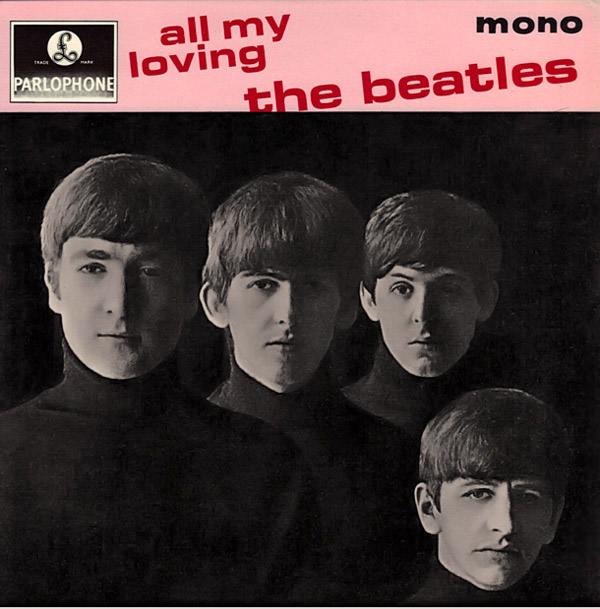
This EP is for all intents and purposes a filler release (as most of their EPs were), using two tracks from each of their 1963 albums. “All My Loving” is definitely a song that should have been a single but wasn’t, though in EP form it made it to a respectable number 12 on that particular chart. The cover is a variation on the With the Beatles cover, adjusted to show a bit more of the darkened half of their faces, and a pinkish header up at the top to give it a bit of color. There’s not too much to be said about this release, other than that it did its intended job of keeping the band in the limelight.


* * *

Credit: Discogs.com

Credit: Discogs.com

Single: “Komm, Gib Mir Deine Hand”/”Sie Liebt Dich”
Released: 5 March 1964 [Germany]

This single, on the other hand, had to be one of the more interesting and esoteric releases the band had ever recorded. The West German branch of EMI Records had been hounding Brian and George Martin to get the boys to record in German, absolutely convinced that their music would not sell at all unless they sung in the vernacular. [By now, we understand that most of the suits at the record labels at this time were often “absolutely convinced” something would not sell, and were almost always proven wrong after the fact.] So on 29 January, in the middle of their long stay at the Olympia Theatre in Paris, they were shuttled over to the Pathé Marconi Studios to record two songs for Germany. Clearly they were not looking forward to this, and must have only done it simply as a thank you to the country that had helped establish them a few years previous. The end result was mixed; as always, they did their best and it went over well, but in the end it really made no difference on the charts. They would not record another song in a foreign language (at least not for this reason and to this extent) again.

Side 1: Komm, Gib Mir Deine Hand
First on the docket on that day was 11 vocal takes of “I Want to Hold Your Hand” in German. They’d used the backing tracks for the English version here, explaining why this version sounds so close to the original. The vocal delivery lacks a lot of the emotion of that original, but it’s worth noting that they did their best, considering they’d only had a day or so to learn the song phonetically from a German vocal coach.

Side 2: Sie Liebt Dich
This version of “She Loves You”, on the other hand, is quite interesting, in that it was a full recording, music and all. The original masters for that single had been destroyed by EMI (one of only a rare few that had suffered that fate due to old and outdated regulations at Abbey Road), they recorded a completely new version in fourteen takes. Unlike the reckless abandon of the original, this version seems a little tame. Having played it so many times live since its release, this version sounds tighter and smoother–it sounds more like the sleek professionalism of “All My Loving” at this point.

All told, the single did reasonably well, but it was a superfluous release. The single itself would show up as an import in the UK, and in the US, “Komm Gib Mir Deine Hand” would show up on the US-only Something New album while “Sie Liebt Dich” would be released by Swan, and eventually show up on the 1980 Rarities compilation. Both would be considered official canon and are now available on the Past Masters compilation.

* * *

Credit: jpgr.co.uk – The Beatles Complete UK Discography site

Credit: jpgr.co.uk – The Beatles Complete UK Discography site

Single: “Can’t Buy Me Love”/”You Can’t Do That”
Released: 20 March 1964

They had be come so efficient with their recording at this point, that not only did they end up cancelling a second day’s recording time for the above single, but they had time left over to record a new song. This time it was Paul’s new track, and one that would become the first single for their upcoming movie that they were about to start shooting at the start of March. Director Richard Lester had requested a few songs from them ahead of time to use within the movie (not so much as plot points but as scenes where they’re actually performing the song), and this was the first of many they wrote at the time. This was the first of an extremely small number of Beatles songs that were not recorded at Abbey Road, but as was often their habit, if they had a good idea, they didn’t want to waste time sitting on it until they returned back to their home base. While the b-side would be recorded a short time later at the end of February, this track became yet another turning point in their career.

[Note: As both of these would end up on the A Hard Day’s Night album, I will go into more musical detail in that entry; for now I will briefly go over the recording notes at this time.]

Side A: Can’t Buy Me Love
Paul’s blues-influenced rocker begins with a fantastic a capella entrance, just like the previous “All My Loving” and the countdown to “I Saw Her Standing There”–he knew how to pull the listener in right from the get-go. And like “She Loves You”, it starts off not with a verse or an introduction, but the chorus itself. It was also decided that, after previous versions that had the distinct Beatles harmony, they decided that a single-voice delivery worked even better. That was George Martin’s doing; it was another wonderful example of the producer hearing potential in a song, playing with the arrangement, and creating a newer and better track in the process.

Side B: You Can’t Do That
Another song written specifically for the upcoming movie, it’s a twelve-bar American blues-influenced track of John’s with a special nod to Wilson Pickett. Of special interest is the fascinating use of seventh chords in the rhythm guitar and the deep jealousy in the lyrics, both of which give the song a nasty edge. In another shake-up of the Beatles love song, he already has the girl, but she’s sneaking behind his back and he doesn’t trust her. This track was recorded at Abbey Road at the end of February, upon their return to the UK after their sojourn to the United States, and was very nearly part of the finished movie, only to be cut in the final edit. It ended up on the non-soundtrack side of the A Hard Day’s Night album in the UK, and on The Beatles’ Second Album in the US.


Considering how the rest of the year would play out for the band, this was probably the most understated and straightforward time of their career before worldwide Beatlemania kicked in. Though their touring schedule was intense, at this point they were not traveling nearly much as they had in the past few years–all told, in the first few months of the year they played a large number of dates at the same places, with no endless traveling in between–but that would change in the next half of the year, when their world tours began and their new movie hit the theaters.

Next up: the Long Tall Sally EP, A Hard Day’s Night, and making movies

Blogging the Beatles 14: The American Label View of Beatlemania, 1963-1964

There have been countless books, blogs, videos, documentaries and what-have-you about the start of Beatlemania, so I’ve decided to do a little something different here and focus not on the fans, but the business. Admittedly, it’s less of a thrill ride, but it’s equally as fascinating, considering the sheer number of Beatle-related titles that were released in the six months between that first Capitol single and their soundtrack for A Hard Day’s Night.

Officially, it wasn’t until the “I Want to Hold Your Hand”/”I Saw Her Standing There” single was released the day after Christmas in 1963 that Beatlemania finally kicked off in the United States. Just over a year after their debut Parlophone single in the UK (and just shy of two years after their “unofficial” recorded debut with the “My Bonnie” single), Capitol Records in the US finally realized they had a potential moneymaker on their hands and chose to jump to it. For varying reasons, however, they decided to retain some semblance of control and made their own decisions as to how they’d go about making that money. Like Elvis Presley and many other rock performers of the day, if they could get away with repackaging the same albums and singles in slightly altered formats, and especially if the young listeners out there kept buying them, then they saw no problems.

Backing up a little here, we should probably mention that the smaller independent labels were in fact trying to do what they could to release everything the band had recorded thus far. Vee Jay did in fact release the first few singles, “Please Please Me”/”Ask Me Why” and “From Me to You”/”Thank You Girl” on 25 February and 27 May 1963 respectively, though they didn’t really do much of anything on the charts. Brian Epstein had also made sure that he didn’t make the same mistake with Vee Jay and made sure any future singles or albums not released by Capitol were on a single-title basis. By the time “She Loves You”/”I’ll Get You” came out, it was instead given to the small Philadelphia label Swan Records. Swan managed to luck out here, as this was the single that kicked off the firestorm in the UK–they might have only owned one Beatles single (technically two, as they were able to also release the German-sung “Sie Liebt Dich” on 21 May 1964 as well), but by the time “I Want to Hold Your Hand” came out, “She Loves You” finally shot back up the charts (and eventually hit Number 1). That one single alone saved the label’s business for at least a few more years.

Vee Jay finally released their version of the American debut album under the name Introducing the Beatles, on 10 January 1964, ten days before Capitol released its “American debut” of the Beatles, Meet the Beatles. Sadly, Vee Jay’s story is a long one of legal troubles, both internal and external. They were an extremely small independent label with insignificant releases and very few big names; their company president Ewart Abner had spent a sizable portion of the label’s finances on gambling and personal debts; and by the middle of 1963, when they’d originally planned to release the album, they instead put it on hold when it seemed there was insufficient demand. However, by the end of 1963, they had a change of mind. Capitol had instead come out guns blazing, informing that they were going to release an all-out blitz campaign for the band. Vee Jay’s board of directors knew they had a full album on their hands, and given their current financial woes…was it worth tempting legal fate by releasing what they had and raking in as much money as they could? Evidently, yes–and multiple times throughout 1964:

–10 January: Introducing the Beatles album (Please Please Me minus “Please Please Me” and “Ask Me Why”)
–27 January: Introducing the Beatles album with a slightly different lineup (the two above songs replacing “Love Me Do” and “PS I Love You” due to Capitol’s first of many legal volleys to stop the label from releasing tracks multiple times)
–30 January: “Please Please Me”/”From Me to You” single
–26 February: Jolly What! The Beatles & Frank Ifield On Stage album: a shameless compilation of Ifield studio tracks (he was a country singer with minor hits in the UK) with both sides of the “Please Please Me” and “From Me to You” singles sprinkled throughout.  No tracks at all were in fact “on stage.”  The label would also reissue this album later in the year with a different cover.
–2 March: “Twist and Shout”/”There’s a Place” (under the subsidiary Vee Jay label “Tollie”)
–23 March: “Do You Want to Know a Secret”/”Thank You Girl” single
–23 March–Souvenir of their Visit to America EP (“Misery”/”A Taste of Honey”/”Ask Me Why”/”Anna (Go to Him)”)
–27 April: “Love Me Do”/”PS I Love You” (on subsidiary Tollie)
–10 August: reissues of the “Do You Want to Know a Secret”, “Please Please Me”, “Love Me Do” and “Twist and Shout” singles under their “Oldies 45” subsidiary label
–September: Hear the Beatles Tell All interview album (interestingly, Capitol had no legal rights to this one)
–1 October: The Beatles vs the Four Seasons album: the Introducing… album, packaged with a recent Four Seasons’ hits album Vee Jay had released
–12 October: Songs, Pictures and Stories of the Fabulous Beatles album–the same Introducing… album under a different name and cover.

Amazing how one label could stretch one album’s worth of songs into four albums, four singles, an EP, four reissued singles, and two reissued albums, all within the space of ten months. Certainly, the label had absolutely no shame in wanting to scare up as much money as they could while they still had hold on the fourteen songs. A small section of the public was willing to spend that money on the same album multiple times, but by the end of the year, those later titles sank without a trace quickly. On 15 October 1964, all legal battles between Vee Jay and Capitol put to rest, all the masters on Vee Jay reverted to Capitol…

…who would then release their own version of these same songs on 22 March 1965 as The Early Beatles. This was most likely more out of completeness’ sake than anything else, just so they could say they released every Beatles song on Capitol. By that time they had also taken ownership of the “She Loves You” single that Swan so briefly owned, placing it on The Beatles’ Second Album on 10 April 1964.  It was repackaging taken to ridiculous extremes…but if anything, The Early Beatles remains the official release in the US Beatles canon.

***

The repackaging of Beatles albums went on for a few more years, up until Revolver in late 1966. For some reasons it made sense, at least to the labels–while a fourteen-track album was not anything surprising in Britain, in the US that was considered a relatively long album, and most of them were cut down from fourteen to ten or eleven tracks. These extra songs would pile up alongside new songs and singles that were popping up in the UK. Capitol made good with these by creating US-only releases that did not have any UK analogue. There was also the fact that both A Hard Day’s Night and Help! were released in the US as full soundtracks–instead of releasing half-soundtracks like in the UK (side one was the soundtrack, side two was non-movie songs), the US versions contained the scores instead.

But consider this: in the space of two years, Capitol was almost as bad as Vee Jay, splitting seven UK albums and various singles across eleven US albums and singles.

Meet the Beatles! (20 January 1964) took half the tracks (and the cover) of With the Beatles alongside various single sides.
The Beatles’ Second Album (10 April 1964) took the other half, plus more single sides and half of the Long Tall Sally EP.
–The EP Four by the Beatles (11 May 1964) featured songs from Second Album.
A Hard Day’s Night (26 June 1964, released on United Artists Records) featured the movie’s songs plus the score.
Something New (20 July 1964) took the non-soundtrack songs from A Hard Day’s Night, the other two Long Tall Sally EP tracks, and “Komm Gib Mir Deine Hand”.
–“And I Love Her”/”If I Fell” and “I’ll Cry Instead”/”I’m Happy Just to Dance with You”, both US-only singles from A Hard Day’s Night (also released on 20 July)
–“Matchbox”/”Slow Down” single (24 August 1964), originally half of the Long Tall Sally EP
Beatles 65 (15 December 1964) contained all but four tracks from Beatles for Sale, one leftover from A Hard Day’s Night, and the “I Feel Fine”/”She’s a Woman” single.
–The second and last Capitol EP, 4-By the Beatles (1 February 1965), featured tracks from Beatles 65.
–“Eight Days a Week”/”I Don’t Want to Spoil the Party” (5 February 1965), two tracks from Beatles for Sale
Beatles VI (14 June 1965) contained the remaining Beatles for Sale tracks, plus various single sides and “Bad Boy”–the one Beatles song specifically recorded for the American release.
Help! (13 August 1965) featured the movie’s songs plus the score.
–“Yesterday”/”Act Naturally” (13 September 1965) from the UK Help! album, a US-only single that would become one of their best-selling songs.
–“Nowhere Man”/”What Goes On” (21 February 1966) from Rubber Soul, a US-only single and a radio favorite.
Yesterday…and Today (20 June 1966) was the last of them, which featured leftovers from the non-soundtrack side of Help!, various singles and tracks missing from the US versions of Rubber Soul (16 December 1965) and Revolver (8 August 1966).

By that time, the Beatles had had enough of Capitol butchering their albums (and yes, this is precisely why Yesterday and Today had the infamous butcher sleeve that it did when it was first released) and made sure that future releases would not suffer the same fate. Thankfully, no more Beatles albums would be torn apart this way in the name of making money off of new albums every three months, with only one album (Hey Jude on 26 February 1970, a compilation of singles sides) being the exception. Capitol relented, having realized that their relentless publicity had paid off in spades. They were one of the label’s biggest-selling bands, their name big enough that they could release anything at this point and it would sell.

***

Most of these label shenanigans were not watched by the band themselves, of course. They paid attention to their own UK releases, but when it came time to the US, they found they couldn’t even begin to make heads or tails of it. John Lennon was known to introduce a song when they played live by saying something along the lines of “here’s a song that’s from our new album…record…single…I think.” Many of the releases were even remixed differently–the most interesting difference being on Beatles 65, which for some reason was drenched in reverb, giving songs, especially “I Feel Fine” and “She’s a Woman”, an extremely heavy echo. While the real masters had been mixed and maybe occasionally touched up by George Martin himself, Capitol had been the culprit behind these not-quite-professional tweaks. You can hear them on the two box sets that came out in 2003-4, The Capitol Albums Volumes 1 and 2 (which is also the only place you can find the US version of Help! with the score intact). The members of the band have often stated they weren’t exactly happy with these remixes, let alone the mangling of the albums themselves, but despite all that, the American releases did their job, and did it well. The constant issuing of new material alongside previously released tracks had kept the band in the sights of the US throughout the first half of the sixties, helping them define an era in American rock and roll.

Sometimes you just need to rock out.

Those of you who know me and my musical tastes, I tend to veer more towards the atmospheric. Anything drenched in reverb and gives off a dreamlike quality I tend to enjoy, thus my love for Cocteau Twins, MBV, all things shoegaze. I also tend to like a lot of 90s Britpop, and of course anything that sounds vaguely similar to the 80s college rock I love so much. I also love a good selection of different kinds of techno/electronica/etc, from Lamb and Hooverphonic to Massive Attack and Tricky. It’s not always mellow, but it certainly has a “body” to it–a spirit that instills a sense of space and place. I feel like I’ve gone somewhere with this music.

Then there’s the other side of my tastes…the complete opposite. Sometimes I’m in the mood for something loud, something filled with ear-bleeding guitar and gut-punching bass and lozenge-needing screams. Pixies and Ministry did that to me, back in ’88. It’s not atmospheric, instead it’s got a thick wall of sound beating down on you, threatening to pick you up off your feet and send you spiraling, just like that scene in Back to the Future. There’s tracks out there where I swear I can feel the force of the track pushing at me like a strong wind beating against my face.

Believe me, I’m not the biggest fan of alternative metal. It rose to power in the late 90s, and for awhile it pretty much took over the playlists of all the alternative rock stations around 1997-99. The first wave of mainstream alt.rock had subsided around then, finding itself a comfy spot on the Adult Alternative stations instead, and the mainstream stations at that time picked up on the dance pop of NSYNC, Backstreet Boys, and Spice Girls. Alternative stations had to do something to remain relevant, so they Turned Up the RAWK. Say hello to Tool, Deftones, Korn, Staind, POD, and even the rap metal of Limp Bizkit (hey, don’t get me wrong–their lyrics may have been stupid, but their guitarists kicked ass).

I was working at HMV when these bands hit, and I was also listening to a lot of WFNX at the time, so it’s not as if I could avoid them. I didn’t hate the sound, but at the time it really wasn’t me. I was still listening to mainstream alternative, the last breaths of Britpop, and the occasional new-agey compilation…it was just my mindset at the time, and the mood I was in, especially when I was writing. While WFNX played “Change (in the House of Flies)”, I was listening to “The Boy with the Arab Strap”…definitely opposite ends of the spectrum there. I would sometimes jokingly call this stuff “meathead rock” because it was a new generation of metal, only this time without the progressive rock pretense.

It wasn’t until probably 2001 or 2002 when I started getting it–I was in a different mindset then, much further along in purging my own personal demons from the 90s, so this music wasn’t bringing me down or rubbing me the wrong way anymore…it was time to rock out. I was getting deeply into POD’s Satellite, Porcupine Tree’s In Absentia (they’d mastered a prog/metal hybrid by that album), and Deftones’ 2003 self-titled at this time. I started to appreciate that it wasn’t just about the heaviness and the volume…like the calmer music I listen to, a lot of alternative metal has its own soul–starker, angrier, and more eager to show its talons, but underneath all the rage, there’s some absolutely stunning melodies going on.

In tandem with that, I was doing a lot of musical catch-up. Despite working at a record store for close to four years, I needed to rediscover a lot of bands that I’d left by the wayside, or hadn’t gotten around to listening to. When I wasn’t buying new releases at Newbury Comics, I was checking out the used and discount bins of various stores (including Newbury) and beefing up my back catalogue with all kinds of stuff. I’m still doing a bit of catch-up, really…just today I found a sweet deal on Amazon and downloaded a handful of early Deftones albums I didn’t already have, and I’m still wondering why I never got into them earlier. Their sound is so melodic and tight, and for years all I heard was the tchug-tchug-tchuggatchug of drop-tuned and heavily distorted guitars. Now I can hear the soul behind it, the dedication to the songwriting, the emotions spilling out, and it’s lovely. Take a listen to Deftones’ “Minerva” for a great example:

I’m well aware there’s louder, dirtier, angrier music out there for those who are into that kind of thing, and I’ve come to appreciate that stuff as well. It’s not anything I’d listen to while doing other things, especially writing (which is when I do most of my music listening), but I get where it’s coming from. Sometimes you need to relax with something soothing…and sometimes you just need to rock out.