Fly-by; No post this weekend due to being afk

Hi all!  Thanks for following and reading…the wife and I will be enjoying a few days’ vacation the next few days, so I will not be able to update the Blogging the Beatles posts.  I’m bummed too, because I’m REALLY looking forward to writing about Revolver, one of my top favorite albums, not just of the band but in general.

I may, however, post a few short things before BtB returns on 6/15, perhaps a few microreviews of some of the great music I’ve been purchasing as of late.  That’s one of the things I’ve been wanting to do, and had planned before my previous PC went kerflooey.

Again, thanks for your patience.  See you soon!


J

Blogging the Beatles 28/29/30: “Day Tripper”/”We Can Work It Out”, Rubber Soul and The Beatles Third Christmas Record

Summer 1965 found the Beatles heading back over to the United States for another round of touring.  These shows were definitely of interest, as they included a return engagement on The Ed Sullivan Show, their first appearance at Shea Stadium in New York, and two shows at the Hollywood Bowl (which were recorded and, along with songs from their 1964 appearances there, were edited, mixed (as much as they could be, at any rate) and released on May 1977’s The Beatles at the Hollywood Bowl compilation).  Also of note is their stop in southern California at the end of August–on the 27th, they were driven to Beverly Hills to visit their one-time hero, Elvis Presley.  The meeting was less than stellar, as the story goes–the boys felt Elvis, who was already deep into his B-movie phase, was a bit of a sell-out, and apparently Elvis felt less than impressed by the band that stole his popularity.  The brief but busy tour ended on 31 August with two shows at the Cow Palace in San Francisco.  Thankfully, they were given six whole weeks off between that last show and recording time.

In hindsight, it was definitely one of those “seemed like a good idea at the time” sort of things, recording and releasing two albums in one year.  They’d done so since their first albums in 1963, and back then it was considered important to keep oneself in the limelight throughout the year.  This was especially important during fourth quarter, when sales were the highest.  Even though Help! had been released at the start of August, they’d still need to create something new in time for the Christmas rush.  In 1963, this was probably not much of a problem, considering the band’s songwriting and recording were relatively quick and relatively easy.  Now two years later, their songs and recording styles were becoming more complex; they were no longer writing the simple love songs they could dash off in a day or so…they were now writing and recording songs with minute details and intricate melodies.  By 1965 and with about a month and a half to work with, coming up with sixteen completely new songs–fourteen for the album and two for the lead single–was going to be one hell of a chore.

The Rubber Soul sessions took exactly one month: 12 October to 11 November.  They were also a continuation of the nighttime sessions that would become typical of the band in their later years.  While many of the sessions for Help! had started in the early afternoon and occasionally lasted well into the late evening, the Rubber Soul sessions saw even more nights where they entered the studio mid-afternoon and stayed past midnight.  Most of this was due to the ridiculously tight deadline (the last day was a marathon thirteen-hour session lasting from 4pm to 7am the next morning), but at the same time the band (and Martin) had realized they felt more comfortable with a night shift.  This was partly due to the “studio boffins” (aka the house technical crew at Abbey Road, complete with white lab coats) having gone home for the night, leaving the boys to their own devices.  This would actually work well for them, as they could get away with more.  Many of their later sonic experiments–the phasing vocals of “Tomorrow Never Knows”, the straight-to-mixing-board overmodulated sound of “Revolution”–would have given these boffins a heart attack, daring to abuse the machinery in such manner.  Of course, there was also the fact that this also left time for the boys to flex their social wings and meet up with friends and celebrities around town during the day.  This was especially embraced by Paul at the time, who had still been seeing socialite Jane Asher at the time.

Still…one month to record what would end up becoming a gamechanger of an album had to be equal parts luck, ability, and insanity.

* * *

Credit: jpgr.co.uk – The Beatles Complete UK Discography site

Credit: jpgr.co.uk – The Beatles Complete UK Discography site

Single: “Day Tripper”/”We Can Work It Out”
Released: 3 December 1965

It had been an agreement between the band, George Martin, and Brian Epstein to have the singles contain all-new songs, or at least songs that had not been released on the album that had currently been released. This was not strictly adhered to, but for the most part they preferred to keep each release as “new” as possible. The end result was that both this single and Rubber Soul were released on the very same day, but are separate entities. Additionally, this is considered the band’s first “double A-sided” single, where both songs are considered the hit, instead of one being relegated to a forgotten b-side. They would return to this type of release multiple times in the future.

Side A: Day Tripper
This track was recorded on the third day of the sessions (16 October), and similar to their previous single-only track “I Feel Fine”, it starts off with one hell of a great guitar lick, courtesy of John, who wrote the majority of the track. However, it’s Paul who sings the main verses, most likely as the melody is more in his range than John’s. John however does come in to sing the lead on the chorus. This is also a good example of where they were at the time in terms of recording style: while the majority of that day’s session was given to this song, there were only three takes recorded, with most of the vocals and extra sounds overdubbed onto the third (and only complete) take later that night. John and Paul both considered this a throwaway song that was written too quickly, but it remains a classic and a great example of their new sound. While the base of this track is a variation on a twelve-bar blues and sped up, with an altered chord progression for the chorus, they make it their own with flair. There’s a delayed build-up of instruments at the intro (guitar, then bass, then rhythm guitar and percussion), the amusing commentary in the lyrics (Paul and John have said this song is mainly about “weekend hippies”, the wannabes of counterculture but only in their spare time), and at the 1:30 mark, instead of a middle eight, we have a glorious build-up-and-release before returning to the last verse and fade-out. All in all, a wonderful song.

Side B: We Can Work It Out
The flip side is equally fantastic, introduced to the group by Paul, with a significant amount of collaboration with John. This was also another example of a song arranged while recording in the studio, nearly all of it on 20 October. It’s mostly Paul’s song, a semi-autobiographical account of his current relationship with Jane Asher. Despite his misgivings in the relationship’s status, he remains positive, expecting everything to eventually work out. John, on the other hand, gives a counterpoint, both in verse and melody: we can certainly have our problems, but life’s too short to avoid fixing them. His short interlude is also in a minor key, adding to the tension. Even George offered something here, suggesting that short waltz-time passage in the midst of John’s section to add a bit of imbalance. It’s definitely a dark song, much more so than the tracks on Beatles for Sale–it’s more personal, and the resolution is left up in the air.

* * *

Credit: discogs.com

Credit: discogs.com

Album: Rubber Soul
Released: 3 December 1965

Whereas Help! (especially the latter half) introduced us to the band’s growing interest in American folk of the sixties, Rubber Soul saw the Beatles fully embracing it and making it their own. There was also continued interest in American soul, especially the newer soul sound similar to Otis Redding and the like. American soul was being fully appropriated by a lot of British musicians at the time, especially the Rolling Stones, thus the “plastic soul” epithet that was given to Mick Jagger at the time. The Beatles, as always, sought not to take the sound and make it their own, but to take certain elements and feed it into their own creations. Thus we have the groove of “Drive My Car” and “You Won’t See Me”, the folk rock of “Nowhere Man”, the Parisian café atmospheres of “Michelle” and “Girl”. Perhaps because of the tight deadline they were forced to find inspiration where they could find it, and in the end it paid off, as the wealth of ideas on this album reach quite far. It’s also the first Beatles album that’s truly a studio album: while Help! was in fact “built up” organically in the studio, there was a certain acoustic sameness to it. Rubber Soul on the other hand embraced so many different sounds that it was not only a much-loved release to their fans, but an inspiration to many musicians, including the Beach Boys’ Brian Wilson, who often said this album was part of his inspiration for their classic Pet Sounds album.

Side A

Track 1: Drive My Car
The first track kicks off the album with another great guitar lick, but the real star here is the absolutely phenomenal bass line throughout–and it’s played by George, who doubles himself on guitar. Previous Beatle songs had the odd bass flourish or two, but it really wasn’t until this track that their bass lines stood out like that. This is a perfect example of their arranging habits at the time as well–there were only four takes of this track, all done on 13 October, but a majority of that night’s session was dedicated to the sheer number of overdubs they put on this track. In an interesting twist of fate, this track nearly wasn’t written, as Paul’s original lyrics, in his opinion were hackneyed and unusable. It wasn’t until he brought it over to John’s house in Weybridge that they settled on a chauffeur theme (again, going somewhere they hadn’t in the past) and it worked out well from there.

Track 2: Norwegian Wood (This Bird Has Flown)
A lovely folk track written in 6/8 time by John (with help from Paul on the refrains), it’s a personal track of his: he later admitted that this was a song about his extramarital affair at the time and wondered if he could get away with writing a song about it. At the same time, it’s got the very typical self-effacing John being the butt of the joke at the end, with the girl he’s cheating with not really caring about him either way. It features many atypical instruments, including George playing a sitar, the first Beatle track to feature it. He’d been introduced to the instrument during the restaurant scene in Help! earlier that year, found the instrument and the sound fascinating, and double-tracked himself on this song. Ringo’s contribution was not of drums but many handheld instruments such as maracas and finger cymbals. The outcome was a bona fide classic track by the band.

Track 3: You Won’t See Me
Paul offers another track here, another personal song of his up-and-down relationship with Jane Asher; this time she had been either avoiding or ignoring him, and he wasn’t sure why. Recorded on the last day of the sessions, this track is a rather simple melody with few chord changes, but its descending melody and counterpoint vocals are used perfectly as part of the song’s melancholy theme. It tries to be happy, but it’s just not getting there because it has nothing positive to connect to. Even the backgrounds are little more than an “ooh la-la-la” an occasional echoing line, and Ringo’s percussion is quite jittery with high hat triplets and tom fills on the fourth beat. It’s a song of not just sadness, but of irritation.

Track 4: Nowhere Man
A very autobiographical song of John’s–he’s pretty much given up pleading for help, instead giving into stasis and inertia. On the other hand, this is an extremely brilliant song, full of their best work. We’re brought in via an a capella introduction via John, Paul and George’s stellar harmony which stays with us throughout. This too has a descending melody, but while the previous track is melancholy, this one is more relaxed and sunny despite its lyric theme, partly due to the driving beat and the full sound of guitars. George pulls off a simple yet excellent solo here on his Fender Stratocaster, electrified to counterpoint the more acoustic sounding rhythms; there’s a great mix of both chord and melody in that solo, punctuated at the end with a high harmonic E. [Personally, this is one of my top five favorite Beatle songs, partly for that solo alone.]

Track 5: Think For Yourself
George’s first of two contributions to this album, it’s another track typical of his songwriting, full of chord changes and odd musical phrases that seem convoluted yet make sense somehow. He also seems to have gone a more personal route here as well, delivering a song about lies and misdirection–not in relationships, but in life. Paul also introduces a new sound here, plugging his bass into a fuzz pedal to give it distortion. So complex was the song that there’s a well-known bootleg track out there of the vocal session in progress, with John especially having a hard time getting it right (and George finally getting a chance to chide him for it!). They knew they were being recorded, and so much of the tension is played for laughs (though with John, it was real yet played up–again with the self-effacing humor)…but still, the end result is a great example of the dedication they gave to their music. [Trivia: a brief snippet of that recording was used for a scene in Yellow Submarine, when they sing “a bit of a tune” to wake up Lord Mayor.]

Track 6: The Word
John and Paul admit this one was one of the rare occurrences where the song was written amidst the haze of marijuana, which they’d started smoking earlier that year. It’s very much a proto-hippie anthem–John pretty much called this his first attempt at a theme that would culminate two years later with “All You Need Is Love”. It hastily written and recorded near the end of the sessions, so one often notices its relatively simplistic melody and lyrics. There’s not too much going on here, with even the vocal melody repeating itself throughout, only resting when John gives it a counterpoint refrain in between verses. George Martin is featured on the harmonium here.

Track 7: Michelle
This lovely little piece had its origins as a farcical party song from John and Paul’s early days in Liverpool. Story goes that they had gone to a party and met some people who were infatuated with the Parisian Left Bank culture and had started singing Parisian love songs. Paul and John, in their own inimitable way, had created their own take by playing a delicate Chet Atkins-style fingerpicking song high up on the fretboard and making up guttural French-sounding noises in response. Come rush time for the Rubber Soul sessions, they resurrected the melody and put actual words to it, adding a quick French lyric in there (a translation of the previous English lyric “these are words that go together well”), and turned it into quite the romantic track.

Side B

Track 1: What Goes On
Ringo gets his star turn in lead vocals with a song originally written by John back in the Quarrymen days and actually attempted once on 5 March 1963 during the “From Me to You” session, but never recorded. It was resurrected with some minor changes (including a few lyrics by Ringo, making it the only song credited to Lennon/McCartney/Starkey) and given a country feel to fit Ringo’s current vocal output. Given the age of the song and the limited melody, there’s not too much to say about this track other than that it feels ever so slightly out of place–it probably would have fit better if it had switched places with Help!‘s “I’ve Just Seen a Face”–but then Ringo would be short a vocal track!

Track 2: Girl
John delivers another melancholy love song–this one of longing, of being in love with a woman quite out of his league. It’s similar to “Michelle” with its French bohemian sound, but it also has a bit of a Bertold Brecht arty story-song to it as well. For a Beatles song of its time, it’s surprisingly laid back–so much so that John couldn’t help but insert a quite audible inward sigh of being hopelessly in love for the wrong reasons.

Track 3: I’m Looking Through You
Another of Paul’s songs about his up-and-down relationship with Jane Asher. Like John, Paul was now working out his inner demons with his songs, and this time he’s starting to question whether or not it’s worth staying on at this point. The original take, found on Anthology 2, is much more acoustic and meandering, but the finished version here has more immediacy and anger; perhaps at this point he had already made up his mind on the relationship and had only to act on it now.

Track 4: In My Life
A deeply heartfelt and breathtaking song from John, quite possibly his most personal yet. Inspired by a journalist’s suggestion that he write a song about his childhood, he eventually came up with this beautifully poetic ode to everyone that had ever had an effect on his life. None are mentioned by name, but that isn’t needed; he instead looks at each and every one personally and lets them know that, after everything is said and done, he deeply and profoundly loves everyone that has ever been near to his heart. The lyrics are so important here that the music is purposely muted, leaving only the vocals up front and center. In perhaps one of their most creative moves, the solo was George Martin’s idea, played at half-speed on piano and sped up when inserted back in, to emulate a harpsichord passage, adding to the pastoral feel of the song. [This is also one of my top five Beatles songs, due to its emotional power.]

Track 5: Wait
In a rare moment of using an older recording, the band grabbed this one from the Help! sessions from June and touched it up with a few percussive overdubs and tone pedal guitar to make it sound closer to the feel of the new album. Because of this the song could fit easily on either of the albums; it has the lighter sound of the former album but the moodiness of the latter. It’s one of many relationship songs written around this time about distance and the fleeting hope that the other would be there upon return. This was considered the very last thing recorded for the new album, the additions done in the wee hours of the morning. George Martin would begin the final remixing of the album that following Monday.

Track 6: If I Needed Someone
The second track offered by George on the new album, this one is much lighter in tone. Its composition is uncharacteristically straightforward, so much that it could almost be considered his attempt at writing a Lennon/McCartney song. George plays a beautiful fingerpicked line played high on his Rickenbacker 12-string repeated throughout. He was heavily influenced by Roger McGuinn’s guitar work with the Byrds on this one–which is ironic, considering McGuinn had been influenced by George’s earlier 12-string work when playing for his own band.

Track 7: Run for Your Life
In counterpoint to the cheating man of “Norwegian Wood”, this time John warns his beloved about cheating on him. [Interestingly enough, both songs were recorded on the same day, 12 October.] He admitted soon after that he wasn’t too happy with this song at all, partly due to lifting two lines from an older Elvis track (“Baby Let’s Play House”) and not really putting much work into it. It’s not the strongest way to end an album, but given the short amount of time they had to work with, it goes out with an uptempo track.

Rubber Soul is considered one of the band’s finest records, and was certainly one of their finest to date. They had chosen to extend on their current influences and expand their lyrical and musical boundaries, as well as search even further into their own personal lives for inspiration. They had indeed been given a month and a half’s respite between the tour and the sessions, but they had also given themselves an incredibly short deadline for a new release in the process. Whether or not that was on accident or on purpose is left unsaid, but it proved once again that they could get away with it–just barely–if they tried. It’s by no means a flawed record, although there are a few weak songs that even the band themselves admit were throwaways. Despite that, they produced a wonderful record full of well-crafted songs that excited the fans and further inspired their fellow musicians. It seems the only boundary they really had here was time; one can only wonder what sounds would have evolved if they’d given themselves a few more weeks or a month more to work with. Come 1966, once they officially gave up touring, they would have all the time in the world. The end results would take everyone completely by surprise.

[Addendum:  the iconic album cover was taken by photographer Bob Freeman near John’s Weybridge home, with them standing atop a small hill and Freeman shooting them from below.  The elongated effect of the shot was created quite by accident when he and the band were choosing possible shots, and the projected image had been warped by the square album-sized card falling backwards.  The band loved the effect and decided on that shot right there and then.  Interestingly enough, the original shot has rarely ever been seen since, and only resurfaced online earlier this year.  You can see it on the Beatle Photo blog here.]

* * *

Credit: jpgr.co.uk – The Beatles Complete UK Discography site

Credit: jpgr.co.uk – The Beatles Complete UK Discography site

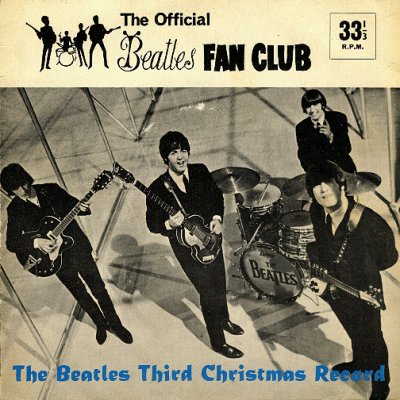
Single: “The Beatles’ Third Christmas Record”
Released to the Beatles’ Official Fan Club: 17 December 1965

The boys finished off the year with another holiday message for their fan club, recorded as an afterthought during the session for “Think for Yourself”. This one may have seemed a bit less than inspired, considering they were about to record the same ‘thank you’ message for the third time. They did their best, however, providing multiple quite out-of-tune versions of “Yesterday” and very silly takes on “Auld Lang Syne” and other holiday standards. One would normally think little of these fan club releases, but this would actually be the last of the straightforward Christmas messages; by December 1966 they would be a full-on studio band only, giving them much more time and creativity to come up with new sounds.

Next Up: The “Paperback Writer”/”Rain” single, Revolver and the “Yellow Submarine”/”Eleanor Rigby” single

Blogging the Beatles 25/26/27: “Ticket to Ride”/”Yes It Is” and “Help!”/”I’m Down” singles, and Help!

The year 1965 rolled in for the band with an already tight schedule–the first two weeks of January saw them finishing up their lengthy Christamas show ‘revue’ at the Hammersmith Odeon that had started 24 December, same as last year’s.  After a few weeks of well-deserved rest, it was time to jump back into the fray in mid-February.  Between 15 February and 11 May, they would be busy not with a tour or the endless radio and tv appearances, but jumping between recording studio, film studio and other locations for their next film project.  At first entitled Eight Arms to Hold You (officially given the name–another Ringo malapropism!–on 17 March during the Austria location shoots, until it was changed a month or so later), this new film would strive to be different from the semi-biographical A Hard Day’s Night.  It would not only be in color, it would also be a completely fictional story.  This second movie would also be directed by Richard Lester and produced by Walter Shenson, though screenwriter Alun Owen was not retained.  In retrospect, the lack of snappy, funny dialogue and smart plot that permeated the first film would be part of its faults–the “Beatles on the run” theme is turned into a farcical chase between a religious cult who want Ringo for their next sacrifice, and the boys are relegated to a lot of what sounds like halfhearted ad-libbing (most of which was inspired by their use of marijuana at this time)–but regardless, it would be a hit as expected.

And with a new film project meant new recordings.  In between filming (and the occasional one-time appearance here and there), they returned to Abbey Road Studios to record their next batch of songs.  As before, they’d planned on doing a half-album’s worth of actual soundtrack songs on Side One, with new album tracks on Side Two, with the occasional non-lp single here and there.  In this case, they’d record two non-lp b-sides this time.  It was a crazy and busy schedule to be sure, but at the same time, it actually worked to their advantage.  Unlike the previous movie, which had a relatively tight script, this one left things open to chance, with many scenes filmed but never used.  When they needed to be filmed performing new songs, they were often new tracks that had just been written a few weeks previously.  This happens plenty of times:  “Ticket to Ride” was recorded on 15 February, filmed in late March in Austria, and released as the lead single in early April; “I Need You”, started on the same day, was filmed in Salisbury Plain in early May; “You’re Going to Lose That Girl” was started 19 February and filmed in a fake-EMI studio on 30 April.

The filming would finish on 11 May, with post-production (overdubs and whatnot) finishing in mid-June.  The movie itself would be released in the UK on 29 July and worldwide soon after.  The album recording would finish on 17 June, with George Martin doing the final mixing days later.  Now it was time to return to Beatlemania:  new singles, new album, more touring, more radio and tv appearances.  Their summer would be jam-packed again, only to have them return to the studio again in August for another album come August (thankfully, they were given six weeks off in between, so they could recharge).  In some ways, 1965 could be considered a rerun of the previous year, but with some differences–they no longer had to puddle-jump all over Britain to appear everywhere, and sonically they sounded even better than every before.  Still, it had already started to wear on them.

Interestingly enough, one idea they had come up with to combat this was to send out pre-filmed performances, something they had come up with late in 1964 for “I Feel Fine” and a few other songs.  The benefits would be two-fold: they would not need to visit every television studio and perform the same song endlessly, and they could also make as many copies as needed and have them sent out to television studios, who could then insert them on any show they chose.  This could be considered the birth of the modern music video; a simple but effective promotional tool and also a quick and easy way to get out of physically appearing on everyone’s shows.  By 1966 when they stopped touring, this would become the only way you could see them performing.

*  *  *

Credit: jpgr.co.uk – The Beatles Complete UK Discography site

Credit: jpgr.co.uk – The Beatles Complete UK Discography site

Single: “Ticket to Ride”/”Yes It Is”
Released: 9 April 1965

The first new single of the year was also the first to break the three-minute mark in a Beatles single.  It’s also a change in sonic direction for the band; the straight-ahead rock of 1963 and 1964 had become infused with more folky sounds, thanks to the influence of Bob Dylan and the burgeoning folk scene in the United States.  These tracks take their time unfolding, giving the listener a chance to pay attention to what’s going on underneath.  At the same time, George Martin had suggested a new approach to recording: instead of attempting multiple takes of the same song and hoping a gem would surface, they would let the songs grow organically.  They would record the backbone of a song with minimal instrumentation, leaving them room to overdub when necessary to build up the track.  In this way, there would be very few actual full “takes” and much less tape used, and more creativity being given to the details.  The Help! singles and album would definitely have their share of quick-take rock songs they were known for, but their sound had definitely matured because of this approach.

Side A: Ticket to Ride

The new single opens up with a beautiful, chiming riff courtesy of Paul McCartney, who also happened to suggest the curious, slightly off-beat drumming to Ringo, which you hear next. Moments later John steps in and gives us a stellar vocal delivery about his girl leaving him. Unlike the downbeat lyrics of many of his Beatles for Sale lyrics, however, this one is almost a return to their earlier lyrical sound–it’s less introspective and a lot simpler. He knows he can’t do anything about her leaving, except feel sad, even when he tries to convince himself that “she ought to think right, she ought to do right by me”. She really doesn’t care what he thinks–she’s out of there, and there’s not a damn thing he can do about it.

One can definitely hear the outcome of Martin’s new approach to recording–the band-as-a-cohesive-whole is still there, especially with the changes in tempo and the deft harmonies of John, Paul and George, there’s also a fuller sound, with plenty more to hear. There are layered guitars and strong additional percussion right there in the foreground, and John’s multitracked vocals sound rich and full. Musically it’s similar to their recent previous output, but they’ve given it more life.

Side B: Yes It Is
John often dismissed this track as a failed attempt, and one can kind of understand his reticence…it’s almost a slower, sadder “This Boy” without the pleading middle eight. On the other hand, that’s it’s strength: it features absolutely beautiful three-part harmony from John, Paul and George (recorded live and not separately, I should add), and though its bridge is more sedate, recalling the self-deprecation of John’s previous songs like “I’m a Loser”, it’s still a strong piece. Of note is George’s guitar playing, this time with yet another new toy: a tone pedal (later dubbed the ‘wah-wah’ pedal), which gives his meandering notes a plaintive touch.

* * *
Credit: jpgr.co.uk – The Beatles Complete UK Discography site

Credit: jpgr.co.uk – The Beatles Complete UK Discography site

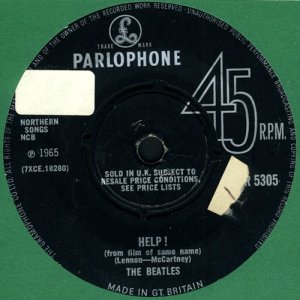
Single: “Help!”/”I’m Down”
Released: 23 July 1965

The next single would be the all-new theme song for their next movie, which would premiere the following week. Both tracks featured sounds that fans hadn’t expected: “Help!”, while quite an upbeat number, is also an extremely folky one, not to mention one of John’s first truly heartbreaking songs about his insecurities; on the flip side, “I’m Down” is a barebones, nothing-held-back rocker that ended up being a concert favorite of theirs. It was a hint of even better, more personal things to come.

Side A: Help!
One of the main reasons for John’s writing the song–aside from it being a real cry for help–lies in the band’s and the director’s indecision on what to name the new movie. Richard Lester had been calling it Beatles 2 or some version thereof, and the semi-official title early on had been Eight Arms to Hold You, in reference to the multi-armed Hindu goddess Kali that is part of the movie’s main plot. John and Paul didn’t like the title, mainly because they really didn’t want to write a song with such a mouthful to sing, and instead came up with the movie’s other main plot: the band on the run and unable to find the help they need to save themselves.
The song itself, as mentioned, is quite upbeat–it’s one of their faster tracks of the time–but the lyrics are quite unexpected. Never before had John been this bare in his emotions. It’s not just about the imagined conflict of the movie, but the stress of life: the feeling of drowning, the inability to find a foothold, the loss of direction. John’s delivery is desperate but not whining–it’s breathless and just this side of breaking, and Paul and George’s harmonies serve not just to punctuate the cry for help, but to bring that tension that much closer to the surface. It’s a simply-written melody, but it’s relentless and doesn’t let up until the final exhalation of “ooh’s” at the end.

Side B: I’m Down
This is a fascinating track of Paul’s, and a revisit of Britain’s fascination with American soul at the time. It’s very reminiscent of their earlier “Long Tall Sally”, but where that track is tight and rocking, this one is purposely disjointed and full of spite. They turn a simple twelve-bar blues riff into a track that threatens to fall apart every time it comes to the chorus, there’s so much tension. Even the lyrics are accusatory: instead of the usual “you’re making me blue” they delivered in the past, it’s now become almost a “how dare you make me feel this way” (“How can you laugh when you know I’m down?”). This track soon replaced “Sally” as their show closer on their international tours (an incredibly spirited version from Shea Stadium in New York can be seen here).
One interesting side note is the studio chat in between takes 1 and 2, when Paul comments on the song, saying “Plastic soul, man…plastic soul.” [This can be heard on the version of “I’m Down” on the Anthology 2 album.] The origin of the phrase is unknown, but it’s said that a black musician had used it to describe the appropriation of American soul by white British musicians, specifically Mick Jagger and the Rolling Stones. By the end of the year, it the phrase would be slightly changed and a new album name would arise: Rubber Soul.

* * *

Credit: jpgr.co.uk – The Beatles Complete UK Discography site

Credit: jpgr.co.uk – The Beatles Complete UK Discography site

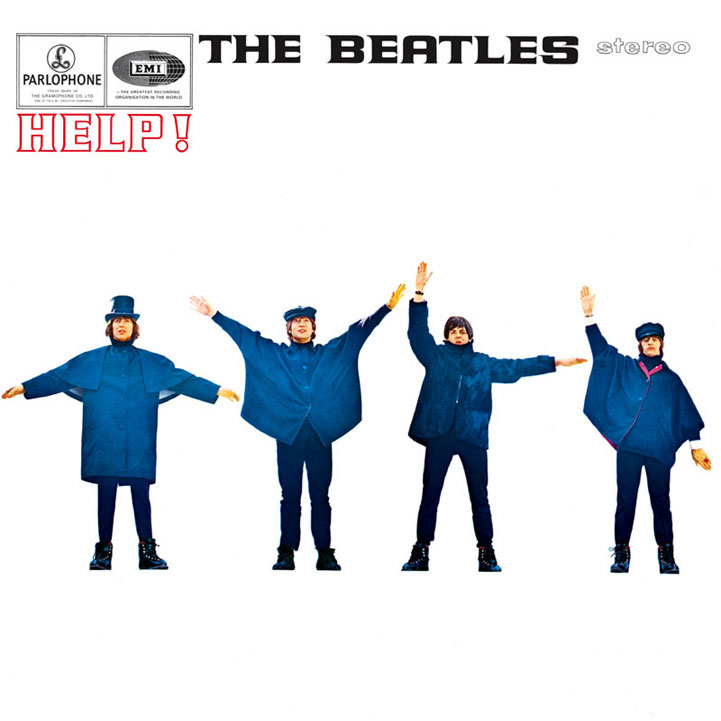
Album: Help!
Released: 6 August 1965

The first Beatles album of 1965 (and the second soundtrack of their career) was released a week after the UK premiere of the movie, just in time for midsummer. The movie itself, while not nearly as clever as A Hard Day’s Night, was full of music, silliness, and capable acting by the foursome, and both the movie and the album quickly became hits of the year. Another interesting outcome was that it introduced eastern music to the band, specifically George Harrison, who would introduce the sitar and other eastern instruments to the band. The foreign sounds didn’t show up on this album, but the change in direction towards folk and balladry definitely did. Given more time than the rushed production of Beatles for Sale, Help! features the band spreading their wings and testing out even more creative ways to define their sound.

Side A

Track 1: Help!
As before, the album starts off with the theme song. The movie uses this song in quite a cheeky way: after the prologue, we see the foursome playing the song in black and white, a nod to their previous film. Only eventually do we notice that darts are being thrown at it by the evil-but-pathetic Klang (played to amusing effect by Leo McKern), hinting that, honestly, that’s the most harm this so-called villain could cause.

Track 2: The Night Before
Another track recorded early in the process, this one was first laid down on 17 February. It’s a typical Paul track that might have fit nicely on Beatles for Sale, so similar is the sound and feel. It’s a surprisingly sparse track, actually–aside from John’s electric piano playing and George’s short but fun solo, there’s not too much that stands out here. In fact, all the instrumentation stays in the background and doesn’t venture too far, saving the front end for Paul’s strong vocals. Of note here, however, is a reference to a drumming trick Ringo used on “I Want to Hold Your Hand” a few years earlier: he plays a loose high-hat through most of the track, only to close it for effect on the quick bridge (during “…last night is a night I will remember you by”). It’s a simple song, but it’s fun. This one appears during the extended Salisbury Plain scene, the second of two songs they’re trying to record surrounded by soldiers.

Track 3: You’ve Got to Hide Your Love Away
John returns here with an overt nod to Bob Dylan, right down to the bare, raspy vocal delivery and the jangly acoustic guitar. It’s an absolutely gorgeous ballad in 6/8 time that extends on the insecurities he sang about on the title track. Here, he’s been beat down and made “two foot small” to the point that he doesn’t dare show his emotions, for fear that he’ll only get hurt again. Even when someone tries to lift his spirits (“How could she say to me ‘love will find a way’?”), he shouts back with a “Hey!” during the chorus, refusing to play along.

Track 4: I Need You
Recorded on the same days as “Yes It Is” (thus the return of the tone pedal on this track), George’s first of two offerings for the album is a summery love song similar to “The Night Before” in that it’s sparse and quite acoustic. It’s even used during the same Salisbury Plain scene. It’s not one of George’s stronger songs lyrically or even musically, but on the other hand, it’s actually a good example of how different his songwriting is to John and Paul’s. It’s a simple love song on the surface, but underneath all that, there are a handful of offbeat elements: ending the verse melody on a seventh note, using the guitar melody to “respond” to the vocal melody, things that John and Paul wouldn’t normally put in their own compositions.

Track 5: Another Girl
Another Paul song recorded the same day as “Ticket to Ride” and “I Need You”, so it definitely shares that acoustic vibe. The track starts off with the chorus, right down to the “…for I have got / another girl” incomplete sentence (it ties in with the end of the previous verse later on in the song), and is full of folksy goodness. Like the other previous similar songs, the instrumentation is secondary to the vocal delivery, and in retrospect that was very much key in the folk songs of the time. The song isn’t all that adventurous either, but it does hint at the old skiffle sound they grew up with…one can easily hear this being played by a young John and Paul with their friends on washboard and other homemade instruments. Filmwise, this song actually works in its scene, shot on a rocky shore in the Bahamas, inciting a laid back, summery feel.

Track 6: You’re Going to Lose That Girl
A rather quick song from John, this one doesn’t get anywhere near the personal demons of the previous songs. Instead, it’s a track similar many of his early love songs, only this time he’s warning his friend that if he doesn’t watch it, someone (namely John himself!) is going to take his girl away from him. This song can easily be seen as a nod to all their previous hits, such as the call and response vocals of “Twist and Shout”, the talking to a friend of “She Loves You”, and the downside of relationships of Beatles for Sale.

Track 7: Ticket to Ride
The soundtrack side ends with the first single, simply one of their greatest tracks of the time. The song features in a classic scene in the film with them miming to the song in the Austrian Alps with grand piano, skiing and sledding, falling about themselves, and having a fun time.

Side B

Track 1: Act Naturally
Ringo very nearly didn’t have a vocal track on this album, due to the fact that John and Paul’s offering of “I’ve You’ve Got Troubles” (recorded but never released until Anthology 2) was rejected as a failed attempt, the band quickly relied on their extensive back catalogue of cover songs they knew and loved. In this case, they took the 1963 Buck Owens country hit and turned it into a fun and pleasant Ringo track. Having noticed that country songs fit well with him, such as the previous “Honey Don’t”, it was a perfect fit. In 1989, Ringo and Buck would record it together as a duet.

Track 2: It’s Only Love
Both Paul and John have admitted this was a throwaway song with uninspired lyrics–in fact, it’s kind of a bland ballad with many stereotypical tricks inherent in that kind of song (the pleading vocal, the lyrics describing a rough relationship, the melody relegated to the background). Still, only the Beatles could dismiss a song as such and still get away with a strong track. George’s wonderful guitar work, the creative uses of sixth and seventh chords, the delayed release of tension in the chorus…it might be a simple song and not very adventurous, but it’s still catchy and well done.

Track 3: You Like Me Too Much
George’s second offering was almost in the running for the film but was dismissed to this side instead. It’s not one of his strongest songs–he was a good writer, but clearly not in the same league as his bandmates. Still, it’s a very typical song of his, full of interesting and unexpected chord changes and melody lines that one wouldn’t necessarily hear in a pop song. Added to that, both John and Paul added some wonderful keyboard work here, with Paul on piano and John on a much more upfront electric piano. The call-response of John and George during the solo is simple but creatively done.

Track 4: Tell Me What You See
Another John/Paul duet, right down to the dual vocals. Neither remember much about this track, hinting that it might be another throwaway, but it does have its interesting quirks. It’s full of percussion in addition to Ringo’s drums. There’s a guiro, claves, and a tambourine all throughout the track, blending in almost seamlessly with the rest of the track. There’s also the breakdown right at the end of each chorus, with the electric piano bringing it back up to speed until the last time around, where it’s used as an outro.

Track 5: I’ve Just Seen a Face
Like “I’ll Be Back” on A Hard Day’s Night, this track and the next feel completely out of context with the rest of the album, partly as they were some of the last songs to be recorded for these sessions. At the same time, they’re both perfect examples of just how fast their songwriting evolved, even within the span of a single album project. This track of Paul’s is purely inspired by country music, with an incredibly fast tempo and some absolutely stunning work from all three guitarists, from the layered 2/4 intro to the hoedown rhythm to the eighth-note solo. Paul’s wordy yet poetic lyrics are pure bliss. It feels more at home on the follow-up album Rubber Soul (it would in fact be released on the US version of that album), but here it’s used to hint at what’s coming soon.

Track 6: Yesterday
The Beatles were consistently at the top of the charts, but in the context of their whole oeuvre to date, they really hadn’t had a bona fide perfect song since “I Want to Hold Your Hand” or “She Loves You”. Then on 14 June–the same day the previous track was recorded–Paul finally laid down a song that had been running through his head for quite some time. The song had resonated with him so much that he was convinced it wasn’t his, but no one could prove otherwise. It’s a deceptively simple song, just a short but catchy melody about love and loss. There’s no resolution, no “it gets better” or “I wish she would return”…it’s just “she’s gone and I can’t get her back”…simple, but heartbreaking. It was recorded with just Paul on acoustic guitar that day, and three days later a string quartet was added, the first Beatles song featuring only one Beatle. The end result became one of the most covered pop songs in the world, and one the best songs Paul has ever written.

Track 7: Dizzy Miss Lizzie
To end the album on an upbeat note, they relied on an upbeat cover of a Larry Williams hit (they also recorded Williams’ “Bad Boy” on the same day, 10 May, and that track would only show up on the US album Beatles VI and not appear on any UK release until late 1966’s A Collection of Beatles Oldies). It’s another rocker similar to “Long Tall Sally” or “Money (That’s What I Want)”, played more for a party mood than a serious track, and they’re clearly having fun here. This is the Beatles finally releasing their tension with some good old rock and roll. After the fact, these two Williams tracks are the last cover songs the band would record as a group, not including the random covers played during the Get Back sessions in 1969; from here on in, they would only record their own compositions.

*

Help!, the album, could easily be considered the point that marked the end of the band as a “pop group”. While there are certainly a handful of pop songs here that are a logical progression from A Hard Day’s Night (specifically its second side) and Beatles for Sale, their songwriting had moved well past the point of simple love songs and covers. Lyrically they’d started to dig well past the surface and into introspective and even philosophical territory, even while still retaining the catchy melodies. Despite it being a half-soundtrack to what was essentially an absurdist comedy film, it was their most personal album to date, even more so than Beatles for Sale, and the fans definitely noticed. And given the last few tracks on the album, it was clear that they were no longer going to keep writing and recording the same style of pop songs. By the time they returned in October to record their second album of the year, their songs would include one with a sitar, another with a piano solo recorded at half-speed to sound like a harpsichord, and a complex, multi-tempo track that would only see release as a single.

Next Up: “Day Tripper”/”We Can Work It Out”, Rubber Soul and The Beatles Third Christmas Record
New posts coming soon! [EDIT: maybe…]

Note:  As it just so happens, the PC here in Spare Oom has decided to have some serious issues in booting up this morning.  This has been an ongoing issue over the last few months, and I’ve been hoping it would be minor, but today seems to be the worst–as of 11am PT it’s still running a Startup Repair, so I’m not entirely sure if it’s stuck in a purgatory loop or if it’s actually fixing itself.  Either way…looks like it’s high time for me to do some PC shopping soon.  I’ll try to keep to my expected schedule as mentioned below while using my laptop, hopefully it won’t be much of a problem.  If it does end up screwing with my posting schedule, I’ll let you all know.

Sorry about that… 😦

–JPC 5/14/13 


Hi all, I apologize for the delay in updating.  It seems that I finished up the major revision of the first novel in my sf/f series, A Division of Souls, a bit sooner than I’d expected, and have been using this time to get the manuscript (and its few extra bits) all nice and tidy for when I submit it to an agent.  I hope to submit it within the next few weeks, so that takes precedence.

In the meantime, not to worry, I have not forgotten to update the Blogging the Beatles posts, nor have I forgotten to do some Walk in Silence music posts either, I just have not had the time. I’m looking forward to a lot of these music posts, as they’re going to be covering quite a few great alternative albums from the 80s.  As soon as I have something new up, I will post the links over at Twitter and LJ as well.  I should hopefully have something up by midweek the earliest, or next weekend the latest.

Also, thought you’d like to know that A. and I will be going to Outside Lands again this year, so sometime in August I will be posting pictures from it like I did last year.  There are a lot of great bands playing this year, so I’m really looking forward to it.

I do apologize for not letting y’all know sooner, and will definitely do better at keeping everyone updated when there’s going to be a delay.

Thanks for following along! 🙂

Walk in Silence: Finding New Music, Immediacy in Availability

I know that I’m the rare music collector–I’m one who will download music, but also still head over to Amoeba on Haight Street and pick stuff up on a semi-regular basis.  I did that yesterday as part of my slow-but-ongoing plan to weed out most of our cd collection, having gotten a good ninety dollars’ store credit out of a pile of titles that have been gathering dust in a closet the last few years.  In the process, I spent a good hour or so digging through equally dusty clearance bins and making out pretty well.  The dollar bins are my friends, because a lot of the time I can find stuff that I want that isn’t available digitally.  As always, the time frame of the titles there are about ten to fifteen years ago (with the occasional exception–for some reason there were a lot of copies of Morning Parade’s album from last year in there), which means it aligns with a lot of the titles I remember seeing during my tenure at HMV and during my weekly jaunts to Newbury Comics back when it was in Amherst.  In the process I also picked up a few new titles that we’d been looking for.  In addition to this, I’ve been ordering a few import cds online lately–the recent and excellent reissues of We’ve Got a Fuzzbox and We’re Gonna Use It!!’s two albums from 1986 and 1989 being the latest–again, because they’re not available digitally.

I’m also an obsessive when it comes to listening.  I’m not sure how rare or how prevalent that is with others, but I’ve always got some music going on in the background wherever I am.  Roadtrips?  Got the local stations on the car radio.  Work?  Streaming something online.  Working out at the gym?  Listening to my mp3 player.  Writing?  Playing something from my digital collection.  Not at my desk?  If we’re not watching something, we’ve got one of the Sirius stations on.  I’m not always focusing on the music, but I’ve always got it playing when I can.  I’ve been that way since I was a young kid in the early 80s.

In the past, I would find new music by listening to the radio–more to the point, once I became obsessed with indie rock, I started paying attention to new things and their release dates.  Again, this really came to the fore once I started working at HMV, previewing them in the stock room before I brought them out onto the floor on Tuesdays.  Even more so when I had my weekly Wednesday comic book/music purchase run in Amherst during the early 00’s.  I fell out of the habit in 2005 when I had couple of major life changes, and I didn’t really get back into it until a good couple of years later.  This would probably explain that gap in 2005-2007 where I kind of remember some indie music, but it doesn’t really stick with me unless I really look at the chronology.  I got back into the habit around 2010-ish when I found Save Alternative, and later started actively looking for college and radio stations on the internet, and even more recently when my wife and I started listening to AOL Music’s Spinner.  Interestingly, I rarely pick up new information from music magazines or websites other than release dates.  I don’t have much against them, but while their coverage is similar to my tastes, they don’t converge enough for me to actually benefit.

I say all this because lately I’ve been listening to college radio again.  I’ve been listening to it for awhile now, but more so than in the last few years.  Because nothing beats getting it from the source.

I wish I could say I’ve got the Jonzbox plugged in and I’m taping stuff as it’s being played, but alas that isn’t true.  I do still have a handful of blank tapes that my sister found lying around, and the Jonzbox still works, albeit just barely, but those days are over.  As much as I’d love to tape radio shows again like I did so many years ago, a handful of the college stations I listen to are well out of range–some of them being on the other side of the country.  That’s the beauty of the internet for me in this respect.  I love being able to listen to WZBC out of Boston College one moment, and KSCU out of Santa Clara U. here in California the next.  There’s also the fact that I can listen to any college station and not really know or expect what they’re going to play next, because for the most part they’re still freeform after all these years, bound only by their show’s theme.

And despite not being able to record these shows, it does occur to me that I can do the next best thing–if I’m interested in a song, I can do what my wife and I have been doing whenever we listen to Sirius XMU and Alt Nation:  write the songs down on Post-Its for further checking out and possible downloading.  I just did that this morning, actually…while listening to a great set on KSCU, I wrote down a small handful of songs I liked and realized I could just as easily zip over to Amazon and download the mp3s whenever I wanted.  While I miss out on recording the semi-professionalism and occassional silliness that goes on with student-run stations, it’s a small price to pay when I can instead buy the music immediately if I so choose, instead of waiting for the weekend/when I get paid to go to the local record store.  And as I’ve mentioned earlier, most of my trips to Amoeba as of late have been for back catalogue.

Still, I do like the idea of listening to the radio again, especially when it’s to listen on certain days for a specific deejay’s show.  It’s a refreshing change from the daily (and sometimes hourly) repeat of the same sounds, and there’s a much higher chance of something new and unknown being played that will catch my attention.  And by listening online, I also get to savor the sounds of different cities.  Northern California’s college radio is a bit more lively and odd than New England’s laid back autumnal sound, for instance.  It’s a pleasant reminder that just when I’m in the mood for a specific sound, or sick of the same music being played, there’s a hell of a lot more always out there that I haven’t tried yet.

Blogging the Beatles 23/24: post-Beatles for Sale review, and Another Beatles Christmas Record

In retrospect, it’s amazing just how far the Beatles managed to reach in popularity–and productivity–in such a short time.  They’d been, for all intents and purposes, a bar band from their humble beginnings in Liverpool all the way to their Hamburg days.  It was only by chance that Tony Sheridan had asked them to be his studio band for a release.  It wasn’t until the end of 1962 that they’d gotten lucky, finding an excellent manager in Brian Epstein and a young and open-minded studio producer in George Martin, and hit #17 on the UK chart with their debut single.  In the ensuing two years, they released not one but four albums, eight singles and an EP, all containing new recordings; shot and released a hit movie; made multiple appearances on both radio and TV; toured in Europe, Australia and parts of Asia, and had a level of success in the United States not seen before by any pop musician from Britain. There aren’t that many bands nowadays that do that much in the span of two years.

All things considered, 1964 was a banner year for them. When they touched down on American soil on 7 February, they were met by loud and emphatic screams and cheers of teenagers who found the band the perfect antidote for post-Kennedy gloom and ennui. In March they started filming A Hard Day’s Night. Every release eventually hit Number One on both the US and UK charts (or at least close to it)–in fact, they hit the rarest of feats: on 4 April, a few weeks after “Can’t Buy Me Love” was released, they had songs in the top five positions on the Billboard singles chart, four of them on different labels: the Vee Jay single “Please Please Me” at #5, Capitol’s “I Want to Hold Your Hand” at #4, Swan’s “She Loves You” at #3, Tollie’s “Twist and Shout” at #2, and Capitol’s “Can’t Buy Me Love” at #1. [They also had an additional seven singles in the Top 100 on that day, totaling an astonishing twelve singles on one chart.] At the end of April, John Lennon released his first book of poetry and literary silliness, In His Own Write.   Their movie was released to thunderous applause in July.  By midsummer they were on tour, and by August their first official US tour commenced, two straight months of continent-crossing mayhem.

All this action with nary a second to breathe, and it nearly did them in. Part of this was obvious–no one had expected the teen fans to be screaming throughout the entire show, not like the Cavern days when the boys could mingle with the crowd after their set or even in between songs. British crowds were noisy, but they certainly weren’t on the verge of hysteria. Shows were booked at halls much too small for their American fanbase, and their sound system was meant for a much smaller space–in such a cavernous hall amidst thousands of howling teens, their amplifiers just weren’t going to cut it at all. They were held captive in their own hotels most of the time, unable to do anything except play cards, write songs, and watch television. There was also the fact that the tour had not been planned according to the size of the country they would be in. In Britain, one could get away with playing in Liverpool, do a show the next day in London, head up to Glasgow and do another show a day or so later, and head over to Blackpool the day after that, with only their chauffeurs and drivers feeling the strain. In the US, they’d hopped from one major city to the next with nary a day off in between–and traveling thousands of miles between shows by air or land. It was exhausting and disorienting.

And yet…despite the ups and downs, the noise and insanity, they’d made it. Beyond their wildest dreams, they’d made it to the big time.

And as a year-end thank you to their most dedicated fans…

Credit: jpgr.co.uk – The Beatles Complete UK Discography site

Credit: jpgr.co.uk – The Beatles Complete UK Discography site

Single: “Another Beatles Christmas Record”
Released to the Beatles’ Official Fan Club: 18 December 1964

“Another Beatles Christmas Record” was recorded on 18 October, the same day they recorded Ringo’s cover of “Honey Don’t”. Much like the previous year’s Christmas message, it was a semi-scripted four minute track (written by their erstwhile publicist Tony Barrow) full of thank yous and year-end reminisces with the typical Beatle silliness thrown in for good measure. They sound much more relaxed and unrestrained, not just going offscript but breaking the fourth wall multiple times (“I wrote a book it says here [in the script]!” says John). The exhaustion that shows on their faces on the Beatles for Sale cover can be heard in their voices here, as they don’t sound nearly as bouncy and full of energy as the previous Christmas single, but regardless, they must have been thankful, if not a bit blown away, by the reception they got from all their fans the world over, and made sure they received the next holiday single.

*

Come the end of this banner year, the boys finished up with another seasonal run of shows at the Odeon Cinema at Hammersmith, London, similar to 1963’s year-end shows. By this time they were on home turf, worn out but able to relax at the end of it all. They had another busy year ahead of them, with another round of touring around the world, two more albums and a few singles to record, and a second movie to film. It would be similar to 1964, and again it would nearly drain them. Music-wise, however, things were changing. They’d learned a lot in the studio over the course of two years…even George Martin began devising new ways to record the band that would not only save them time but make the process more creative and relaxed. The band would take in even more outside influences, moving away from the American soul and Motown of the covers they’d cut their teeth with and onto the country and folk of the American troubadours like Bob Dylan. The lyrics were becoming less doe-eyed and more introspective, already hinted at on many of John’s contributions to Beatles for Sale.

If 1963 had been their rise to UK stardom and 1964 had been their US rise, then 1965 would be the year of change, personally and professionally.

Next Up: The “Ticket to Ride”/”Yes It Is” and “Help!”/”I’m Down” singles, and Help!

Blogging the Beatles 20/21/22: post-A Hard Day’s Night releases, “I Feel Fine”/”She’s a Woman” single, and Beatles for Sale

After the summer release of their first movie, there was a flurry of releases, both related and unrelated, to fill up an entire late summer-into-early-fall season. Some of them were mentioned in previous posts (Vee Jay’s plethora of “releases” and the US releases of Something New and A Hard Day’s Night). Since I went into detail about the Long Tall Sally EP and A Hard Day’s Night releases in my last entry, I will pass up going into detail and only list the movie-related (and EP related) releases here.

The United States had a heads-up on the A Hard Day’s Night soundtrack, having been released a good two weeks earlier on 26 June 1964. As mentioned previously, the American version differed in that it did not contain the non-film songs from the UK version. Instead, the film songs from the band were interspersed with the orchestral score arranged by none other than George Martin himself (this score would end up being reissued a short time later–with a few extra non-film tracks–on United Artists Records under George Martin and His Orchestra), and the non-film songs would be released a few weeks later on 20 July as part of the Something New album. There were also a number of singles released at the same time:

–A Hard Day’s Night/I Should Have Known Better (released 13 July)
–And I Love Her/If I Fell (released 20 July)
–I’ll Cry Instead/I’m Happy Just to Dance with You (released 20 July)
–Matchbox/Slow Down (released 24 August)

The UK releases, on the other hand, were much more conservative, obviously being that no massive media blitz was needed. After the tandem release of A Hard Day’s Night, the “A Hard Day’s Night”/”Things We Said Today” single, and the Long Tall Sally EP, there were no further releases on the docket until five months later, with the follow-up EPs to keep them in the limelight until the next project was ready:

Extracts from the Film ‘A Hard Day’s Night’ (released 4 November)
(I Should Have Known Better / If I Fell / Tell Me Why / And I Love Her)
Extracts from the Album ‘A Hard Day’s Night’ (released two days later on 6 November)
(Any Time At All / I’ll Cry Instead / Things We Said Today / When I Get Home)

After their last recording on 2 June which would wrap up the movie and EP project, they would not head into the studio again until 11 August, when they were to start recording their next album and single. In the meantime, they kept themselves quite busy with the movie premiere, many television and radio appearances, and Ringo’s bout of tonsillitis that caused Jimmy Nicol to fill in for six shows during a short tour through Australia and the Netherlands/Denmark area. Even then, this next round of sessions would be broken up by yet another tour–this time their first official tour of the United States. This would give them precious little time to write any new material, so instead of a full album’s worth of originals like A Hard Day’s Night, they only came up with ten songs, necessitating six covers (and a seventh that was never released until much later) from their older repertoire to fill in the gaps.

Schedule-wise, it seemed the world of Beatlemania was a blur of nonstop touring, frequent appearances, and young screaming girls everywhere, and it’s amazing to think that in addition to all of that, they somehow managed to also record two full albums and a handful of singles for three years in a row. Perhaps this is one of the main reasons that one can hear a major difference between the songs of the early years (1962-1965) and the later years (1966-1970)…once they were given more room to breathe and less of a jam-packed schedule, they were able to focus even more on their music. This wouldn’t happen for another couple of years, but you can definitely hear that things were starting to change.

*      *      *

Single: “I Feel Fine”/”She’s a Woman”
Released: 27 November 1964

Credit: jpgr.co.uk – The Beatles Complete UK Discography site

Credit: jpgr.co.uk – The Beatles Complete UK Discography site

The next new release from the band was a non-album single that preceded the album they were working on. Both tracks were actually recorded near the end of the sessions in October, and this was definitely a great example of the surprisingly quick turnaround of writing-to-recording-to-release that the band could occasionally pull off. The two tracks have a similar upbeat feel that could possibly fit in with the A Hard Day’s Night sound, but it’s also clear that there are outside influences at work here as well, specifically the soul of Motown and Ray Charles. In addition to that, it’s clear that the band had also become quite comfortable in the studio, and in the process had begun to experiment with their sound.

Side A: I Feel Fine
And nothing is more experimental in late 1964 than deliberate feedback! This track started out as a riff that John had come up with around 6 October while the band was recording “Eight Days a Week”, and had nearly thrown it away as ‘rubbish’ until he’d written a song around it, recording it two weeks later on 18 October. It was during one of those takes that the band had stopped playing to take a listen, when John, playing a semi-acoustic Gibson at the time, put his guitar down to head to the control room. He’d leaned the guitar against the amplifier, and the ensuing feedback stopped everyone in their tracks. Any other producer at the time would have screamed bloody murder at such reckless treatment of instruments, but it being the Beatles, they thought it was the coolest sound ever, and wanted it in the song. And George Martin being the producer he was, willingly obliged by suggesting it as an intro, preceded by a harmonic pluck of the A string on Paul’s bass. And another classic moment in Beatle music is born.

The song itself is excellent, a mixture of Ray Charles’ upbeat soul and trademark Beatle melody, and some of the best playing the band put on record to date. John’s signature riff plays throughout the main verses and echoed by George (who pulls off a brief Carl Perkins-style solo halfway through), and there’s some phenomenal harmonization going on here. Even Ringo deserves some serious accolades here, with some of his fastest and most intricate playing of ride cymbals and tom-toms. It’s a song that leaves you breathless just as John and George trade the riff on the fade out.

Side B: She’s a Woman
Paul, in the meantime, had written an equally driving song in the style of one of his favorite singers, Little Richard, which explains why the song is in such a high register (even for Paul at the time). This is also one of their first tracks where the song deliberately starts on the backbeat, with John’s Rickenbacker 325 hitting all those funky seventh chords. And once the song proper kicks in, we hear Paul playing a deliberate countermelody on bass and piano. George and Ringo don’t have too much to do in this song, but they do deliver a great solo and solid percussion. The track is relegated a b-side, but it’s still a great rock song that fit in quite well with the rest of the tracks they recorded at this time.

* * *

Album: Beatles for Sale
Released: 4 December 1964

Credit: jpgr.co.uk – The Beatles Complete UK Discography site

Credit: jpgr.co.uk – The Beatles Complete UK Discography site

The band released their follow-up album one week after the above single, just in time for the Christmas rush. It’s a record of a band evolving again, becoming older and more mature, and of a band whose persistent and unending hard work was starting to pay off. As is often commented, one can see this hard work in the eyes of the band on the iconic autumnal album cover shot by Robert Freeman in Hyde Park. They may look exhausted here–unlike the poses on With the Beatles a year previous, where they look confident and maybe a bit nervous–but they’ve also retained that confidence, that they can now show that they’re not a band in the dark but a band out in the world. The title itself may be a cynical response to the cost of their overwhelming worldwide fame, but it could also be a response to the level of fame they were at: they could easily sell themselves now, without using outside help.

Side A

Track 1: No Reply
One of the most repeated comments about Beatles for Sale is its downbeat attitude, and given the first three tracks on this album, it’s hard to refute that point. The album starts off with one of John’s songs that may be autobiographical–it’s a song of dark jealousy, about possibly being two-timed by his girl (in this case, his wife Cynthia, even though John’s often later commented that a lot of his “jealousy” songs were really about himself, projected onto other people). The music itself is given a darker edge as well, playing up the mood of the lyrics: the song is played in a quiet acoustic manner…only to burst out in emotional pain at the end of each verse, and worse, in angry accusation during the middle eight. The band had never written such an angry love song before, so this certainly set the tone for the rest of the album.

Track 2: I’m a Loser
As if to counterpoint the accusatory nature of the opening song, John returns with another, this time as if to say, “You know what–forget what I just said. I’m just an idiot.” Here he opens himself up even more, revealing the hard truth that his anger and jealousy is really an inner weakness–deep down, he’s afraid of himself and afraid of the pain. This track is highly influenced by Bob Dylan, but it’s also influenced by the sad country music they were listening to at the time, like that of George Jones.

Track 3: Baby’s in Black
Three songs in, and the band is yet to bring out a happy song–definitely unlike any other Beatles release at the time. This third track of John’s feels like an old-school American country ballad, written in 6/8 time and sung as a duet (similar to “If I Fell”, in which both vocals are the main melody). Written for their Hamburg friend Astrid Kirchherr, who’d been the fiancee of John’s old school buddy Stuart Sutcliffe before he died. The three had been extremely close friends, and their loss had hit them hard.

Track 4: Rock and Roll Music
The album finally gets an emotional lift with a phenomenal cover of Chuck Berry’s classic rock song, done as only the Beatles could do it. If you went back and listened to the original, you’d hear a much more laid back version, one that sounds almost quaint at this point. The Beatles instead chose to give it their live interpretation by cranking up the guitars and screaming out the lyrics. Its placement here is almost cathartic, as if it’s high time to let go of the emotional baggage they felt at the moment and just rock out.

Track 5: I’ll Follow the Sun
It seems the emotional release of the previous track only lasts so long, as we’re right back down to the melancholy of love thwarted. This time it’s Paul with a lovely ballad about leaving. As a counterpoint to his previous “Things We Said Today” in which he hopes things are better in the future, this track says the opposite, as if there was no future in that relationship, and that he’d warned her this would happen. Paul’s songs at this time were never as emotionally raw as John’s, but he could be just as cold in his departure. It’s actually an older track dating from around 1960, but they never recorded it previously as it wasn’t considered “hard” enough for their original leather-jacket image. [On a lighter note, Ringo performs on an altogether different piece of percussion equipment here–his knees. It was one of the first Beatles tracks where he’s on the track but not playing his drum set.]

Track 6: Mr. Moonlight
Another cover is brought in, this of an obscure b-side by Dr. Feelgood and the Interns that was a cult favorite of British teens back in the day. It’s kind of a weak track here, as it’s a straightforward cover that doesn’t vary from the original. Still, it’s a reminder of their early pre-studio days when most of their live set was filled with adventurous covers. Its only saving grace, really, is John’s stellar vocal delivery (with able assistance by Paul), although it took them a few tries to nail it!

Track 7: Kansas City/Hey, Hey, Hey, Hey
The first side finishes up with a third cover, this one of a medley made famous by Little Richard of an old Wilbert Harrison blues song matched with one of his own. Paul being a serious Little Richard fan (and no mean impersonator!) they deliver a solid party track. It unfortunately gets lost in the darker mood and the long list of covers on this album (it works much better as an opening salvo on the 1965 US release Beatles VI), but it’s a great cover nonetheless.

Side B
Track 1: Eight Days a Week
The second side starts off on a much happier note, this time with an unexpected twist–a fade-in. It’s also the first song they’d brought in unfinished, quite unsure how to arrange it. The Anthology version shows an altogether different cold opening with a harmonizing “ooh’s” from Paul and John, before eventually settling on the opening guitar riff. Elsewhere on the arrangement one can find an interesting use of quiet singing on the two bridges, as well as Ringo’s use of floor toms both on the intro and the coda.  In retrospect, this song is almost like a return to their simpler “Love Me Do” era songs, only updated to fit their current sound.

Track 2: Words of Love
Yet another cover, but this time it’s a lovely interpretation of an early Buddy Holly tune, complete with some excellent vocal duet work by Paul and John, and possibly the inspiration for some of their own “duet melody” songs like “If I Fell”. Again, it’s a straight cover, but it highlights their strengths here. Aside from the vocals, George delivers some excellent guitar-picking here, quite clearly in his Carl Perkins phase.

Track 3: Honey Don’t
Cover number five on the album, and Ringo’s vocal entry on this album. John had sung this one back in their Cavern days, but it suited Ringo quite well, as his vocal delivery here has to be the best he’s given the band so far. The cover itself sounds a bit sparse, as if it had been recorded more as a jam than a true album track–John’s rhythm guitar is unadventurous and quite loose, and George’s two solos are almost the note-for-note the same, but that only adds to the charm of this Carl Perkins track.  Clearly, Ringo’s strengths as a singer lay in country music.

Track 4: Every Little Thing
One of the few really strong tracks on this album, this one is unique in that it was written by Paul, but John is the primary vocalist here, even though Paul is there as backup. [One way to figure out who wrote what in the Lennon-McCartney catalog is to hear who sang it, as they often sang their own compositions.] It hints at a Buddy Holly track, actually, with its plaintive vocals and “I’m a lucky guy” lyrics, which Paul had written while still living at Jane Asher’s house. The arrangement is quite nice, sparse and tight during the verses, and more unbound in the chorus. In a hint of what was to come, Ringo introduces another non-standard instrument to a rock song: the timpani drum, using it to great effect during the chorus to underscore its importance.

Track 5: I Don’t Want to Spoil the Party
As if to bring the opening theme of the album back around again, John brings another Dylanesque track to the fore, this time a song of love thwarted. There’s no jealousy, no anger…just heartbreak here, as his girl has stood him up, and he doesn’t want to bring everyone else down in the process. It’s not one of his strongest songs, and feels a bit like he didn’t try all that hard with this one, but there’s some great guitar work going on here, and the vocal melody is deliberately resigned.  In retrospect, it’s one of his strongest emotional songs in that it’s so retrained–he’s not lashing out or accusing here, he’s completely blaming himself.

Track 6: What You’re Doing
In an interesting change, it’s Paul this time who’s writing a song of a relationship in trouble. Supposedly written about his current relationship with Jane Asher (who was quite the socialite at the time; Paul, when not on stage or in the studio, was more of a stay-at-home guy), it’s a song about questioning what the status of their relationship is, and more specifically, where she thinks they are. Is she serious, or just playing games? Does she truly love him, or the idea of being with him? The music itself is a perfect complement to the lyrics–it’s sharp and staccato, leaving uncomfortable silences everywhere. Hardly any instrument, save George’s excellent 12-string playing, resonates for more than a moment.

Track 7: Everybody’s Trying to Be My Baby
The album ends with the last cover, and interestingly, a Harrison vocal. This time it’s another Carl Perkins track, this time about the perils of being a bit too famous, and closes up the theme of the entire album quite nicely. Like “Honey Don’t”, the cover is delivered much like a loose jam, but considering they knew this song so well, it didn’t take that many tries to perfect it.  George had many guitar heroes in his lifetime, and Carl Perkins was right up near the top there, so this can also be thought of as a personal ‘thank you’, as he delivers his guitar and vocal work with care and admiration.  Recording engineer Geoff Emerick gave George’s voice a STEED effect (send tape echo & echo delay), giving it an odd yet pleasing multiple-echo sound that hints at the amateur recording processes of yesteryear.  And as a final nod, they deliver a false ending–just when you think it’s going to stop cold, they sneak back with one final jazzy riff.  It’s a fun way to end an otherwise downbeat album.


Beatles for Sale may in fact be a deeply uneven and perhaps even a weak album to some, but it’s not without merit. Given that it was recorded in roughly six days over the course of four months scattered in between dates of a major world tour, and so quickly on the heels of a major album and movie breakthrough, it’s a wonder they were able to finish it at all in time for the Christmas season. Even more surprising is a seventh cover, Little Willie John’s “Leave My Kitten Alone”, had been recorded and ended up unreleased until 1995’s Anthology 1. Still, it remains a relatively strong album, if not a stellar one. As I’d mentioned in previously, the A Hard Day’s Night track “I’ll Be Back” was definitely a sign of things to come…the band had evolved from the simple by-the-books pop songs and started experimenting with different soundscapes and themes, and Beatles for Sale is full of songs that sound nothing like their previous output, even despite half of it being cover songs. It also hints at the folksy sound they would perfect once they recorded Rubber Soul a year later, under very similar circumstances as this one.

As an aside, the songs here actually benefit from the US track shuffling. As Beatles ’65, four tracks were taken off (Eight Days a Week, Words of Love, I Don’t Want to Spoil the Party and What You’re Doing–they would appear a short time later on Beatles VI), and I’ll Be Back and the I Feel Fine/She’s a Woman single are added, creating a slightly shorter and much tighter sounding album, and one with a slightly more positive outlook. If you listen to the songs on that album–and forgive the US meddling of adding ridiculous echo to a few songs–one can forgive the exhaustion and resignation that permeates Beatles for Sale and hear the songs instead as a band once again in motion–they were maturing, both as artists and as people. This version is available as part of The Capitol Albums Vol 1 box set. It’s well worth checking out.


Next Up: Another Christmas Beatles Record and post-Beatles for Sale releases

Blogging the Beatles 18/19: Long Tall Sally EP and A Hard Day’s Night

The multiple shows and appearances in the first two months of 1964 out of the way, the Beatles now moved on to their next major project: a film.  It seemed the natural thing to do, as many of the big rockers of the time were making or were about to make their own musical movies.  Most likely inspired by Elvis Presley’s star turns in the American film industry over the last few years, it was considered yet another viable avenue for worldwide fame.  The end result was more often than not a drive-in quality film not unlike the Beach Party movies Frankie Avalon and Annette Funicello became known for: a lot of fun to watch and listen to, but very little in the way of substance and plot.  But that wasn’t as important as the music that would be featured–the point was to show the band in their natural habitat, performing hit songs.  The storyline would be halted, the band would head up on stage and perform a big song, and would continue again once the song was finished.  All kinds of bands including Cliff Richard (Expresso Bongo and The Young Ones), The Dave Clark Five (Catch Us If You Can, aka Having a Wild Weekend in the US) and Chuck Berry (Rock, Rock, Rock) would make films like this, to varying success.

The Beatles actually began recording music for their movie before they started filming, per director Richard Lester’s request.  Lester was an American who had started making his name  primarily in Britain, making comedic and often irreverent films, his first being the bizarre experimental short The Running, Jumping & Standing Still Film with comedian Peter Sellers.  That was a particuar favorite of the Beatles (especially John, who was a huge Goon Show fan), which helped Lester get hired for the film.  Lester wanted a few songs beforehand so he could fit them into the shooting script, and the band gladly provided.  They would only need a small handful of songs–maybe seven or so–for the film itself, but they treated the assignment as sessions for a follow-up album.  The viewpoint was that Side A would be songs from the film, and Side B would be “songs from the album of the same name”.  In the end, they laid down seventeen new songs, providing them with a full thirteen-track album, as well as an EP that preceded it.

Credit: discogs.com

Credit: discogs.com

EP: Long Tall Sally
Released: 19 June 1964

Side A
Track 1: Long Tall Sally
Little Richard’s early 1956 single was a huge favorite of the band and one they often played in their early days. Recorded on the afternoon of 1 March during the earliest days of the A Hard Day’s Night sessions, this was Paul’s baby–he could do a mean Little Richard wail, and he nailed it in one take. With all four band members rocking their hardest and George Martin providing the piano backing, the first take was so perfect that they didn’t bother doing another. It’s an all-out rocker that leaves you breathless.

Track 2: I Call Your Name
Recorded the same day as “Long Tall Sally”, this was an older track of John’s written at least a few years previous, which may explain the band’s return to the simpler lyrics of their first songs. It’s another curiosity, for a few reasons. First, this was originally a track given to fellow Liverpudlians (and fellow Epstein roster band) Billy J. Kramer & the Dakotas, who relegated it to a b-side (interestingly, its a-side was another Lennon/McCartney track given especially to them, “Bad to Me”). Second, John wanted to record it as he was unhappy with Kramer’s version (and admittedly, theirs is a bit of a hash). Third, it’s one of the first band tracks that feature George’s new toy, a Rickenbacker 360/12 guitar, one of the first electric 12-strings out there, and one he’d use in a number of songs from this period. And fourth…it’s the rare moment when the band switches into a completely different sound for the solo, in this case ska, of all things. In all honesty, it’s not one of their strongest songs, but as always, it’s a solid one.

Side B
Track 3: Slow Down
This Larry Williams track from spring 1958 had long been a staple in their early live shows (and one of two Williams tracks they’d record), a simple 12-bar blues rock song. I’ll be straight here–this recording is a complete mess, even though there were six takes done on 1 June – their first recording session after all filming of the movie had finished and a holiday had been taken. The playing here is fast and extremely loose to the point of sloppiness. There’s also a noticeably bad mix error around 1:14 in which the bass and the piano disappear for a few seconds, not to mention John screwing up the lyrics around the same time. And yet, it’s almost as if it was done that way on purpose, a track that was supposed to sound like it was played by a band up on stage at a bar, who’d already had a few too many, and no one seems to mind. It’s rocking, it’s messy, and somehow it manages to still be good.

Track 4: Matchbox
And now a track for Ringo! The band had been big fans of Carl Perkins since their Hamburg days, and this old blues standard (originally “Match Box Blues” from 1927 and updated by Perkins in 1957) was often performed during the time, specifically for the drummer to sing. Pete Best sang it during those early years, and Ringo handily took over when it came time for them to record it, which they did the same day as “Slow Down”. It’s a simple song for Ringo to sing, more in his limited vocal range than “Boys” and “I Wanna Be Your Man”, and a fun track for the whole band to jam to.

All told, this quick EP did reasonably well in the UK, and two of the tracks even made it as a single in the US (“Matchbox”/”Slow Down” hit a respectable #17 in the charts). It’s by no means their best work, but it’s an excellent example of a band’s evolving sound finally falling into place–a mix of American blues and rock, and British pop–and it’s also a great example of a band refusing to stay in one style.

*      *      *

Credit: jpgr.co.uk – The Beatles Complete UK Discography site

Credit: jpgr.co.uk – The Beatles Complete UK Discography site

Album: A Hard Day’s Night
Released: 10 July 1964

The Beatles’ first movie was released on 6 July to rave reviews worldwide–everyone had expected another throwaway movie, and no one had expected such a detailed, decently acted, well-written, and extremely well-made film from scruffy rock stars. The humor was distinctively British and to some extent specifically Liverpudlian, that ‘we’re taking the piss out of you because we like you’ working class irreverence. It was also made with the idea that not only would the kids love it, but the grown-ups would enjoy it as well. In a brilliant move from Lester and screenwriter Alun Owen, all four band members were able to show their own personal side, specifically in solo scenes. John got to play the silly but smart leader to his heart’s content, Paul got to play the straight man with responsibility (Wilfred Brambell played his “clean” grandfather that they had to take care of), George showed a quiet but deep intelligence in an unexpectedly serious scene (he’s cornered by clueless fashion designers and asked his opinion, thus introducing the word “grotty” to the world), and Ringo got to show his natural acting chops in a wonderfully somber solo scene. Its ‘day in the life of a musician’ plot made such a lasting impression that it still influences other music-related movies to this day. The soundtrack, started in early March before filming started and completed in June once it ended, was released a few days later in the UK.

Side A (songs from the film)

Track 1: A Hard Day’s Night
This track opens up with a distinctive Beatle note–a crash of guitars and piano so inventive that no one can seem to figure out how the hell they did it (the Wikipedia entry has some interesting theories on it, however), and one that sets the tone not only for the album but the film. In the movie, the first thing we hear is that chord, placed right at the cold opening (no fade in) of the boys being chased all over the city. The lyrics opine about their day being hellish, but in the end when they come home, it’s totally worth it. In those two-plus minutes of music and film, we know exactly what the movie’s about: it’s tough, but often fun, being a world famous rock musician. One last note–this was the very first time John and Paul wrote a song to order.  In this case, thanks to Ringo’s malapropism-influenced title, they now had to come up with a theme song within a few days. The title had been chosen and confirmed for the movie on 13 April; by the sixteenth, they had the song in the can.

Track 2: I Should Have Known Better
Another of John’s, this was one of the first Beatles songs to have a Bob Dylan influence, even though it’s not quite as obvious this time out. One of the first in the new batch of songs, you can immediately hear a difference from their past few releases already. Their musicianship continues to tighten, but they’re becoming more adventurous with their songwriting. Though this track is very much in the mold of their verse/chorus/bridge oeuvre, you can hear the subtle differences. George plays a wonderful yet simple solo, again using his Rickenbacker 12-string and giving it a much fuller sound.

Track 3: If I Fell
John certainly outdid himself with this track, as there’s all kinds of fascinating things going on here. Let’s start with that opening: you get an introductory passage that doesn’t repeat anywhere else in the song, which also contains eight chord changes–D#m-D-Db-A#m-D#m-D-Em-A–all within the span of sixteen seconds. Once the main song starts, we’re brought into a beautiful duet between John and Paul sharing lead (with George filling in the occasional seventh-note), with all sorts of major and minor chords being played. Like its predecessor “This Boy”, it’s one of John’s best early efforts.

Track 4: I’m Happy Just to Dance with You
John and Paul wrote this one for George to sing, and it was recorded the same day as “Long Tall Sally” and “I Call Your Name” (1 March), which is interesting in itself, considering how vastly different the three songs sound. This is a lovely and restrained song with relatively simple love song lyrics, and it’s used wonderfully as a ‘filler’ performance track in the movie, one of the few times they actually stop what they’re doing to play a song.

Track 5: And I Love Her
This could easily be a companion piece to John’s “If I Fell” in terms of sound and composition. Paul’s lovely acoustic ballad has some absolutely stunning guitar work here, with John strumming a Gibson acoustic and George playing a Ramirez classical. George’s work here is stellar, the simple four-note low end complementing the eighth-note high end and even delivering a lovely romantic solo. It features in one of my favorite scenes in the movie in terms of cinematography.

Track 6: Tell Me Why
Recorded on the same day as the previous song (27 February), this track was written by John just a few months earlier (either during their extended stay in Paris or their US visit) and is one of his many multi-layered songs. I say this in terms of lyrics and composition, as on the surface, it sounds like a swinging, almost doo-wop track that anyone could have written…but underneath the all the poppiness, the lyrics belie a deep jealousy and mistrust.

Track 7: Can’t Buy Me Love
Released as a single a good few months before the movie, this song closes out the “film” side of the album on an upbeat note. For the most part it’s a simple 12-bar blues riff with a few chord embellishments along the way, but Paul turned it into an irresistibly catchy tune and a surefire hit. It’s also used in one of the most famous scenes in the movie (and is a nod to Lester’s own Running Jumping & Standing Still Film). Originally the scene was to have “I’ll Cry Instead” playing, but this song worked much better, given its fast and breezy tempo.

Side B (songs from the album)
Track 1: Any Time At All
By June, the band had over half the album in the can–with all of the songs from the movie done and a good handful of the rest done as well–they had a few more days left to fill up the rest. On 2 June they recorded three tracks that would fill up this side of the album, including this incredibly strong track from John. It can easily be considered one of the defining Beatle tracks that divide the early years of simple songs and the next phase of more elaborate and folky songs. Of note is a middle-eight solo written by Paul; it’s a simple bridge that does little more than use an ascending melody to build tension, but it’s a great example of how well John and Paul worked together, feeding off of each other’s ideas.

Track 2: I’ll Cry Instead
John’s original entry for the “break-out” scene in the movie is a relatively short track that sounds very much like a country song. It’s another song of jealousy and heartbreak, but unlike “Tell Me Why”, this one has a more positive outlook–he knows he’s the jealous type, but he’s not going to get everyone else involved in his drama. In an inspired move, twice the band uses the trick of lifting all the instruments out of the mix for a few seconds right at the end of the second and third verse (right under “I’ll show you want your loving man can do”), creating not only tension but also expectation once the music kicks back in.

Track 3: Things We Said Today
Another of my favorite tracks from this album, and also released as the UK b-side to the “A Hard Day’s Night” single. This is another of Paul’s songs in the “letter” format, even though it’s delivered more like an internal monologue or a hushed conversation rather than a written love letter. It’s wistful and sad, but wishful and positive at the same time, especially with the harder-edged middle eight. The lyrics are also quite mature, years older in theme than the simple love songs of just a few years previous.

Track 4: When I Get Home
This track, recorded the same day as “Things We Said Today” and “Any Time At All”, is an interesting counterpoint to the title track–while “A Hard Day’s Night” embraces the inherent craziness that comes with being a musician, “When I Get Home” is about wanting to escape that craziness as soon as possible and get home to his girl. This just goes to prove that while John could write a seething and jealous lyric, he could also write something purely from the heart.

Track 5: You Can’t Do That
The b-side to “Can’t Buy Me Love” finds its way here near the end of the album, having been dropped from the movie. This track was supposed to be a part of the ending concert segment of the film, but was dropped due to time as well as it being a slow track compared to all the other upbeat tracks in that scene. As mentioned previously, John wrote this as a nod to Wilson Pickett, relatively unknown at the time but well liked by the band.

Track 6: I’ll Be Back
This album closer is interesting in that it not only shows how much musical ground they’d covered in a short amount of time, it also hints at what their next few releases would sound like. One of the handful of songs recorded on 1 June, John’s song mirrors Paul’s “Things We Said Today” as if to hint to their fans that the band–at least the bouncy and lovable moptops the world knows–is going away, but they’ll be back sometime down the line. They’ll be different and somehow irrevocably changed, but they’ll come back to them one way or another. Given these two songs were written and recorded so relatively close together, one wonders if John and Paul had done that on purpose…

*      *      *

In retrospect, this could be considered the album where they finally found their signature sound and knew exactly what they wanted to do from here on in.  A Hard Day’s Night, the album, is miles ahead of the rough and raw Please Please Me, and much more polished and orderly than With the Beatles. And all this while at the height of their career! Despite the distractions of movie making, tours, television appearances and live shows, they kept a keen eye and ear on what they liked and what influenced them, and paid attention to how it translated into their music. All those years of hard work had finally paid off, and they were about to reap the wards in spades.

Next up: The various A Hard Day’s Night singles, “I Feel Fine”/”She’s a Woman” and Beatles for Sale

Blogging the Beatles 15/16/17: All My Loving EP, ‘Komm Gib Mir Deine Hand’/’Sie Liebt Dich’ single & ‘Can’t Buy Me Love’/’You Can’t Do That’ single

It was January of 1964, and it looked as though the Beatles were not stopping to catch their breath any time soon. They were finishing up a few weeks’ worth of “Christmas shows” in London, recording live songs for the BBC, doing a televised show at the London Palladium, and heading off to France for a marathon of shows there. Their fame was growing at a phenomenal rate at this point, having finally broken in Europe outside their proving grounds of Hamburg, Germany. But that was just the beginning–at the start of February, they’d fly to the United States and play their most important shows ever: Washington Coliseum, Carnegie Hall, and two appearances on The Ed Sullivan Show. These would prove to Capitol Records (and the rest of the world) once and for all that they were a rock and roll force to be reckoned with.

Being out on the road did not mean they weren’t working on new music. New songs were still being worked on, and a new album was slated for the summer to coincide with the movie they were about to shoot as well. In true Brian Epstein fashion, he refused to have the band act in a second-rate low-budget musical like the ones Elvis and Cliff Richard had made in the past. Scriptwriter Alun Owen had been hired to capture the distinct Liverpudlian style of humor the boys were known for. As soon as they returned from the US, they’d be not only behind the mike, but in front of the camera.

In the meantime, Parlophone made sure the busy Beatles remained in the charts and on the radio as much as possible.

Credit: jpgr.co.uk – The Beatles Complete UK Discography site

Credit: jpgr.co.uk – The Beatles Complete UK Discography site

EP: All My Loving
Released: 7 February 1964

Side A:
All My Loving
Ask Me Why

Side B:
Money (That’s What I Want)
PS I Love You

This EP is for all intents and purposes a filler release (as most of their EPs were), using two tracks from each of their 1963 albums. “All My Loving” is definitely a song that should have been a single but wasn’t, though in EP form it made it to a respectable number 12 on that particular chart. The cover is a variation on the With the Beatles cover, adjusted to show a bit more of the darkened half of their faces, and a pinkish header up at the top to give it a bit of color. There’s not too much to be said about this release, other than that it did its intended job of keeping the band in the limelight.


* * *

Credit: Discogs.com

Credit: Discogs.com

Single: “Komm, Gib Mir Deine Hand”/”Sie Liebt Dich”
Released: 5 March 1964 [Germany]

This single, on the other hand, had to be one of the more interesting and esoteric releases the band had ever recorded. The West German branch of EMI Records had been hounding Brian and George Martin to get the boys to record in German, absolutely convinced that their music would not sell at all unless they sung in the vernacular. [By now, we understand that most of the suits at the record labels at this time were often “absolutely convinced” something would not sell, and were almost always proven wrong after the fact.] So on 29 January, in the middle of their long stay at the Olympia Theatre in Paris, they were shuttled over to the Pathé Marconi Studios to record two songs for Germany. Clearly they were not looking forward to this, and must have only done it simply as a thank you to the country that had helped establish them a few years previous. The end result was mixed; as always, they did their best and it went over well, but in the end it really made no difference on the charts. They would not record another song in a foreign language (at least not for this reason and to this extent) again.

Side 1: Komm, Gib Mir Deine Hand
First on the docket on that day was 11 vocal takes of “I Want to Hold Your Hand” in German. They’d used the backing tracks for the English version here, explaining why this version sounds so close to the original. The vocal delivery lacks a lot of the emotion of that original, but it’s worth noting that they did their best, considering they’d only had a day or so to learn the song phonetically from a German vocal coach.

Side 2: Sie Liebt Dich
This version of “She Loves You”, on the other hand, is quite interesting, in that it was a full recording, music and all. The original masters for that single had been destroyed by EMI (one of only a rare few that had suffered that fate due to old and outdated regulations at Abbey Road), they recorded a completely new version in fourteen takes. Unlike the reckless abandon of the original, this version seems a little tame. Having played it so many times live since its release, this version sounds tighter and smoother–it sounds more like the sleek professionalism of “All My Loving” at this point.

All told, the single did reasonably well, but it was a superfluous release. The single itself would show up as an import in the UK, and in the US, “Komm Gib Mir Deine Hand” would show up on the US-only Something New album while “Sie Liebt Dich” would be released by Swan, and eventually show up on the 1980 Rarities compilation. Both would be considered official canon and are now available on the Past Masters compilation.

* * *

Credit: jpgr.co.uk – The Beatles Complete UK Discography site

Credit: jpgr.co.uk – The Beatles Complete UK Discography site

Single: “Can’t Buy Me Love”/”You Can’t Do That”
Released: 20 March 1964

They had be come so efficient with their recording at this point, that not only did they end up cancelling a second day’s recording time for the above single, but they had time left over to record a new song. This time it was Paul’s new track, and one that would become the first single for their upcoming movie that they were about to start shooting at the start of March. Director Richard Lester had requested a few songs from them ahead of time to use within the movie (not so much as plot points but as scenes where they’re actually performing the song), and this was the first of many they wrote at the time. This was the first of an extremely small number of Beatles songs that were not recorded at Abbey Road, but as was often their habit, if they had a good idea, they didn’t want to waste time sitting on it until they returned back to their home base. While the b-side would be recorded a short time later at the end of February, this track became yet another turning point in their career.

[Note: As both of these would end up on the A Hard Day’s Night album, I will go into more musical detail in that entry; for now I will briefly go over the recording notes at this time.]

Side A: Can’t Buy Me Love
Paul’s blues-influenced rocker begins with a fantastic a capella entrance, just like the previous “All My Loving” and the countdown to “I Saw Her Standing There”–he knew how to pull the listener in right from the get-go. And like “She Loves You”, it starts off not with a verse or an introduction, but the chorus itself. It was also decided that, after previous versions that had the distinct Beatles harmony, they decided that a single-voice delivery worked even better. That was George Martin’s doing; it was another wonderful example of the producer hearing potential in a song, playing with the arrangement, and creating a newer and better track in the process.

Side B: You Can’t Do That
Another song written specifically for the upcoming movie, it’s a twelve-bar American blues-influenced track of John’s with a special nod to Wilson Pickett. Of special interest is the fascinating use of seventh chords in the rhythm guitar and the deep jealousy in the lyrics, both of which give the song a nasty edge. In another shake-up of the Beatles love song, he already has the girl, but she’s sneaking behind his back and he doesn’t trust her. This track was recorded at Abbey Road at the end of February, upon their return to the UK after their sojourn to the United States, and was very nearly part of the finished movie, only to be cut in the final edit. It ended up on the non-soundtrack side of the A Hard Day’s Night album in the UK, and on The Beatles’ Second Album in the US.


Considering how the rest of the year would play out for the band, this was probably the most understated and straightforward time of their career before worldwide Beatlemania kicked in. Though their touring schedule was intense, at this point they were not traveling nearly much as they had in the past few years–all told, in the first few months of the year they played a large number of dates at the same places, with no endless traveling in between–but that would change in the next half of the year, when their world tours began and their new movie hit the theaters.

Next up: the Long Tall Sally EP, A Hard Day’s Night, and making movies