When I started my research for the Walk in Silence project last year, I’d decided to write some personal notes and reflections on how college radio affected me in the late 80′s. It was a brief overview of what I want to cover in this book that lasted for twenty-five installments, a sort of a detailed outline of memories, thoughts on influential (to me) bands and albums, friendships, and such. I’ll be posting these sporadically on the site over the next few weeks or so.
1988 – THE BEST YEAR EVER
I suppose most of my love for the year 1988 comes from the fact that it was the second half of my junior year, the school year where I had the most fun and have the most fond memories. After a good few years of feeling out of place and trying to find myself, meeting up with my friends of that year was definitely a positive for me.
There was also the burst of creativity I’d had as well. Just before Christmas break in 1987 I’d had this goofy idea of wanting to meet up and jam with others to play this alternative stuff, now that I’d bought that bass guitar. When I returned after break, I’d put up a flyer sometime in March or April, looking for like-minded musicians. Most people scoffed, but two people took the bait—Chris and Nathane. On April 22nd we became the Flying Bohemians.
Which meant someone—all three of us, really—had to get writing with music.
This, in turn, gave me a new push that I needed for my writing. Before then, I’d been writing (or at least attempting to write) novels, the major one being the Infamous War Novel. During 1987 I wrote and finished a silly John Hughes-inspired screenplay, and started many later-aborted stories. Once I started the Bohemians, however, this gave me the outlet of writing lyrics and poetry. The early stuff was pretty bad, considering I was new to to the format (or at least coming back to it—I wrote poetry in fifth grade for a special project and still have that stuff lying around somewhere), but I got the hang of it pretty quickly.
A lot of the poetry was, at the time, inspired by the music I listened to. A lot of the darker and weirder passages were inspired by the Cure (with a nice dollop of weird dreams I’d had that I’d use as a starting point), to the point that some were given subtitles of “The Cure.” Another was called “Wire Sisters” as it had been inspired by the angular wordplay of Wire and the goth darkness of The Sisters of Mercy.
It would also be much later in 1988-early-1989 (my senior year) that I’d revive a story I’d toyed with earlier that would become Belief in Fate, a second person narrative (POV inspired by Jay McInerney’s Bright Lights Big City, which had just recently been made into a movie), a roman a clef about trying to get the hell out of a small town and yet still being anchored to it. That story would, like the IWN, go through many different versions over the years until it became a non-fiction book—this one.
As for music, this was a year that just seemed to click for me and everyone else. Many key albums came out this year (or had come out in late 1987 and were hot during 1988). To wit:
Sinead O’Connor, The Lion and the Cobra. This was released early November 1987, but it really took off in early 1988. O’Connor played against all kinds of feminine stereotypes here–a bald head instead of long flowing locks, an occasionally booming voice that spiked your heart rather than soothed it, and lyrics that held nothing back. It’s a stunning debut that has funk, Celtic, balladry, and gritty rock all in one place–no wonder so many American reviewers weren’t quite sure what to do with her. The opening track “Jackie” is a perfect introduction: quiet and plaintive (and mixed low), ascending into deafening and primal (and overmodulated), all within the span of a minute or so.
Public Image Limited, Happy? A lot of PiL fans tend to like 1986’s Album more (or perhaps their more adventurous early post-punk albums), and I believe even John Lydon thinks this album’s a bit too mainstream, but I quite like this one, and it got a lot of play on my walkman. It starts with their excellent single “Seattle” and never lets up until the bizarre “Fat Chance Hotel”.
Depeche Mode, Music for the Masses. An album from September 1987, and a massive breakthrough for the band. After years of loyal fans but very little radio play in the States, this one featured some of their best songwriting and production (“Never Let Me Down Again”, “Strangelove”, and “Behind the Wheel” were the big singles) and gave them scores of new fans. It paved the way for their next studio album two years later, Violator, which would of course bring them even more fame.
The Smiths, Strangeways, Here We Come. Released on the same day as Depeche Mode’s album, this last studio album from the Smiths would be released soon after they’d broken up, but it remains a stellar final release. Like most Smiths albums, it’s all too short and most of the titles seem longer than the songs, but many are catchy as hell. This one also has a slightly different sound than most Smiths releases, perhaps a more mature sound, and it ended up being a good hint at what Morrissey’s solo album would sound like.
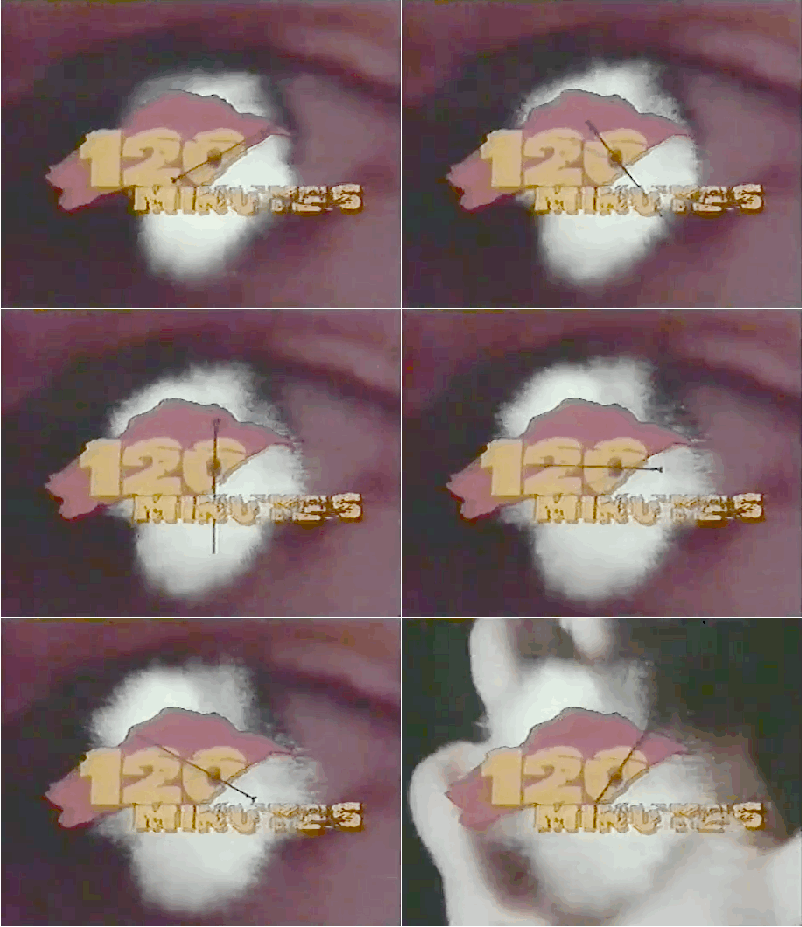
Cocteau Twins’ Blue Bell Knoll. After years of being distributed stateside by the indie label Relativity, the band signed with major label Capitol and released a very strong album. A little more upbeat than previous albums and EPs (and definitely more radio friendly than their previous two, the etherial Victorialand and The Moon and the Melodies), this one caught the ear of many a new fan and critic. The track “Carolyn’s Fingers”, while not an actual single, got quite a bit of airplay on alternative stations and even had a video that got heavy play on 120 Minutes. This one hit me as a gorgeous album that somehow aurally captured the mood and feel of a New England spring. Very heavy play on my headphones that year, and a key album in my learning how to play the bass guitar.
The Church, Starfish. Their make-it-or-break-it album, according to their history. Many of their albums up to 1986’s Heyday were great albums, but never quite reached the heights they were looking for, even in their native Australia. They decided to relocate to Los Angeles for this one, and their feeling of dislocation (so to speak) influenced the urgency and tension of these newer songs. The opener “Destination”, for instance, is evidence of that. Their big hit—at least in the US, as it barely made a dent in Australia the first time out—“Under the Milky Way”, is a thing of simple and beautiful brilliance. Written about a nightclub they had frequented in Europe, it became their biggest and most well known hit, and my all-time favorite song. It, as well as the rest of the album, oddly enough remind me of the feeling of sad inevitability that my friends were leaving for college in September. Not necessarily the sadness I felt, but the determination that I would have as much fun hanging with them was I could until they left. To this day this album reminds me of how close we were. It also, through its jangly reverb sound, reminds me of Athol in the autumn.
Morrissey, Viva Hate. Morrissey’s debut solo album. After the acrimonious breakup of the Smiths, a lot of people wondered if Mozz could go it alone, without the songwriting of Johnny Marr. With lyrics (and Stephen Street) on his side, he came out with a stunning debut that expanded the sound, something no one expected. Gone was the trademark Marr jangle, replaced by strings and wistful melodies. The first single, “Suedehead”, went over well, giving listeners a hint of things to come. The second single, “Everyday Is Like Sunday”, went even further, encompassing both the strong writing and Mozz’s trademark lyrics of despair. Out of all the former Smiths, he would end up being the most popular and successful.
Peter Murphy, Love Hysteria. Murphy had been relatively quiet over the last few years after Bauhaus split…the other three kept themselves busy, David J going solo, and Daniel Ash and Kevin Haskins forming Tones on Tail before the three reunited and formed the enormously successful Love and Rockets. Murphy, on the other hand, released an album with Japan’s Mick Karn under the name Dalis Car, before releasing a moderately successful debut, Should the World Fail to Fall Apart. In 1988, however, he formed a new backing band (The Hundred Men, named after one of his lyrics) and recorded a fantastic sophomore album. It was certainly an adventurous one, working from dark ballads like “All Night Long” and “Socrates the Python” to poppy and radio friendly atmospherics like “Indigo Eyes”, to anthems like “Time Has Got Nothing to Do With It”. Unlike the harshness of the previous album, this one embraced the moodier, more ambient sound that Bauhaus was known for on their later albums, and would become his signature sound. The first single “All Night Long” became a radio hit both on college stations and elsewhere, and its grainy-8mm, sepia-toned video was put on heavy-rotation on 120 Minutes.
Wire, A Bell Is a Cup Until It Is Struck. During the mid-to-late 80s, a number of bands and musicians mentioned this once-obscure British post-punk band as a major influence—many from Husker Du to REM looked to the band’s early albums and singles from the late 70s for their unique “angular” sound—punk that didn’t go where you expected it to. The band originally split in 1982 for solo endeavors, but in 1986 they surprised everyone with a return, a new EP (Snakedrill) and a new sound they jokingly called “beat combo”. They followed the EP with a new album (The Ideal Copy), and in 1988 they released an even more melodic follow-up, led by the poppy single “Kidney Bingos”. Considered the most “pop” of their albums of this time, it was a welcome return for longtime fans, and a perfect introduction for new fans like myself. Along with the follow-up single “Silk Skin Paws”, this album connected with many fans of challenging and interesting music.
Joy Division, Substance. I mention this one, because the US had finally paid attention to New Order in 1987 with their compilation of the same name. many were familiar with New Order by this time via that album and the movie Pretty in Pink (which featured three of their songs), so it only made sense for their American label to release a compilation of their previous incarnation—one that had a legend of its own in their tortured singer, Ian Curtis. This album introduced Joy Division to many new fans (including myself), compiling early tracks with well known singles (“Transmission”, “She’s Lost Control”, “Atmosphere” and “Love Will Tear Us Apart”). They were by no means brilliant musicians, but their hooks were definitely memorable, and inspired a whole new generation of musicians and lyricists. “Atmosphere” is another of my all-time favorite songs (and as stated earlier, the origin of the title of this project) and one I equate to my senior year in high school…it was very much the soundtrack song of my last few days in my hometown.
The Sugarcubes, Life’s Too Good. America’s introduction to Bjork started here with the deceptively poppy and quirky single “Birthday” (deceptive in that the song’s lyrics are a bit disturbing once you realize what it’s about). The pixie-ish singer and her cohorts played a very off-kilter brand of Icelandic pop that was both danceable and weird. Picked up by Warner and distributed with a bright highlighter-green cover, this was a big favorite on campuses everywhere. They would eventually break out with a US tour alongside Public Image Limited and New Order. The band only lasted for two more albums, but Bjork is still high-profile, both onstage and off.
The Godfathers, Birth School Work Death. Not exactly a big name stateside, but a great punk album that has a pretty decent following. These guys, formerly a psychedelic garage band called the Sid Presley Experience, took on the image of pinstripe suit-wearing gangsters and projected a frustrated anger different from any other punk bands of the time. Think Johnny Cash if he was British and really pissed off. My British friend Eric introduced me to this band, which would soon become a mainstay that year on 120 Minutes. The title song was a frustrated, angry take on the “life’s hard then you die” theme, and a big college radio hit as well. The album was all rockers, even the slower love song “Just Like You”.
Living Colour, Vivid. I mention this one next because they shared a bill with the Godfathers on an MTV college campus tour later in 1989, which I want to see at UMass Amherst with Chris and Nathane. I originally saw these guys as a more mainstream, less controversial Bad Brains, though in retrospect they were more of a Funkadelic-meets-Chili Peppers-meets-metal band. Either way, their explosive debut single “Cult of Personality”, with its blaring guitar and drums and soulful voice of Corey Glover (LC fans will remember him in a bit part in Oliver Stone’s Platoon a few years previous), hit the airwaves in a huge way—enough that even straight rock stations were picking it up. Years later this is still a staple on alt.rock radio. The rest of the album is equally strong, loud and topical.
I could go on with more great albums that came out in 1988…at first I thought the only reason I enjoy these releases so much is because of the time frame—a happy time for my teenage years. The more I look at it, however, the more I look at the history behind what prompted these releases, the more I realize that this was indeed a year of serendipity for many well-known and well loved musicians. Some were coming off a tenure with a popular band. Some were coming into their own after struggling without success. Still others recorded a make-or-break album that pushed them further in the right direction.
When I read about how 1992 was supposedly “the year punk broke”, I always interpreted that as “the year it went mainstream,” and not exactly in a good way. Not to sound like an indie poseur, but by 1992 there was such a glut of alternative bands that it all started getting watered down.
In 1988, though…that was the year when “college rock made its presence known”—it became a bit more acceptable to listen to the stuff without fear of contempt, when it started to infiltrate the rock airwaves on the right side of the dial.
15-19 October 2010, edited/amended 8 November 2011

 Walk In Silence