Outside Lands: Day 3

Sadly, we didn’t make it to the end of the day, so we’re going to miss Bloc Party and Stevie Wonder, but we did get a few more great bands in today before we called it a weekend:

First up was a band called Infantree that we’d heard of but didn’t really know, but we ended up really liking. Kind of moody indie rock and really great musicianship.

Infantree at the Panhandle stage

Soon after we stuck around at the Panhandle stage and saw Birdy. She’s known for doing some pretty interesting piano covers, including Phoenix’s “1901” and The Naked and Famous’ “Young Blood”. Not exactly my cup of tea, but she and her band were quite enjoyable.

Birdy while playing “Young Blood”

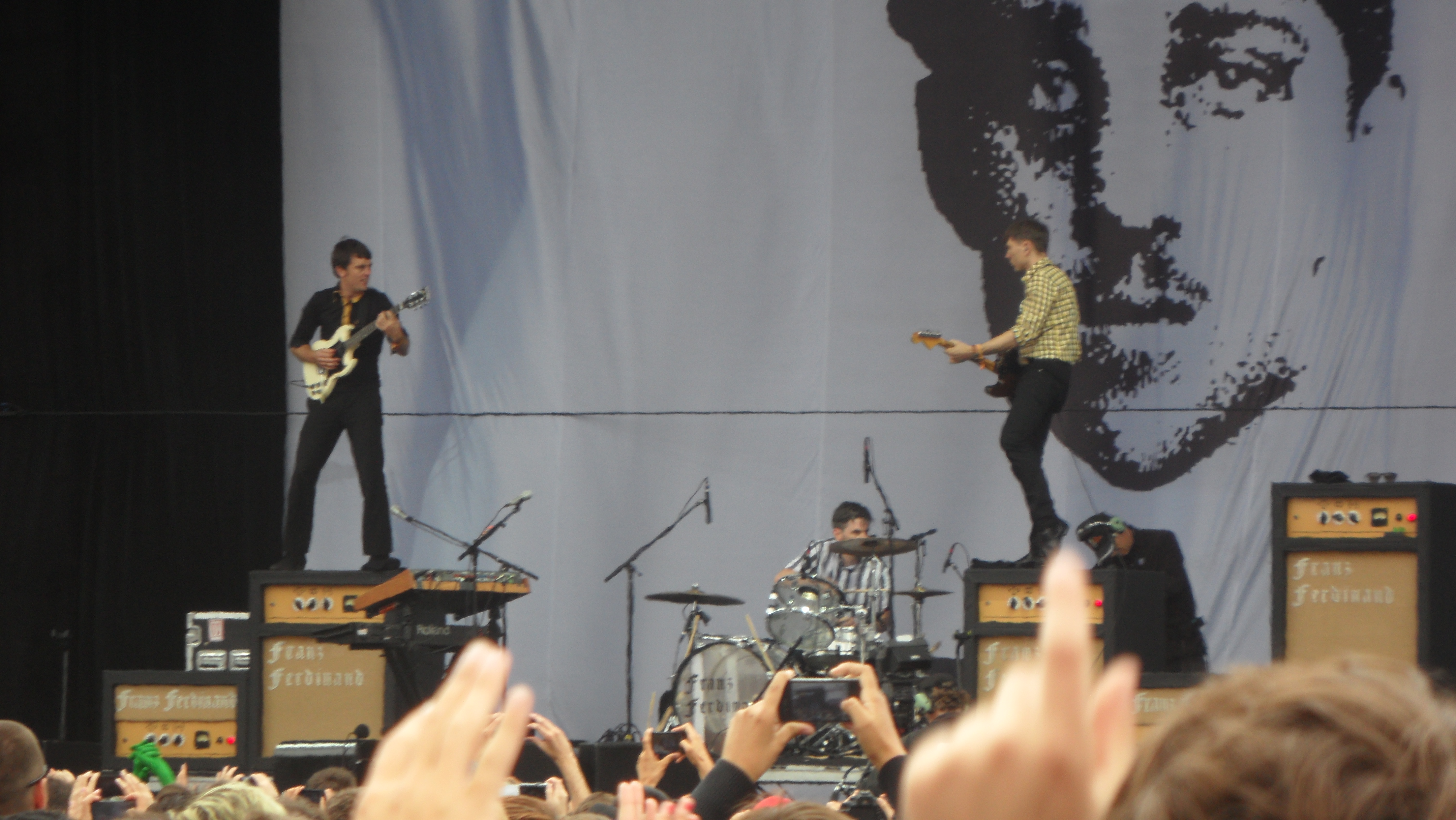
Then to the big afternoon deal–Franz Ferdinand! This was A.’s big name she was waiting to see, and they did not let us down. They kicked off with “Matinee” and hit all their biggest hits like “Do You Want To” and of course “Take Me Out”, and also performed a lot of new songs that may be on their next album. They all joined on the drummer’s set for the final track. Excellent show.

Rocking out on the Polo Fields stage. Yes, that’s Gavrilo Princip as the background picture.

Nick McCarthy and Alex Kapranos dueling it out

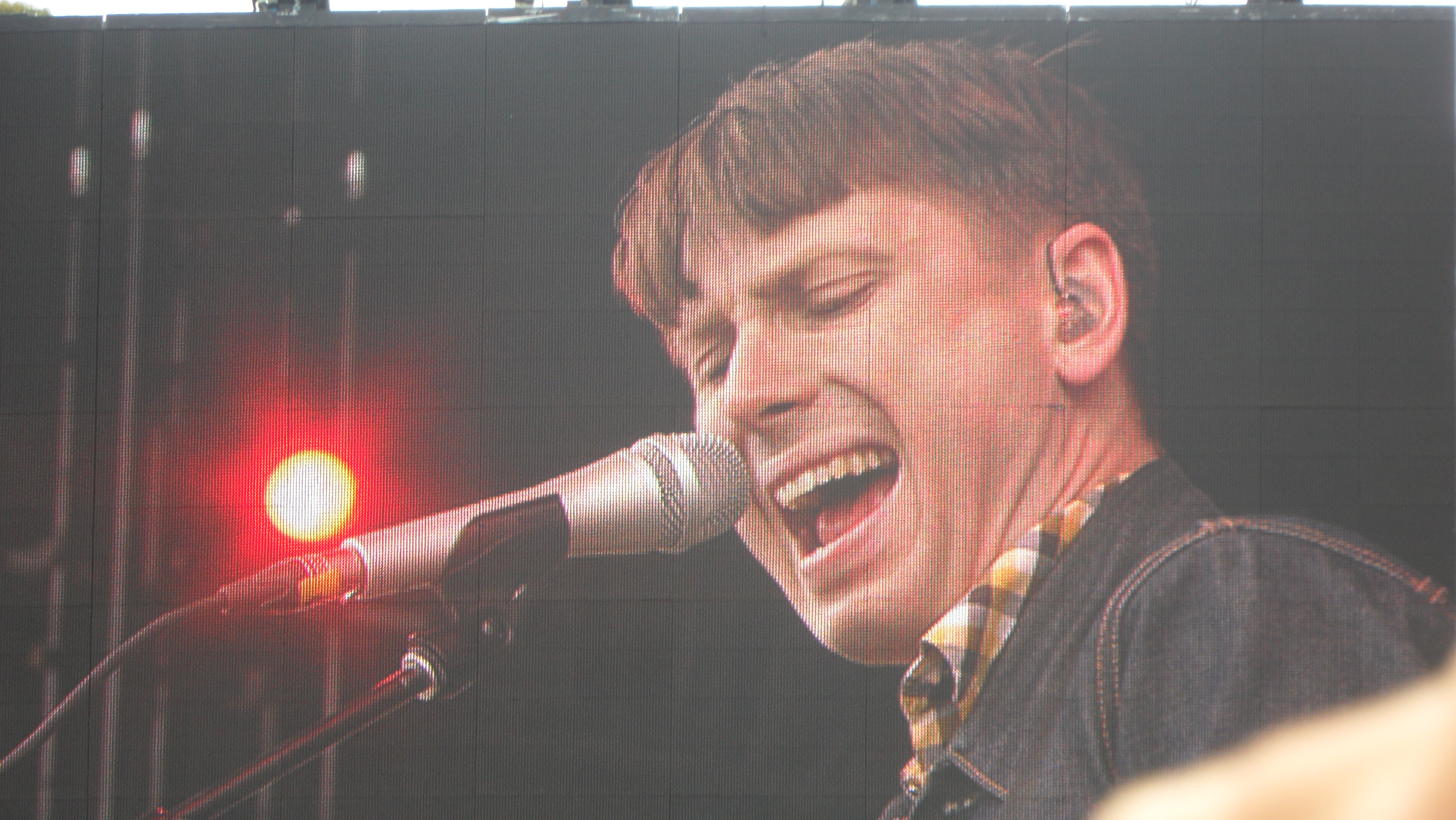
Alex rocking out

Lastly we headed back to the Panhandle stage to catch Electric Guest. Sadly I didn’t get any good pictures of them as we sat near the back and the crowd filled up surprisingly quickly, but they put on a fun show.

…and that’s pretty much it for us. We called it a day after that. We are definitely thinking of going next year, however!

Outside Lands: Day 1

So A. and I went to Outside Lands this afternoon (we’re also going tomorrow and Sunday), San Francisco’s own music and craft festival that takes place in Golden Gate Park–in this case, about four blocks south of us. In the past couple of years we’ve been able to hear the bands from our apartment…not loudly, but just enough where we could recognize a few songs playing. Last year we were amused by the fact that we could hear Arcade Fire’s “Wake Up” (and the attending crowd going wild). We decided this year that we should go, considering the number of great headliners for this year.

A. got to see Tanlines (I ended up getting there late because I had to work until just after lunch), and we met up to see a silly local band called Wallpaper. After that show, we headed to the polo field to get some food and check out a few of the major acts.

The Polo Field, from the back forty

First off was Fitz and the Tantrums, who put on a phenomenal show, and they definitely know how to do it. Their sound was tight, and they knew how to work a crowd with their retro soul sounds.

After that was one of the performers I’d been waiting for: Beck. I’d last seen him live at the old Foxboro Stadium in (I think) 1998 or 1999, so it would be interesting to see him perform songs after that era.

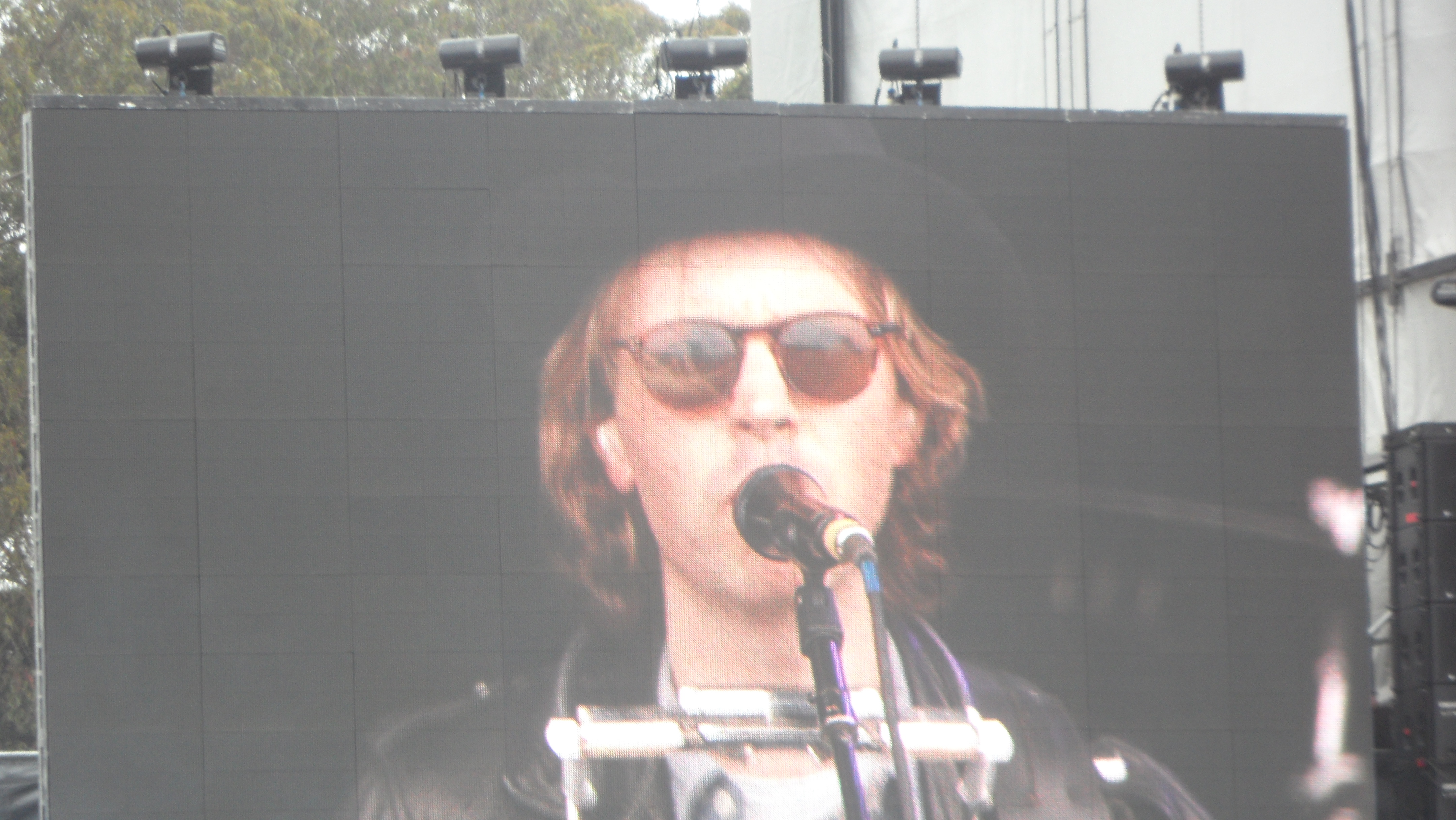
Sometimes the best shots were of the monitors, but hey, why not?

I LOVE how this one came out.

Beck’s band was quite eclectic–a lot of older guys who, despite a few sound problems in the first few songs and a few flubbed lines, really enjoyed playing his warped style of indie rock. I did enjoy the few Odelay tracks they played, and loved that he played “Gamma Ray” (I’m not sure, but I’m convinced they were playing Danelectros on that), but I was quite pleased when they played not one but three songs from Sea Change, quite possibly my favorite of his albums.

And then came Foo Fighters, who kicked all kinds of ass and did not let up once. Dude, these guys fucking ROCK, and I’m not saying this because I’m a fan…they’re just THAT good live.

Dave Grohl rocks your ass.

Somehow I got all six guys in shot and somewhat in focus here!

Thank you and good night!

So tomorrow we’re looking forward to Animal Kingdom, Geographer, The Be Good Tanyas, Explosions in the Sky, The Kills, Passion Pit, and Sigur Ros. Metallica is playing on the Polo Field tomorrow night, and we’re iffy on that one, but we may just pop in on the back forty just to check them out for a song or two. More pix to come!

It’s beginning to and back again

One of the pleasant and unexpected side effects of working on the Walk in Silence project is being able to see the cyclical nature of things.  Well, let me rephrase that–I did expect to see certain patterns emerging here and there, but I’ve been amused and entertained by how they emerge…how new things are often mutations of the original, and others are similar or reverential to its inspiration.  I see it most clearly through the indie music that we’ve been listening to on the Sirius stations as of late…I now make it a game to find similarities between the songs being released nowadays and those of the 80’s–the “[current band] sounds like [80’s band]” meme.  Some of them are more obvious: Beach House’s “Myth” certainly picks up where Cocteau Twins’ “Crushed” left off, for instance; others are more of a nod to the past, such as M83’s “Midnight City” being a perfect fit on a John Hughes soundtrack.

One of the other ways I see this is in the evolution of indie rock (as it’s called nowadays).  Since I’ve done quite a bit of homework on the subject (well, at least coming up with a theory on how it evolved from punk to New Wave and post-punk to “college rock” and so on, at any rate), I’ve come to the conclusion that the genre is now at the point where it’s back to where it started: mostly aural and closer to its origin.

To elaborate:  by “mostly aural” I mean that this music is mainly listened to on streaming websites or online radio stations now, rather than visual, considering that the video outlets of yore (MTV, VH1, etc.) have moved past the music video as its main programming.  Videos are relegated to YouTube and Vimeo and elsewhere, where we can check them out whenever we want.  The video has always been a four-minute jolt of caffeine to the music lover, a visual layer to add to the aural layer–the icing on the cake.  Back in the 80’s, us kids used to watch MTV for hours on end, gorging ourselves on these things.  We couldn’t get enough, partly because it played so many things we never heard elsewhere.  That, of course, changed years ago.

By “closer to its origin”, I mean that indie music has always, at least in theory, been about the tight link between the band, its output, and its fans.  It’s no secret that the big labels have always latched onto the Next Big Thing, colluded with the radio stations and the video channels to get as much airplay as possible, leaving the less commercial music to fall by the wayside.  Agreed, a lot of the less commercial stuff you can take or leave, but the subgenre of indie rock has always been different–it’s the weird cousin that you’re never quite sure about, who seems to be in a completely different movie altogether.  I say “closer to its origin” because a lot of the early indie music, the DIY punk and the small-label creations, embraced the musicians rather than using them for a profit.  When the Big Label consolidation started in 1998 with Universal and Polygram, and later Sony and BMG in 2008, a lot of otherwise creative bands either flew the coop or were unceremoniously dropped (or worse, ended up dissolving).  Even despite some independent labels’ short lifespans, many labels at least tried to keep the focus on the band and its output.  And thanks to the power of the internet, computer software and sites like Bandcamp, a lot of bands are foregoing even signing to a label, choosing instead to record and mix their music on their PC, convert it to high-bitrate file formats, and sell it themselves, reaping much of the profit in the process.  And because of that, a lot of the creation is purely of the band, with no outside influence from the labels or radio.  It’s all about what the band laid down.

Ultimately, at least for me anyway, this marks the return of music listening as a purely solitary event.  Indie rock has gone through quite a lot of changes since the 80’s.  It slowly started infiltrating the commercial side sometime around 1986-87–John Hughes’ soundtracks, and REM’s Document are but two major points off the top of my head–eventually finding its own chart in Billboard in 1988 (under “Modern Tracks”), and finally becoming hip and mainstream in 1991, thanks to Nirvana’s Nevermind and other albums of the time.  The 90s iteration of indie rock was an interesting shift: it became the mainstream due to the drying up of the old guard, hair metal and hard rock.  But in the process, the radio stations that had prided itself on being truly alternative–namely, the college radio stations–were at a crossroads.  Should they play the same alternative rock song being played on a commercial station, and should they even entertain the thought and risk being seen as a sellout?  And thus indie rock evolved again–the commercial alt.rock becoming the normal rock, and the more leftfield indie taking on different influences, from rap to world to jam and everything in between.  I could go on, but this would take awhile, and I’ll be covering it in WiS anyway.  Point being–come 2012, indie rock is about as prevalent as hip-hop, bubbly pop, dance, and every other genre under the sun, thanks to the power of the internet.  We have infinitely more ways to listen to music than we ever did in the past.

Which brings me back around to the beginning:  listening as a purely solitary event.  Ultimately, we’re no longer listening to the boring and harmless “listen at work stations” (as I call them), prevalent as they may be, because we don’t have to.  Unless I’m stuck in a supermarket or in an office, I can:

–listen to multiple websites streaming new releases so I can see if I like them before buying them.

–listen to multiple online radio stations.

–listen to one of the multiple Sirius music channels on our TV.

–listen to the stations that I used to listen to on the east coast, while living on the west coast–including the college stations that influenced and inspired me years ago.

–go to the band’s official site and listen to their new and as-yet-unreleased album, and even order it directly from them.

–simply start up Media Monkey on my PC, or turn on my mp3 player, and listen to any one of the thousands of songs in my collection.

In the end, this is what listening to music has been all about, at least for me:  listening to music on my own terms.  It lets me enjoy it as a purely aural treat and as a personal soundtrack.  It inspires moods and writing sessions.  College rock was my genre of choice back in 1986 because it was so unique and catered to my teenage geek years.  Indie rock is still my genre of choice now because, despite its evolution, at its core it’s still all about originality, creativity, and recording something true to yourself.  Despite all these new outlets and thousands of new bands, genres and subgenres, it’s still all about my own personal enjoyment with a song or an album or a band, and maybe discovering something new in the process.

And in this day and age, it’s blessedly easier to achieve that personal nirvana.


Once upon a time…or maybe twice…

I always say my music collecting officially started at Christmas of 1978, when my mom bought me The Beatles’ 1967-1970 album…but how did I come to chose that album, of all things?  I mean, barring the fact that the collection really started a few months earlier with the Sgt Pepper’s Lonely Hearts Club Band soundtrack, there has to be a reason I’d become obsessed with the Beatles at the tender age of seven.  Well, there’s two reasons:  the aforementioned 1978 movie that we went to see that summer, and another movie that had been playing on one of the local independent television stations:Yellow Submarine.

I don’t remember exactly when I first saw this animated feature, but I know it was on WLVI, Channel 56 out of Boston.  They played it at least once every summer, their own worn copy with all the pops and skips and edits, sometimes as a double-bill with Help! afterwards.  I fell in love with the movie instantly and looked forward to watching it every time it came on.  They played it in December of 1980 when John Lennon was murdered, and that was the year I grabbed a few blank cassettes and taped the entire movie onto tape.  (I remember it was this year because I taped a Lennon tribute show hosted by Casey Kasem that they played afterwards.)  I listened to that recording through 1981, and by the time WLVI played it again, I knew the movie by heart.  To this day, I can still quote nearly most of the movie, given a prompt.

This movie, the Sgt Pepper soundtrack, and the Beatles in particular, were major influences on how I listen to music.  I’d been a radio listener probably since I first noticed specific songs playing on the car radio during our family vacations–the fact that I had all older siblings who latched onto music before I did probably helped me do the same–but the Beatles were probably the first band where something clicked, and I stopped being a passive listener and became an active one.  And by active, I mean that I’d actually paid attention to the songs, learned their lyrics, and explored their sounds.  The original songs fascinated me, especially when I’d come to know many of them through the Sgt Pepper versions.

A few months ago, Yellow Submarine recieved a second remastering and release onto dvd.  Both times (1999 and this year), the release was prefaced by a short tour of select movie houses, and I of course had to go.  The first time they played it at the Brattle Theater in Cambridge MA, and that was the first time I’d ever seen the movie on the big screen, after having watched it on tv for years.  Back then, it had been remastered to Dolby Digital 5.1 and the movie sounds and visuals cleaned up considerably…plus, it was the first appearance of the “Hey Bulldog” sequence that had been edited out of the US version and later UK versions.  A new soundtrack was released, Yellow Submarine Songtrack, which to this day remains the only songs by the Beatles that are remixed to 24 tracks.  [Nearly the entire Beatles oeuvre was recorded on a 4-track mixer, barring Abbey Road and a few singles.  Think of that bit of info next time you listen to the brilliance of “A Day in the Life”.]  A second remastering took place recently and this latest version just came out a few weeks ago on both dvd and Blu-Ray.  I could not pass up going to see it at our local theater around the corner, and I was not let down.  The colors and sounds were vibrant and exciting, and the mix was clear enough that I could actually catch pretty much every line of dialogue effortlessly.

The interesting thing about watching Yellow Submarine every few years or so is that I still pick up on new things, or at least see things in a somewhat different light.  I remember watching it in high school and being surprised when it finally clicked in my head that war-torn Pepperland held a gritty parallel to WWII-era Europe.  Or finally catching the ridiculous number of puns (“Can’t help it, I’m a born Leever-puller”), Beatle song references (In the Sea of Holes… J:”Hey, this reminds me of Blackburn, Lancashire.” P: “Oh, boy…”) or sly music references (“Four score and thirty-two bars ago, our forefathers…”) hidden in the dialogue.  Or the fact that, this current time, how Chief Blue Meanie really needs to go on meds and maybe even take an extended stay in a psych ward, given his completely-off-the-rails psychosis.  Even the little bits of animation are brilliant, such as the pan-down of the Liverpool skyline right before “Eleanor Rigby” starts, or the initial panning across the Sea of Holes in incredible detail, or the clever use of rotoscoping in many scenes.  It’s not a perfect piece of animation, as you can definitely see slight mistakes throughout, but it’s sure as hell a creative one.

Yellow Submarine is definitely one of my Top Five movies, and one I’ll never get sick of.  Watching it as a kid defined who I was and how I listened to music, and despite its psychedelic roots, it still holds up as a quirky but extremely fun movie that everyone should see at least once.

Walk in Silence…The Singles

Listen in Silence. Sure, kind of a goofy name for a compilation (let alone a series that’s still going strong to this day), but the aim was this: these are the songs I listen to, in silence. They’re not aural background, they’re songs I actually pay attention to. It’s a compilation I’d listen to at night on my headphones, after everyone’s gone to bed and the rest of the world is fast asleep.  Starting off with the well-known snotty guitar riff of Violent Femme’s “Blister in the Sun”–itself one of the very first tracks I’d ever heard on college radio a few years previously–and filled with album tracks and songs I’d heard on 120 Minutes over the previous month or so, LiS may have been the fourth “official” non-radio mixtape I’d created, but it was the first one that I was proud of. It was also the first compilation in which I’d consciously chosen all college rock tracks.

I don’t have a specific date when it was made, but I can safely say it was sometime around August of 1988. There are some current tracks, but there’s also quite a few older tracks as well.  They were all from cassettes I’d purchased in the past year or so, all of which were rotating through my Walkman and being borrowed by my college-bound friends for dubbing.  In retrospect, I also think this is also the one compilation that wasn’t created out of any specific theme (like the three before it) or mood (like the countless mixes thereafter).  It was the last gasp of being close to all my friends of the previous year and a half, who’d graduated just a few months earlier–and this compilation was sort of a ‘greatest hits’ of that time.

The first Walk in Silence compilation on the other hand, was created to fit a mood a few months later.

By this time I was back in school, floating through senior year, trying to get through this last bit of hometown residency so I could get the hell out of Inkspot and on to college in The Big City of Boston. I put WiS together in October of 1988 to combat the frustration and annoyance of all my closest friends having left Inkspot already, as well as having no real girlfriend at the time. It started out very similar to LiS in that it was to be another collection of “college rock greatest hits” but soon ended up containing quite a few tracks reflecting my mood at the time.  It starts off strong and angry with Depeche Mode’s “Stripped” and ends exhausted and resigned with Joy Division’s “Atmosphere”.  Many tracks were actually taken from promo singles that had been lying around at the radio station where I was working. The station had still been receiving the occasional promo single and album, mostly from Warner Brothers affiliated labels, but since the station ran via satellite feed, these gems were gathering dust.  I’d taken it upon myself to borrow them between shifts and dub them onto compilations so I would have them in my collection. By this time I think I understood the “flow” of a compilation, having innately picked up the trick while listening to various concept albums I enjoyed. I’d discovered quite early on that I enjoyed an album that had continuous ebbs and flows, as well as a nice strong bell curve as if it told a story. [This is why I thought John Cusack’s diatribe about making the perfect mixtape in High Fidelity cracked me up, because it’s so true.]  Whereas LiS sounds like a jumble of tracks that flow together well and sound like a shuffled playlist from a typical weekend afternoon in the late 80s, WiS deliberately starts out strong, comes to a relatively positive peak at the switch of tape sides, only to show the breaks in the wall and ending up with the stark minimalism at the end.

The title actually didn’t come to me until midway through making the compilation, when I’d realized that “Atmosphere” would be the perfect track to end it with. I’d toyed with various titles that afternoon, but somehow I knew that using that lyric would be perfect.  The bit at the end, “…The Singles,” is something I stole from Chris, who’d been making his own compilations around the same time; we’d both borrowed it from the couple of greatest hits compilations that were floating around at the time, specifically The Cure’s Standing on a Beach – The Singles. Giving it the name Walk in Silence also ties in with why I called the previous oneListen in Silence…if that one was for listening, this one was for when I felt I was truly alone.  It was a compilation to drive the point home that I was on my own, for the most part.

Compilation-making was about borrowing and dubbing someone else’s tapes and records, especially when one of us was heading out of town for the long haul. We’d make copies of these albums, but we’d also create these ‘albums’, sometimes with themes and sometimes just a mix, while we still had all the source material.  We always called them compilations, not mixtapes…or at least I did, at any rate, as for some reason I always thought of ‘mixtape’ as an unorganized jumble of tracks, like my old tapes of stuff I got off the radio. I treated them as full albums, like the K-Tel albums we used to buy years before, only with music suited to my own tastes. And like the K-Tel albums, each one would be given a specific name.  It was something I’d do on a Sunday afternoon before my shift at the radio station, finishing it just in time for it to have its premiere listening that Monday on the bus ride to school. Walk in Silencewas the first one–the first of many, really–to capture my moods on a ninety-minute tape and truly give me a soundtrack to my life.

Twenty-four years on, I still make these compilations, and still use some of the same names as well, including the two above.  The creation isn’t nearly as time consuming, since for the most part I’m making copies of mp3s, putting them in a new folder, adjusting the running order, and editing the tags.   In essence, instead of creating a playlist that can be deleted or lost, I create a new album, just as I did in the past, only digitally this time.  The blank cassette is gone along with writing on the c-card, and debating how much I can fit on each side without anything getting cut off or wasting blank space.  It’s quick and painless, and I can even re-edit the running order if need be.  Some of the magic of getting everything on tape–listening to each track from start to finish, listening to it evolve organically, and doing the best we can to catch the entire song without a bad edit–a lot of that’s gone, but the output is still the same, especially when it comes out a lot stronger than you’d expected.

Middle of Yesterday

I’ve been listening to albums from 2001 over the last few days, and I’ve come to realize that a good number of them are a lot better than I remember them being. I’m quite certain that the main reason that year’s music doesn’t quite stick with me is due to the events of September 11th of that year.  An event like that will pretty much trump any other memories you might have milling about in your cranium.

Still, that’s why I listen to music, and why I’m not afraid to listen to music from that year.  Thankfully, I don’t have many albums or songs that deliberately trigger memories of that day–just the few titles that had the bad luck to come out on that day, and the few songs that are on a personal mixtape dedicated to that event (some people had different ways to process what happened–that was mine).  I chose not to let my emotions tied to music and other media get tainted by that.  If anything, music was what got me through it. I’m listening to these albums and songs by deliberately not tying them in with that event.  Instead I’m listening to them as what they are–releases from bands I happen to like.

I’m also listening to albums I felt were merely okay and not remarkable or memorable, and doing two things: first, I’m taking them for what they are, despite their critical acclaim or panning.  Secondly, I’m listening to them in the context of where that band was at that time to explain why they sounded like they did. For instance, I listened to REM’s Reveal today and found myself actually quite enjoying the album, despite remembering I wasn’t as impressed the first time out.  Back in 2001, I was still a big fan of early REM (read: everything up to and including Out of Time–I liked but didn’t get excited over everything after that), and this newer, mellower sound didn’t quite gel with what I wanted them to sound like. I think that’s one of the issues right there–as sometimes passive listeners, we often want our favorite bands to have the same sound all the time, but write new songs.  It’s a double-edged sword; they get the continuous hits, but eventually they burn out, or we get burned out on them.

On the same token, some bands go in a different direction where I initially feel they’re just not as strong.  REM and U2 are good examples of this.  I once derisively described their later work as “stuff you’d hear on VH1.”  It wasn’t until I moved past that and listened to this music again that I truly appreciated it and gave a true opinion about it.  I like their later stuff now; it’s just that it took me a while to get used to it.  They’re not as adventurous or ‘alternative’ as they once were, but that’s fine–they’ve gotten older and moved on, and finally, so have I.

Another good example is Radiohead, in terms of changing sounds.  I loved everything up to OK Computer, but their double-whammy weirdness of Kid A and Amnesiac kind of threw me off, and I never quite got into them after that.  It wasn’t until just recently that I “got” what they were doing, and find them fascinating again.  A. and I stayed up late a few weeks ago when they were livestreaming their Coachella show, and man, did they kick ass!  I gave up trying to shoehorn them into the pre-2000 alternative rock sound they had, and embraced their adventurous musicianship.

This isn’t to say that 2001 was filled with weird, slight, or dud albums; there are some true gems in that year, many that don’t get nearly as much due as they should.  Skindive’s one album, despite its low sales, is an excellent album on par with Curve’s earlier music.  Our Lady Peace’s Spiritual Machines is still my favorite of theirs, even though it didn’t quite get the airplay or the push it needed.  Elbow’s debut Asleep in the Back is a great start for a brilliant band.  Not to mention big hits like Jimmy Eat World’s Bleed American and POD’s Satellite, which were absolutely huge.  Despite all that went on at the end of the year, a lot of great music came out that still stays with us.

I think on a more personal note, one of the reasons the music from 2001 may not have gelled is that it was a transitional year for me.  I’d acrimoniously left HMV the previous fall, and was now working at Yankee Candle–not only a change of position, but a complete change of surroundings, going from Central Massachusetts to the Pioneer Valley.  I was driving west to work instead of east.  Added to that, I’d finished The Phoenix Effect and done some revising, and after a small number of failed submissions, I’d decided to completely rewrite the story as A Division of Souls, the first book in what ended up as a trilogy.  I was also now writing almost daily down in the Belfry (my writing nook) at that time.  And lastly, because of my defection from the record store, I’d stopped being as obsessive and overly eager to buy and listen to every damn thing that came out, and started to become more particular about what I bought.  I would give myself a limit to what I could spend on a weekly basis at Newbury Comics–about seventy dollars was the maximum, most of the time–so I would often make note of things I’d buy at a later date, or find used somewhere.  By 2002, I’d gotten back into the swing of things, writing daily and listening to all sorts of music, and of course moving on with my life.  I was in a good place by then, regardless of what was going on in the world.  I’d at least achieved some form of inner peace, which meant I could branch out and listen to new things with a clear mind and ear.

Listening to these albums now in 2012, along with all the other albums and songs I’ve procured in the last decade, is a lot like listening to them for the first time.  This is especially true when I haven’t listened to some of them for at least four or five years, such as with the REM album.  Songs I’d completely forgotten about or hadn’t bothered to pay attention to the first time around come shining through as new songs to me.  Some of them sound only slightly dated, but others haven’t aged a bit.  It’s a learning experience, immersing myself in this music again.

Songs in the key of life

I’ve come to the conclusion that I’ve gone past the point of being a music collector and should now consider myself an archivist.

I say this, having gotten to the point where I am now fulfilling my eMusic points by downloading albums that I’d never gotten around to buying in the past.  More specifically, I’m downloading a handful of pop albums from the 70s and 80s that I once listened to as a teen, as well as a  handful of recent pop albums.  Just the other day I downloaded the three Wham! albums, two Billy Idol albums, Robert Palmer’sRiptide(the one with “Addicted to Love”, for those playing along), and Mr. Mister’sWelcome to the Real World.  And just today, thanks to Amazon’s one-day 99-cent mp3 sale, I now own Katy Perry’s Teenage Dream.

But the willing forfeiture of my IndieCred™ card isn’t the point here.  My point is that my music collection has grown quite absurdly large, thanks to the ripping of purchased cds and downloads over the last eight or so years, building complete discographies (sometimes down to the single level).  I’ve always been a completist, ever since the days when I searched for all the Beatles band and solo albums and singles as a kid.  Sometimes I’ll just buy a few tracks of the band if I’m not a big fan, but more often than not I’ll eventually end up buying their entire catalog.

There’s something to be said about buying an album that I’ve always wanted to pick up, or finding a sweet deal on an album I’ve been curious about, but why am I grabbing all of these tracks?  Am I ever going to listen to any of them any time soon?  I actually did a quick tally to see how many tracks I have and how long it would take for me to listen to all of them at least once, and came up with just shy of one full year.  Suffice it to say, I have a ridiculous amount of music.  At present I probably have over 100,000 tracks.  A good many of them are doubles or even triples (or more) due to my creating the mp3 version of the band’s single release, or its presences on one of my many mixtapes recreated as a playlist.  There’s also the box sets, soundtracks, and compilations, and albums owned by my wife.  Still, that’s a lot to contend with.  I’m surprised I still have some space left on the drive it’s on.

But again, why do I have so many, and why am I still collecting? Well, why not?  It’s a hobby–not quite a full-blown obsession, at least not as bad as it once was–and it’s one that I truly enjoy.  There are always new bands coming out with new releases, and old bands that I’m finally discovering, and records I used to have on vinyl and never transferred to digital.  Part of the interest comes from the creativity of music and the emotions it can evoke.  I love it when a piece of music moves me emotionally, be it classical or alternative or rock, and I especially love it when a song blows me away.  Even more so when a whole album can do that.  Part of it also comes from the history of not just the band, but history itself.  The story of how a song was created as an emotional response to an event is fascinating–such as Neil Young’s heartbreak and anger over the Kent State shootings causing him to write “Ohio” as a form of both protest and release.  The history of the many genres of rock music are fascinating as well, as is the history of radio, at least to me, at any rate.  That’s why I’m currently writingWalk in Silence.

Then there’s just the fact that I love a good life soundtrack.  I love having music playing in the background, and it definitely comes with my upbringing.  My mom always had the radio on in the kitchen when she was cooking, and my dad always had the radio on downstairs in the basement when doing research.  My sisters also listened to the radio quite a bit when I was a kid.  Added to the fact that nearly all of us have a bit of musical ability to some degree, it’s hard to stay away from it.  Our family was always surrounded by it.  It only made sense that I’d eventually bring it to its logical conclusion by collecting the things I listened to.  It wasn’t enough for me to be a casual buyer of music, I had to go the whole hog.  I could never understand how others could just own a handful of tapes or records, most of them in sad shape.  They were missing out!

As I continue to download more songs and expand the collection even more, I realize that I’m at the point where I’m coming close to being an archivist.  My father collects information about our home town as a local historian.  I’m collecting music to create an ongoing library much in the same way now.  I’m no longer thinking of music collecting as a way to feed my urge to buy the latest thing or keep up with the hits; I’m actually at the point where I’m collecting them to make sense of my life, and life in general.

RTS Repost: Songs to Learn and Sing – Music Clubs and Their (and My) Downfall

[RTS, or ‘Rockin’ the Suburbs’ from the Ben Folds song, is the occasional music-related series of posts I’ve been writing on my Live Journal of the same name for the last few years.  I’ve decided to repost some of them here for your enjoyment. — JC]

–Originally posted at my LiveJournal, 4 March 2009.

I’m not sure exactly when, but I’m sure it was sometime mid-1986 when I first joined one of those music clubs.  I’m pretty sure it was RCA that first time.  I’d seen the pull-out ads in TV Guide inserts for years (If I remember correctly, I think I sent one in with a penny taped to the card when I was five or six, knowing nothing of the contractual obligations that time, and my parents were shocked to see albums coming in the mail and duly sent them back, telling the company how old I was.  I don’t count that time. 😉 ).  I think the selling point for me was that they had titles that I couldn’t find at the local Music Forum or Mars Bargainland department store.  They had stuff that I was just beginning to hear about on college radio, and read about in Star Hits (aka Smash Hits in the UK and later on in the US) and elsewhere.

I’d somehow talked my parents into letting me join it, promising I’d be good and only order things when I had the money.  For the most part I did pretty good that time around, ordering only when I had money to spend (I worked at various jobs then, either at the local YMCA or at Victory Supermarket).  I was also really good at sending those response cards back, making a habit of choosing music as soon as possible if I had money, or going without if I didn’t.  I also sort-of shared the club with my sisters, asking them if they wanted me to order anything for them so I could make good on the contract quicker.

I think the first time I quit that club was because they didn’t have everything I was looking for…their rock selection, while interesting and perhaps more diverse than the local stores were offering, didn’t have enough.  I quit RCA and and after awhile joined either Columbia House or BMG, not sure which.  It may have been Columbia House, as I think it was about the same time that my friend Chris was trying to get some free albums by signing friends up, and I of course was taken in.  That must have been mid-1987, because one of the titles that I ended up buying at that time was The Smiths’ Strangeways Here We Come.  Columbia House had a better selection, dealing with nearly all the major distributors at that time.  By this time, what was on major labels I could order from CH, and whatever was on an indie label or was an import, I could find at Main Street Records down in Northampton.  Again, this worked pretty well, and rarely was I scratching for money to pay off an album I’d ordered.

I think the reason I quit that time was because I needed to save money for college, and I had to drop a lot of things I didn’t need.  As tempting as it was to keep this up, I had to do without.  There was also the fact that I’d missed on sending the response cards more than a few times, so I figured it was high time to do away with it before I got into more trouble.  I don’t remember exactly when I quit, but I’m pretty sure it was during senior year.

Then there was college.  At that point?  Let’s just say that my monetary problem started around this time, primarily in the form of used record stores.  By that time I was obsessed with collecting music, and having two main record stores (Newbury Comics and Tower Records) and three good-sized used record stores (Nuggets, Planet and Mystery Train) within a few block of my dorm was not helping.  I’d be spending money on albums when I should have been spending it on paying the phone bill or on food.

And somewhere during sophomore year?  I joined again, this time BMG.  Lord knows why.  I guess I had the big idea that ordering albums from a music club made more sense than going hogwild at one of the stores down the street.  I’d do one instead of the other.  Of course, that idea didn’t last long…

I finally quit for good sometime in 1992, soon after I moved out of the apartment I shared with L., when I was well and trully broke and owing some serious money to all sorts of places.  I made good with the contract, bought what I needed to buy, and never joined another music club again.  It would take a few more years of bad money decisions and way too much album-buying before I was able to turn my debt around, but at least this one temptation was away from me.

—–

So here we are, 2009, and the BMG Music Club is finally about to give up the ghost.  I have such a small cd collection now I can just about fit it in two large wooden boxes in the closet (and this is after having an immensely large collection acquired from four years at a record store and four years of frequenting Newbury Comics and elsewhere).  My collection is now in digital format, growing slowly but surely through online means such as Amazon, eMusic, and elsewhere.  eMusic is the only thing I use that comes close to being what these old-school music clubs used to be, where I have a finite amount of time to choose what music I want.  I’m in much better shape financially, so it’s something I can afford and keep well under control.  I can still go to the local Barnes & Noble, or take the train up to Amoeba, but I don’t buy physical cds nearly as much as I used to, and I’ve noticed that lately my physical cd buying has been of old titles–stuff I’m finding in used or sale bins.  I’m pretty much catching up with stuff I either had on vinyl, or things I never got around to buying back in the day.

On the other hand, however, I’m still a collection fiend.  I’m one of those collectors who wants the entire discography of a band if I really like them.  I could do with just their albums, but I want their singles and rare b-sides as well.  (I could do without some of the 12″ remixes that are nothing more than a cheapass dance beat with the vocal tracks pasted on them, though.)  If I was still a weaker man, we’d have a larger apartment so I could put all my cds and all our books together in a “study” room, and I’d be scraping by monetarily.  I could still pare down on what I buy and download, and I will admit that it sometimes distracts me from my writing time, especially when I’m playing around with my library, recreating my compilations via playlists on my player.

On the whole?  I do sometimes miss being in those clubs.  It was fun while it lasted, but like everything else, its time has come and gone, and it’s time to move on.

RTS Repost: ‘This is the end of the broadcast day…’

[RTS, or ‘Rockin’ the Suburbs’ from the Ben Folds song, is the occasional music-related series of posts I’ve been writing on my Live Journal of the same name for the last few years.  I’ve decided to repost some of them here for your enjoyment. — JC]

“This is the end of the broadcast day…”

That’s a phrase you don’t hear much anymore, do you?

With the large number of terrestrial stations picking up satellite feeds or having overnight shows (pre-recorded or otherwise), and all the internet and satellite stations (at least the ones not run out of someone’s basement) running twenty-four seven, it’s kind of strange in this day and age to hear a station read out the end-of-day legal sign-off.  You know, the one that says the above phrase, followed by the technical jargon of where the station is broadcast from, where their tower is, and what frequency they’re at.

Even rarer nowadays is hearing the station go off the air, followed by the hiss of static.

I’ve been listening via internet to WAMH, Amherst College’s radio station and the one I’ve been listening to since 1987, especially on the weekends with their Potted Plant countdown.  I could be listening to any other station here in the Bay Area, or even Save Alternative (which in my opinion is doing a great job of resurrecting the freeform radio format), but you all know my love for college radio, so I try to listen to it as much as I can while it’s on the air.  Since WAMH usually goes off the air about 10 or 11pm Eastern time, I get to hear the sign-off at 8pm out here on the west coast.

The funny thing is that I remember as a kid hearing the sign-off all the time, and for a brief stretch I knew WCAT’s by heart when I worked there in 1987-88 and again in 1995-96.  I was hired for weekends back in the 80s (I thank my friend Chris for that position), back when it was only an AM station that went off the air at sundown.  I had to play a prerecorded cart of the owner reading off the same legal sign-off, played exactly fifteen seconds before shutting down, so that I could power down right on time.  I had to do the same thing as well at my college radio station, when I had a late night show on WECB, and again at the other college station when I had the alternative show on WERS.  By the time I returned back to WCAT in my last radio gig, that station was broadcasting on both AM and FM frequencies, but I only had to play it for the AM station.

There’s something melancholic about hearing a radio station sign-off, at least for me.  When I was a kid–and even as a teenager–radio was my link to the real outside world, past my family and past the small town I lived in.  I think that, more than anything else, was what pulled me towards radio in the first place, even more so than the idea of playing all my favorite songs and sharing them with other listeners.  I liked the community aspect to it, a sort of etheric connection that kept everyone informed and entertained.  Of course, the internet is a hyped-up, jacked-in, overloaded version of that idea, but somehow it isn’t the same…where the internet is aural and visual, terrestrial radio is only aural and therefore more personal–the deejay is talking to you, informing you, playing you music for your enjoyment.  The internet, while it can also do that, sadly also has the effect of turning you into a five year-old with a sweet tooth let loose in Wonka’s Chocolate Factory–if you have no self-control, you end up overindulging.

Hearing that sign-off always leaves me with a sense of sadness, that I’ve reached the end of a performance, leaving me to make my way back to the real world again.  I’ve been entertained by the deejays and the music, I may have even learned a few things, but their job is over for the day.  Hearing it today reminded me that the school year is almost over, and this station will soon be off the air for the summer, leaving me to my own devices.  It also reminded me that today is Sunday, and my relaxing weekend is almost over.  This time, instead of needing to go back to school the next day, I have to go to work.

Still…I’m glad radio is still out there, whether it’s online or terrestrial.  Even if it is a fleeting entertainment, it’s a sound salvation (as Elvis Costello sang), and still my favorite way of relaxing.  Even when it’s the end of the broadcast day.

Walk In Silence: An Introduction [Excerpt]

[The following is a rough draft excerpt from the introduction to Walk in Silence.  This passage explains how I got into listening to music, and how I became obsessed with ‘college music’ of the mid-to-late 80s.]

My first memory of listening to music—specifically, the act of recognizing, liking, and remembering a song—is of the car radio playing Gordon Lightfoot’s “Sundown” while on a family vacation.  As I was the youngest of four kids and all the members of my family were avid music listeners if not novice players, I learned music appreciation at an early age.  As I got older I’d latch onto whatever my older sisters were listening to, either through their seven-inch single and album collection, or the local rock stations, or records we took out of the library.  One of Boston’s independent television stations would play The Beatles’ Yellow Submarine every year, to everyone’s enjoyment.  In 1978 my parents took me to see Sgt Pepper’s Lonely Hearts Club Band, the Bee Gees/Peter Frampton movie sort-of-based on the Beatles album of the same name.  Both movies sparked a long-lasting interest in the Beatles for me, and I remember taking out their 1962-1966 compilation album, also known as the ‘Red’ album, out of the library quite often.  By that Christmas my mom bought me the companion album (1967-1970, the ‘Blue’ album).  Exactly fifteen years later in 1993 when she bought me the same album on CD for Christmas, I’d joked that my now-gigantic record collection was entirely her fault.  By 1980, the seeds of my music collection had started, beginning with the Beatles.  One by one, I’d find an album or compilation or single at the local department store or at a yard sale or flea market that I didn’t have, and beg my parents to let me buy it.  New or used, I didn’t mind, as long as I got more of their stuff.  My first completist-level music obsession!

Also by this time, I’d become aware of the end-of-year countdowns on the radio.  I was fascinated by these, excited about guessing what the top spot would be, and picking up on songs that I’d somehow missed.  One of my older sisters had taped some previous countdowns in the past, but had only chosen specific songs. I had to go one better and tape the whole thing.  I would actually bother my Dad into buying me a handful of blank cassette tapes at the local Radio Shack so I could tape the countdown.  The downside to this was that we did not have a tape recorder directly connected to the stereo, so any ambient noise such as phone rings or someone coughing would be caught on tape forever.  I tested my sisters’ patience dearly by shushing them whenever they came into the room.

A year or so later, we were all enthralled by the wonder that was a new channel called Music Television when cable TV was finally available in town.  MTV had come up with the brilliant idea of showing nothing but music videos.  Even their buffer “filler” videos of random black-and-white stock footage were set to music.  The fledgling channel played all kinds of things, whatever videos they could lay their hands on.  They played the Top Forty pop I knew from the radio, the simple performance videos of rockers, and otherwise obscure music that I’d never heard before.  I picked up on all sorts of music at that point, and began to suss out the different subgenres of rock.  I’d started to consciously develop a taste for different styles of music, gravitating to some and avoiding others.

Around the same time, I’d also discovered a show on the USA Network called “Night Flight”, which played four hours of all kinds of weird things on Friday and Saturday nights, and if I was able to stay up late, I’d watch some of them.  Sometimes they played cult movies like Reefer Madness or 2001: A Space Odyssey; sometimes they played video art installments; sometimes they had themed music video shows.  Along with the then-unprogrammed MTV, these two would occasionally foray into showing videos of bands I’d never heard of, such as Hunters and Collectors, Split Enz, The Cure, Ministry, and Depeche Mode…music that rarely got played on commercial radio.  Interesting stuff to be sure, but nothing that really grabbed me at the time.  I was aware of it, but I didn’t “get” it the first time.  Besides, by the early 80s, I and everyone I knew had fallen prey to Top 40 radio and MTV’s pop style.  Videos were eye-catching and had a plotline, and were shot in or emulated exotic locations.  Meanwhile, my continuing love for countdowns drew me towards the American Top 40 radio show on the weekends, which pulled me further into the pop mainstream.

Somewhere along the line, probably around 1984, I also got a personal stereo—not exactly a Sony Walkman and it didn’t have a cassette player, but it was close enough, it was my own and I was thrilled to have it.  I’d gotten it as a Christmas present from my Dad’s company, and it was the first present I’d gotten from them that wasn’t a toy or a game.  It became one of my prized possessions, because I could now listen to the radio at night in private, without having to worry about waking anyone up.  Not too many stations came in, due to our house being in a valley, but I didn’t care, because all the stronger ones did.  And let me tell you—listening to music through stereo headphones was a revelation to me!  I was floored by the added depth to the music I already knew, suddenly being made aware of intricate noises and flourishes going in different directions, things I’d never noticed before!  This was heaven!

[That is to say, I had noticed stereo before, much earlier, but never really paid much attention to it.  Back in the 70s when your primary source of music was either an ancient radio or your sister’s alarm clock radio, the idea of stereophonic sound didn’t really enter the mind.  I think I’d first noticed it sometime in the late 70s when I listened to Electric Light Orchestra’s Out of the Blue while lying on the floor with the two stereo speakers on the family turntable pointed directly at my ears.  Not the smartest thing to do, but a neat trick when you’re eight or nine years old and it doesn’t take much to amuse you.]

During all that pop music, I also developed a taste for jazz. I’d always enjoyed it through my mother’s small but interesting collection—I knew Dave Brubeck’s “Take Five” from a very early age—but never really got too into it, at least not until I got that little radio.  It all started innocently when I was merely scanning the airwaves for something to listen to at night when I really should have been sleeping.  Like I said—music in stereo was a revelation to me, and I devoured as much of it as I could by that time.  Perhaps it was that I felt this innate need to branch out again…I’d liked the Top 40 stuff, there was only so much of it I could take, especially with the same songs in heavy rotation.  At that point, I thought that getting into a new genre of music would be something neat to do, and perhaps assert my individuality in a way.  I was certainly moving away from my old circle of friends I’d known since grade school, and needed to find out who I really was.

I soon found myself down at the other end of the dial, landing on WFCR, a station operating out of University of Massachusetts in Amherst and part of the ‘Five College Radio’ public radio consortium.  They would play extended blocks of jazz musicians, live and studio recordings, and I got a very quick crash course on the cool jazz genre—Herb Ellis, Dave Brubeck, Oscar Peterson, Zoot Sims, and so on.  I gravitated towards that traditional laid back trio sound of piano, bass and drums, and their long, seemingly improvised arrangements and mood pieces.  The music painted a mental picture in my head of being in a smoky and dimly lit cocktail lounge, drinking martinis.  That was the thing for me back then, as a writer-in-training; I would try to create scenes based on images that would come to me while listening to music, and put them to paper…I would later call it my ‘music video treatment’ method of writing.  I finally got to enjoy live jazz once as a kid, when at a cousin’s wedding reception I snuck over to the lounge side of the building and watched a local jazz band perform.  I didn’t enjoy the smokiness back then, but I certainly loved the music and the atmosphere.

Then something strange happened.  I don’t remember the exact day, but I’m pretty sure it was early spring 1986, because that’s a few months after Bruce Springsteen’s saxophonist Clarence Clemons had a minor hit with “You’re a Friend of Mine.”

Why do I remember that song, of all things?  Because on that one night, while once again scanning the radio for good jazz on a school night, I unexpectedly stumbled upon this song.  Now, before I ever started paying serious attention to the ins and outs of radio, I always regarded that end of the dial as the “boring” end and rarely paid any attention to it in my youth. Any station lower than 91.9 was deemed non-commercial by the FCC, so most NPR and college stations broadcast at those lower frequencies.  Any commercial stations had always been anchored on the upper end back then, so all the rock and Top Forty stations were usually at 99.1 and above.  Right in the middle between 91.9 and 99.1 were the adult stations, programmed with easy listening, ‘Beautiful Music’ (or as we know it in more derogatory terms, ‘elevator music’), classical, country, news, or jazz—stuff the older generations might have listened to and the kids avoided.

So when I heard this Clarence Clemons/Jackson Browne duet somewhere around 88-point-something, I stopped in confusion—why were they playing this song all the way down here?  Well, since I actually kind of liked the song and hadn’t heard it for some time, I decided I’d listen to it and see what came next.  Perhaps this was a new rock station I could listen to?  Perhaps someone local had jerry-rigged a radio antenna and was illegally broadcasting?  I didn’t know the FCC rules at the time, so I had no idea what was going to happen next.  To my surprise however, instead of hearing a segue into another song or a commercial—or even a deejay for that matter—I heard nothing but silence.  Not the hissing static of a station off the air, but complete quietness.  I was intrigued and amused at the same time—someone fell asleep at the controls!  I’d of course heard commercial stations making that mistake, followed by the flustered words of an embarrassed deejay who’d forgotten to flip a switch.  I’d also listened to stations going off the air for the evening, but they usually played a music bed and read some legalese before shutting down.  What was going on?  About a half-minute later, I heard music playing again.  Not a commercial or a flustered deejay apologizing…but another song, as if nothing had happened.

This new song, however, was not the popular rock music I was expecting, especially after a Clarence Clemons track.  It was something close to rock, but it sounded nothing like what I was used to.  It had all the components of rock, but it didn’t sound the least bit commercial.  In fact, it sounded a bit anti-commercial, like they were purposely going out of their way not to have a popular hit.  In a strange way, I kind of liked it—it appealed to the same part of my brain that had latched onto jazz music in that it was different and challenging.  Intrigued, I listened a little further, just to see what they would play next.  I figured I’d wait for the deejay to come in and offer the playlist.  Once I knew what they played and what station this was, perhaps I’d do a bit of digging the next time I was at a record store and pick some of these things up.

Ten minutes and three long songs later…

This was definitely strange, and not something I was used to in the rock genre.  Sure, on those NPR stations you’d hear a full symphony or album side or something before they came in to let the listener know what they just played, but on rock radio?  You’d be lucky if you hear two songs in a row without a quick buffer in between—you know, that testosterone-fueled, gravelly-voiced “You’re listening to Springfield’s HOME OF THE RAWK!” type of teaser.  Plus, these weren’t exactly poppy or ballsy rock-out songs…they were quiet and meandering, and maybe even a bit underproduced…or they were lush arrangements with a lot of atmosphere and echo, done with surprisingly little instrumentation.

I don’t remember any of the songs I’d heard that night except two—Violent Femmes’ “Blister in the Sun” and The Cure’s “A Forest”.  Two songs that couldn’t be more different from each other…one song short, loud and boisterous, and the other expansive and dreamy.  I’d heard of both bands before in passing (and would realize later on that I already knew The Cure’s “Let’s Go to Bed” from the early days of MTV), but had never actively sought them out since I was still into the popular stuff.  I was fascinated by the sounds I heard, though…this was stuff that had so many more layers, evoked so many different moods.  With the Femmes I pictured a couple of snotty guys with so-so ability playing in their dad’s garage, playing their uncles’ acoustic instruments and jamming away with abandon…something I’d be doing myself a few years later.  With the Cure…suddenly I found myself somewhere in the middle of a cold and dark forest well past midnight with a cool breeze pushing against my face, listening to the sounds of night around me.  Certain classic rock bands had evoked this kind of imagery in my head in the past (Led Zeppelin, late Beatles, Cream, and so on), but very little mainstream rock had done so for the last few years.  On that one night, however, I was hearing a cornucopia of different styles, each kicking my brain into overdrive.  Something about this noncommercial rock clicked with me on a mental and spiritual level—somehow I knew right then that this was the kind of music I needed to be listening to now.

Eventually I found that the station was WMUA, broadcasting out of the University of Massachusetts in Amherst, about thirty or so miles southwest of Athol.  College radio!  I’d heard my older sisters talking about it in the past, but I never checked it out until then, and since they weren’t fans of the genre, I never paid much attention to it.  I’d always assumed that these stations were a school version of a commercial station, playing the same stuff I’d hear on rock stations only without commercials or the hype, or if they were more adventurous, they’d be playing progressive rock (in the genre sense) like Rush, early Genesis, King Crimson and so on.  But now that I’d experienced it on my own, I finally understood what it was about.  College radio wasn’t merely just a springboard or a testing ground for future disc jockeys, but an institution for free form experimentation, and a platform for bands with a lot of talent but sometimes little commerciality in the United States.  It was an outsider’s haven, and as a dorky teenager in a small town, I knew it would be my haven as well.  I knew this was a genre in which to immerse myself.  It was something different and exciting, something different than the pop music I thought excited me.  This was so much more.