Welcome to Bridgetown: Ask me anything!

I’m starting a backlog of writing-themed posts for my Bridgetown blog. What would you like to know?

I’m up for anything–my writing process, where I get the ideas, what the trilogy is about, the ins and outs of alien life in the future, weird things, goofy things, fun things…anything!

Feel free to leave your query in the comments section of this here post, or you can email them to me at jon.p.chaisson (at) gmail (dot) com.

Blogging the Beatles 51/52: No One’s Gonna Change Our World compilation and The Beatles’ Seventh Christmas Record

The next two items in this series are more curiosity pieces than actual Beatles canon, and were both released pretty much as afterthoughts at this point in the band’s history.  One was a leftover from early 1968, and the other a final fan club release cobbled together out of unrelated solo recordings.  Both were released in the last days of 1969, one week apart, some months after the band had unofficially split up.  Fans at this time had no idea of the band’s true status, other than the upcoming Let It Be film and album and some solo endeavors, so if anything, they must not have expected anything was up, other than a few random holiday season releases.

The last time all four Beatles would be in the studio together was back on 20 August 1969, finishing up major editing and mixing work on “I Want You (She’s So Heavy)”, though they would enter Abbey Road separately over the next few months for one thing or another.  John would come in a few weeks later in a failed attempt to mix and release “What’s the New Mary Jane” as a Plastic Ono Band single, and again a few weeks after that to work with Paul on finalizing “You Know My Name (Look Up the Number)” as its possible b-side.  Ringo would also show up in early December to work with George Martin on his television special With a Little Help from My Friends.  And in early 1970, Paul, George and Ringo would return to work on a few last-minute tweaks to a few Let It Be tracks.  Other than that, however, they would no longer record together collectively as the foursome they once were.

*     *     *

Album: No One’s Gonna Change Our World
Released: 12 December 1969

In early 1968, actor and comedian Spike Milligan–lead member of the venerated Goon Show crew–fashioned a charity album for the World Wildlife Fund.  He’d asked the band for a musical donation, and given the band’s adoration of the Goons, they willingly bent one of their cardinal rules:  the Beatles will never allow their music to be released on any various-artist compilation.  The album would contain a fascinating and vast mix of singers and musicians, from The Bee Gees, Cilla Black, The Hollies, Lulu, Cliff Richard, and more.  Given the Beatles’ status, they would of course get top billing, not to mention have the album name borrow (and slightly change) one line from their track.  The album itself was delayed for quite a time, originally to be released in late 1968 but held off until December 1969.  It remains the one compilation album that the Beatles willingly donated their time and music to.  [There have been various soundtracks featuring Beatles recordings since, but they have all been Beatle-related documentaries, such as Imagine John Lennon and The US vs John Lennon, or the Cirque du Soleil production Love.  To this date they have not let any band recordings show up on any non-band related soundtracks or compilations.]

Side A, Track 1: “Across the Universe”

The fourth and final track recorded before the band’s trip to India finally makes its appearance here.  The track very nearly showed up as a bonus track on a possible EP containing the new Yellow Submarine tracks, but after that idea fell by the wayside, the track lingered until it was gladly given to Milligan for his pet project.  It’s a gorgeous, dreamy song of John’s, though it’s one of his that he was never fully happy with.  Like “Tomorrow Never Knows”, he had a specific sound in his head that he wanted, but could never adequately reproduce or even describe.  He absolutely adored the lyrics, however, claiming them to be one of his best poetic works.  Oddly inspired by irritation via a conversation he’d had with Cynthia (apparently she’d been going on about something, and after they’d gone to bed, the opening line “words are flowing out like endless rain into a paper cup” popped into his head), he instead turned it into a deeply spiritual lyric taken from the band’s growing interest in Transcendental Meditation.

The track itself is light and almost completely acoustic, mainly featuring consistent rhythm guitar strumming from John, with the occasional noodling from George on electric guitar with light tremolo and wah-wah effects.  Paul shows up on piano and Ringo on  percussion, though they are so deep in the mix they’re barely noticed.  The song itself is lovely; its home key is a high D chord and there is a semblance of a melody, though, like “I Am the Walrus”, he uses multiple melodic phrases to achieve it.  Also fascinating and extremely rare is the fact that two young girls are featured on the track as well:  Lizzie Bravo and Gayleen Pease, two “Apple Scruffs” (the small but loyal group of hangers-on outside the studio who would cheer the band on as they arrived and left the studio) were brought in to sing the high-register part of the chorus “nothing’s gonna change my world”.

This track, recorded in early February, would go through multiple versions before its two major releases.  The first, remaining close to the original February sessions, would have wildlife sound effects added on 2 October, would be released here.  There were attempts to put some rather experimental sounds on the mix, such as the band humming, George featuring heavily on tambura, and a plethora of backwards effects–this version would show up on multiple bootlegs over the years.  It was later decided by Glyn Johns, the producer tasked with creating a Get Back album in January 1970, to clean up the original, take out the two girls, and use that as a John donation to the album (his output was rather thin by this point).  Finally, in late March/early April, Phil Spector had taken over the project and created an altogether different version, the one that shows up on the Let It Be album.

*       *       *

Single: The Beatles’ Seventh Christmas Record
Released to the Beatles’ Official Fan Club: 19 December 1969

Like the previous fan club Christmas single, this last outing was created out of separate solo recordings and put together by Kenny Everett.  This one is even more of a hodgepodge of directionless, unscripted recordings from the four.  Gone is the humor and the silliness of previous recordings.  Any humor seems a bit forced.  There’s not really much exciting here, other than a home recording of John and Yoko talking to each other at Tittenhurst, a bit of riffing and chatting from Paul, a song and a shameless plug of The Magic Christian from Ringo, and only a quick hello from George.

Taken in the context of the previous recordings, it seems kind of a sad and wistful end to a fascinating career.  On the other hand, it’s four men who are fast approaching their thirties and taking their life and their fame more seriously.  John and Yoko are clearly in love with each other here, sometimes cloyingly so, but they clearly enjoy each other’s company.  Paul’s segments are somewhat reminiscent of his 1968 message, a simple acoustic song and a thank you to the fans; at this point it’s believed he was working on tracks for his solo debut McCartney, so there seems to be a bit of distraction in his voice.  Ringo, on the other hand, clearly enjoys the holidays after all these years and still offers a bit of lighthearted humor and an old standard or two.

This would be the last new Beatles fan club release; by December of 1970 they had publicly and officially broken up.  That year’s release for the fans would then be a semi-official compilation of the previous seven recordings on solid twelve-inch vinyl.  The UK version, titled From Then to You, would have a simple white card cover with a printed label pasted on.  The US version would be slightly more exotic, using past pictures of the band and named The Beatles Christmas Album.

*      *      *

At this point, the band had completed almost all the projects that they had set out to do in the past year.  They were leaving very little behind; all told, there is an extremely small number of songs that were recorded and completed in studio during their time together that would not be released.  Many of those songs would remain in the vaults for years, only surfacing on inferior-sounding bootlegs, until the Anthology series arrived in 1995-96.  That left only one project to be released: the Get Back sessions.  That title would remain so until early spring of 1970, when they would finally be released in May under the name Let It Be, alongside the film of the same name.  The project was so fraught with personal and musical issues, that hardly anyone in the band wished to work on it.  Eventually they would hand it to the famed producer Phil Spector, who would turn questionable recordings into quite the interesting final chapter of the band’s existence.

*      *      *

Next Up: “Let It Be”/”You Know My Name (Look Up the Number)” and Let It Be

Jonc’s Best of 2013 Lists

Here we go, kids–time again for my personal top favorites of the past year! I’m going a bit retro with the format this time out, as that seems to have been the theme for me this year: revisiting older processes, tweaking them, learning from them, and updating them when and where necessary. Case in point was my end of year compilation, something I’ve been creating, or attempting to create, and sometimes failing for one reason or another, since 1988. There’s another retro thing right there: most if not all of you have heard me go on about that year in music, how influential and exciting it was for me. So I’d decided to go old-school and build it up aesthetically (Rob Fleming from High Fidelity would be proud of me), and in the process, I’ve decided that this year’s Lists will also be the same. Okay, I didn’t start with the countdown lists until the late 90s during my stint at HMV, but still…it’s the return to the countdown that matters!

So without further ado…

JONC’S TOP MUSIC OF 2013

Well, THAT Came Out of Nowhere…: Best Unexpected Releases from Classic Bands and Singers
My Bloody Valentine, mbv
The London Suede, Bloodsports
Boards of Canada, Tomorrow’s Harvest
Paul McCartney, New

‘Don’t You Already Have This?’ ‘Yes.’ ‘But You’re Buying It Anyway?’ ‘Uh…Yes?’: Best Box Sets and Reissues
We’ve Got a Fuzzbox and We’re Gonna Use It!!, Bostin’ Steve Austin [Splendiferous Edition]
We’ve Got a Fuzzbox and We’re Gonna Use It!!, Big Bang [Orgasmatron Edition]
So happy these two 80s albums finally got a remaster/reissue! Two of my favorites from 1986 and 1989. They couldn’t sound more different from each other (the former is loud and punky, the latter is sleek and poppy), but Fuzzbox were a hell of a lot of fun.
Love and Rockets, 5 Albums
This set is highly recommended; the first four LnR albums plus a disc of rarities, it’s some of the best college rock out there, and a HUGE influence on my own music.
The Clash, Sound System
The seminal punkers finally get a remaster, and OH MAN does this collection sound freakin’ AWESOME. It’s a vast improvement over the original CD masters.

Listening to Their Older Siblings’ Records: Best Retro-Sounding Releases
The History of Apple Pie, Out of View
Panda Riot, Northern Automatic Music
Nightmare Air, High in the Lasers
A number of bands nailed the noisy, dreamy shoegaze sound pioneered by My Bloody Valentine and Lush. Excellent stuff.
Smallpools, Smallpools EP
A four-tracker with sounds lifted straight from Prince’s Revolution days. Synthpoppy goodness.
Savages, Silence Yourself
A band that picks up where the original postpunk left off so many years ago, channeling LiLiPUT and early Siouxsie & the Banshees.
Daft Punk, Random Access Memories
This time out the duo borrowed Nile Rodgers for a while to channel some sweet 70s soul and disco beats. Great mix.
Capital Cities, In a Tidal Wave of Mystery
A band firmly stuck in early MTV 1982 new wave, complete with Alphaville keyboards set on “French horn” setting.

I Want My MTV YouTube: Best Videos
Capital Cities, “Safe and Sound”
With a song like this, it’s only fair that it has dancing. And it has a lot of it.
Rogue Wave, “College”
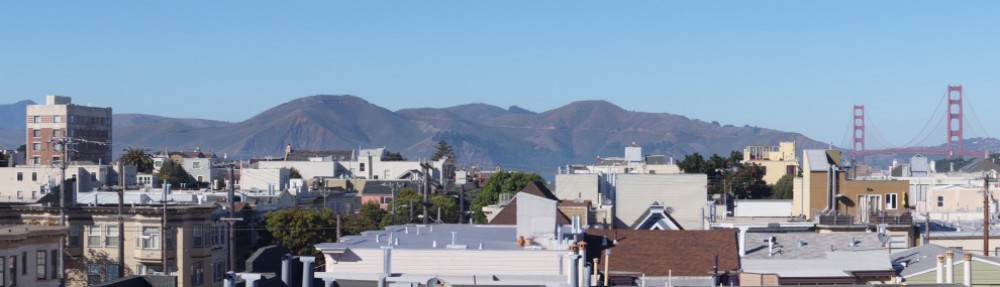
Okay, I admit I only knew there was a video for this about a few days ago. It’s on this list because this was filmed in the Presidio, about a mile or so away from my apartment. I know exactly where that spire is, and have taken many pictures of it! Also: I can’t be sure, but I think they’re riding the 1 California at the beginning and end of this video. 🙂
Cayucas, “High School Lover”
Goofy video, but it fits the goofiness of the song.
Pearl Jam, “Sirens”
The guys look GREAT for a band that’s been around since 1991!
World Order, “Last Dance”
Or, you know, pretty much any World Order video. They’re all awesome. 🙂

Best Songs
20. Johnny Marr, “Generate! Generate!”
19. Yeah Yeah Yeahs, “Sacrilege”
18. How to Destroy Angels, “Ice Age”
17. The London Suede, “Barriers”
16. Small Black, “Free at Dawn”
15. MS MR, “Hurricane”
14. Low, “Plastic Cup”
13. Boards of Canada, “Reach for the Dead”
12. The Polyphonic Spree, “Popular By Design”
11. My Bloody Valentine, “New You”
10. Rogue Wave, “College”
9. Placebo, “Too Many People”
8. Django Django, “Default”
7. Editors, “A Ton of Love”
6. Wire, “As We Go”
5. Trails and Ways, “Como Te Vas”
4. Pearl Jam, “Sirens”
3. Cayucas, “High School Lover”
2. Bastille, “Pompeii”
1. Dutch Uncles, “Fester”

Best Albums
20. Cut Copy, Free Your Mind
19. Depeche Mode, Delta Machine
18. Small Black, Limits of Desire
17. Little Green Cars, Absolute Zero
16. How to Destroy Angels, Welcome Oblivion
15. MS MR, Secondhand Rapture
14. Beady Eye, BE
13. Bastille, Bad Blood
12. Arctic Monkeys, AM
11. The National, Trouble Will Find Me
10. Dutch Uncles, Out of Touch in the Wild
9. My Bloody Valentine, mbv
8. The Polyphonic Spree, Yes, It’s True.
7. Sleigh Bells, Bitter Rivals
6. Editors, The Weight of Your Love
5. Tired Pony, The Ghost of the Mountain
4. Pearl Jam, Lightning Bolt
3. Wire, Change Becomes Us
2. Johnny Marr, The Messenger
1. Boards of Canada, Tomorrow’s Harvest

We Sing and Dance As We Go: The Singles 2013

For your listening/viewing pleasure, here’s my year’s end best-of compilation.  Enjoy!

Tape 1

Side A
1. The Neighbourhood, “Afraid”
2. Bastille, “Pompeii”
3. Small Black, “Free At Dawn”
4. Cayucas, “High School Lover”
5. Foals, “My Number”
6. MS MR, “Hurricane”
7. Dutch Uncles, “Fester”
8. The National, “Don’t Swallow the Cap”
9. San Cisco, “Awkward”
10. Rogue Wave, “College”
11. Tame Impala, “Elephant”

Side B
1. My Bloody Valentine, “In Another Way”
2. Nightmare Air, “Escape”
3. Capital Cities, “Safe and Sound”
4. Chvrches, “Recover”
5. The Boxer Rebellion, “Diamonds”
6. Johnny Marr, “Generate! Generate!”
7. Cold War Kids, “Miracle Mile”
8. Editors, “A Ton of Love”
9. Trails and Ways, “Como Te Vas”
10. Depeche Mode, “Heaven”
11. The London Suede, “Barriers”
12. Wire, “As We Go”

Tape 2

Side A
1. Dropkick Murphys, “The Boys Are Back”
2. Gary Clark Jr, “Ain’t Messin’ Round”
3. Placebo, “Loud Like Love”
4. Django Django, “Default”
5. Sleigh Bells, “Tiger Kit”
6. Christian McNeill & Sea Monsters, “Zero”
7. Beck, “I Won’t Be Long”
8. Arctic Monkeys, “Do I Wanna Know?”
9. Imagine Dragons, “Radioactive”
10. AWOLNATION, “Not Your Fault”
11. The Airborne Toxic Event, “Hell and Back”
12. Ra Ra Riot, “Dance with Me”

Side B
1. My Bloody Valentine, “New You”
2. Alison Moyet, “When I Was Your Girl”
3. Fitz & the Tantrums, “Out of My League”
4. The Polyphonic Spree, “Popular By Design”
5. Tegan and Sara, “Closer”
6. Panda Riot, “Good Night, Rich Kids”
7. Gold Fields, “Dark Again”
8. Local Natives, “Heavy Feet”
9. Little Green Cars, “Harper Lee”
10. Sara Bareilles, “Brave”
11. Frank Turner, “Recovery”

Tape 3

Side A
1. Yeah Yeah Yeahs, “Sacrilege”
2. Franz Ferdinand, “Right Action”
3. Pearl Jam, “Sirens”
4. Cut Copy, “Free Your Mind”
5. Dale Earnhardt Jr Jr, “If You Didn’t See Me (You Weren’t on the Dancefloor)”
6. The History of Apple Pie, “Mallory”
7. Atoms for Peace, “Ingenue”
8. Eels, “New Alphabet”
9. Johnny Marr, “I Want the Heartbeat”
10. Phoenix, “Trying to Be Cool”
11. The Postal Service, “A Tattered Line of String”

Side B
1. Tired Pony, “All Things All At Once”
2. Wire, “Re-Invent Your Second Wheel”
3. Goldfrapp, “Drew”
4. Low, “Plastic Cup”
5. David Bowie, “Where Are We Now?”
6. How to Destroy Angels, “Ice Age”
7. Beady Eye, “Soul Love”
8. Boards of Canada, “Reach for the Dead”
9. Placebo, “Too Many Friends”
10. World Order, “Machine Civilization”

End Notes:

1. Yes, I made Tape 3 Side 2 quiet and reserved on purpose.  A sort of winding down, like one does at the end of the year.  I balanced it out with the last two songs, meant to be one of my personal views of the year (the Placebo track), and an uplifting final track (the World Order track).  I do this with a lot of my multi-tape compilations, and is meant sort of like a detachment before seeing everything in a fresh light again.

2. I will also be doing a much shorter WSaDAWG:TS13 addendum playlist focusing solely on reissue/box set highlights from this year.  More on that in a later post.

3. My year end review will be posted at my Live Journal blog as always, and will post it here as well.

Walk in Silence: End of Year Wrap-Up and Plans for 2014

Hi Gang!

I’m sure you all are awaiting the next few Blogging the Beatles posts from me, and granted, I will definitely get to them in the next week or so.  You know how the last few weeks of the year are…a lot of last-minute running around, catching up on things, holiday errands and whatnot, and the end-of-year/end-of-quarter insanity that happens at work.

Over the last day or so I’ve also been building up a classic old-fashioned best-of-year compilation: I may not be committing this music to tape or cd like in the past, but considering it’s been twenty-five years since the first year end compilation I did, I felt it prudent to work within the confines of the original: I’d work in batches of forty-five minutes, as if I were creating this mix on ninety-minute tapes like the ones I’d buy at Radio Shack.  I’d also focus more on the sequencing–over the past few years, I’d basically build a file full of mp3s, jumble them up using random shuffle, and do some final tweaking with songs I wanted in certain positions.  This time out, I’m building the playlist song by song, with specific placement for certain songs.

I’d mentioned on Twitter that I’d chosen We Sing and Dance As We Go: The Singles 2013 for this year’s compilation; this is actually a nod to the first one I made in 1988.  The title comes from Wire’s “As We Go” from their Change Becomes Us album from this year, which closes out Tape 1 at 89 minutes 20 seconds.  The first one had the title of Does Truth Dance? Does Truth Sing?: The Singles 1988, which comes from Wire’s “A Public Place” from their A Bell Is a Cup Until It Is Struck album, which ends Tape 1 on that year’s compilation.  This past year has definitely been one of retromania–college rock bands from the 80s releasing new product, new bands from today releasing sounds very similar to the 80s vibe, and a hell of a lot of impressive reissues and box set retrospectives as well.  I will most likely cover a number of these at the start of the new year.

But yes…as noted on Twitter, I will be posting the playlist for We Sing and Dance As We Go: The Singles 2013 as soon as I complete it.  I will also be working on a year-end post as well.


So!  In other news, I have a few more posts to go for the BtB series:

No One’s Gonna Change Our World (featuring “Across the Universe”) and The Beatles’ Seventh Christmas Record

–“Let It Be”/”You Know My Name (Look Up the Number)” and Let It Be

–The new songs “Free As a Bird” and “Real Love” (of course I was going to include those!)

Once those are done, I will, as mentioned previously, be ramping up on the music posts here at Walk in Silence.  I plan on posting some kind of record review, whether it’s from the 80s heyday of college rock or something new that just came out.  I’m hoping to get at least one post up per week, but if I can manage another one at some point, that’s fine too.  I’m looking forward to writing up some new articles in the new year, and I hope you’ll enjoy them.


Happy Holidays! 🙂

Blogging the Beatles 49/50: Abbey Road and the “Something”/”Come Together” single

By spring 1969, it was clear that the Beatles as a band was coming to a close.  There were many and varied reasons for this, but in all honesty, it really came down to four guys, three of them close friends since 1957 or so, finally moving on and going their separate ways.  The band, for all intents and purposes, had run its course of a decade-plus years, and now the four men had grown up into separate individuals.  John, having long grown out of the allure of being in a rock band and finding new love and hints of stability, couldn’t wait to move on.  Paul, even though he’d been the de facto manager of sorts in trying to keep the band together, now felt the urge to do his own thing.  George, always in the shadow of his two older and more prolific bandmates and their sometimes volatile relationship, hungered for his own musical endeavors separate from the rest of the band.  Ringo, the latecomer (a close friend since at least 1960, he joined the band in 1962) and friend to all, even had his own distractions: he had a taste and natural ability to acting and had active roles in multiple movies.

Even though the results of the Get Back sessions had been a disaster, they still planned on releasing it at some point; however, they had all decided (but not officially claimed) that if the Beatles were to dissolve, they wanted to go out on a high note.  They asked George Martin to produce, who adamantly stated that he’d do so only if they recorded the way they used to: with direction, creativity, and a distinct lack of volatility.  The band agreed, and returned to the studio.

The new project would be an interesting mix of new, old, and recent-but-unfinished.  Though the majority of the album would be recorded in summer 1969–mostly between 1 July and 29 August, at Abbey Road–a few songs received a kickstart early on.  Despite the slow erosion happening within and outside the band, the group as always had a never-ending itch to create.  The genesis of some songs popped up during the Get Back sessions, such as “Octopus’ Garden” and “Maxwell’s Silver Hammer”.  Others dated back to snippets from the India trip and The Beatles sessions, such as “Mean Mr Mustard” and “Polythene Pam”.  These were added to a small but significant list of completely new songs as well.  A handful of these songs would be started in fits and starts before July, in between the many various personal appointments going on, such as Ringo’s filming and George’s surgery and recovery of having his tonsils removed.  Even John’s unexpected car accident and recuperation caused slight delays and his lack of input.  Mundane reasons to be sure, but perhaps this signaled that health (both physical and mental) were finally being taken seriously.  The nonstop limelight of the sixties were giving way to the hide-for-awhile-between-releases seventies.

*      *      *

Credit: jpgr.co.uk – The Beatles Complete UK Discography site

Credit: jpgr.co.uk – The Beatles Complete UK Discography site

Album: Abbey Road
Released: 26 September 1969

The Beatles’ final recorded album (and penultimate album release) may have been seen as somewhat of a sell-out to some critics of the time, and for varied reasons.  It’s the most lush-sounding and intricately-crafted album of their career.  This was a rarity in that it was recorded only in stereo (any monaural versions are not true and separate mono mixes like their previous works, but fold-downs of the final stereo mix), and on an eight-track mixing board as well, which gave them a lot more aural room to play with.

The title itself is an obvious homage to the studio that had treated them so well since 1962, even as they are walking away from the building on the iconic front cover.  [Abbey Road Studios is behind those trees to the left, just behind George’s head and the “28IF” Volkswagen.]  All four would eventually return to the studio to work on future solo projects, but as a band…privately, it was agreed that this would very well be the last project done as a full band.  It only stood to reason that they go out the way they came in.

*    *    *

[Note: Due to recent copyright arguments on YouTube, I unfortunately can’t post any video links this time out. Chances are the links for the previous Blogging the Beatles posts are dead too. Sorry about that! ]

Side A

Track 1: Come Together
The album kicks off with a startlingly swampy blues song from John. Originally inspired by Timothy Leary’s run for California governor against Ronald Reagan (Leary’s theme was “Come together, join the party”), this track shows immediately how well the four could play together when they put their hearts into it. The basic track for the final version (take 6) had all four doing what they do best: John singing some of his most offbeat lyrics, George delivering some great blues riffs, Paul slinking away on bass, and Ringo playing subdued yet intricate drums. The song itself really doesn’t have any meaning other than the possible self-parody John was known for, but that doesn’t really matter–the fact that it’s got one killer blues groove going is enough to make it memorable.
[On a personal note, this was probably one of the first Beatles songs I was aware of, having heard Aerosmith’s cover of it on the radio before I went to see Sgt Pepper’s Lonely Hearts Club Band as a kid.]

Track 2: Something
Another relatively new song follows, this time one of George’s all-time best compositions. It’s a gorgeous love song (though per George, not about Patti–his aim was to write a love song with Ray Charles in mind as singer) that takes its own time unraveling, and its deliberate meandering only adds to the song’s excellence. By this time George had become quite adept at song structure, and this one is a great example: it starts quietly and sparsely, most of the tune relying on the lyrics to carry it. It isn’t until the second verse that George Martin’s strings come in to complement the melody. By the end of it we’ve hit the first bridge, the strongest of the sections, with each instrument building up in force and emotion before his second refrain of “I don’t know, I don’t know…”, bringing it all back down to quiet contemplation and a bluesy and Claptonesque slide guitar solo. In the last ten seconds of the song he hints at another bridge refrain, only to end the song on a high positive note instead. All in all one of his best tracks.

Track 3: Maxwell’s Silver Hammer
Paul’s first offering for the album was originally a late entry to The Beatles but missed the deadline. It re-emerged briefly during the Get Back sessions (the band performs a run-through with Mal Evans on anvil in the Let It Be film) until it finally popped up in early July. Paul may have gotten a bit of flack from the other three during the sessions for this song, most likely due to his three-day attempt at trying to get as perfect as possible, much to the others’ annoyance. John actively disliked this song much like he did with “Ob-La-Di Ob-La-Da”, as it’s a very slight, twee song–another of his “Granny music” songs, as John would say. Still, Paul’s obsessiveness with this song actually makes sense on an interesting level: for a science-y sound he used a recently-purchased Moog synthesizer, which back then was a keyboard surrounded by a confusing bank of knobs, plugs and wires, so Paul must have wanted to take his time to make sure the sound worked with the song rather than it being an intrusive wall of bleeps and blats. [Even rock band keyboardists who were adept at using one, like Ray Manzarek and Keith Emerson, found it unwieldy at times.] It can be somewhat of a cutesy, cloying song, but it still works as an interesting composition, very much along the lines of Paul’s Sgt Pepper era tracks.

Track 4: Oh! Darling
Paul’s next track could easily sit alongside “Come Together” as one of the band’s best blues tracks. It popped up near the end of the Get Back sessions (you can hear a bluesier jam version on Anthology 3), but got a major boost on 20 April. The basic track is a wild and dirty jam–tighter and more melodious than “Yer Blues” but equally as fierce–with a surprising twenty-six live takes with all four playing loud and hard. Paul would then try numerous takes of his vocal, which he did on purpose: he wanted a raw-throat sound to his voice and would come in early so he could belt it out on his own. The end result is a down-on-my-knees heartbreaker of a track that sounds like it could have been recorded late at night in a packed smoky bar.

Track 5: Octopus’ Garden
Ringo offers one of his own tracks here, a light-hearted and fun track inspired by a cruise he’d taken in 1968. As with most Ringo songs for the Beatles, it doesn’t venture too far melodically, though by 1969, he had enough confidence and strength in his singing voice (quite possibly due to his recent foray into acting) that his delivery is quite strong here. It’s a nice summery song with John delivering some lighthearted fingerstyle guitar, Paul plinking away on the piano and minimal bass, and George supplying licks possibly inspired by slack-key guitar. The three also offer a lighthearted (and silly, during the solo) backing vocals that complement the song well.

Track 6: I Want You (She’s So Heavy)
The first side ends with a quite sinister track from John that ends up being the second longest track in their catalog at 7:47. It shares an interesting quality with a few other long tracks in their discography in that, in certain versions, they have an extended final section. “Hey Jude” features its famous four-minute fade out, and the early version of “Revolution 1” featured the same. The only difference here is that, unlike the “Hey Jude” coda featuring a different musical refrain than the rest of the song, we’re treated to the final arpeggiated riff here in the first few seconds of the song. Musically it may sound a bit corrupt and morally questionable–the minimal lyrics pretty much suggest a lecherous need for the focus of his desire–but all that aside, it’s one of the most powerful and dynamic tracks they’ve ever done. George and John both play lead blues riffs here and Paul chases along with a fascinating array of trickling bass lines. Billy Preston also makes an appearance here, playing a wonderful run of riffs on his organ. The song also changes tempo multiple times, going from a rock beat to a rhumba beat to a slithery dirge, until it finally hits the final arpeggio section again. At this point the riff doesn’t let up–it only gets darker and angrier and louder. A wash of white noise slowly enters the picture just past the five-minute mark, adding to the apocalypse until the last few seconds are about to take over and then–nothing. In a brilliant move from John, they chose not an ending or a fade-out, but a cold edit into silence, which leaves us gasping at the end of Side A.

Side B

Track 1: Here Comes the Sun
The second side starts off with a complete one-eighty from where we left off on the previous side, with a joyous, lighthearted song from George. Written on an uncharacteristically warm and sunny April day in 1969 at a house owned by Eric Clapton (and it had indeed been a long and cold winter in the UK that season), he’d decided to play hooky from the tedious day-to-day business at Apple and relax. Everything about this song is bright, from George’s delicate arpeggios and sing-song keyboard work, Paul’s upper-register bass playing (he only goes low during the “sun, sun, sun, here it comes” bridge), and even Ringo’s tight and quiet drumming. [John was laid up in the hospital due to a car accident from early to mid July, so he does not feature here.] It’s not overt, but the arpeggiated triplets are borrowed from the common codas for Indian ragas, especially with the wind-down “1-2-3 / 1-2-3 / 1-2 / 1” phrasing. This track also hints at George’s later solo work, especially from Thirty-Three and 1/3 forward, where he felt free to pursue his lighter, more spiritual side.

Track 2: Because
John’s next offering is a hauntingly gorgeous track featuring some of John, Paul and George’s best harmonies ever put to tape. Supposedly inspired by the chords to Beethoven’s “Moonlight Sonata” and played on electronic harpsichord by George Martin (with John echoing the melody on guitar), it’s an extremely trippy and strange paean to…something, we’re not sure what. That’s not as important, though, as the vocal delivery by the three men is the most important part of the track. Recorded and overdubbed twice more so it features nine voices, the vocals carry the entire track through its just short of three minutes. The listener is still not entirely sure what the song is about, but that doesn’t matter, because it was absolutely lovely to listen to.

Track 3: You Never Give Me Your Money
The “Abbey Road Medley” official starts here with Paul’s not-so-subtle ode to their new manager, Allen Klein. [While John and George liked the man and Ringo was ambivalent as usual, Paul actively disliked and distrusted him.] That aside, it could also be considered an ode to working class suburbia, the ennui and frustration of being too broke to do anything but wish one was elsewhere. It’s a fascinating song of three separate parts: the slow and pessimistic arguing of lovers–the motif which is borrowed later on near the end of the Medley; the bustling daydream of hopes deferred played almost in boogie-woogie style; and finally the rocking and grooving finale of optimistic escape. Each section sounds completely different from the other two, even though it’s played straight through with very little change of instruments. It’s one of Paul’s strongest and most adventurous tracks of the latter period of the band.

Track 4: Sun King
John returns with a quiet and unassuming song similar to two others of the era: this is the second song highlighting quite detailed harmonies (similar to “Because”), and it also features the lazy F#m7-to-E riff inspired by Fleetwood Mac’s “Albatross”–the same phrase he’d used just a few months earlier on “Don’t Let Me Down”. The vocals are lovely, but the lyrics have even less meaning than “Because”, featuring just a few straight phrases and a lot of ersatz Spanish-sounding phrases. It ends at just shy of two and a half minutes, giving way to the next track in the medley.

Track 5: Mean Mr. Mustard
The next track segues in perfectly, right on beat and key, though it’s one of John’s leftovers from the Esher demos for The Beatles. It’s a slight and silly song about a miserly man who refuses to spend his money on anything (apparently inspired by an article he’d read). It could be seen as a filler track–and John quickly wrote this one off as a dud–but there’s some interesting bits here. First off, instead of a normal twelve-bar blues riff, the back half of the phrase goes up to D instead of down to A, giving it a bit of added flavor. The last few bars of the song are also done in 3/4 time rather than 4/4, as if to speed up the feel of the track. The song ends with a return back up to D–originally to segue into the short acoustic “Her Majesty”, but changed to segue perfectly into the next track instead.

Track 6: Polythene Pam
Another of John’s Esher demos for The Beatles, this one hints back at their early career and lives. There’s quite a lot of silly wordplay here–not the weird and purposely obtuse stuff John would write later, but his earlier, pun-filled works–and it’s sung in a very thick Scouse accent. The four are playing with gleeful abandon here, with a lot of guitar whoops and surfy licks, all with Ringo laying down a rumbling beat. As with the previous, the last phrase of the track changes chord here in order to lead us into the following track.

Track 7: She Came In Through the Bathroom Window
Paul returns with another extremely strong track, this one inspired by their erstwhile fans that hung around the studio and sometimes his house around the corner on Cavendish Avenue, in which one had actually broken into his house at one time. It’s a quirky song, not quite a love song but not quite a story song either; it’s a bit of both, a man and woman at odds with each other and yet entwined in each other’s fate. There’s some great playing here as well (both this and “Polythene Pam” were recorded in one go), with extremely tight vocals and instrumentation.

Track 8: Golden Slumbers
Another song from Paul, partly inspired by Thomas Drekker’s “Cradle Song” (and possibly inspired, though never proven, by Paul’s lingering wish for the band to go on as it once had), it’s a short and simple piano-based piece, but its dynamics are fastinating, as it starts out as a soothing lullaby but turns into an urging plea for a respite. This build from soft to loud carries the song over to the next track.

Track 9: Carry That Weight
Recorded alongside the previous track, it takes off from the heightened power of the previous track with all four members singing the chorus in unison. This is the most intriguing song on the album despite its short length, as it features multiple motifs from earlier tracks on the album: an extra verse from “You Never Give Me Your Money”, and the arpeggios from “Here Comes the Sun.” Though Paul stated the song was about the frustrations of running Apple at the time, John and many others saw it as a commentary on the band themselves–even though they were on the verge of breaking up, they knew that whatever they did separately would never equal what they had done together as a band.

Track 10: The End
A hard edit after the final arpeggios of the previous song brings us to the penultimate track of the album, and the only song that features a solo from all four members of the band, even Ringo, who hated drum solos (and gets his out of the way first thing). Each guitarist then shows off their one of their signature styles: Paul with his bright and full notes; George with his bluesy bended notes; and John with his hard and crunchy riffs. This builds up gradually until it stops short and all instruments drop away except for Paul’s quiet piano, hovering for a few seconds before the final coda kicks in.

And it’s one hell of a heartbreaking coda: it’s a final goodbye to everything that the band endured in the sixties–all its ups and downs, highlights and misfires, pleasures and pains, successes and failures, celebrations and losses, and everything in between, summed up in one line: …and in the end, the love you take is equal to the love you make. One short angelic “ah-aah”, and the song…and the band…is done.

Track 11: Her Majesty
…and not to be left on such a morose note, an almost thrown away track formerly wedged between “Mean Mr Mustard” and “Polythene Pam” gets added as a last wink and nod to their fans. Paul’s short acoustic ditty is a bit of an afterthought and thrown on by Abbey Road tape operator John Kurlander and forgotten until the final mix listen. The band enjoyed the surprise, and decided to keep it in. The cover for the first editions of the album had already been printed and did not mention this song, and so was considered an early example of a “hidden track” on a rock record.

*

If the Beatles wished to go out on a high note, or at least finish their career as a band with their best work to date, Abbey Road certainly did its job. It’s not considered their best album overall, though it’s quite high up on an extremely high number of critics’ lists, but given their history and the place they found themselves in at the end of the sixties, it can definitely be considered their best output at that time.

Over a surprisingly short stretch as a recording band–just about seven years, from late 1962 to mid-1969–they’d touched upon so many fascinating and disparate musical styles, from Tamla and Motown to blues to country to folk to pop to psychedelia to hard rock and beyond. It only made sense that Abbey Road become a swan song of their own voices and styles–this was the band as themselves. It was also an album similar to The Beatles in a way; it was the sound of four different men’s styles, gelling miraculously where the previous album failed to do so.

All four members would be working on solo releases by the end of the year, and their initial solo work would carry hints of what they’d given to this album. John’s post-avant garde albums would feature both hard-edged and plaintive work, indicative of his personality; Paul would be free to continue on his poppier and more melodic work; George, finally free from John and Paul’s shadow, would shine through with excellent songwriting and guitar work; and even Ringo would shine with some of his best singles–often aided by the other three, in one way or another.

*      *      *
Credit: thebeatlesbible.com

Credit: thebeatlesbible.com

Single: “Something”/”Come Together”
Released: 31 October 1969

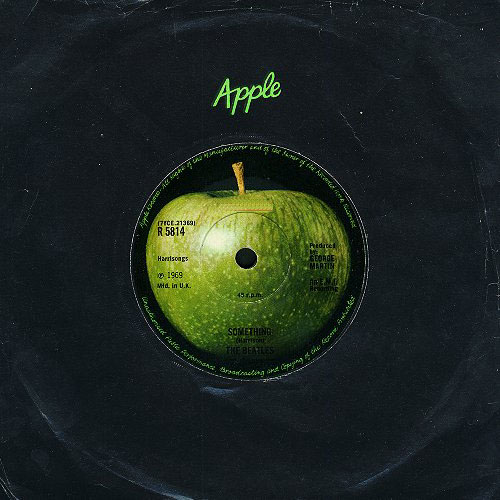
Unlike previous single releases, the band had no leftover tracks they wished to release, and so they chose to feature two of the strongest songs from Abbey Road here.  They felt that George’s “Something” was the stronger track, and gave it the “apple skin” side, giving John’s “Come Together” the “core” side.

Side A: “Something”
As mentioned in an earlier post, this track popped up late in the sessions for The Beatles, but George felt strongly enough about this track that he felt it would work better on their next project (or possibly a solo release, considering the situation).  The phrase “something in the way she moves” was borrowed by label mate James Taylor, but the rest was all George’s creation, and it’s lovely.  An interesting bootleg version lasted a surprising eight minutes, with a lengthy piano coda at the end played by John (whose instrumentation is all but obscured in the final version).  This coda would be dropped, but John would end up using it for the track “Remember” from his Plastic Ono Band album the next year.

Paul would revive this song much later from about 2002 onwards, playing it mainly on ukulele, as a loving tribute to George.

Side B: “Come Together”
John’s great bluesy rocker actually got him in legal trouble in 1973; the line “Here come old flattop/he come groovin’ up slowly” sounded way too similar to the line “Here come a flattop, he was movin’ up with me” from Chuck Berry’s single “You Can’t Catch Me”, and was soon sued by Morris Levy and Big Seven Music Corp, that song’s publishers. Wishing to avoid any further problems, they settled out of court with John agreeing to record a handful of other songs held by that publisher. The sessions for those songs would be infamous and troubled in their own way, mainly by drugs and drink (John and a host of friends, including Harry Nilsson), an unstable producer (Phil Spector), and a relationship breakdown (John and Yoko), but by 1975 he made good on his agreement and released Rock ‘n’ Roll, his last recordings before semi-retiring for five years.

*        *        *

For the Beatles, these recordings would most likely be considered their last original work as a band. They hadn’t exactly broken up or informed anyone that they had done so, but they had chosen not to say anything for the time being. The wedge had been planted the previous year, but the arrival of Allen Klein had been the final nail in the coffin. They may have met up occasionally for business meetings or Beatles-related issues, but by this time they were no longer a recording entity. The only thing left at this point would be to set their affairs in order–and perhaps release whatever became of the Get Back sessions–but other than that, the band was pretty much over at this point.  All that remained was the music.

*        *        *

Next Up: No One’s Gonna Change Our World and The Beatles’ Seventh Christmas Record
Blogging the Beatles 47/48: the “Get Back”/”Don’t Let Me Down” and “The Ballad of John and Yoko”/”Old Brown Shoe” singles

In 1969, it was obvious to those around them, and especially to themselves, that the band was splintering badly. The events of 1968, from the good but misguided intentions of the India trip, to managing themselves after Brian Epstein’s passing, to the unveiling of Apple Corps, to the protracted and often solo production of nearly three dozen songs over the course of five and a half months…it was too much, too soon, and too disorganized. Patience and tolerance was deteriorating. John, Paul and George had been best mates and constant companions for over ten years at that point, knew each other’s strengths and weaknesses…and especially what set them off.

The Get Back project had been another of Paul’s ideas; given that their sound’s evolution had expanded as far as it could possibly have taken them by 1967, and that their attempt at a more organic sound for The Beatles ended up more disjointed than cohesive, perhaps it was time to start over again, start from the beginning. Become a foursome again, play simple rock and roll that had influenced them so deeply in the late 50s. It had also been a good couple of years since their last touring performance. The semi-live performances of “All You Need Is Love” in 1967 and “Hey Jude” and “Revolution” in 1968 had somewhat rekindled the happier memories of playing live–just the four of them rocking out and having fun. Upon their next meeting in late 1968, Paul suggested perhaps playing out again. George emphatically nixed the idea–he wasn’t about to relive the frustration of getting mauled by fans and not being able to hear himself play, let alone sing, even if the PA systems had improved since then. John was interested, but in his own way, refused to say yes or no…and he was by this time distracting himself with multimedia art installments with Yoko. Ringo, ever the nice guy, would go with whatever the other three agreed on.

Okay, touring was out. Perhaps a one-week appearance somewhere? A one-off show? A television special?

That last suggestion had merit. It provided the least amount of preplanning and production. It would another fulfillment on their United Artists contract, it would keep them in the spotlight…and perhaps it would force them to behave more maturely in each other’s presence.

Rule Number One: No overdubs (or at least no obvious multitracking). The music would contain only the four members playing, forcing them not just to become a cohesive unit again, but would rekindle their ability to counterpoint each other’s playing, an ability that they had in spades back when they started but had lost over the course of the last few years. Any additional sound effects would possibly be played by their assistant Mal Evans, and any additional keyboards would be played by their friend and labelmate Billy Preston.

As they say, the best laid plans…

*      *      *

Credit: thebeatlesbible.com

Credit: thebeatlesbible.com

Single: “Get Back”/”Don’t Let Me Down”
Released: 11 April 1969

The Get Back project had pretty much ended by the end of January–not so much with a bang, but a whimper. Jamming and rehearsing at Twickenham Film Studios had been arduous and frustrating; it seemed obvious that the band was not happy at all there. After moving to their new Apple Studios, they worked a week or so more until the end of the month, still disjointed but somewhat more cohesive now. Regardless, there were a good handful of usable songs somewhere in that mess, enough to cobble into an album and perhaps a single or two. Many of the filmed rehearsals included a full-band performance that could be used as a promotional film. Even their semi-planned “live” performance on the roof of 3 Savile Row on 30 January might have carried some gems.

Side A: Get Back
One usable song was a great shuffling jam that quickly became a fan favorite, and it has quite the interesting history. Its genesis came from an untitled bluesy jam on 7 January, borrowing a lyric from George’s “Sour Milk Sea” (“Get back to where you should be”) and changing it slightly. A few days later, inspired by UK Cabinet minister Enoch Powell’s wildly extremist ‘Rivers of Blood’ speech from April 1968, Paul wrote a scathing satire of anti-immigration and pro-discrimination. Two versions of these lyrics surfaced, the slower, more Elvis-inspired “Commonwealth” and the more visceral, angry “No Pakistanis”. The latter is much closer to the released final version. By the time a serious full take was laid down, the immigration satire had been dropped, or at least severely dialed back; the final lyrics seem more of a commentary of the band itself, letting go of the extraneous and returning to the source of your happiness.

The single version was recorded on 27 January in their Apple Studios after much studio rehearsing on the 23rd. Many versions were recorded at this time, including an ever so slightly different take that would eventually surface on the Let It Be album. This version would suffice as a tight single until they had something down for their next release. It was quickly produced and released just a few months later, much like their stopgap album-only singles. By this time they knew it would take awhile for the special-turned-movie and album to surface (not to mention they’d washed their hands of it by then). Despite its dark history, to this day it’s still considered one of their biggest late-era hits, and Paul has revived it numerous times on his tours.

Side B: Don’t Let Me Down
Though it’s often commented that John’s role in the Get Back sessions was minimal–in essence, he was pretty much phoning it in at that point–it’s not to say that his songwriting had deteriorated. Personally he was dealing with a hell of a lot of personal demons, many of which were threatening to take over his public life if not his sanity. In this instance Yoko became a saving grace for him, an anchor he’d desperately needed for years. In response, “Don’t Let Me Down” was written as a desperate plea; he was hopelessly in love with this woman who could help him find his inner peace–this song is him down on his knees, begging that, for once in his life, the thing closest to his heart would not break him.

The track is an incredibly sparse blues track (its F#m7-to-E riff influenced by Fleetwood Mac’s “Albatross”, interestingly enough, and used again later in “Sun King” on Abbey Road), with just the four playing their usual instruments and supported by Preston on electric piano. Despite its bare essentials, it still comes across as an incredibly heartfelt track. The vocals are rough in tone yet tight in delivery, and Paul and George’s countermelody in the bridge is phenomenal.

*    *    *

As this would be the only release to surface (for now) from the Get Back sessions, it was just enough to tide over the curiosity of the fans and the critics, many of whom had heard quite a few rumors about what they were up to but were yet to hear anything substantial. Despite the trainwreck the project ended up being, very few seemed aware that anything was wrong. These two songs sounded like a logical extension of the organic sound of The Beatles, so no one seemed surprised by the bare sounds. It would be a little over a year before they’d eventually hear and see what really had transpired in that month.

*      *      *

Credit: beatlesbible.com

Credit: beatlesbible.com

Single: “The Ballad of John and Yoko”/”Old Brown Shoe”
Released: 30 May 1969

Right around the same time the “Get Back” single had been released, John was itching to get back in the studio to record his next song about his ongoing relationship with Yoko. After many setbacks and a long and arduous divorce settlement, the two had finally gotten married in March, recording and filming all along the way. The sounds turned into their third avant-garde outing Wedding Album, their filming turned into Honeymoon, and the story fodder for their next single. It also served as the kicking-off point for their next album project–one that would be their last as a foursome, but one that would be done right this time, back at Abbey Road with George Martin back behind the finally-installed eight-track boards.

Side A: The Ballad of John and Yoko
The lyrics to this song tell the story, pretty much verbatim, of the trials and tribulations of trying to get married when you have so many things going against you. John and Yoko’s quest to tie the knot had been filled with roadblocks. Due to their drug bust earlier in 1968 as well as their vocal anti-war stance, several government agencies were refusing to let them enter their countries, or at least were making it hard for them to do so. Many critics and fans thought John had gone off the deep end, many having seen and/or heard Yoko’s weird performance art. Despite all that, they chose to soldier on, until the band’s assistant Peter Brown (who had been Brian Epstein’s assistant before then) informed them that they could at last get married in Gibraltar. The second half of the song also mentions one of their Bed-Ins for Peace, in which they would stay in bed all day, inviting any critic and reporter to speak with them about their peace movement. An admittedly silly idea for a war protest (they were fully aware of its ridiculousness–that was partly the point), but in the context of the song it also serves as a cutting jab at those same critics and reporters who were already writing them off as whackjobs.

Musically, this is quite fascinating: it’s only John and Paul playing everything here, as George was on holiday and Ringo was in the middle of filming The Magic Christian with Peter Sellers. It’s a quick song that only took about eleven takes on 14 April, one take which includes a breakdown mid-song where John yells to a drumming Paul “Go a bit faster, Ringo!”, to which he replies “Okay, George!”. It also serves as the return of engineer Geoff Emerick, who had left in disgust during the sessions for The Beatles some months earlier.

Due to its lyrics, it did of course have its own run of trouble; many stations refused to play it because of the use of “Christ” and “crucify” in the lyrics, but that would not stop the single from being a hit, reaching #1 in the UK and #8 in the US.

Side B: Old Brown Shoe
George serves up a rocking b-side to this single, the final version recorded on 18 April. It’s almost his own take on Paul’s “Hello Goodbye”, an exercise in opposites, but more on a metaphorical level.  He lets himself go wild here, foregoing his usual oblique lyrics and inserting witty and sly riffs about having a relationship while being a full-blown pop star.  A full band plays here, delivering an extremely tight and detailed performance. Most obvious is Ringo’s drumming here, strong and to the fore, playing snare on the unexpected upbeat for nearly the entire song (he switches only briefly on the bridges, where he plays on the downbeat instead). George also delivers a powerful, heavily treated Claptonesque solo. There’s some confusion as to who’s playing bass–most say it’s Paul, but George has also claimed it was him playing instead, but there’s some great tandem bass and guitar riffing going on here. John originally had a rhythm guitar riff on this song, but it did not make the final cut, his only surviving parts being backing vocals.

Compared to many of George’s previous songs, this one sticks out as an incredible leap forward in composition. His abilities had been hinted at, especially on Revolver and The Beatles, but here we finally hear just how strong his songwriting really is. By this time he had quite the backlog of tracks just waiting to be put down on tape, but as most Beatles albums were primarily Lennon-McCartney productions, he was willing to hold back. By the end of 1970, free of his band, he would deliver many of these gems on his first true solo album, All Things Must Pass.

*    *    *

This single was an unexpected turnaround both for the band and for their fans. Having expected the groggy, spare sounds of the previous album and single, they instead heard a grand production, clear and glorious. It might just be possible that after a year or so of questionable releases, they’d rebounded, found their magic, and were rearing to go again. This was released so quickly after “Get Back”, which was still high in the charts at the time, that perhaps that possibility was a reality. The truth was somewhat different, but no less magical: the fantastic Fab Four had returned.

*      *      *

The latest single now released, they felt positive about the next project. It would be a true back-to-basics studio record–perhaps not the barebones attempt of Get Back, but more like the albums they’d been recording a few years previous. This would be more like a logical progression after Rubber Soul or Revolver, bypassing the high experimentation and psychedelia of Sgt Pepper and the meandering Magical Mystery Tour. In a way they were going to write off The Beatles and Get Back as steps in the wrong direction, even though many of the tracks on the next project were in fact coming from the sessions for those two albums. The truth, however, was more straightforward: they knew there was a real possibility they were about to go their separate ways, and decided that their last effort would be their absolute best ever. They returned to Abbey Road and asked Martin to produce them one last time, in order to bow out in the best way they could.

Next Up: Abbey Road and the “Something”/”Come Together” single

Fly-By: Sorry for the delay/Reading Material/Coming Soon

Hey there! Much apologies for the delay. You’d think with the ending in sight, I’d get this series done on time, but due to having quite the busy weekend schedule over the last month, I haven’t been able to get to them. I will also be afk and busy this weekend, but I should hopefully be back on the high horse by Monday. If I’m not putting out fires and saving small kittens from trees and Timmy from the damn well upon return to Day Job, I may even sneak some work in during the week.

Speaking of the Beatles…I am happy to say that I have picked up Mark Lewisohn’s Tune In – The Beatles: All These Years Vol 1 yesterday and have dropped absolutely everything I’ve been reading just so I can read this book. I’m only about 60 pages in and the four lads haven’t even met each other yet, but I can say it’s quite great reading so far. 🙂

[And yes, as an aside, I did in fact also order the “Expanded Edition” that will be around 1000 pages longer. Because I’m that much of a nerd.]

Lastly…in the next month or so, I will be slowly building up a new blog tied here at WordPress that will tie in with my SF trilogy. I won’t go into too much detail now, except that it will serve as a sort-of “official” writing blog as well. More on this later as it unfolds!

Until then…