Blogging the Beatles 4: Please Please Me LP

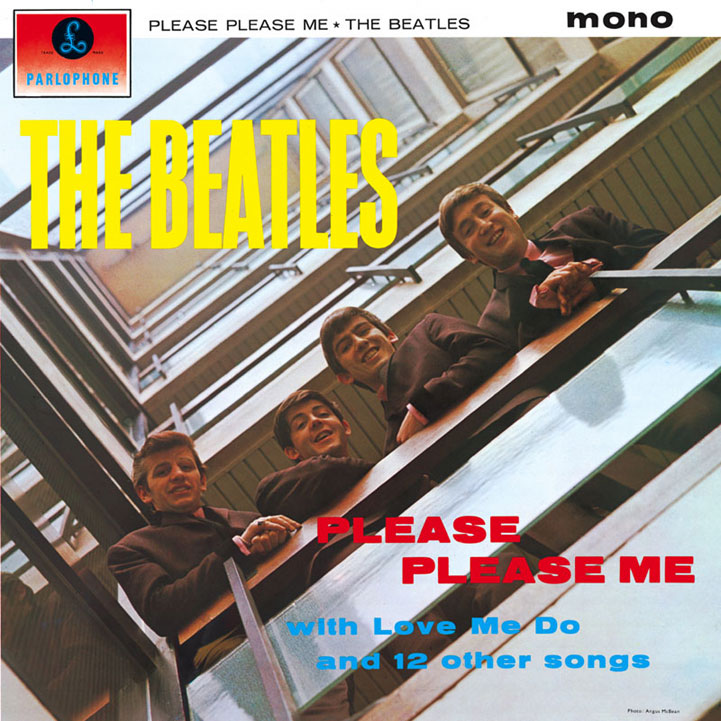
image via discogs.com

Album: Please Please Me
Released: 22 March 1963

Let’s start with some interesting facts:

1. Photographer Angus McBean, who had previously worked on comedy record covers, took the famous picture in the stairwell of the old EMI house in Manchester Square on 5 March after an unsatisfactory session with photographer John Dove. Dove’s ideas were very typical of the day: standing on stairs, corny dance poses, arty ground-view shots. McBean’s iconic shot was quite different from the norm, especially for a debut album.

2. Four songs already recorded as singles made their presence known here, the A and B sides mirroring each other (the “Please Please Me” single in reverse order and ending Side A, the “Love Me Do” single in its right order, starting Side B). This running order is quite uncommon for the time, considering most pop albums would have the hit songs starting Side A, so the average listener would hear the hit song right off the bat.

3. The remaining ten tracks (plus an eleventh unused track, “Hold Me Tight”, which would be rerecorded and released on their second album) recorded for this album were all done on 11 February in 585 minutes (roughly ten hours, not including breaks, and not including two extraneous overdubs by George Martin), for the princely sum of four hundred pounds. And John Lennon had a heavy cold at the time.

Mind you, recording an album in a day was typical for the time, but it was quite rare for every single track to be up to snuff–more often than not, a pop singer’s album would contain two or three hit songs and the rest would truly be filler: half-baked songs and throwaways that were recorded to pad the playing time. Added to that, eight out of the fourteen tracks were written by the band themselves, with only six covers used.

Granted, even though their recorded output at this point was exactly three singles, they were by no means amateurs. The band was ridiculously busy at this point, playing shows nearly every single day for about two and a half years straight, sometimes double shows (one afternoon, one evening). This was the price they paid for wanting to be famous pop stars, and they weren’t going to be lazy about it. They wrote and jammed in between shows, on tour buses, on days off, whenever. Thanks to the unflagging loyalty and relentless work of Brian Epstein in managing their tours and recording time, the band could solely focus on what they did best: the music itself.

Side A
Track 1: I Saw Her Standing There
…and what a great way to start an album! George Martin had understood they were primarily still a live band at this time, so he’d decided to keep the excited count-in (very rare in studio tracks back then) nicked from Take 9 (which you can hear on 1995’s “Free As a Bird” single) and edited onto Take 1. The song itself, a great party rocker written by Paul and aided by John, is one hell of a great opening track for an album, especially when it’s not the big single of the moment. It’s a love song, but it’s also a love song for the excitable British youth of the era–Paul’s not meeting a girl on the street or in a quiet parlor…he’s catching a girl’s eye on a crowded dance floor and falling in love instantly. This is exactly why, when the song was released in the US as a single at the end of 1963, it would be the main catalyst for Beatlemania in America. It provided the kids exactly what they wanted to hear.

Track 2: Misery
This one’s interesting, in that they’d specifically written it for Helen Shapiro, who they’d been touring with for the last few weeks on a package deal, and was about to record a country album in Nashville. However, Shapiro’s manager nixed the idea, and the song ended up in Kenny Lynch’s hands–Lynch was a well-known actor/singer in Britain who was part of the Helen Shapiro tour (and interestingly enough, he later ended up on Paul’s Band on the Run album cover…he’s the guy right behind Paul, grabbing the shirt of the guy behind him). Lynch’s version ended up being the first Beatles song to be covered by someone else. John and Paul both admit this is a space-filler song for the album, considering it was for someone else, but they don’t waste it. The vocals have strong delivery, and the playing is tight. It’s also one of the first Beatles songs where George Martin features as a session musician, offering the piano opening.

Track 3: Anna (Go to Him)
The second song recorded during the third session of the day, and you can hear John’s voice starting to crack ever so slightly here from strain. This is pretty much a straight cover of Arthur Alexander’s original, right down to Ringo’s drumming; the single had come out in late 1962 on Dot Records, so it’s most likely that this was another in the Beatles’ recent live repertoire of obscure American singles. Despite all that, it’s a strong cover that captures the desperation of Alexander’s, right down to the the pleading middle eight.

Track 4: Chains
The first of two George-sung songs on the album. This Goffin/King composition was a hit for Little Eva’s backup singers, The Cookies. Though this is another spot-on cover and a filler, the Beatles loved it for the three-part harmony. It was covers like this that inspired harmony in future songs of their own such as “She Loves You” and “Nowhere Man”. This song seems just a touch above George’s range, as he tends to reach a bit on the higher notes and thus sounds ever so slightly flat, but for a vocal debut, it works well.

Track 5: Boys
Even Ringo was given a lead vocal now and again, often simple songs to fit his minimal range. This cover of a Shirelles b-side is definitely a live staple and a crowd pleaser (and one to let the other three rest their voices a bit). Unlike most gender-switching covers, however, the band only changed the pronouns in a few verses (from “my” to “her”) and the rest of the track is another nearly spot-on cover, with George soloing where the original’s sax solo resides.

Track 6: Ask Me Why
It’s interesting to hear this and the next few tracks within the context of the rest of this album, for a few reasons. First of all, John’s voice is obviously cold-free here and a lot stronger. And while I felt it was kind of a weak song and understandably relegated to the b-side of “Please Please Me”, it fits really well in the middle of this album. Stylistically it’s very similar to the other mid-tempo songs here like “Do You Want to Know a Secret”, and is a good segue between the raucous “Boys” and the poppy “Please Please Me”.

Track 7: Please Please Me
Again, I find it quite fascinating that the current single on the charts at the time was planted right here in the middle, and at the end of the first side. This was part of George Martin’s plan, to sequence the album as if it were a live show: don’t put the big hits at the beginning, because everyone will walk away after you play them–put the hits in the middle so they have to wait, but not for too long.

Side B
Track 1: Love Me Do
This is the re-recorded version with Ringo on tambourine and session player Andy White on drums. Again, context plays here: its sparse, countryish style is quite different from the rest of the songs on the album, but not enough for it to stand out like a sore thumb. It’s contained here mainly to say “you remember this from six months ago? Well, here they are, and they sound even better!”

Track 2: P.S. I Love You
Again, one of my favorite tracks of their early career, and one of Paul’s best early songs. Compare this track to “A Taste of Honey” and “Baby It’s You”, and you can see how deftly Paul can pick up on a musical style. And as with “Ask Me Why”, this track works okay as a single, but works even better as an album track.

Track 3: Baby It’s You
The next-to-last song recorded that day, and John’s voice is really starting to waver here. Another Shirelles cover, it’s another live staple and filler. Paul and George (with a bit of John) provides backup vocals, but it’s mainly John here, delivering a very Motown-esque vocal. Listening to these tracks in chronologically-recorded order, you can hear the band are a bit tired here (this was most likely somewhere around Hour Nine in the session), but despite that, they deliver the goods.

Track 4: Do You Want to Know a Secret
This was written primarily by John and inspired by “I’m Wishing” from Disney’s Snow White, a track John knew from his childhood. He turned it into a simple “I’m falling in love with you” track, specifically for George to sing. At the time, George was not much of a songwriter, but he was often given equal stage time for his vocal abilities. In these early days, his singing voice had a gruff tone–you can hear more of that Liverpudlian accent than with the other two. It’s not as strong as John’s or as dead-on as Paul’s, but it’s unique and it works well here.

Track 5: A Taste of Honey
The first track for the band’s afternoon session that day. The song was written originally as an instrumental for the Broadway version of the Shelagh Delaney play of the same name. It was given lyrics soon after and recorded by Lenny Welch, who released it as a single in late 1962. It was most likely this version that the Beatles knew and copied, as theirs is close to the original. There’s some lovely guitar work here from George, who calmly plucks the strings during the verses and strums the chorus. John, Paul and George get some nice harmonies in there on the title phrase (and the “doo-doo-dn-doo”). Even Ringo’s quite restrained brush playing is perfect. One of my favorite bits in any Beatles song is in the “I will return” refrains here…Martin gave Paul some heavy echo to emulate the poor soul walking away, hands stuffed in pockets and sad to be leaving, and it works brilliantly. Added to that, we’re given a tiny speck of hope at the end, when the B minor-to-F# minor riff repeats only to finally land on F# major instead. Maybe he really will return…

Track 6: There’s a Place
Though this is the next-to-last track on the album, it was the first track they’d attempted to record that day, with ten takes. John uses the harmonica sparingly here, but it’s an interesting use, with the first note of the melody being a dissonant E-flat, echoing the song’s personal sadness. It’s a John and Paul song from start to finish, sharing harmonized vocals throughout. George makes a minor vocal appearance with harmony on the chorus.

Track 7: Twist and Shout
…and how else could they end the album, but with their showstopper? Originally a throwaway dance track by Philly band The Top Notes in 1961, it was soon covered with great success by the Isley Brothers in late 1962, and the Isleys’ party-shaking performance is obviously the one that the Beatles decided to emulate. This was their live set closing number, the one to go out with a bang, and after a brief bit of debate and argument down in the Abbey Road canteen, it was decided as the last song to record. John’s voice is quite audibly in shreds at this time, so they had to get it right the first time (a second complete take was attempted but quickly aborted when it was obvious he just didn’t have any voice left). Despite the obviously painful vocal delivery, they nailed it flawlessly, and it remains one of the bands’ best known and loved songs of the early era.

*

This obviously was not your typical debut album of the early sixties. This was a band purely dedicated to their craft and a love of music. You can hear signs of their trademark sound right from the beginning–the harmonies, the boundless energy, the unique songwriting ability, even the clever way John and Paul played off each other. It was an instant hit in the UK, and stayed in the charts for weeks, where it finally got chased off by…their second album, With the Beatles.

And yet in the US…Capitol Records didn’t care for it at first. Obviously their parent distributor, EMI, thought quite well of the band, but the US were slow to catch up. For most of 1963 in America, Capitol passed on their early output, leaving Epstein to broker a deal with low-budget label Vee Jay for the album. Even then, a legal delay caused it not to be released until January 1964, one full week behind Meet the Beatles, when Capitol finally jumped on the bandwagon. And to add insult to injury, Vee Jay capitalized on their license by releasing the same album (or songs from it) under at least four different titles. Even the band’s singles before “I Saw Her Standing There” languished on small labels like Swan and Tollie. Capitol would finally buy out the license in 1965, “officially” releasing the songs under the title The Early Beatles. It wasn’t until the CD releases in 1987 that the US finally saw Please Please Me as it ought to be.

Mind you, the album wasn’t even out yet and they were already working on their next single.

Next up: “From Me to You”/”Thank You Girl” single
Blogging the Beatles 3: ‘Please Please Me’/’Ask Me Why’

Credit: jpgr.co.uk – The Beatles Complete UK Discography site


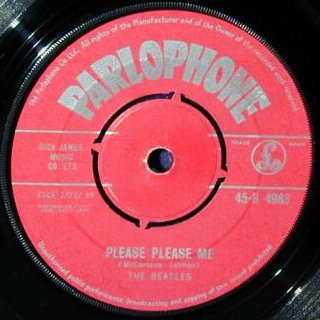
Single: “Please Please Me”/”Ask Me Why”
Released: 11 January 1963

So–how to follow up with your big (or in this case, somewhat modest) debut single? For George Martin, he was still adamant to have the band release “How Do You Do It”, but the Beatles stood on their principle of releasing their own songs as singles. There was a good couple of months’ worth of time between their previous session and this next one, however, and they didn’t rest on their laurels. They had an extremely busy tour schedule, not only in Liverpool but elsewhere in the country, as well as a two-week stint in Hamburg at the Star Club with Little Richard. The Beatles were no longer a bar band…they were a professional band now, playing venues and going on radio shows and keeping their name out there–thanks to manager Brian Epstein who had become their official manager just that January. They might have had only one single (technically two) out there, but they weren’t about to let these moments pass them by. They finally reconvened at Abbey Road on 26 November to record two more songs for a follow-up single.

Interestingly enough, this next single catapulted them to the number one spot on a lot of British charts, including NME’s, but–it’s not considered a true number one, because Record Retailer at that time was considered the “official” UK chart (sort of like Billboard for the US in a way), and it only hit #2 there. This would also explain why the song is not on the 1 compilation.

Side A: Please Please Me

A much more uptempo song for them, and a good thing. Sources state that the original version written by Lennon was a slow ballad not unlike Roy Orbison’s “Only the Lonely” (which he has stated was an inspiration), but after Martin’s suggestions, the pace was quickened and the mood made livelier. It’s a fun song, really–it showcases a lot of their best moves at the time. Starting off with another of John’s harmonica lines, this one is less countrified than on “Love Me Do”, and is used more as background. John and Paul deliver the main verses as a duet not unlike the Everly Brothers, John singing the main melody and Paul harmonizing up top. Then there’s a little something unexpected–a guitar and drum fill played to ‘rev’ up to the next line. Even better is that quick stop and reverse-melody guitar fill taking us into the climbing chorus. And that’s just in the first thirty seconds! And there we are, about halfway through the song: the middle eight. The Beatles were masters at the middle eight, that bridge where the melody is counterpoint to the rest of the song, where the plot of the song hangs in the balance before coming back to the familiar verse and chorus again. There’s also the different repetitions within the song–the singsong harmonica line, the wordplay of the title itself, and the the triple repeat of the final line of the chorus at the end of the song. And to top it all off–none of this is overtly noticeable. It retains its simple catchiness.

All this was of course old hat to them by then, as they’d written countless songs over the last few years, inspired by the countless bands they’d toured with and seen Hamburg and elsewhere, as well as all the American records they’d gotten their hands on. But to British ears, this was new and fresh–something so much different than the crooners and the poster boys. There were a lot of new bands out there doing this at the time (the Rolling Stones, for one), but the Beatles were one of the first to break through to major success, and this song was the first one to do it in the UK.

Side B: Ask Me Why
This one’s obviously a filler, a typical “I love you” song (they even use the phrase as the first line) inspired by the soul of Smokey Robinson and the Miracles. A relatively newer track written earlier in the year and played primarily on stage, they used this as part of their June EMI audition and used up the remaining recording time to bash out a few takes of this song. They gave it a jazzy spin, hitting all kinds of minor chords and sevenths. John and George pretty much play the same thing, yet with different styles: John plays straightforward for the backbone, while George embellishes his strumming in a cabaret sort of style. The vocals are impeccable here, John taking up the lead and Paul and George providing backup. There is a bit more experimentation in the stop-start melody trick here, something they’d use a few more times in these early releases, but again, nothing that really stands out. It’s not their most exciting song to date, but as with their work ethic at the time, they put enough dedication into it to be released as a flipside.

Next up: Please Please Me, the debut album

Blogging the Beatles 2: ‘Love Me Do’/’P.S. I Love You’

Credit: jpgr.co.uk – The Beatles Complete UK Discography site

Single: “Love Me Do”/”P.S. I Love You”
Released: 5 October 1962

Hard to believe this song is fifty years old as of last Friday. The official debut of the Beatles–official meaning this was their first release on a major label (Parlophone) and the start of a long and interesting relationship with EMI. Recorded a month previous (September 4th, fifteen takes), this song has some interesting background: the most obvious reason for recording was for the boys to get their first single out after being signed. They’d had a tryout at Abbey Road Studios with producer George Martin a few months previous (6 June), but this September session was the real thing. This was also the first recording session with their new drummer, Ringo Starr, after booting Pete Best in mid-August. And lastly, this was also the session where Martin insisted that they record a cover. Well…the Beatles had learned their chops doing covers, but they’d written numerous songs themselves by then, and weren’t about to budge.

Cover songs were actually more profitable, and more successful, back in the fifties and early sixties, it was a surefire way to get a hit, especially if you’re a band that isn’t too well known outside your hometown. And the track, “How Do You Do It”, isn’t that bad of a song, to be honest. But you can definitely tell that the boys really weren’t that into it…John’s vocal delivery is strong but uninspired, and the rest of the band don’t seem to want to put much energy into it. The track was quickly shelved, lesson learned. They focused the rest of their time and energy on the other two songs slated for that day.

Side A: Love Me Do
This track is definitely indicative of the songs John and Paul wrote from around the Quarrymen days of the late 50s to their Hamburg days (this one apparently dates back to about 1958 or 1959). It’s a playful riff on the “moon in June” rhyme scheme they knew so well–so much, they had it down to an artform. There’s nothing more obvious than the “I love you/always be true” couplet. It could be a song you’d hear anywhere on the radio at the time. But less noted is how regional the song is. It’s almost a country song, a working-class sound in a way, with its steady but unassuming beat and John’s harmonica–it’s a riff you’d hear someone play while walking the docks in Liverpool. Their hometown was considered the boonies back in the day, well north of metropolitan London, and this “Mersey Sound” (as the locals termed it) gave them a unique edge. Also different from most songs at the time is the shared vocal–after all, this wasn’t John and the Beatles or Paul and the Beatles, but The Beatles…a group, not a lead singer and his backing band. Only when the “someone to love” middle eight comes in does it waver between Paul alone and Paul and John together, as well as Paul’s solo “love me do…” when John jumps in on the harmonica again.

This first single version is nowhere near as polished as it really should have been, really. Musically, it’s as tight as they could get at the time, but considering this was their first real session for an actual release, nerves are definitely to blame for its shakiness. Martin was apparently not too impressed with Ringo’s drumming on the track and hired session musician Andy White to fill in, demoting Ringo down to tambourine. There’s also the fact that Paul’s voice is clearly not as strong in the first version–he warbles during the middle eight and his “love me do…” sounds far from perfect. The second version is much tighter both in the music and vocals, and Paul gives a much braver delivery. After the first edition of the single, this second version took its place and also made its way onto the debut album.

Side B: P.S. I Love You

Honestly, you’d think this was a track from The Music Man or one of those musicals of the time that they were so fond of covering (such as “A Taste of Honey”, which they would soon record for their first album), given the complex melody of this song, but no…it’s one of Paul’s, and one he wrote during one of their stints in Hamburg. It’s an interestingly simple melody that utilizes some pretty complex chord changes. It’s also an epistolary song, another easy and winning songwriting trick at the time. Sort of inspired by the “letter” songs about a woman waiting at home, hoping her man would return, Paul writes this as himself being the man on the road, promising he’ll be home when he can. But it’s the amazing melody he wrote that elevates it from a simple love song to a gorgeous one. There’s no slow intro here…it starts off with the letter, pen already in hand, already writing. It’s a fast love song, played uptempo with a cha-cha beat, which makes the track feel romantic and hopeful, rather than wistful. Lastly, Paul does something unconventional by singing both the call and response parts of the last round of the main verse: “As I write this letter (Oh!)/Send my love to you (You know I want you to)/Remember that I’ll always (Yeah!)/Be in love with you…” There’s so much going on in this little song that in retrospect, it’s amazing that this was the b-side to their first single. It’s a lovely track and one of my favorites of their early recordings.

All in all, it’s not a bad debut. It’s not a phenomenal single at any stretch, and perhaps it’s a bit reminiscent of every other poppy love song out there at the time, but it was unique enough for people to take notice. It only hit #17 on the British charts, but for the boys, just getting on the charts at all was enough to excite them and aim even higher.

[More on these songs when I review the Please Please Me album.]

Next up: “Please Please Me”/”Ask Me Why” single

Blogging the Beatles 1: ‘My Bonnie’/’The Saints’

NOTE: Welcome to the first of many ‘Blogging the Beatles’ posts! I’ve been wanting to do this for some time now, considering I’ve been a fan of the band since I was a child. My aim is to go through all of the Beatles’ official music releases in the UK catalog, in chronological order. My approach to this series is going to be twofold: first, I’ll give some detail to the release, including any recording notes as well as what was going on in the world at the time, just to give the release some cultural background. Secondly I’ll give my own take on the release, any opinions and/or thoughts about it. Hope you enjoy this series!

*    *    *    *


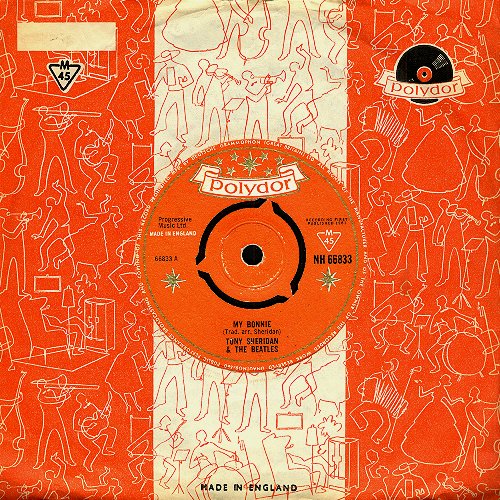
Single: “My Bonnie”/”The Saints”
Released: October 1961 (Germany), 5 January 1962 (UK)

Some background is in order:

The era was the summer of 1961, and popular music was evolving at an amazing rate. Only a few years before, Elvis was singing countrified blues and Bill Haley and His Comets were playing dancy swing. The popular music of the day spanned all kinds of disparate genres by the start of the sixties, from the soul of Motown, the jazz of Brubeck, the country of Patsy Cline, and the rebellious new “rock and roll” of The Shadows and more. And with the sudden influx of youngsters grooving to these new beats, the music labels knew a cash cow when they saw one.

At this time, it was still de rigeur to have a lead singer (preferably a pin-up of some sort) backed by a band, whether it was a solo singer backed by the ubiquitous Wrecking Crew, or Cliff Richard and his Shadows. It was a holdover from the jazz orchestra days when you had So-and-So and His Band filling the dance floors. This was especially exciting in post-WWII Europe, when everyone was just about sick of hiding in their houses and wanted to get out and have fun. The historic transport hub of Hamburg, Germany became a hotspot of youth activity, especially with art and music. After a few years of playing around Liverpool, The Beatles made their way to Hamburg for two stints at various music clubs in the red light district, with two aims: learn their chops, and get famous. You could most likely call this the Beatles’ “bar band” era, since in essence, that was what they were. They didn’t get famous, but they had a regional following and they stuck with their killer schedule, playing multiple shows a night.

During the first stint, they had met a solo singer/guitarist named Tony Sheridan, a fellow Liverpudlian who played nightly at various clubs and had set a name for himself in Germany as a mid-level rock crooner. They hung out, jammed, and occasionally even played on stage together, and in the summer of 1961 Sheridan had asked the band if they wanted to be his back-up band for some of his songs. Now, considering the band’s wishes for fame, how could they resist? They recorded a small handful of songs under the name “The Beat Brothers” which were soon released in October of that year. [Rumor states that the name change was warranted because “Beatles” in a German accent sounded like “peetles” which was apparently slang for a man’s naughty bits…but I’m more inclined to think that the label (Polydor) wanted a more generic yet still catchy name for the band to make Tony’s name stand out, which was a common label move.] The above two songs were selected as a lead single.

It sold reasonably well in Germany, and the oft-told story goes that someone brought a copy of this single into a small London record/hi-fi equipment shop hidden on the upper floor of a furniture store, handed it to its manager Brian Epstein, and the rest is history. It’s not often considered part of the official Beatles canon, but it is definitely their first released recording. It’s by no means an exciting debut, but it was enough to get them noticed by the locals and give them a step towards a professional level.

Side A: My Bonnie
The song itself is a typical rock interpretation of an old standard, of course. This was a common trick in the 50s and 60s, to “update” the sound of a well-known song so the kids would love it and even the older generation would enjoy it. Tony and the band start the track off in typical showbiz fashion as a slow ballad with harmonized vocals and some well-played guitar…then BAM! A repeated G7 chord swings it into high gear, and we’re off on a wild surf ride. Paul McCartney’s voice is obvious about a minute in, singing the high end, while John Lennon hits rather comedic vocal bass notes. The guitar work is tight but not mechanic, as you can hear both Tony and George Harrison hitting some Berryesque riffs every now and again. Pete Best, here being one of the very few songs he’d record with the band, keeps the beat strong but never gets overbearing. It’s a dirty, unkempt version of the song, and Tony warbles quite a few of the notes as if he couldn’t quite hit them, but that’s part of its charm–this is the Beatles as Bar Band, cutting loose and having a bit of fun in the studio.

Side B: The Saints
Another old standard–this one an old Christian hymn from Belgium–given the rock and roll treatment. Fats Domino did it first and Bill Haley had introduced their own swing versions, but Tony and the band give it their own interpretation as a rocker. It starts off as a quiet shuffle and slowly builds until you’re not sure if it’s a lively gospel song or if it wants to do the Twist. Again, this is very typical of the time–get a song everyone knows and remodel it in a way that will get the crowd out on the dance floor. This track isn’t quite as thrilling as ‘My Bonnie’ is, and a few of the other tracks the band worked on with Tony are much stronger, but it’s a good b-side nonetheless.

Personally, I could go either way with their Sheridan-era recordings, as they’re good for historical purposes, but nothing that would hint at greatness. They were still wet behind the ears here, learning what being a professional musician was about: hard work, long days and nights, bouts of loneliness and insanity, all at a level most would have not dreamed of nor wanted. But they were stubborn enough to want it, and persevered.

NEXT: the official debut single, ‘Love Me Do’/’PS I Love You’

Once upon a time…or maybe twice…

I always say my music collecting officially started at Christmas of 1978, when my mom bought me The Beatles’ 1967-1970 album…but how did I come to chose that album, of all things?  I mean, barring the fact that the collection really started a few months earlier with the Sgt Pepper’s Lonely Hearts Club Band soundtrack, there has to be a reason I’d become obsessed with the Beatles at the tender age of seven.  Well, there’s two reasons:  the aforementioned 1978 movie that we went to see that summer, and another movie that had been playing on one of the local independent television stations:Yellow Submarine.

I don’t remember exactly when I first saw this animated feature, but I know it was on WLVI, Channel 56 out of Boston.  They played it at least once every summer, their own worn copy with all the pops and skips and edits, sometimes as a double-bill with Help! afterwards.  I fell in love with the movie instantly and looked forward to watching it every time it came on.  They played it in December of 1980 when John Lennon was murdered, and that was the year I grabbed a few blank cassettes and taped the entire movie onto tape.  (I remember it was this year because I taped a Lennon tribute show hosted by Casey Kasem that they played afterwards.)  I listened to that recording through 1981, and by the time WLVI played it again, I knew the movie by heart.  To this day, I can still quote nearly most of the movie, given a prompt.

This movie, the Sgt Pepper soundtrack, and the Beatles in particular, were major influences on how I listen to music.  I’d been a radio listener probably since I first noticed specific songs playing on the car radio during our family vacations–the fact that I had all older siblings who latched onto music before I did probably helped me do the same–but the Beatles were probably the first band where something clicked, and I stopped being a passive listener and became an active one.  And by active, I mean that I’d actually paid attention to the songs, learned their lyrics, and explored their sounds.  The original songs fascinated me, especially when I’d come to know many of them through the Sgt Pepper versions.

A few months ago, Yellow Submarine recieved a second remastering and release onto dvd.  Both times (1999 and this year), the release was prefaced by a short tour of select movie houses, and I of course had to go.  The first time they played it at the Brattle Theater in Cambridge MA, and that was the first time I’d ever seen the movie on the big screen, after having watched it on tv for years.  Back then, it had been remastered to Dolby Digital 5.1 and the movie sounds and visuals cleaned up considerably…plus, it was the first appearance of the “Hey Bulldog” sequence that had been edited out of the US version and later UK versions.  A new soundtrack was released, Yellow Submarine Songtrack, which to this day remains the only songs by the Beatles that are remixed to 24 tracks.  [Nearly the entire Beatles oeuvre was recorded on a 4-track mixer, barring Abbey Road and a few singles.  Think of that bit of info next time you listen to the brilliance of “A Day in the Life”.]  A second remastering took place recently and this latest version just came out a few weeks ago on both dvd and Blu-Ray.  I could not pass up going to see it at our local theater around the corner, and I was not let down.  The colors and sounds were vibrant and exciting, and the mix was clear enough that I could actually catch pretty much every line of dialogue effortlessly.

The interesting thing about watching Yellow Submarine every few years or so is that I still pick up on new things, or at least see things in a somewhat different light.  I remember watching it in high school and being surprised when it finally clicked in my head that war-torn Pepperland held a gritty parallel to WWII-era Europe.  Or finally catching the ridiculous number of puns (“Can’t help it, I’m a born Leever-puller”), Beatle song references (In the Sea of Holes… J:”Hey, this reminds me of Blackburn, Lancashire.” P: “Oh, boy…”) or sly music references (“Four score and thirty-two bars ago, our forefathers…”) hidden in the dialogue.  Or the fact that, this current time, how Chief Blue Meanie really needs to go on meds and maybe even take an extended stay in a psych ward, given his completely-off-the-rails psychosis.  Even the little bits of animation are brilliant, such as the pan-down of the Liverpool skyline right before “Eleanor Rigby” starts, or the initial panning across the Sea of Holes in incredible detail, or the clever use of rotoscoping in many scenes.  It’s not a perfect piece of animation, as you can definitely see slight mistakes throughout, but it’s sure as hell a creative one.

Yellow Submarine is definitely one of my Top Five movies, and one I’ll never get sick of.  Watching it as a kid defined who I was and how I listened to music, and despite its psychedelic roots, it still holds up as a quirky but extremely fun movie that everyone should see at least once.