Blogging the Beatles 40/41: Magical Mystery Tour EP and the Christmastime (Is Here Again) fan club single

The next project of recording–this of the music for the planned Magical Mystery Tour television film–started before Sgt Pepper had even been released. In fact, it started mere days after the last notes of “Sgt Pepper’s Lonely Hearts Club Band (Reprise)” were put to tape, after Paul had returned from a visit to the United States. The movie itself would remain in the planning stages for a good while, as filming would not start until mid-September 1967. The recording of the music for it would be scattershot, the theme song recorded in April alongside the future Yellow Submarine music, the rest being picked up in August and September. Late 1967 would be an extremely trying time for them financially and emotionally, so it may seem that the Magical Mystery Tour project might have been seen in two ways: one, as a financial outlet for their recently-created business partnership Apple Corps, and two, as an emotional outlet (or perhaps an emotional escape) for the devastating loss of Brian Epstein. It seemed that they had finally escaped the insanity of early 60s Beatlemania, only to exchange it for the insanity of running a business with little to no prior experience, and without their longstanding manager. They had great ideas…but they had little to no idea how to expand on them or if they would even work.

As mentioned before, the Beatles were creatively drifting at this point as well–as George Martin would say, they were in their “try anything” phase which was producing mixed results. Musically they were still creative, but it was taking longer for them to achieve their goals–if they in fact had any at that point.

The film itself is a testament to this. The plot was partly inspired by Ken Kesey’s Merry Pranksters and their traveling bus Further, as well as the charabanc trips of the Beatles’ youth (these were chartered, low-cost day trips via coach, usually to a seaside resort or another tourist attraction). There was no plan and very little script, other than Paul’s pie-chart outline and a few planned performances. It was mainly filmed via an extremely small crew, including the band themselves (I am assuming they used 16mm or 35mm stock, given the quality and the timeframe), and the idea was, like their recorded output at the time, “be at the bus station on Monday and we’ll see what happens.” The finished product is a trippy, disjointed and amateurish film resembling a home movie. It’s quite colorful and has its moments, but as a whole it was understandably panned by critics and fans alike. There are a few creative passages, such as the fabulous weirdness of the “I Am the Walrus” segment, the hilarious (yet sadly too short) cameo of Victor Spinetti as an incomprehensible army drill sergeant, and The Bonzo Dog Doo-Dah Band’s burlesque performance of “Death Cab for Cutie” (yes, that is where the band got its name!)…but much of it is filler. Many fans who saw this on its Boxing Day airing saw it in black and white, and their reaction was quite negative.

The band agreed that the release was subpar and despite further airings in color, it was deemed a misfire. Perhaps it was time to rethink their future plans–or in this case, make some future plans instead of “seeing what unfolds”. They would use their upcoming India retreat as a way to make some concrete goals, write completely new songs, and become a full-fledged band again.

*      *      *

Credit: discogs.com

Credit: discogs.com

EP: Magical Mystery Tour
Released: 8 December 1967

Given that they did not have a full album’s worth of new songs to provide, nor did they want to release an album half-filled with music they’d released earlier in the year, it was decided to release the soundtrack to their television film as a double EP. The format itself wasn’t nearly as popular as it once had been, and was not popular at all in the US, but it was deemed the only acceptable way to release it. As mentioned in the previous entry, this was released only in EP format in the UK, and the American full-album version (the six MMT tracks on one side and in a different order), the previous three 1967 singles on the other) would not be released in the UK until 1976, at which point it finally became official UK canon and later officially part of their discography.

The original EP–and early vinyl copies of the American version–included a wonderfully packaged 28-page insert that included stills from the film as well as a comic book version of the film itself. The comic book is set up in a children’s story book fashion, one page split into six images with a few simple sentences describing the scene (and obviously omitting a lot of the slower scenes in the film). This insert vanished for a good number of years, but finally resurfaced, much to many fans’ delight, with the 2009 remastered cds.

Side A, Track 1: Magical Mystery Tour
A fanfare opens up the EP (and the film) with the roaring sound of a coach bus and Paul, as barker, calling out to everyone to come and enjoy the trip he’s about to take them on. The first track recorded for the project on 25 April, just a few days after Paul’s return from his US trip, it’s a lighthearted rock song that does its job as an entrance theme. Interestingly the vocals were recorded at a lower speed and played back faster, giving Paul’s lead and John and George’s backup a much different, and much more jovial tone. Of note here, though, is a curious and unexpectedly jazzy fade out…they were known for extending the ends of their songs in the studio around this time (a number of White Album-era songs would get treated this way), even if they were eventually edited out, but this was most likely the first time it would stay in the final mix. It serves as a musical segue from the opening shots to the movie proper.

Side A, Track 2: Your Mother Should Know
The next song recorded for this project popped up on 22 August–a good number of months after most of the Yellow Submarine tracks had been finished and the Our World project had been finished. Curiously this track was started not at Abbey Road but at Chappell Recording Studios, another independent studio in London (like their previous recording at Olympic, Abbey Road had been booked solid at this time). This is another of Paul’s compositions and very similar to his “old-timey” songs he was occasionally fond of writing (and which John would later snipe about, post-breakup). It was also the last song that Epstein would hear them recording, as he would pass away days later.

It’s another simple song, somewhat vaudevillian in its way, and one can hear it in the production. The main chord progression is circular and shuffles along as if played on banjo–in fact, one can hear George’s guitar faintly on the right speaker sounding remarkably like one, specifically near the title refrain. It was used in a Busby-Berkley-style musical scene at the ending of the film, as a celebratory end to their magical trip.

Side B: I Am the Walrus
Previously seen as the b-side to the “Hello Goodbye” single (see the previous entry), it was accepted here on the EP due to its segment in the film. This song was the first track they recorded (on 5 September) after Epstein’s death, after a heady meeting on 1 September at Paul’s house in St John’s Wood (mere blocks from Abbey Road on Cavendish Avenue). Despite their loss and their lack of direction, they’d decided to soldier on with the Magical Mystery Tour project as well as with their upcoming India retreat. They did not want to keep things unfinished, nor did they want to continue without any plan in mind.

Side C, Track 1: The Fool on the Hill
A third Paul song, started properly on 25 September after a brief outtake on the 6th. It’s a ballad similar to “Here There and Everywhere” or “For No One”, based mostly on a piano melody. It could easily be Paul’s answer to John’s “Nowhere Man”–a song about a man blissfully unaware (perhaps on purpose) of the world around him. This song, however, takes on a slightly darker edge, revealing that this “Fool” may actually be a lot smarter than he’s letting on–some have stated that it was based on the Maharishi Mahesh Yogi. While Paul paints the man as inattentive and oblivious in the light verses sung in a major key, the chorus describes him as seeing the bigger and darker picture, sung in minor. Adding to the childlike quality of the song is a solo played on recorder by Paul. The song shows up in an interesting passage of the movie, a dreamlike segment with Paul walking around Nice, France, which was shot in late October.

Side C, Track 2: Flying
This track is a standard twelve-bar blues riff instrumental–their first instrumental since attempting one with “12-Bar Original” a few years previous, and the first Beatles track credited to all four members. It’s purposely laid back and dreamlike, with John playing the main melody on mellotron, and Paul and George playing the guitars. Originally entitled “Aerial Tour Instrumental”, it was used in what was to be another dreamlike sequence, hinting that the tour bus was flying through these magical clouds as it headed towards its destination. It’s a relatively short blues jam at just over two minutes, but dynamically it’s kind of fun, starting quietly but building up to a vocalized crescendo. It ends with the burbling sounds of mellotron tape loops created by John and Ringo…which, in one of its unedited forms, went on for a further seven minutes. This extended ending was used as incidental music throughout the movie.

The segment of the movie that features this two-minute version was created using unused aerial footage from Stanly Kubrick’s 1964 film Dr Strangelove and lab-tinted various colors. It unfortunately didn’t translate well into black and white during its initial airing on BBC1 and added to the negative reaction to the film, but in its colorized form (which works much better on the remastered 2012 DVD release than it did on the subpar 80s VHS version), it’s fun to watch.

Side D: Blue Jay Way
George supplied the final track on the EP written at and about a street in the Hollywood Hills where he’d rented a home in 1967, where he’d had to wait for their press officer Derek Taylor to arrive one evening. The opening line “There’s a fog upon LA” refers specifically to the fact that up in the Hills it would get quite foggy and reaching the street (via quite a circuitous route) one could get easily lost. To add to the fog and the trippiness, pretty much every instrument here is treated with some kind of flanging effect, from George’s voice to Ringo’s drums (curiously pushed forward in the mix here) and the swirling organ. It too had its own segment, in the form of a movie-within-a-movie, with the bus riders entering a tent to watch the performance which was alternately shot on a foggy street and in one of the Beatles’ back yards.

*    *    *

The EP (and the US album) concluded what would be probably one of the most peculiar eras in the Beatles catalog. The freedom they longed for came to fruition in late 1966, giving them more creative freedom and time to build more complex recordings. Out of this came two phenomenal releases: the “Strawberry Fields Forever”/”Penny Lane” single and Sgt Pepper’s Lonely Hearts Club Band, both considered their finest achievements. Their success however left them unsure where to go from there–they were under a new contract, running a new production company that would make more sense financially (read: would raise them more money while simultaneously avoiding the punishing British tax code for performers), and could do anything they wanted but had no plan. There have been a number of books written about their financial issues from this time forward (Peter Doggett’s You Never Give Me Your Money is a particularly damning account for everyone involved), as well as their personal and emotional (and health) states at this time, so it’s easy to see that the latter half of 1967 could be viewed as a starting point where it started going downhill.

That said, listening to the EP/album in this day and age, and on its own without the history behind it, it’s a wonderful collection of the band at their most eclectic: they were firmly in “rock” territory by this time, having moved far enough away from their pop origins and their brief foray into folk rock. Many of the songs were brimming with creativity, not to mention a deep knowledge of the songwriting craft, giving their tracks many more layers than one would notice upon first listen. It’s also the band at their most psychedelic–which is understandable, given the era in which the songs were recorded.

*      *      *

Credit: jpgr.co.uk – The Beatles Complete UK Discography site

Credit: jpgr.co.uk – The Beatles Complete UK Discography site

Single: Christmas Time (Is Here Again)
Released to the Beatles’ Official Fan Club: 15 December 1967

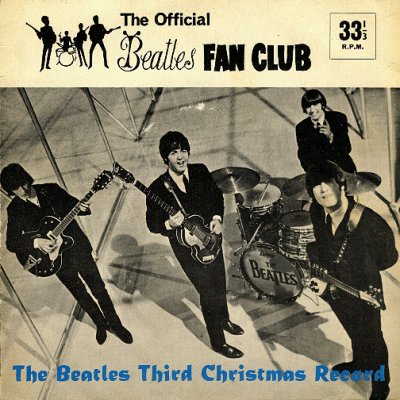
The Beatles saw 1967 out with one last recording, this time with another fan club message. As with 1966’s self-penned silliness, the Beatles wrote the script (such as it was) for this one as well, this time in the form of what sounds like a Christmas eve BBC broadcast. It starts off with a rocking theme song which is then interspersed throughout the recording, which contains a skewered take on radio entertainment at the time: a game show, a repeating commercial for Wonderlust, an interview with a stodgy politician, and more. Even George Martin gets in on the fun this time, stating “They’d like to thank you for a wonderful year” (echoed by George H, and then the four boys, in deadpan) before the track ends with a reprise of the theme, overdubbed by laughing and hooting. As an epilogue, they’ve also edited a fade-out from 1966’s recording, with John reading a season’s greeting in a fake Scottish accent. While it’s not nearly as slapstick as 1966’s recording, it’s equally as silly in terms of British humor.

*      *      *

Given all the events that unfolded in 1967–the new sounds, the personal events, the participation in Our World and other projects–the year was quite a rollercoaster, and in retrospect it could have been part of the impetus for their frustrations, failings and eventual breakups down the road. Many books have stated that the band was well aware that they were skirting into unknown territory, and freely admitted that they were not the best businessmen when it came down to it. The times were changing again, and so was the band. They had been a part of the blissful and blissed-out Summer of Love, created a soundtrack to it even, but near the end of the year, it was time to come back down to reality. Still, they chose to remain as positive as they could for the time being, entering 1968 with a few abbreviated recording sessions in January and February for potential singles and another Yellow Submarine track, before heading out to India in April. By the time they returned back to London in May, they had a new slew of songs they had written during their time off, and had even more to record as that new project grew. Those sessions would become quite fruitful, but quite contentious as well.  The result would offer some absolutely stunning and memorable songs, as well as the most argued-about Beatles album in their catalog.

Next Up: the “Lady Madonna”/”The Inner Light” and “Hey Jude”/”Revolution” singles

Blogging the Beatles 38/39: “All You Need Is Love”/”Baby, You’re a Rich Man” and “Hello Goodbye”/”I Am the Walrus” singles

It’s a testament to how seriously the Beatles took their craft when one realizes that even after retreating from the public eye, their cumulative studio time did not really diminish all that much. Back in this golden era of rock music, musicians would not have even entertained the thought of taking months or even years off between albums. Part of it was the perceived need that one’s band had to be constantly in the spotlight, or at least brought back into it after a short time–one can wonder if this might have been a response to Elvis Presley’s nearly two year absence from the public eye back in the late fifties due to his Army stint. When Elvis returned, his music style remained pretty much the same, but the style of popular rock music had already changed, leaving him far behind. In order to remain relevant, one had to constantly stay on top of things, and no popular band wanted to run the risk of irrelevance.

The Beatles’ next projects–there were in fact three recorded in tandem at this time–kicked off even before Sgt Pepper’s was released on 1 June 1967. All were to be multimedia events. One was the band’s next motion picture project, an animated feature named after and partly inspired by their 1966 single “Yellow Submarine”. It was a major undertaking, using over two hundred artists and using multiple styles of animation from limited animation to multilayering to rotoscoping. The band themselves were not interested in appearing or acting in this particular film, but had agreed to record music specifically for it (and later, once they watched a rough cut and loved what they saw, agreed to a short real-life cameo at the end). The small handful of songs for the movie would be recorded at this time. The movie would be released in the UK in summer 1968 (and a few months later in the US), but the soundtrack itself would not be released well until 1969.

The second was another mini-project thought up by Paul on his way back from his trip to the US in late April (if you remember from the last entry, the “Sgt Pepper Reprise” track was the last to be recorded for the previous album just before he took off for this trip). On the flight home he had come up with a short movie somewhat inspired by Ken Kesey’s Merry Pranksters bus that was currently touring around the US at the time…a decidedly British take on the mystery trip, in which the band and their friends take a chartered bus to an unannounced destination [more on this for the next installment]. Most of the filming for this project didn’t take place well until September, but the music was started at this time.

The third much simpler project was participation in a special television appearance unlike any they’d had before. Our World was to be an international event created by the BBC: multiple countries from around the globe were to take part in what is probably one of the first truly global (physically and politically) television broadcasts. It was to be a two-hour focus on life around the world, looking at culture, sport, health, art, and even the future. The Beatles had been invited to be a part of the “Artistic Excellence” segment, and were asked to write a song specifically for it. Both Paul and John had come up with a song, and though it was never revealed what Paul’s song may have been (Beatles biographer Mark Lewisohn posits that it might have been “Your Mother Should Know”), it was John’s offering of “All You Need Is Love” that was used. The band performed the song semi-live (playing against a pre-recorded take) in the early evening of 25 June 1967. The single would be released just shy of two weeks later.

*       *       *

Credit: jpgr.co.uk – The Beatles Complete UK Discography site

Credit: jpgr.co.uk – The Beatles Complete UK Discography site

Single: “All You Need Is Love”/”Baby You’re a Rich Man”
Released: 7 July 1967

It’s up to question by the various band members and George Martin as to whether this single had been written for the Our World special, or if it had just been a few songs of John’s he was working on at the time, but it remains a classic single for many reasons. First of all, it could probably considered one of the quickest turnarounds from studio to single yet for the band, even considering the fast release of some of their early singles. But more importantly, it definitely captured the counterculture vibe of the Summer of Love–while all the world was in turmoil, it was a distinct reminder that peace and love were still strong in the minds of sixties’ youth.

Sadly, it would also be the last release seen by their manager Brian Epstein before his untimely death on 27 August. His passing would deeply affect the band in more ways than anyone would have expected. In that respect, it was quite the bittersweet single…Epstein would only witness the band at the peak of their career.

Side A: All You Need Is Love
In another testament to the band’s expertise in songwriting, though the band was well aware that they had been assigned to write a song to deadline, they had put it off until the last possible moment. This particular track was brought in and started on 14 June, a mere eleven days before the live broadcast. The basic tracks were actually started at Olympic Sound Studios in the Barnes neighborhood of London, though overdubs and further vocals were recorded at Abbey Road. Olympic Sound had become one of the top independent recording studios in London, churning out a number of hit songs (including those by the Rolling Stones) and soundtracks.

John would later say this song could easily have been a rewrite of his earlier 1965 song “The Word” (off Rubber Soul, though with much better lyrics and specifically tailored to the current counterculture atmosphere). It’s also a unique track in that, like a small number of Beatle tracks from the 1966-67 period, it contains a number of changing time signatures. The main verses are played in 7/4 time, switching to 8/4 for one bar and returning for one more bar of 7/4, before hitting a 4/4 chorus. Quite evident as well are many borrowed musical themes: the first thing you hear on the track is a symphonic phrase of the French national anthem, “La Marseillaise”; the callback “ra-tatah-tatah” in the chorus is from Wayne Shanklin’s “Chanson D’Amour”, a French pop hit from 1958; and in the fade out, the symphony plays phrases of “Greensleeves”, one of Bach’s Brandenburg concertos (played by David Mason–who had earlier played the piccolo trumpet on “Penny Lane”!) and Glenn Miller’s “In the Mood”; even the Beatles themselves ham it up with John singing “Yesterday” and “She Loves You” just as the song fades out. It’s a clever multilayering of both musical chronology and genre to fit the show’s theme, all scored by George Martin.

Lyrically it’s one of John’s greatest achievements thus far–he delivers quite long and unique lines of verse, counterpointing it with a very short and repetitive chorus. The theme itself could have been filled with weak imagery and hippie platitudes (such as he had done with “The Word”), instead pushing himself to make a valid point. He’s not just saying “Love conquers all”, he’s saying there’s nothing so bad in this world that it can’t be fixed or at least remedied with a bit of understanding and compassion. It goes to show that when he truly put his heart into it, his lyrics could have a deep impact on its listeners.

[Note: The video link is to a copy of the actual Our World broadcast, complete with all their friends in studio (including Mick Jagger and Keith Richards, Keith Moon, Eric Clapton, and many others). The released single version was superimposed on the video for clearer sound.]

Side B: Baby, You’re a Rich Man
Despite it being relegated to a b-side, this song was actually the first of the small handful of new tracks to be recorded specifically for the Yellow Submarine film project. It’s also the first Beatles song completely recorded and mixed, start to finish, outside of Abbey Road, instead done at Olympic Sound Studios. Recording took place on 11 May for this joint John-and-Paul track; John had provided the main lyrics (under the working titled “One of the Beautiful People”) and Paul provided the main chorus. It’s very similar to “Lovely Rita” in sound, with nearly every sound on the recording given some special effect, either generated or manmade. Paul creates a faux-backwards loop sound with his bass right at the beginning by plucking a dampened bass string; both pianos are heavily treated with trebly double-tracking (and in the mono mix, given a “spin-echo” effect at the end of each verse to further give it a fake-backwards sound); to top it off, a Clavioline (an early precursor to a synthesizer) was used on its oboe setting to create a trippy Indian raga-style feel.

Lyrically no one is really sure who it’s about, though there have been theories by various critics and biographers that this song was about Brian Epstein. Epstein had been from a well-off family and was often seen in upper-class circles, and in typical John fashion, this could have been a response to that, asking him “how does it feel to be one of them?” It’s also been said (in Bob Spitz’s band bio, for example) that Epstein was well aware of his stature and understood John’s good-natured jibe, even if he himself was not all that comfortable in those circles.

As the song was released as a b-side here, it was not assigned a spot on the Yellow Submarine album soundtrack, though it does appear in the movie. A segment of the track is used when Ringo “saves” the Sgt Pepper band from the glass bowl that has entrapped them via the “hole in his pocket”.

*    *    *

The single itself was an instant hit, especially given its release and its theme, and stayed on the Billboard charts for eleven weeks. “All You Need Is Love” could probably be the most prevalent song in the band’s catalogue pre- and post-breakup; it was not only featured as its own single, it was featured in a major climactic scene in Yellow Submarine as well as on its soundtrack album, was available on the US version of Magical Mystery Tour, and shows up on no less than three pre-Anthology compilations. Its most curious appearance, however, was in the classic sixties science fiction show The Prisoner (of which the band were fans): in its final episode, it is heard while Numbers 2, 6, and 48 begin their final escape.

After its release, the band spent their summer building up more tracks for the Yellow Submarine film project (we will cover those for the soundtrack album), and recording songs for the Magical Mystery Tour EP and filming footage for that project. It was also about this time that George and his wife Patti met Maharishi Mahesh Yogi and sat in on one of his Transcendental Meditation lectures at Caxton Hall in London; he soon talked the rest of the band into sitting in on a further lecture. The Maharishi’s words and ideas had taken effect on the band to one level or another, and they would later agree that perhaps an extended vacation to India to meditate and reconnect with themselves might help their future endeavors. According to Bob Spitz’s biography, it was during this particular second lecture that the band had received word that Brian Epstein had died. His passing, as well as the time it took to finish up their current productions, had caused the band to delay their trip to India until early 1968.

*        *        *

Credit: discogs.com

Credit: discogs.com

Single: “Hello Goodbye”/”I Am the Walrus”
Released: 24 November 1967

As was usual for the band, their latest single track was written and recorded in tandem with the current projects, but was considered separate and would not show up on either release. [Keep in mind: Magical Mystery Tour was originally released only as a six-track double EP in the UK and was not released as a full UK album until 1976…the current full-album version that is now considered canon is actually the 1967 US release with the EP expanded to contain the previous three singles. Thus, “Hello Goodbye” was at first a non-album single.] Backed with a track of John’s that would appear on the Magical Mystery Tour EP, it’s a single that might not be the strongest song they had at the time, but it was certainly a fitting coda for the Summer of Love.

Side A: Hello Goodbye
This is very much a Paul song, one that is light and entertaining on purpose, with very little depth to it lyrically. It’s said that Brian’s assistant Alistair Taylor had been visiting Paul one evening and had asked Paul how he wrote his music; in response, they both sat down at Paul’s harmonium and had Taylor call out the opposite of a word Paul would say while he was playing. It’s a simple lyric about opposites and differences, all focused on the “I don’t know why you say goodbye / I say hello” chorus.

Musically, however, it’s a feast for the ears! There’s quite a lot of instrumentation here, from maracas and handclaps, drums, pianos, organs, and layered vocals. Paul also deftly has the main melody and the lyric melody playing off each other, always going in opposing directions; the vocals rise as the melody descends, and vice versa. Even the finale of the song is used as a counterpoint; while the majority of the song is in midtempo and always changing and stops cold, the “hey-la, hey-lo-ah-lo-ah” ending is played double-time, repeated ad nauseum, and fades out.

On the surface, this can be seen as somewhat of a slight song dashed off at the last minute, but it’s also a great example of the band’s now-vast understanding of professional songwriting.

[Note: The above link is for another promotional film they created at the time; this one was shot at Saville Theatre and directed by Paul himself.]

Side B: I Am the Walrus
John’s most psychedelic track to date could be both the start of his avant garde period and part of his frequent returns to his childhood during this time. This song was all about sounds and visuals for him. The sound of the wobbly two-note vocal melody was inspired by the sound of police sirens going by his home, and the lyrics were partly inspired by the goofy rhymes he and his childhood friend Pete Shotton would come up with to try to gross each other out (thus the “yellow matter custard” lyric). A majority of the lyrics, however, were also inspired by a letter he’d received from his alma mater, Quarry Bank High School, in which a languages teacher was having his students analyze Beatles lyrics; John’s typically rebellious answer to that was to write them most deliberately incomprehensible lyrics he could think of.

Musically it’s also fascinating; in the main verses there are two separate descending chord progressions that are quite different yet achieve the same result of barely contained tension, and the entire chorus is simply a C-D-E progression played once. The song also changes pace exactly two minutes in with a breakdown both musically and aurally; the accompanying strings fall down to the low E, only to swoop back up a few moments later for the “sitting in an English garden” middle eight. It’s here that the original stereo mix falls into “fake” stereo for the rest of the song, and it’s for good reason: on 29 September, while working on the mono mix of the track, John decided to throw one last touch onto the song, in the form of a live broadcast of Shakespeare’s King Lear (specifically, parts of Act IV Scene VI) that happened to be playing on the BBC Third Programme. John had wanted white noise in the background, specifically the sound of a meandering radio dial hitting the random stations–it was a nod to the late nights as a kid when he would stay up late, listening to Radio Luxembourg and other foreign stations that only came in at that time. By the long ascending fadeout of the song, the radio stayed on the Lear scene, and became a classic element of the song.  As this effect was recorded straight onto the mono mix, that rendered a true stereo mix impossible at the time, though an attempt was made on the 2006 Love soundtrack/compilation, with the original superimposed on a pre-overdub stereo mix.

The single was, of course, an immediate hit both in the UK and in the US. John half-joked that he felt “Walrus” was the stronger of the tracks and should have been the A-side, but regardless, both songs are strong and are still fan favorites. They also both had a darker edge; they weren’t as jovial and whimsical as Sgt Pepper or as pastoral as the “Strawberry Fields”/”Penny Lane” single. The mood was changing already, and the band could see it. The blissful optimism in both countries was eroding and giving way to dreary frustration. The drug haze was wearing off, and many weren’t liking what they saw.

*       *       *

The Yellow Submarine project deadline was much farther out at this point, given that the production had just started, and many of the songs to be used in the movie were previously released (mostly from the Revolver and Sgt Pepper albums). By early summer they had “Baby, You’re a Rich Man”, “All Together Now” and “It’s All Too Much” in the can along with the Pepper outtake “Only a Northern Song”, with “Hey Bulldog” to be recorded in early 1968. That left them with the remaining Magical Mystery Tour songs and visuals to work on. George Martin has admitted not being entirely happy with this batch of work, as he felt they were still stuck in their “random” phase (“hey, this instrument sounds neat through a flanger and taped backwards, let’s use it!”) and while there were some strong songs during this time, there were also some less than stellar songs as well, their charm lost due to a lack of vision or direction. After their crowning achievement, it seemed they weren’t quite sure how to proceed.

It can also be noted that the evolution of the band, both musically and personally, had changed. All four members were drifting into their own lives…Paul, who was deep into his own artistic phase at this time, was about to break up with Jane Asher and would soon start seeing rock photographer Linda Eastman; John’s marriage to Cynthia was about to end and was working through quite a few personal issues, and he would soon meet and fall for avant garde artist and filmmaker Yoko Ono; George was fiercely dedicating himself to his spiritual studies, whether or not the others were willing to be just as dedicated; and Ringo was busy starting a family with his wife Maureen and two sons Zak and Jason (son Lee would be born in 1970). They had also become somewhat lost emotionally and spiritually, especially since Brian’s death…it had hit them hard, and they were now faced with the burden of finding a new manager, as well as starting up their own company, Apple Corps. It could be said that between the loss of Brian and the lack of direction after the Sgt Pepper project, they were starting to forget what it was they were aiming for, and instead of backing away and taking stock, they started taking part in multiple projects all at once. Nearly all these events and changes took place in late summer 1967, so these projects could possibly be thought of as the a prologue to the next phase in the band’s career. It was only afterwards, a few years later, when it became clear that this might not have been the best of choices.

Next Up: the Magical Mystery Tour EP and the Christmas Time (Is Here Again) fan club single

Blogging the Beatles 36/37: “Strawberry Fields Forever”/”Penny Lane” single and Sgt Pepper’s Lonely Hearts Club Band

To fully understand where the new Beatles sound came from–that of more creative, more artistic music and lyrics, and a move away from the quick and easy love songs of a few years previous–one should also take into account what was going on in the world at the time, musically and historically. By 1965, there had been a distinct change in viewing the world, and it was decidedly generational. The younger crowd were now well aware of historical events both in the US, the UK and abroad. Racial tension was at a high in both the UK and the US.  Societal tension as well, the haves and have-nots becoming ever more polarized. The US had started deploying soldiers to the ongoing war in Vietnam at that time, and by 1967 the number of young soldiers there was soon to reach its peak. Back at home, more and more people of the same age were growing frustrated–there was a real and terrifying chance they would be called into duty to fight in a war they did not believe in. By late 1966 and early 1967, the younger generation started feeling the strain.

At the same time, there were movements in certain cities where that same generation had come up with an answer to the tension: peace and love. It took hold in all kinds of forms, depending on where you were. London, then currently hitting the height of fashion with Mary Quant and other designers, as well frequent but low-level recreational drug use, became “Swinging London” with its feverishly bright colors of Carnaby Street and the vibrant nightclub scene. San Francisco, on the other hand, had just kickstarted its own community movements, specifically as a “together we’re stronger” movement to counteract the generational and class-centric tensions going on. More to the point, San Francisco’s idea was to “look after your brothers and sisters” because it felt like no one else was at the time. Both scenes did involve some recreational drug use of course. In January 1966 Timothy Leary put on the first Acid Test in that city (equal parts party, concert, and LSD sharing), and in January 1967 he was one of the guest speakers at the Human Be-In in Golden Gate Park, ushering in the “turn on, tune in, drop out” alternate lifestyle vibe. By that point, both London and San Francisco scenes had become somewhat blissed out, maybe even a little blissfully ignorant of world events, and in the process it had started to influence the sounds of the music coming out at the time.

That’s not to say that all rock music was political or oblivious in nature; it was more that eyes and ears had been opened, partly due to mind-altering drugs and partly as a need to break out of long-standing social mores that didn’t fit anymore. Musicians had stopped thinking about trying to write the next big radio hit, and started thinking: let’s see how far we can take this. By the mid-sixties, central California had created a bluesy-folksy sound in the Grateful Dead, Creedence Clearwater Revival and Janis Joplin; in southern California, the Beach Boys were growing out of their surf-pop phase and venturing into detailed songwriting and recording (especially evident with 1966’s Pet Sounds). Elsewhere we had the freakishly weird psychedelia of Frank Zappa, the countless garage-psych bands, and the brutally honest lyricism of folkies like Dylan and Simon & Garfunkel.

In addition to this was a relatively new and untested sound: FM Radio.

FM had been around for quite some time, but had never really caught on publicly. Part of this was due to the fact that most listeners were either tuning in with the big bulky radio console in the living room (most of which still only picked up the AM frequencies), or in the hands of teens via small transistor radios. By the mid-sixties, however, many electronics companies were making newer and smaller radios that could pick up both bands, but at this point the radio business really hadn’t jumped on the FM bandwagon yet (and in effect, most FM stations, though commercial to some extent, did not have that much advertising that early in the game). This left the playing field–so to speak–wide open for the music directors and the deejays. Many of these announcers were decidedly not of the old-school variety, refusing to put on silly voices and say corny jokes to get revenue. Instead they were mostly music lovers, the fans who had grown up listening to the Beatles, the Rolling Stones, and other bands and singers who sounded nothing like their parents’ favorite performers. This unexpected freedom created a format soon to be called “free-form”, in which they would not just play the singles (and on heavy rotation at that, like the AM pop stations), but would often play obscure album tracks and b-sides.

A perfect playing field for the new, rock-oriented Beatles.

*       *       *

Credit: discogs.com

Credit: discogs.com

Single: “Strawberry Fields Forever”/”Penny Lane” single
Released: 17 February 1967

The band reconvened for their new sessions on 24 November 1966 with a completely clean slate. They didn’t have any concrete ideas of what the next album was going to be about, much less what it might sound like. They only had one song at first–a wispy, meandering song by John that he’d written in Spain during the shoot for How I Won the War, and a vague idea of how they’d view their new endeavor. During their extended vacation at the end of 1966, Paul had come back from a visit to the US having seen a number of new bands with odd names like “Uncle Jessy’s Medicine Show” or the like, and it had occurred to him: why not view the new work in a different light? Maybe instead of writing and singing “the latest Beatles pop hit”, why not write and sing as if they were a completely new band? They’d started going in that direction on Revolver, especially with the far-out psychedelia of “Tomorrow Never Knows”, so to the rest of the band, it made sense. Time to move forward in a new direction.

Side A: Strawberry Fields Forever
John’s new song was quite an introspective piece on multiple levels. He’d started withdrawing into himself (and into LSD and cannabis) about this time, not really knowing who he really was within, and was also dealing with his crumbling marriage to Cynthia. Was he normal, or was he going crazy? Was he the writer and the musician, or was he the performer? Perhaps to answer these questions, he needed to look back to his childhood and retrace his steps. The outcome was a dreamlike nostalgia like nothing he’d written before.

The finished recording itself is quite possibly one of the most detailed and complex recordings they’d ever put to tape. The first few takes were more pastoral–quiet and meandering, the offer to “let me take you down ’cause I’m going to Strawberry Fields” sounding more like a request to detach from the world for awhile. That mood was heightened by the appearance of a new instrument to the studio, the mellotron, formerly used in the studio for sound effects but here used–quite possibly for the first time on a rock record–as a full-fledged instrument. The end result of the first few takes remain quiet, but by Take 7, John–known quite well for his lack of patience–had decided that the song needed a LOT more oomph to it. On 8 December when they returned to the track, they tried a new approach, this time playing it much harder and louder. They enjoyed this new version and used it as the master for overdubs with horns and strings, among other things. Lastly, John threw in one more spanner: he confessed to George Martin that he liked the opening of the softer pastoral version in a lower key, but also liked the latter half of the louder, nearly complete version recorded one key higher…and wondered if they could be edited together. Martin being ever resourceful and creative, managed it almost too easily: slow one down and speed one up until they matched both in pace and key. [One can hear the edit at precisely one minute in: “let me take you down, ’cause I’m” [EDIT] “going to…”] The end result was a fantastic piece of dreamy psychedelia that no one had expected from the band–it would only hit #2 on the UK charts, but it was a wonderful introduction to the new sound of the band.

Side B: Penny Lane
This song of Paul’s was started on 29 December 1966, though he had started writing it nearly a year previous. It seemed to be a perfect counterpoint to John’s semi-nostalgic song–while “Strawberry Fields” is more introspective and the namesake is only used in passing, “Penny Lane” went into great detail describing everything one could see in that particular location of Liverpool when Paul was growing up. It’s quite a lively track full of semi-fictional characters going about their daily lives, all seen by a young man at the bus terminal in the square. Paul went to great lengths to give it a high, bouncy feel, playing short, hard chords on the piano and later having musician David Mason play a Bach-like solo on a piccolo trumpet. It’s a well-loved track, and Paul still plays it live to this day.

*    *    *

Since both tracks were so strong (and their only other track put to tape at this time was the somewhat less poppy “When I’m Sixty-Four”), Brian Epstein chose these two tracks as a double A-side single. Promotional videos were made for both songs and shot in Knole Park in Sevenoaks, Kent, and shown around the world. The packaging for the single came in a color cover, quite rare for UK singles at the time, with a shot of the band on the cover and individual toddler shots on the back. The band even looked different–the moptops were replaced by longer stylish cuts, they’d all grown facial hair, and even their clothes style had changed. George Martin famously admitted that releasing them as a single and thus taking them out of the running for an album was possibly the worst move he’d ever made in the music business…had he not done that, the sound of the album could have ended up being quite different. Still…it’s an exceptional single, and one that took almost everyone by surprise. And if they thought this single had come out of nowhere…

*       *       *

Credit: discogs.com

Credit: discogs.com

Album: Sgt Pepper’s Lonely Hearts Club Band
Released: 1 June 1967

One can only wonder what a regular Beatles fan thought of this album when they dropped the needle down on it for the first time. The preceding single was definitely a sign that the band had completely changed their sound from just a few years ago, but what would they be expecting to hear? Perhaps the cover itself was a hint: it clearly wasn’t the loveable moptops anymore. The old Beatles were Madame Tussauds wax figures in black and off to the side, looking somewhat tired and morose. The new Beatles were in colorful band uniforms standing around a colorful bass drum, and surrounded by statues and cut-out pictures of famous people past and present. And on the back, instead of a stock shot of the band or a punchy article written by Tony Barrow, it presented all the lyrics to the songs, superimposed over a small picture of the band looking as though they were about to perform, with Paul conducting. And those lyrics weren’t the regular love songs of yore.

This wasn’t going to be a record full of three minute radio-friendly pop gems, that was for sure.

The album could be considered partly a concept album–a relatively new creation in rock at the time–in which the Beatles are envisioning themselves as Sgt Pepper’s band, playing their songs. Sure, some could say this was a bit of a pretentious move for them (and Paul actually admitted as much in a later interview about it), but in hindsight, it seemed to be the right course of action for them at the time. They didn’t want to just try something new to see how it sounded…they wanted to see how far they could take it.

Side 1

Track 1: Sgt Pepper’s Lonely Hearts Club Band
The album starts off, curiously enough, with audience sounds. Taken from source recordings for an older Beyond the Fringe comedy album, it literally sets the stage for the rest of the album: you’re about to see Sgt Pepper’s band play live, just for you. The song itself starts a few seconds later, a curious yet fascinating mix of introductory march and groovy rock sound, with Paul playing a loud and crunchy lead guitar throughout. Lyrically and musically it’s a simple track, but it sets the scene for the entire album: here we are, the new band, ready to play songs for you. And for the first time, one Beatles song segues perfectly into the next…

Track 2: With a Little Help from My Friends
…in this case, a feature song for Ringo to sing, under the guise of singer Billy Shears. It’s an incredibly simple song melodically–there’s only five notes to it, if you think about it–but lyrically it’s a lovely piece that ties in with the “new band” theme. We might not be that great, but give us a chance and I think you’ll like us. The lyrics also fit Ringo perfectly–he’d always been happiest playing with his three best mates, and when they offer a call-response on the second and third verses (and the bridges), one can truly hear the friendship they shared.

Track 3: Lucy in the Sky with Diamonds
After two introductory songs, we’re brought in to a track of John’s that, for the first time in a Beatles song, dives headfirst into the whimsical world of John’s subconscious mind. Though decidedly not about LSD per se (despite the long-standing naming myth), the drug did influence just how far he was willing to go with his wordplay. The imagery here is otherworldly, full of strange colors and odd people and things and sung with heavily treated vocals, but at the same time it could also be looked at as a love song to a girl who could literally blow his mind. Musically it’s fascinating, a quiet and delicate melody in 3/4 played in just a few notes by Paul on an organ and accompanied by sparse guitars and tamboura, until the chorus kicks in, played in 4/4 time as a counterpoint.  Nearly every instrument has been treated with some kind of effect, including John’s voice, drenched in ADT (Artificial Double Tracking).  It’s an extremely trippy song, but it’s fascinatingly arranged.

Track 4: Getting Better
Paul and John follow up with an upbeat song that sounds reminiscent of what they were aiming for on Revolver. The lyrics are incredibly straightforward–Paul sings about once being a less-than-stellar man in his youth but seeing the error of his ways and indeed “getting better all the time.”  He’d borrowed the phrase from temporary fill-in drummer Jimmy Nicol (that was his stock answer whenever being asked about how he was getting along with the band), and John throws in a clever “It couldn’t get no worse” response in the chorus.  The arrangement here, unlike the live sound of the first two tracks and the deliberate muddiness of the “Lucy”, is sparse and remarkably clear, with chiming guitars and choppy piano, as if to make the song as bright and positive as positive. That clarity is wonderfully counterpointed during the verses about how bad he once was; the first half of each verse is played low and droning, only to pick up at the end.

Track 5: Fixing a Hole
A Paul song that somewhat continues the self-examination theme, this time focusing on all the moments where he loses track of where he’s going and what he’s doing. It’s also about those around him at that point in his life, specifically the fans and followers, some of whom really didn’t get that he and the other three also had a mundane private life as well. This song is also unique in that it’s the first Beatles song (not including the two German-sung remakes in 1964) recorded at an EMI studio that wasn’t Abbey Road, which happened to be booked solid on 9 February. They instead recorded a few takes at Regent Sound Studio, and built the final song off Take 2 from that session.

Track 6: She’s Leaving Home
An incredibly haunting song written by both John and Paul, partly inspired by the occasional stories they’d heard of young women disappearing in the UK for one reason or another–in this case, a girl who had run away from home to be with her boyfriend. The arrangement here is so sparse it feels nearly empty, which only adds to the sadness of the song. John and Paul sang their vocals together in Greek chorus style, with John playing the girl’s parents, lamenting her disappearance and unable to see what they might have done to chase her away. Quite heady stuff lyrically, and miles away from even their most recent songs like “Ticket to Ride” or “In My Life”. [As an aside, the mono and stereo versions are different, in that the mono version is sped up to sound a semitone higher, apparently to make Paul sound younger and the song slightly more upbeat.]

Track 7: Being for the Benefit of Mr. Kite!
Ending Side 1 on a more upbeat note, John features an incredibly fun track whose lyrics were taken almost wholesale from an antique circus poster he’d recently bought. It’s a track that’s quite close to the whole imaginary Sgt Pepper theme, a song introducing the feats and wonders of a number of circus performers, and arranged to sound as much like a fairground as possible. John, George and Ringo all take part playing the many harmonicas on the track; the ending bars contain not just a perky organ melody but a mishmash of steam organ recordings played forwards and backwards.  Again, this reinforces John’s budding habit of infusing whimsy into his music instead of just his writing.  It’s an interesting parallel to “Lucy” in that, while both are dreamlike, the former takes a fever-dream route while “Kite” takes it in a childlike direction, the innocence of going to a festival to see the acrobats and the dancing horses.

Side B

Track 1: Within You Without You
This is actually George’s second attempt at a song for the album; the band had originally recorded the track “Only a Northern Song” in late February, but as the sessions went along, it was clear that the track would not fit the overall sound of the rest of the album. So instead on 15 March, George–and only George, along with Indian instrumentalists–recorded this deeply spiritual track inspired by his ongoing studies of Indian music, spiritualism and culture. Lyrically it’s a meditation on one’s place in the world, specifically how, despite what one may think or believe, everything goes on whether one is connected or not. While George’s musicianship in this style was hinted at on Revolver (specifically with “Love You To”), here he brings it out front and center, building a three-part song of introduction, meditation and reflection. Even more fantastic here is George Martin’s orchestral score (added a few weeks later on 3 March), which not just echoes the tones of the Indian instruments but attempts to mimic them, with sliding notes and pizzicato taps. Perhaps the most curious and unresolved part of the song is in its final seconds, once the song winds down; the spiritual calm is broken by canned laughter, perhaps meant to lighten the overall mood of the song, or to provide a lighter segue into the next track. [I’ve always felt that it was a Zen-like reminder that the message may be serious, but that does not mean one must remain serious forever.]

Track 2: When I’m Sixty-Four
This ditty actually dates back to their days at the Cavern Club in Liverpool–Paul once noted that this track was his attempt at writing for a lounge singer, or perhaps someone like Sinatra. By the time they returned to it in December 1966, they’d exchanged the swinging sound for a much lighter soft-shoe vaudeville one, complete with a jazzy clarinet trio, which seemed to fit the “when I get older, losing my hair” theme. In addition to that, Paul suggested they record it in a lower key and speed up the master (it was recorded in C, but the released version is in D-flat); the effect not only makes him sound younger but also makes the song sound like an old-timey jazz 78rpm record recorded played a bit fast. It’s a fun song that doesn’t take itself seriously at all–much like the original Cavern days version, which was often performed whenever their amplifiers lost power.

Track 3: Lovely Rita
To continue the light ambience, Paul brings in a fun and quirky love song about a female traffic warden he’s fallen for. It too is a silly track, almost a pastiche of John’s “Norwegian Wood” in a way, in which the narrator tries to bring the woman home (so to speak!) but is thwarted in the end–this time by Rita’s sisters who are keeping an eye on the two. Musically it sounds like the band had a hell of a lot of fun recording this on 23 February, as their playing is quite jovial and bouncy, the vocals are delivered tongue firmly in cheek and quite heavy on the ADT, and the background noises are John, Paul and George humming a tune via paper-and-comb.

Track 4: Good Morning Good Morning
John’s current habit of writing about the mundane side of life came to the fore here, a bright and lively track inspired by none other than a Kellogg’s Corn Flakes commercial. The “rise and shine” theme is evident throughout, as the narrator (singing in a rare second person here!) describes the day as it unfolds–unlike “Penny Lane” with its slice of life description, “Good Morning” is more of a mise-en-scene–you’re walking down the street, feeling tired and run down, but things will get better, because everyone around you is so full of life–even if it’s just for something as mundane as tea and soap operas. This recording fascinating on multiple levels: its shifting time signature of 3/4, 4/4 and 5/4 just in the verses alone; the horns (played by the band Sounds Incorporated, who’d toured with the band previously) are miked similar to “Got to Get You Into My Life”, with the pickups in the bells of the saxes to get a rich wall of sound out of them. And to top it off, in a wink to farm sounds found on the Beach Boys’ Pet Sounds, John had George Martin insert all kinds of wildlife sounds at the end, with the implicit instruction that the follow-up animal had to be capable of scaring (or eating!) the animal before it. Thus we go from rooster, to cat, to dog, and upwards until the song fades out on a stampede of wild elephants, which fades into the distance, leaving only the rooster again. In a brilliant editing move, Martin deftly cross-cuts the start of a rooster crow with….

Track 5: Sgt Pepper’s Lonely Heart’s Club Band (Reprise)
…a guitar note! The band’s road manager Neil Aspinall had suggested the band do a reprise of the first track, considering it had been an “introductory” song, and the album could wind down with a “closing” song as well. This version, recorded exactly two months after the original, was a rocking interpretation, a rousing “thank you and good night” track lasting just a minute and a half. It was recorded in one marathon session of multiple takes (mainly due to the fact that Paul was leaving on a US trip the next day), but for the most part it was recorded nearly completely live, with very little overdubbing of vocals and a few light touches. It’s short, but it’s nothing but solid playing from everyone involved.

Track 6: A Day in the Life
Though this track was recorded relatively early in the sessions (19-20 January, with additional work done a week or so later), by the time they finished recording, they knew that this absolutely had to be the last track on the album, no question. It’s long been considered one of their best compositions, and given the amount of time dedicated to it (a total 34 hours, twenty-two more than the entirety of Please Please Me!), it’s by far one of their most complex productions. There are three distinct parts–the first and third, written mostly by John and taken from recent newspaper articles (the death of friend Tara Browne in a car accident, the report that the roads in Blackburn were filled with potholes, and so on), and the middle section provided mostly by Paul (a simple nostalgic trip of riding the double-decker bus through Liverpool when he was younger), each with its own personality. The first part is performed with deliberate slowness, starting quietly but growing increasingly louder until we reach the end. The link to part two is via a crazy idea from Paul and Martin, in which an orchestra plays an unscripted rise from the instrument’s lowest note up to its highest in the space of 24 bars. That link serves not just to wind up the listener but the speed, as Paul’s section comes in double-time, a bouncy and simple melody meant to evoke a commuter running late. The second gives way to a third part via an absolutely breathtaking eight bars–it’s not complex, but listen to how Martin takes a simple four-note score and makes it dynamic by gradually increasing the volume. In part three we’ve returned to an abbreviated repeat of John’s first section, played double-time as well…only to be brought back to that nightmarish ascension again. This time, once everyone hits that high E, we’re left floating up in the air for a brief second…only to come crashing down–hard–on a final low E chord. That final breathtaking moment is played by John, Paul, Ringo and Mal Evans on three pianos and George Martin on a harmonium, and is drawn out to nearly forty seconds via the recording level being brought up as high as possible as the piano’s natural reverberation slowly fades.

[And in typical Beatle fashion, just as the listener is left breathless, the original UK pressings of the album had a quick few seconds’ banter added just at the right moment that it would be played in the runout groove, thus causing it to be played in an infinite loop until the stylus was picked up. It’s since been added in a fake loop on the CD version, and is found in its brief three-second form on the US compilation Rarities under the title “Sgt Pepper Inner Groove”.]

* * *

Sgt Pepper’s Lonely Hearts Club Band was released during the height of the Summer of Love–1 June in the UK, and 2 June in the US–and was immediately embraced and lauded by nearly every fan and critic. A few critics felt it was a bit over the top, but for the most part, it was considered the band’s ultimate masterpiece. It’s been near or on the top of many Best Ever Rock Album lists, and it’s been celebrated, imitated, and made into multiple tribute albums (one of the best being 1988’s Sgt Pepper Knew My Father, an NME tribute album compiled for a UK teen runaway hotline). It took nearly five months to record and mix, over double the time given for Revolver, and as no tracks had been leaked until its final release, not even the critics knew what to expect. In the end it set the bar up so high that many other bands could only wish to reach that far, but at the same time it gave those same bands something to aim for. Rock music had turned a page, evolving out of its place as a teen commodity and becoming more of an art form. Pop music was still around and had its true fans, but those with a deeper, more emotional tie to the music they loved were finally given something they could fully embrace. The Beatles were well aware of this, and though they still had a firm foothold on the pop charts, they knew that from here on in, they could (and would) try anything.

Next Up: The "All You Need Is Love"/"Baby You're a Rich Man" and "Hello Goodbye"/"I Am the Walrus" singles

Blogging the Beatles 34/35: A Collection of Beatles Oldies and Pantomime: Everywhere It’s Christmas single…and more

Saying “no” for the first time in years must have come as a deep relief to the Beatles.

By the end of 1966, two versions of the band existed. On the one hand, there was the happy-go-lucky, plucky, mop-topped foursome seen by the media and the fans. They were the boys with the quick wit and the catchy and simple pop songs everyone knew and loved. They were the boys seen in A Hard Day’s Night, Help!, and the American cartoon series. On the other hand…they were four utterly exhausted young men, four professional musicians stuck in an unending purgatory of inane press questions, and surrounded by mindless screaming fans who couldn’t hear a damn note they played anyway. They were a band recording songs miles away from the simplicity of “She Loves You” and “I Want To Hold Your Hand”, songs they couldn’t play live because they were too complex (not to mention the fans still wanted “She Loves You” three years on). They were desperate to move on, before they became sad caricatures of themselves.

By the fall of 1966, they’d had enough. They stopped touring, passed up a large number of public appearances (and willingly provided their “promotional films” for a reasonable price instead), and, to top it all off, decided not to record a second album for the year. Brian Epstein was understandably frustrated and worried, but in the end he accepted the truth that his charges had simply had enough. With this, Epstein, George Martin, and the band all agreed that they would at least put something out for the Christmas season, and EMI decided on a ‘greatest hits’ compilation. It would only be released in the UK and created primarily to ensure that a majority of the group’s songs and singles were available in the UK, including the rarity “Bad Boy” (only released on the US album Beatles VI in 1965 at that point).

In effect, there would be no new releases for the band, at least not until 1967, with a single in February and a new album in June. It was an extremely risky move for any band, but they felt their sanity and their health was worth that risk.

*      *      *

Credit: discogs.com

Credit: discogs.com

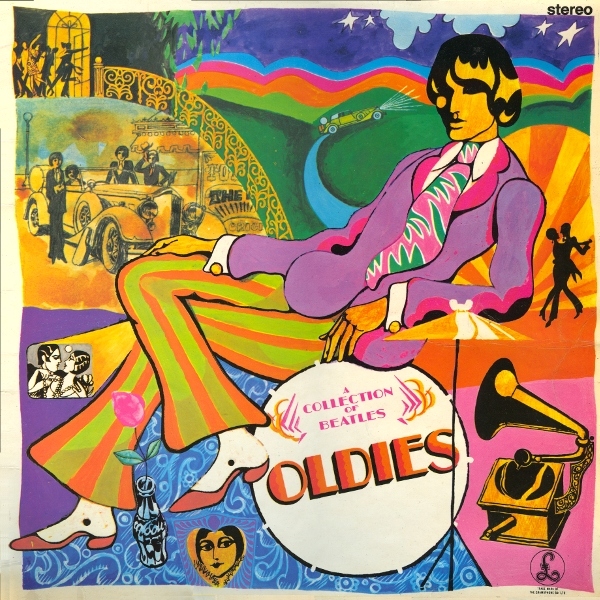
Album: A Collection of Beatles’ Oldies
Released: 9 December 1966

This production was a relatively quick gathering of hits from the past three years, with just a bit of tweaking. The album was to be released in both mono and stereo (just like the previous albums), and considering that all the UK singles to this point had been released only in mono, this called for five of the tracks to quickly be remixed into stereo. This job was given to George Martin, who worked on them over four days (31 October, 7 November, 8 November, and 10 November), with nary a Beatle in sight. The earlier tracks proved to be a bit trickier–many of the 1963 tracks had been recorded on two-track, which necessitated a “fake stereo” remix of “She Loves You” (the original master had been destroyed, so engineer Geoff Emerick created one by placing the low end frequencies on the left and the high end frequencies on the right) and a sort-of-stereo remix of “From Me to You” (the two-track tape divided, music on the left and the vocals on the right). The others were tidied up, and by the last day everything was good to go.

Side A
Track 1: She Loves You
From the single, originally released 23 August 1963.
Track 2: From Me to You
From the single, originally released 11 April 1963.
Track 3: We Can Work It Out
From the ‘Day Tripper’/’We Can Work It Out’ single, originally released 12 March 1965.
Track 4: Help!
From the single, originally released 23 July 1965, and the album Help!, originally released 6 August 1965.
Track 5: Michelle
From the album Rubber Soul, originally released 3 December 1965.
Track 6: Yesterday
From the album Help!, originally released 6 August 1965.
Track 7: I Feel Fine
From the single, originally released 27 November 1964.
Track 8: Yellow Submarine
From the ‘Yellow Submarine’/’Eleanor Rigby’ single and the album Revolver, both originally released 5 August 1966.

Side B
Track 1: Can’t Buy Me Love
From the single, originally released 20 March 1964, and the album A Hard Day’s Night, originally released 10 July 1964.
Track 2: Bad Boy
The sole “new” track, at least in the UK. This Larry Williams original was recorded the same night (10 May 1965) as another Williams track, “Dizzy Miss Lizzie”. In an extremely rare move, this song was recorded specifically for the American market, who were at this time still creating their own Beatle discography separate from the official UK one. They’d figured the cover might show up on a UK EP sometime later, but never surfaced until this compilation. It’s one of their many pre-fame covers, and so they were able to record it quickly (seven takes of a two and a half minute song, plus overdubbed vocals).
Track 3: Day Tripper
From the ‘Day Tripper’/’We Can Work It Out’ single.
Track 4: A Hard Day’s Night
From the single, and the album A Hard Day’s Night, both originally released 10 July 1964.
Track 5: Ticket to Ride
From the single, originally released 9 April 1965, and the album Help!, originally released 6 August 1965.
Track 6: Paperback Writer
From the single, originally released 10 June 1966.
Track 7: Eleanor Rigby
From the ‘Yellow Submarine’/’Eleanor Rigby’ single and the album Revolver, both originally released 5 August 1966.
Track 8: I Want to Hold Your Hand
From the single, originally released 29 November 1963.


All in all, a quick release for the always-busy fourth quarter, but for a band that had only been recording professionally for just shy of four years, it was an excellent cross-section of their many and varying sounds over that time.  In retrospect, it’s also a great overview of what would be the first half of the Beatles’ main output:  well-crafted and catchy pop, interspersed with the occasional stroke of early genius.

*     *     *

Credit: jpgr.co.uk – The Beatles Complete UK Discography site

Credit: jpgr.co.uk – The Beatles Complete UK Discography site

Single: Pantomime: Everywhere It’s Christmas
Released to the Beatles’ Official Fan Club: 16 December 1966

This was quite a change from their previous Christmas releases, and quite possibly their most enjoyable. Instead of being semi-written by their press secretary Tony Barrow, the boys took it upon themselves to write ten short and silly pantomimes–a long-standing British holiday tradition of short and often humorous skits and music put on for family or audiences. The band had done their fair share of them over the years, both with family and with the Christmas shows they’d put on at the Hammersmith Odeon. Recorded not at Abbey Road but in the basement studio of their music publishing office, Dick James Music, it contains a few short original songs similar to old vaudeville tunes interspersed with equally short (and often unresolved!) skits. The end result is nearly seven minutes of comic absurdity and silliness.

*      *      *

It may have seemed to the public that the band had decided to take the rest of the year off, but in reality they remained busy, just on their own terms. It just so happened that they were now in between recording contracts–the previous one had been fulfilled by the singles and the Collection album–and a new one would not arrive until late January 1967, so they did not need to write or record a thing if they didn’t want to. They were at a crossroads–they were no longer a touring band, they had no pressing projects, and their music had evolved beyond anyone’s expectations. They were truly at a point where they could do whatever they wanted.

Once all recording was done for Revolver and the last tour was finished, the four went their separate ways to contemplate their next moves.

John took up director Richard Lester’s offer to take a role in his next film, How I Won the War, and filming took place between 6 September and 6 November (a week in West Germany, and the rest of the time in southern Spain). He shocked the world and got an army-regulation haircut and was given a pair of round-framed National Health glasses for the role of Private Gripweed. The hair quickly grew out after filming, but the glasses became a signature look and to this day are still sometimes referred to as “Lennon specs”. Of course, the schedule of a film production is often long and sometimes quite boring, with a lot of standing around, and not much to do when one is not needed. John of course spent his evenings reading and visiting friends, and writing music. It was here that he would write what would be their next single and take the band into a new and uncharted direction.

Paul, in the meantime, kept busy with friends and family. Earlier in the year he’d purchased and moved into a house on Cavendish Avenue in London, conveniently a few blocks away from Abbey Road Studios, and not too far from Mick Jagger’s house in Regent’s Park. In addition to this, now that he’d gotten his own place, he found himself immersed in art. In late 1965 and early 1966 he’d helped friends open up the Indica Gallery in London, and to decorate his new house he’d started purchasing artworks. He found himself fascinated by Belgian surrealist René Magritte and purchased a few of his paintings, including one of an apple–which would, in a year or so down the line, be the inspiration for their next venture, Apple Corps. And lastly, in late November he had tapped Epstein’s production company for a possible movie scoring project. Out of that came the score for The Family Way, a Hayley Mills drama-comedy based on the 1963 play All In Good Time. The music itself was recorded by George Martin with an orchestra, but one can definitely hear McCartneyisms in the soundtrack. Much of the incidental music contains simple passages that don’t amount to too much, but the recurring theme, later dubbed “Love In the Open Air” for a single release, has Paul writing a haunting yet beautiful theme that could fit easily alongside “For No One” or “In My Life”. [Interestingly, this soundtrack is often not considered the first solo Beatle release, as Paul only scored it but did does not appear on the record.]

George, on the other hand, knew exactly what he wanted to do with his spare time. Since hearing the Indian music played during the restaurant scene in Help!, he’d become fascinated not only with the music but the culture. In early September he flew to India to study the sitar, as well as learn Yoga and philosophy. The journey would be a pivotal one, as it would change his whole outlook on life and become an extremely spiritual person until his passing in 2001. It would also deeply affect his songwriting, which he felt had been stuck in stasis for years (not to mention stifled by his bandmates John and Paul), and had only begun to truly bloom on Revolver. Upon return, his songs would still be overshadowed by the others, but they would be much stronger and more confident. By 1968 he would have his own movie to score (the trippy misfire Wonderwall), and by 1970 he would have a double album’s worth of songs ready to release to wild acclaim.

Ringo, of course, decided to do little but stay with his family in Surrey for the time they spent apart. It may have been the least adventurous thing to do, but given their schedule since they began years ago, I would most likely have chosen the same thing!

By the time they reconvened on 24 November, they began recording that song John had written in Spain, and kick off a new phase of their recording career.

Next Up: The “Strawberry Fields Forever”/”Penny Lane” single and Sgt Pepper’s Lonely Hearts Club Band

Blogging the Beatles 31/32/33: “Paperback Writer”/”Rain” single, Revolver, and “Yellow Submarine”/”Eleanor Rigby” single

It had certainly been one hell of a ride for the Beatles in the few years they’d been a professional (and prolific) band with hit singles and albums. Considering their auspicious debut in the autumn of 1962, the two albums a year, the non-album singles, concerts, television and radio appearances, and two feature films, they’d done all this with rarely any time to unwind. It was a runaway train with way too many people at the switch, and something was due to go catastrophically wrong sometime soon. If they were going to continue as a band, the four boys would definitely need to gain some personal control pretty damn quick.

It seemed that the first half of 1966 would be relatively calm and pretty much the same as it had the last two years–go out on tour, do the usual media appearances, and somehow squeeze the recording of an album in there. This time they gave themselves some breathing room: three full months of vacation! From January to April, the public at large saw neither hide nor moptopped hair of the band. This time is for the most part unchronicled, but most biographies have the four going their separate ways and doing their own thing: John living at his home in Weybridge and weighing his future with Cynthia and son Julian; Paul with his on-again, off-again relationship with Jane Asher, George thinking about his future (and near the end of the year, post-tour, heading over to India to expand his knowledge of Indian music), and Ringo mainly hanging with family and everyone else. It was only three months, but it was a much needed escape from the nonstop insanity they could barely escape. By 6 April they were back in the studio, ready to record their next album. As they had no feature film to shoot this time out, they could afford to take their time on this, and they gave themselves a good two and a half months on this project, recording up until 21 June.

From there, they would go on yet another globe-trotting tour until August. They had not told anyone this (and had only mentioned it to the closest members of their inner circle), but at this point they had already decided that this was going to be their last ever tour, at least until further notice. It had ceased being fun for them. More often than not, they had little idea of what city they were in, given that they had become their own prisoners, locked up in hotels night after night. More importantly, the technology of live rock music had not caught up with the clamoring fans at this point; their amplifiers barely reached over the ear-splitting din of thousands of screaming teenagers. They’d admitted as much that their musicianship had faltered to the point of substandard because they couldn’t hear themselves play half the time. Even the ever-jovial John had become outright nasty at times on the tours, yelling at the crowd to shut up–not that they could hear him, of course.

But unhinged fans and the nonexistence of upgraded equipment weren’t the only problems during this touring season. In early April, John had been speaking with a journalist friend, Maureen Cleave, about music and life in general, and John relished this as an intelligent interview–instead of the ridiculously silly questions they were always hit with (about their hair, what kind of drinks they like–the same silly and inane questions they’d heard since 1963!), he was given a platform to talk about real things–what did he feel about the world in general? At that point, he’d been reading a lot about religion (more on this later), and he’d uttered the (in)famous words “Christianity will go. It will vanish and shrink. I needn’t argue with that; I’m right and will be proved right. We’re more popular than Jesus now.” An off-the-cuff statement to be sure, but he hadn’t meant that as a slur at all; he’d meant that his fans were more excited and involved with popular media (and the Beatles in particular) than they were about religion. It has been published in the London Evening Standard soon after, with very little fanfare. It wasn’t until late July, that Datebook, a US teen magazine, reprinted the quote and blew it into a major scandal. The resulting outcry led to record banning and burning, angry fans (particularly in specific areas of the US). John later recanted and explained himself, but the damage had been done. Many of their remaining US dates were hit with suspiciously “accidental” problems such as lack of canopy during an outdoor show, locked gates at terminals, and halfhearted security.

That wasn’t all; in June they had played their only shows in Japan, a five-show/three-day event at Nippon Budokan–at that time a sacred arena only reserved for judo matches, which caused a major flap there. Their next show was on 4 July in the Philippines, which ended up a complete fiasco: they’d publicly been invited to visit President Marcos and a number of young fans at the Palace–which they had no prior knowledge of until the last minute–and had refused to commit due to it being scheduled under an hour before showtime. This was perceived as a slight against the country, and the government made sure their remaining time in the country was as hellish as possible. They’d been charged with not paying income taxes from the show’s receipts (which the promoter was currently withholding); the security that was to escort them from the hotel to the airport had curiously been withdrawn; the airport manager had refused to give them assistance; authorities had conveniently “lost” the records of the band arriving, thus making them potential illegal immigrants. And after all was said and done and the band and entourage had finally lifted off, the government sent out a Parthian shot to the press stating that the Beatles had meant no slight to the First Lady at all. By far, one of the worst touring experiences of any band, ever.

By the time they finished playing their last ever show in front of a paying audience at Candlestick Park in San Francisco on 31 August, George (supposedly) said it best as their plane took off: “Well, that’s it. I’m not a Beatle anymore.” They had had enough.

It was time to become a full-fledged studio band.

*   *   *

Credit: jpgr.co.uk – The Beatles Complete UK Discography site

Credit: jpgr.co.uk – The Beatles Complete UK Discography site

Single: “Paperback Writer”/”Rain”
Released: 10 June 1966

The band’s latest recording sessions in 1966 continued the sonic exploration and invention they’d begun with the Rubber Soul sessions the year before, moving further into uncharted territories. They weren’t so much given carte blanche in the studio, as much as they’d just gone ahead and done it without asking to see if they could get away with it. April had been quite the month for inventing new sounds, and on the 14th and 16th of that month they worked on what would become their next non-album single. They’d stretched the boundaries lyrically and musically with their previous single “We Can Work It Out” with its multiple segments and changing time signatures, but now they began playing with sonic changes–variable speed, pumped up bass lines, and even reversed tape. This single would be the gateway to an all-new Beatles sound that would far outpace not just their previous efforts, but those of their peers.

Side A: Paperback Writer
The new Beatle sound invites us in with a glorious multilayered a capella vocal from Paul, John and George, and kicked into high gear with Ringo’s incredibly fast-paced drumming (listen closely to his high-hat triplets between the third and fourth beat) and a stellar riff from Paul that repeats throughout the song. There’s some question as to whether that’s also Paul on the bass (session worker Ian McDonald claims that’s Paul on bass and George on guitar, but session pictures show the opposite), but regardless, the bass line is the key here. Story goes that John had once questioned a few people as to why the bass guitar in a certain Wilson Pickett song sounded so much more up front than any Beatles track to that date, and this particular sound was the result. Historically, the bass at that time was mixed relatively low to avoid the stylus on record players from jumping from the vibrations, but thanks to a recent acquisition of equipment by EMI that could create louder and deeper master recordings, they were able to punch up the low end. The result was the first Beatles single mixed louder than anything they’d previously done.

Also of note is the link above to the official visual for the song–the band had previously toyed with proto-music videos in 1965, but they had all been shot on video with very little thought to quality or expense. With this song and its flipside, however, they’d hired director Michael Lindsay-Hogg to shoot visuals on film. The end result was a new unexpected visual for music at the time–in color and in higher definition, in a real setting instead of on a prefabricated stage. As they had decided not to tour anymore and would cut down considerably on media appearances, they had decided this would be the best form of promotion from here on in.

Side B: Rain
This stunning b-side has all sorts of interesting tricks up its sleeve, starting with its speed, of all things. Deep into their growing love for studio experimentation, they found that slowing tracks down often gave their songs a fuller, beefier sound (especially with the guitars–that low note just past the breakdown is one hell of a great gut-punch), and it’s quite evident on this track. The backing track was recorded nearly a half-step up and slowed down at normal speed, while John’s vocal was recorded at a slower speed to play faster in playback. There’s also the well-documented first appearance of a backwards recording in a Beatles song, the first line of the first verse inserted in backwards at the end of the song. Ringo often stated this was one of his personal favorites they recorded, and it’s not hard to see why–he shows quite a masterful sense of timing here, not just with the opening beats (that first double-hit is on the upbeat) but with the breakdown near the end of the song.

[Note: There were three promotional films shot for this–one is in color at Chiswick House, and two takes in black and white in an otherwise darkened studio. The version I’ve linked to here was shown during the Anthology TV series, and is an edit of all three.]

*   *   *

Credit: discogs.com

Credit: discogs.com

Album: Revolver
Released: 5 August 1966

This album was destined from the start to be unlike any other album out there. They had always kept their public appearances and their personal creations separate, always aiming to write and record music on their own terms and not others’. With very few exceptions–the written-to-order “A Hard Day’s Night” and the occasional song written specifically for another performer–they catered only to their own whims. This was especially important as all four were uniquely and actively creative in their own ways, and were always keen on trying something new…especially if it hadn’t been done before by anyone else. Setting the tone for the entire sessions, the first track recorded would sound unlike anything else out there at the time. And given that they’d only recorded “She Loves You” just shy of three years previous, it was indeed a step in a direction no one else would have expected of the band at all.

The album set the standard for electric guitar-based rock, inspired thousands of musicians, consistently reaches a high placing in any “best albums of all time” charts, and is often touted as the top favorite Beatles album of many fans (including myself). The whole album is bursting with creativity, even down to the collage-and-drawing cover done by their Hamburg friend Klaus Voormann. There’s also the introduction of a new recording technique–artificial double-tracking, or ADT–which would automatically double-track their vocals, leaving the laborious task of double-tracking themselves to the tape operator. In short, the vocals would be slightly altered by an oscillator and thus creating a second, perfectly-matched vocal line that would fill out the vocal delivery. It’s an album full of classic Beatle moments, fresh new ideas, and hardly a weak filler song in the bunch. It’s a record so perfect for the band that even the four members considered it one of their best achievements.

Side A

Track 1: Taxman
The album starts out with the first of three Harrison tunes, this time a clever (and literal) dig at the price of fame. It’s an incredibly tight recording–so tight it sounds sparse, full of clipped notes and short, harsh guitar fills with sixth and ninth chords, and a scathing attack of a guitar solo. It was recorded a few weeks into the new sessions (started 21 April and finished sometime later), and while it doesn’t contain any real experimentation, it does benefit from the new louder sound mixing. This turned into a fan favorite many years down the road, to the point that The Jam “borrowed” the sound for their single “Start!” in 1980.

Track 2: Eleanor Rigby
Paul’s first track is a hauntingly beautiful ballad that, like “Yesterday”, features only himself on vocals (with John and George only contributing to the “ahh look at all the lonely people” chorus), but bypasses that song on a number of levels. While the former song is a sad lament, this is a bleak character study of missed opportunities and, yes, lonely people–another example of songwriting they’d never tried before. George Martin scored the string octet (four violins, two violas and two cellos), giving the song a baroque feel. Interestingly it was agreed by not just Paul and Martin but the session musicians that playing sans vibrato gave the track an even sadder feel. [Another one of my top favorite tracks of theirs for quite a few reasons!]

Track 3: I’m Only Sleeping
This trippy song of John’s is another good example of his writing a song about nothing…but in this case, it’s inspired by his purposely doing nothing. The three month respite had seen him do little but hang out in his Weybridge home, watching television, napping, and doing little else (aside from some recreational drug use), and it was a blessedly needed change from the frenetic pace of the last few years. In retrospect, this could be a parallel to his much later solo song “Watching the Wheels”–the theme is nearly the same, dismissing the nonstop movement of society and instead accepting his own leisurely pace. Of note here is another appearance of reversed recording–this time it’s Paul and George noodling around in the studio to create a backwards guitar solo.

[In another example of always finding something new every time I listen to this band, I always thought that sound at exactly 2:00 in was Paul or John making an odd noise in the studio, but it’s actually Paul yawning!]

Track 4: Love You To
George returns with a second track, and his first song directly inspired by his growing love for Indian music. Recorded in a single evening, it features George as the sole Beatle on nearly the entire track; Ringo is present on tambourine and Paul provided early takes on backing vocals (which did not make the final mix). Nearly everything else is played and sung by George alone, with only session musician Anil Bhagwat playing the tabla. It’s a phenomenal track that mixes the mystical sound of Indian instruments (a gorgeous alap intro holds the song for a full half minute before everything else joins in) with a distinctly English electric guitar providing counterpoint. Certainly an incredible step from three years previous when he wrote “Don’t Bother Me”.

Track 5: Here, There and Everywhere
As Rubber Soul inspired Brian Wilson to record the Beach Boys’ Pet Sounds, thus Pet Sounds inspired Paul to write this gentle but gorgeous ballad. It’s surprisingly simple all around–its lyrics harken back to their early love songs, and the vocal delivery is merely a shifting triad chord (the first, third and fifth notes in an octave). But its simplicity is what gives it its charm–it’s a beautifully crafted and timeless pop gem that could have been released at any point in time and still work. Both Paul and John considered this one of their top favorite Beatle tracks.

Track 6: Yellow Submarine
Ringo’s vocal turn this time out is an absolutely charming and lovable song written by Paul and John, specifically for him. This time out it’s an imaginative song of fantasy, a story of living in a fanciful submarine where everyone could come and live and play. Paul had envisioned it as an old fisherman telling tall tales to a youngster–the original version (found on the b-side of the “Real Love” single) has an spoken word introduction that captures the feel of nautical adventures. Even the recording itself sounds like a party–there’s whooshing waves, burbling bubbles, fleet calls, steamship noises, marching feet, clanging chains and a singalong at the end, all recorded 1 June. It might by a silly and slight song, but it’s still loved by many, and would be used as the theme (musically and plotwise) to their next film a few years later.

Track 7: She Said She Said
Another trippy song from John, this time a track inspired not just by LSD but by a strange poolside conversation he and George had had with actor Peter Fonda back in August of 1965. Multiple sources offer varying versions of what happened that day other than that nearly everyone had gotten wasted on the drug, and that Fonda had been saying increasingly weird things that alternately fascinated and bothered the band. This track is nearly a throwaway, as it had been hastily written and ended up being the last thing recorded for the sessions when they realized they were one song short.

Side B

Track 1: Good Day Sunshine
Paul opens up the second side with an upbeat vaudevillian-style pop song partly inspired by the Lovin’ Spoonful’s “Daydream”. While John might sing about sleeping, Paul prefers the great outdoors here, ready to take a lovely walk in the park. It’s a relatively sparse sing, with Paul on piano and bass, and Ringo on drums–George and John do not play on this song, only offering backing vocals. At the time, this was considered one of the quickest Beatle songs put to tape; after a number of taped but uncounted run-throughs, they recorded three takes of the backing track and chose Take 1 as the best, then sprinkled a few overdubs here and there over the following days. Of note is George Martin’s honky-tonk piano solo, recorded at a slower speed to make it sound peppier.

Track 2: And Your Bird Can Sing
There’s some speculation as to what (or who) this song of John’s is really about, but that’s secondary to what is probably some of the best guitar playing of the Beatles career up to this point. George and Paul play in tandem here, releasing a wonderfully chiming riff that opens the song and punctuates each verse, and comes to a ringing coda on an unexpected note. It’s an incredibly fun song that might not be about anything at all–so much so that the Anthology version has John and Paul breaking up into hysterics as they try to lay down vocals.

Track 3: For No One
As if to counterpoint the upbeat qualities of the two previous songs, Paul comes back with another ballad, this one a bitter take on a relationship nearing its end. The entire song sounds fragile: the high piano is doubled by an equally high clavichord (both played by Paul), with Ringo providing slight percussion duties. Session player Alan Civil plays a delicate French horn passage (Paul had heard him play on the radio a few nights previous and felt it would be a perfect fit) that’s both uplifting and melancholy at the same time. This one isn’t so much a song about regret, as it is about acceptance and relief, and enduring the pain.

Track 4: Doctor Robert
One thing can be said about John’s mid-era Beatles songs–he was able to write about something (or in this case, someone) in his life and hide it in plain sight. In this case, it’s a fun, lightweight pop song with innocuous lyrics about a doctor with the ability to make you feel better no matter what the ailment (and in reality, a paean to one or more people they knew who supplied them with drugs). The lyrics are very typical of the British folk movement, short melodramatic vignettes about one person or another, so if you weren’t aware of the band’s recreational drug use at the time, it would fit in perfectly alongside “Yellow Submarine” as nothing more than fluff.

Track 5: I Want to Tell You
George’s third offering is a fabulous piece of subtlety–on the surface it sounds like a man in love at a loss for words, but the further you go, the song is really about the inability to truly express one’s thoughts and emotions, fighting for the right words to say that may or may not be there. To expand on the frustration in the lyrics, George “created” a new chord at the end of each verse, hitting an E-flat 7th chord with an F thrown in to give it a noticeable dissonance. It’s not just the chords, either; the drums are loud and loose, as is Paul’s piano playing, giving the mix a somewhat slippery feeling…making it just that much harder to grasp whatever it is George is trying to say.

Track 6: Got to Get You Into My Life
This could very well be yet another drug-inspired song (Paul, in his book Many Years from Now, casually mentions that it’s about marijuana), but musically, it’s a fabulous and energetic homage to the sounds of Tamla Motown soul. Three trumpets and two tenor saxophones almost take center stage on this song, miked with the pickups inside the bells, that it comes out as one impressive wall of noise. It took them some time to figure out exactly how they wanted this one to sound, as they’d recorded the main backing tracks on 7 April, but didn’t get around to adding the horns and vocals until 17 June. In turn, ended up an excellent and well-loved pop tune.

Track 7: Tomorrow Never Knows
It’s hard to find the best words for this track, as it’s considered one of the biggest defining moments in the Beatles catalogue. It’s just on the verge of avant-garde, just shy of being an Indian raga, and still manages to be a full-fledged rock song the likes of which no one had ever heard before. Inspired by the recent books on religion John was reading at the time, he came up with this absolutely stunning track. The first thing you hear is the droning tamboura, dizzily pulling you into a wild ride of metaphysical lyrics, a tape-looped jungle of unearthly sound effects, and some of the most unbridled instrument playing and sound production they’d ever put to tape. John’s voice is filtered through a rotating Leslie speaker on the last verse, Ringo beats the hell out of his kit with a jilted beat, Paul hammers on the bass and provides a reversed guitar solo, and George doubles himself on sitar. It’s just shy of three minutes long and never leaves the key of C, but it’s one hell of a ride. And consider this: the track was recorded on the first day of the Revolver sessions…a mere three years after they recorded “She Loves You”. For quite obvious reasons, this song is considered one a top favorite of quite a number of fans–including myself, of course–simply because it’s one of those songs that leaves you completely speechless.

*   *   *

Revolver can easily be considered the start of the next phase of the Beatles discography. While it might bear some slight resemblance to its predecessor–songs like “Doctor Robert” and “And Your Bird Can Sing” fit quite nicely on the US album Yesterday and Today alongside the singles and Rubber Soul tracks on that album–it remains its own entity as well. While the previous album was more acoustic and folk oriented, Revolver is most definitely a rock record, aimed at amplification. It also proved that if the band was given time and space and little disruption, they could stretch their boundaries even further. If they gave themselves two and a half months to work on a masterpiece, one could only wonder what would happen, now that they were no longer a touring band.

*   *   *

Credit: discogs.com

Credit: discogs.com

Single: “Yellow Submarine”/”Eleanor Rigby”
Released: 5 August 1966

There’s not too much to add here that I haven’t already mentioned above, other than that this single ended up being their second deliberate “double A side” single (either song could be the radio hit), and the first single with Ringo on lead vocals. And despite the simplicity of the song (and the ongoing negative media frenzy due to John’s words on Christianity), it hit the top spot on the charts in the UK and hit number 2 in the US, blocked only by the Supremes’ “You Can’t Hurry Love”.

And on a more personal note, this was the first Beatles single I ever owned–I don’t exactly remember how or where I procured it, but I know it was soon after I bought 1967-1970 (aka ‘The Blue Album’), and right about the same time I started obsessing over them and watching Yellow Submarine on TV each time it came on. I also distinctly remember being somewhat frightened by “Eleanor Rigby” as a child due to its haunting sound and lyrics–but I’ve definitely come to love this song as a wonderful piece of history.

Next Up: A Collection of Beatles’ Oldies and Pantomime: Everywhere It’s Christmas

Walk in Silence: Love and Rockets, 5 Albums

[Hi all! And welcome to a new feature here at WiS–using the title of the blog (and my book project) as the main theme, I’ll be featuring albums from the college rock years of the 80s that have been personal favorites of mine. The entries will be similar to the Blogging the Beatles series–featuring overviews of some (if not all) songs from that release, personal reactions, and maybe a brief history as well. Hope you enjoy!]

* * *

Credit: Discogs.com

Credit: Discogs.com

Love and Rockets: 5 Albums box set
Released: 13 May 2013 (UK)

Love and Rockets was a very influential band in my younger years. Back in autumn 1986, MTV had been pushing their second album, Express, by playing commercials for it, as well as playing the videos for “Ball of Confusion” and “All In My Mind” on their late night rotation (as well as on 120 Minutes when it went on the air that November). That was right about the same time I’d returned to listening to college radio after discovering it earlier that year, so that band became one of the foundation points when I jumped straight into the alternative rock sound. I’d picked up Express at the Rietta Ranch flea market in Hubbardston, of all places–and it became one of my favorite albums of that year. Over the course of four albums in the late 80s, I fell in love with their distinct sound of dreamy acoustic guitars, neo-psychedelia, and post-punk. They ended up influencing my own songwriting style as well.

The band itself has quite the pre-band history–it’s comprised of the three musicians from Bauhaus: guitarist/singer/songwriter Daniel Ash, bassist/singer/songwriter David J, and David’s brother, drummer Kevin Haskins. After the break-up of Bauhaus and singer Peter Murphy going solo, they kept themselves quite busy…Daniel Ash and Kevin Haskins turned their part-time project Tones on Tail into a short-lived but full-time project, releasing one album and a handful of great singles. David J kept busy with both an impressive solo career (including work with comic writer Alan Moore, creating music for his V for Vendetta series) as well as studio assistance with The Jazz Butcher. By 1985 they’d reconvened and started up a new band. Taking their name from the highly acclaimed comic book of the same name by Jaime and Gilbert Hernandez, they created a unique body of music that borrowed not just from their previous bands’ sounds but also of the guitar-centric soundscapes gaining ground at the time, such as those of XTC and Cocteau Twins.

5 Albums is part of a new box set series from the UK Beggars Banquet label; this one comprises Love and Rockets’ four 80s albums–1985’s Seventh Dream of Teenage Heaven, 1986’s Express, 1987’s Earth Sun Moon and 1989’s Love and Rockets–plus an additional collection called Assorted! which contains a number of b-sides and rarities, including their one-off Bubblemen “side project” EP. The four main albums are for the most part the same as the 2000-2003 reissues with little change (the version of the self-titled album here omits the bonus cd, most of which was moved to Assorted, minus the radio interview and performance), and for those who have these already, only Assorted is of interest, as it contains many b-sides not available elsewhere, as well as the unreleased track “Sorted”. This box is mainly for those who are completists (like me), but it’s an absolutely wonderful–and cheap!–way to introduce yourself to a phenomenal band. Let’s take a look at a few of the albums and tracks therein:


The debut Seventh Dream of Teenage Heaven, originally released in October 1985, is steeped in acoustic post-punk and drenched in atmospheric reverb–all the tracks save one are over five minutes long and contain deliberately calculated instrumental passages that make the songs soar. Lyrically the band showed a complete 180 from the gothic references in Bauhaus, or even the trippiness of Tones on Tail, instead focusing on personal introspection. This one was only released in the UK at first, only making an appearance in the US in November of 1988 with a reshuffled track listing and two single b-sides added, after their second and third albums had been released.

There’s some lovely work here, especially the pastoral “A Private Future” and the absolutely stunning instrumental “Saudade”, both showcasing Daniel Ash’s phenomenal guitar work. There’s also a few curiosities like the deliberately plodding “The Game”, but there’s also bluesy rockers “Dog-End of a Day Gone By” and “Haunted When the Minutes Drag”. The latter track would get a boost in early 1988 when John Hughes featured it on the soundtrack to his movie She’s Having a Baby. This current version also contains their debut single, a cover of The Temptations’ “Ball of Confusion”, which would also show up on the original US version of Express. All told, Seventh Dream is a stunning debut for the band–it’s not an album full of hit singles, but it’s certainly full of great musicianship and tight songwriting.

Express was released in mid-September of 1986, a banner year for quite a few bands that would define college rock–The Smiths, the Cure, Depeche Mode, The Mighty Lemon Drops, The Chameleons, and more. Their second album is much more upbeat and a lot trippier, infusing their love for sixties’ psychedelic rock into all sorts of places. The one-two punch on the first tracks “It Could Be Sunshine” and “Kundalini Express” hint at garage psych with mystical lyrics and spacey guitars, setting the tone for a much more electric and eclectic album than the previous one. They’re followed up with the American single “All In My Mind”, which eerily predates and predicts the dreamy sound of shoegaze, which would surface nearly three years later. The album also has its share of acoustic tracks similar to those on Seventh Dream, including a much slower version of “All In My Mind”, as well as the closer “An American Dream”. But the ultimate psychedelic track on this album is the speedy “Yin and Yang (The Flowerpot Man)”, a six-minute psychedelic freak-out of weird sounds, disjointed lyrics, and Bo Diddley strumming amped up to eleven. As mentioned earlier, many US fans were introduced to the band with this album, and it’s a great place to start.

Earth Sun Moon was released almost exactly one year later in September 1987–the same month that featured highly-lauded (and often game-changing) albums by The Smiths, Depeche Mode, Public Image Ltd, REM, and the Red Hot Chili Peppers–but instead the band had decided to go an altogether different route than the previous two albums. While Seventh Dream felt almost prog-rock in its scope and Express focused on psych-pop, this new track delved into the sound of late sixties San Francisco folk. It was no ‘peace-and-love’ album to be sure, but it had the philosophical ‘who are we and where are we headed’ vibe. The first track “Mirror People” sets the scene for the entire album, a self-aware metaphorical fence-sitter watching everyone act like everyone else, but deep down he knows he’s just as bad (“quite content to sit on this fence, quite content now a little bit older…”). This is a band that wants to have peace and love…but knows quite well that in reality, true peace and love, even inner peace, is hard to come by. The rest of the album focuses on this theme–the single “No New Tale to Tell” (Just how unique are we, compared to everyone else?), “Here On Earth” (Life goes on, with or without our participation), and “Waiting for the Flood” (We face what we’re afraid of in order to live) are just a few examples of how layered this album can be, despite its lack of strong sound. It’s one of my favorites of theirs, even though it’s considered one of their weakest.

Love and Rockets was released in September of 1989, and after a two year absence, their sound had moved in another direction…this time with loud, dissonant guitars, sparse, demo-like workouts, and even alternative pop. In some ways it sounds like they’d taken a page from the Jesus and Mary Chain, and in retrospect it was a perfect choice–by late 1989, the sound of “college rock” had morphed into the harder-edged “alternative rock” (and soon to splinter into all kinds of subgenres from Britpop to Grunge). For many who loved the more acoustic ballads of the previous albums, this was certainly a jolt. Preceded nine months earlier by the single “Motorcycle” / “I Feel Speed” (two completely different iterations of the same song, the former a ballsy rocker and the latter a dreamy blues played mostly on a bass guitar), this album also produced the band’s first Billboard Top 10 hit (it reached #3, and hit #1 on the Modern Rock chart) with the slinky, sexy “So Alive”. That hit track is the exception, though–while that one is perfect pop production, the rest of the album deliberately alternates between loud and clunky (“**** (Jungle Law)”, a middle-finger to one of their worst critics, and an industrial take on the 12-bar blues, “No Big Deal”) and quiet and dreamy (the lovely, jazzy “The Teardrop Collector” and the Bowie-esque “Rock and Roll Babylon”). It’s as if this album is self-titled on purpose; half blissful Love and half aggressive Rockets.

[This would be the last we see of the band for a good few years; they would finally reconvene in late 1994 with the electronica-heavy Hot Trip to Heaven, follow it up with the more organic Sweet FA in 1996, and finish their recording career with 1998’s disjointed Lift. These albums are interesting on their own, but aren’t quite as strong as the original first four.]

The new Assorted! compilation (only found as part of this box at this time) collects many b-sides and curiosities that aren’t already found on the repackaged previous albums. As mentioned earlier, most of the second disc of the reissue of the 1989 album is found here, including the unreleased Swing! EP, the lone Bubblemen EP, as well as the live b-sides found on “No New Tale to Tell” and “Mirror People ’88” singles which were not previously available. The only surprise here is an otherwise unreleased “Sorted”, an upbeat acoustic track that sounds like a demo stuck between Earth Sun Moon and Love and Rockets.

* * *


I’ve been known to listen to all four of these albums in chronological order in one go, as they fit so well together, going from meandering acoustic noodling to heavily distorted noise. Love and Rockets are no more, but they’ve become one of the many important alternative bands of the 80s, not just through their heritage but through their excellent songwriting and musicianship. Many might know of them only through the “So Alive” single, but there’s quite a lot more to the band than just the hit. Sure, I picked it up because I’m a completist and needed the missing b-sides, but I also picked it up because they’re some of my favorite albums of the late 80s, and well worth coming back to time and again.

Fly-by; No post this weekend due to being afk

Hi all!  Thanks for following and reading…the wife and I will be enjoying a few days’ vacation the next few days, so I will not be able to update the Blogging the Beatles posts.  I’m bummed too, because I’m REALLY looking forward to writing about Revolver, one of my top favorite albums, not just of the band but in general.

I may, however, post a few short things before BtB returns on 6/15, perhaps a few microreviews of some of the great music I’ve been purchasing as of late.  That’s one of the things I’ve been wanting to do, and had planned before my previous PC went kerflooey.

Again, thanks for your patience.  See you soon!


J

Blogging the Beatles 28/29/30: “Day Tripper”/”We Can Work It Out”, Rubber Soul and The Beatles Third Christmas Record

Summer 1965 found the Beatles heading back over to the United States for another round of touring.  These shows were definitely of interest, as they included a return engagement on The Ed Sullivan Show, their first appearance at Shea Stadium in New York, and two shows at the Hollywood Bowl (which were recorded and, along with songs from their 1964 appearances there, were edited, mixed (as much as they could be, at any rate) and released on May 1977’s The Beatles at the Hollywood Bowl compilation).  Also of note is their stop in southern California at the end of August–on the 27th, they were driven to Beverly Hills to visit their one-time hero, Elvis Presley.  The meeting was less than stellar, as the story goes–the boys felt Elvis, who was already deep into his B-movie phase, was a bit of a sell-out, and apparently Elvis felt less than impressed by the band that stole his popularity.  The brief but busy tour ended on 31 August with two shows at the Cow Palace in San Francisco.  Thankfully, they were given six whole weeks off between that last show and recording time.

In hindsight, it was definitely one of those “seemed like a good idea at the time” sort of things, recording and releasing two albums in one year.  They’d done so since their first albums in 1963, and back then it was considered important to keep oneself in the limelight throughout the year.  This was especially important during fourth quarter, when sales were the highest.  Even though Help! had been released at the start of August, they’d still need to create something new in time for the Christmas rush.  In 1963, this was probably not much of a problem, considering the band’s songwriting and recording were relatively quick and relatively easy.  Now two years later, their songs and recording styles were becoming more complex; they were no longer writing the simple love songs they could dash off in a day or so…they were now writing and recording songs with minute details and intricate melodies.  By 1965 and with about a month and a half to work with, coming up with sixteen completely new songs–fourteen for the album and two for the lead single–was going to be one hell of a chore.

The Rubber Soul sessions took exactly one month: 12 October to 11 November.  They were also a continuation of the nighttime sessions that would become typical of the band in their later years.  While many of the sessions for Help! had started in the early afternoon and occasionally lasted well into the late evening, the Rubber Soul sessions saw even more nights where they entered the studio mid-afternoon and stayed past midnight.  Most of this was due to the ridiculously tight deadline (the last day was a marathon thirteen-hour session lasting from 4pm to 7am the next morning), but at the same time the band (and Martin) had realized they felt more comfortable with a night shift.  This was partly due to the “studio boffins” (aka the house technical crew at Abbey Road, complete with white lab coats) having gone home for the night, leaving the boys to their own devices.  This would actually work well for them, as they could get away with more.  Many of their later sonic experiments–the phasing vocals of “Tomorrow Never Knows”, the straight-to-mixing-board overmodulated sound of “Revolution”–would have given these boffins a heart attack, daring to abuse the machinery in such manner.  Of course, there was also the fact that this also left time for the boys to flex their social wings and meet up with friends and celebrities around town during the day.  This was especially embraced by Paul at the time, who had still been seeing socialite Jane Asher at the time.

Still…one month to record what would end up becoming a gamechanger of an album had to be equal parts luck, ability, and insanity.

* * *

Credit: jpgr.co.uk – The Beatles Complete UK Discography site

Credit: jpgr.co.uk – The Beatles Complete UK Discography site

Single: “Day Tripper”/”We Can Work It Out”
Released: 3 December 1965

It had been an agreement between the band, George Martin, and Brian Epstein to have the singles contain all-new songs, or at least songs that had not been released on the album that had currently been released. This was not strictly adhered to, but for the most part they preferred to keep each release as “new” as possible. The end result was that both this single and Rubber Soul were released on the very same day, but are separate entities. Additionally, this is considered the band’s first “double A-sided” single, where both songs are considered the hit, instead of one being relegated to a forgotten b-side. They would return to this type of release multiple times in the future.

Side A: Day Tripper
This track was recorded on the third day of the sessions (16 October), and similar to their previous single-only track “I Feel Fine”, it starts off with one hell of a great guitar lick, courtesy of John, who wrote the majority of the track. However, it’s Paul who sings the main verses, most likely as the melody is more in his range than John’s. John however does come in to sing the lead on the chorus. This is also a good example of where they were at the time in terms of recording style: while the majority of that day’s session was given to this song, there were only three takes recorded, with most of the vocals and extra sounds overdubbed onto the third (and only complete) take later that night. John and Paul both considered this a throwaway song that was written too quickly, but it remains a classic and a great example of their new sound. While the base of this track is a variation on a twelve-bar blues and sped up, with an altered chord progression for the chorus, they make it their own with flair. There’s a delayed build-up of instruments at the intro (guitar, then bass, then rhythm guitar and percussion), the amusing commentary in the lyrics (Paul and John have said this song is mainly about “weekend hippies”, the wannabes of counterculture but only in their spare time), and at the 1:30 mark, instead of a middle eight, we have a glorious build-up-and-release before returning to the last verse and fade-out. All in all, a wonderful song.

Side B: We Can Work It Out
The flip side is equally fantastic, introduced to the group by Paul, with a significant amount of collaboration with John. This was also another example of a song arranged while recording in the studio, nearly all of it on 20 October. It’s mostly Paul’s song, a semi-autobiographical account of his current relationship with Jane Asher. Despite his misgivings in the relationship’s status, he remains positive, expecting everything to eventually work out. John, on the other hand, gives a counterpoint, both in verse and melody: we can certainly have our problems, but life’s too short to avoid fixing them. His short interlude is also in a minor key, adding to the tension. Even George offered something here, suggesting that short waltz-time passage in the midst of John’s section to add a bit of imbalance. It’s definitely a dark song, much more so than the tracks on Beatles for Sale–it’s more personal, and the resolution is left up in the air.

* * *

Credit: discogs.com

Credit: discogs.com

Album: Rubber Soul
Released: 3 December 1965

Whereas Help! (especially the latter half) introduced us to the band’s growing interest in American folk of the sixties, Rubber Soul saw the Beatles fully embracing it and making it their own. There was also continued interest in American soul, especially the newer soul sound similar to Otis Redding and the like. American soul was being fully appropriated by a lot of British musicians at the time, especially the Rolling Stones, thus the “plastic soul” epithet that was given to Mick Jagger at the time. The Beatles, as always, sought not to take the sound and make it their own, but to take certain elements and feed it into their own creations. Thus we have the groove of “Drive My Car” and “You Won’t See Me”, the folk rock of “Nowhere Man”, the Parisian café atmospheres of “Michelle” and “Girl”. Perhaps because of the tight deadline they were forced to find inspiration where they could find it, and in the end it paid off, as the wealth of ideas on this album reach quite far. It’s also the first Beatles album that’s truly a studio album: while Help! was in fact “built up” organically in the studio, there was a certain acoustic sameness to it. Rubber Soul on the other hand embraced so many different sounds that it was not only a much-loved release to their fans, but an inspiration to many musicians, including the Beach Boys’ Brian Wilson, who often said this album was part of his inspiration for their classic Pet Sounds album.

Side A

Track 1: Drive My Car
The first track kicks off the album with another great guitar lick, but the real star here is the absolutely phenomenal bass line throughout–and it’s played by George, who doubles himself on guitar. Previous Beatle songs had the odd bass flourish or two, but it really wasn’t until this track that their bass lines stood out like that. This is a perfect example of their arranging habits at the time as well–there were only four takes of this track, all done on 13 October, but a majority of that night’s session was dedicated to the sheer number of overdubs they put on this track. In an interesting twist of fate, this track nearly wasn’t written, as Paul’s original lyrics, in his opinion were hackneyed and unusable. It wasn’t until he brought it over to John’s house in Weybridge that they settled on a chauffeur theme (again, going somewhere they hadn’t in the past) and it worked out well from there.

Track 2: Norwegian Wood (This Bird Has Flown)
A lovely folk track written in 6/8 time by John (with help from Paul on the refrains), it’s a personal track of his: he later admitted that this was a song about his extramarital affair at the time and wondered if he could get away with writing a song about it. At the same time, it’s got the very typical self-effacing John being the butt of the joke at the end, with the girl he’s cheating with not really caring about him either way. It features many atypical instruments, including George playing a sitar, the first Beatle track to feature it. He’d been introduced to the instrument during the restaurant scene in Help! earlier that year, found the instrument and the sound fascinating, and double-tracked himself on this song. Ringo’s contribution was not of drums but many handheld instruments such as maracas and finger cymbals. The outcome was a bona fide classic track by the band.

Track 3: You Won’t See Me
Paul offers another track here, another personal song of his up-and-down relationship with Jane Asher; this time she had been either avoiding or ignoring him, and he wasn’t sure why. Recorded on the last day of the sessions, this track is a rather simple melody with few chord changes, but its descending melody and counterpoint vocals are used perfectly as part of the song’s melancholy theme. It tries to be happy, but it’s just not getting there because it has nothing positive to connect to. Even the backgrounds are little more than an “ooh la-la-la” an occasional echoing line, and Ringo’s percussion is quite jittery with high hat triplets and tom fills on the fourth beat. It’s a song of not just sadness, but of irritation.

Track 4: Nowhere Man
A very autobiographical song of John’s–he’s pretty much given up pleading for help, instead giving into stasis and inertia. On the other hand, this is an extremely brilliant song, full of their best work. We’re brought in via an a capella introduction via John, Paul and George’s stellar harmony which stays with us throughout. This too has a descending melody, but while the previous track is melancholy, this one is more relaxed and sunny despite its lyric theme, partly due to the driving beat and the full sound of guitars. George pulls off a simple yet excellent solo here on his Fender Stratocaster, electrified to counterpoint the more acoustic sounding rhythms; there’s a great mix of both chord and melody in that solo, punctuated at the end with a high harmonic E. [Personally, this is one of my top five favorite Beatle songs, partly for that solo alone.]

Track 5: Think For Yourself
George’s first of two contributions to this album, it’s another track typical of his songwriting, full of chord changes and odd musical phrases that seem convoluted yet make sense somehow. He also seems to have gone a more personal route here as well, delivering a song about lies and misdirection–not in relationships, but in life. Paul also introduces a new sound here, plugging his bass into a fuzz pedal to give it distortion. So complex was the song that there’s a well-known bootleg track out there of the vocal session in progress, with John especially having a hard time getting it right (and George finally getting a chance to chide him for it!). They knew they were being recorded, and so much of the tension is played for laughs (though with John, it was real yet played up–again with the self-effacing humor)…but still, the end result is a great example of the dedication they gave to their music. [Trivia: a brief snippet of that recording was used for a scene in Yellow Submarine, when they sing “a bit of a tune” to wake up Lord Mayor.]

Track 6: The Word
John and Paul admit this one was one of the rare occurrences where the song was written amidst the haze of marijuana, which they’d started smoking earlier that year. It’s very much a proto-hippie anthem–John pretty much called this his first attempt at a theme that would culminate two years later with “All You Need Is Love”. It hastily written and recorded near the end of the sessions, so one often notices its relatively simplistic melody and lyrics. There’s not too much going on here, with even the vocal melody repeating itself throughout, only resting when John gives it a counterpoint refrain in between verses. George Martin is featured on the harmonium here.

Track 7: Michelle
This lovely little piece had its origins as a farcical party song from John and Paul’s early days in Liverpool. Story goes that they had gone to a party and met some people who were infatuated with the Parisian Left Bank culture and had started singing Parisian love songs. Paul and John, in their own inimitable way, had created their own take by playing a delicate Chet Atkins-style fingerpicking song high up on the fretboard and making up guttural French-sounding noises in response. Come rush time for the Rubber Soul sessions, they resurrected the melody and put actual words to it, adding a quick French lyric in there (a translation of the previous English lyric “these are words that go together well”), and turned it into quite the romantic track.

Side B

Track 1: What Goes On
Ringo gets his star turn in lead vocals with a song originally written by John back in the Quarrymen days and actually attempted once on 5 March 1963 during the “From Me to You” session, but never recorded. It was resurrected with some minor changes (including a few lyrics by Ringo, making it the only song credited to Lennon/McCartney/Starkey) and given a country feel to fit Ringo’s current vocal output. Given the age of the song and the limited melody, there’s not too much to say about this track other than that it feels ever so slightly out of place–it probably would have fit better if it had switched places with Help!‘s “I’ve Just Seen a Face”–but then Ringo would be short a vocal track!

Track 2: Girl
John delivers another melancholy love song–this one of longing, of being in love with a woman quite out of his league. It’s similar to “Michelle” with its French bohemian sound, but it also has a bit of a Bertold Brecht arty story-song to it as well. For a Beatles song of its time, it’s surprisingly laid back–so much so that John couldn’t help but insert a quite audible inward sigh of being hopelessly in love for the wrong reasons.

Track 3: I’m Looking Through You
Another of Paul’s songs about his up-and-down relationship with Jane Asher. Like John, Paul was now working out his inner demons with his songs, and this time he’s starting to question whether or not it’s worth staying on at this point. The original take, found on Anthology 2, is much more acoustic and meandering, but the finished version here has more immediacy and anger; perhaps at this point he had already made up his mind on the relationship and had only to act on it now.

Track 4: In My Life
A deeply heartfelt and breathtaking song from John, quite possibly his most personal yet. Inspired by a journalist’s suggestion that he write a song about his childhood, he eventually came up with this beautifully poetic ode to everyone that had ever had an effect on his life. None are mentioned by name, but that isn’t needed; he instead looks at each and every one personally and lets them know that, after everything is said and done, he deeply and profoundly loves everyone that has ever been near to his heart. The lyrics are so important here that the music is purposely muted, leaving only the vocals up front and center. In perhaps one of their most creative moves, the solo was George Martin’s idea, played at half-speed on piano and sped up when inserted back in, to emulate a harpsichord passage, adding to the pastoral feel of the song. [This is also one of my top five Beatles songs, due to its emotional power.]

Track 5: Wait
In a rare moment of using an older recording, the band grabbed this one from the Help! sessions from June and touched it up with a few percussive overdubs and tone pedal guitar to make it sound closer to the feel of the new album. Because of this the song could fit easily on either of the albums; it has the lighter sound of the former album but the moodiness of the latter. It’s one of many relationship songs written around this time about distance and the fleeting hope that the other would be there upon return. This was considered the very last thing recorded for the new album, the additions done in the wee hours of the morning. George Martin would begin the final remixing of the album that following Monday.

Track 6: If I Needed Someone
The second track offered by George on the new album, this one is much lighter in tone. Its composition is uncharacteristically straightforward, so much that it could almost be considered his attempt at writing a Lennon/McCartney song. George plays a beautiful fingerpicked line played high on his Rickenbacker 12-string repeated throughout. He was heavily influenced by Roger McGuinn’s guitar work with the Byrds on this one–which is ironic, considering McGuinn had been influenced by George’s earlier 12-string work when playing for his own band.

Track 7: Run for Your Life
In counterpoint to the cheating man of “Norwegian Wood”, this time John warns his beloved about cheating on him. [Interestingly enough, both songs were recorded on the same day, 12 October.] He admitted soon after that he wasn’t too happy with this song at all, partly due to lifting two lines from an older Elvis track (“Baby Let’s Play House”) and not really putting much work into it. It’s not the strongest way to end an album, but given the short amount of time they had to work with, it goes out with an uptempo track.

Rubber Soul is considered one of the band’s finest records, and was certainly one of their finest to date. They had chosen to extend on their current influences and expand their lyrical and musical boundaries, as well as search even further into their own personal lives for inspiration. They had indeed been given a month and a half’s respite between the tour and the sessions, but they had also given themselves an incredibly short deadline for a new release in the process. Whether or not that was on accident or on purpose is left unsaid, but it proved once again that they could get away with it–just barely–if they tried. It’s by no means a flawed record, although there are a few weak songs that even the band themselves admit were throwaways. Despite that, they produced a wonderful record full of well-crafted songs that excited the fans and further inspired their fellow musicians. It seems the only boundary they really had here was time; one can only wonder what sounds would have evolved if they’d given themselves a few more weeks or a month more to work with. Come 1966, once they officially gave up touring, they would have all the time in the world. The end results would take everyone completely by surprise.

[Addendum:  the iconic album cover was taken by photographer Bob Freeman near John’s Weybridge home, with them standing atop a small hill and Freeman shooting them from below.  The elongated effect of the shot was created quite by accident when he and the band were choosing possible shots, and the projected image had been warped by the square album-sized card falling backwards.  The band loved the effect and decided on that shot right there and then.  Interestingly enough, the original shot has rarely ever been seen since, and only resurfaced online earlier this year.  You can see it on the Beatle Photo blog here.]

* * *

Credit: jpgr.co.uk – The Beatles Complete UK Discography site

Credit: jpgr.co.uk – The Beatles Complete UK Discography site

Single: “The Beatles’ Third Christmas Record”
Released to the Beatles’ Official Fan Club: 17 December 1965

The boys finished off the year with another holiday message for their fan club, recorded as an afterthought during the session for “Think for Yourself”. This one may have seemed a bit less than inspired, considering they were about to record the same ‘thank you’ message for the third time. They did their best, however, providing multiple quite out-of-tune versions of “Yesterday” and very silly takes on “Auld Lang Syne” and other holiday standards. One would normally think little of these fan club releases, but this would actually be the last of the straightforward Christmas messages; by December 1966 they would be a full-on studio band only, giving them much more time and creativity to come up with new sounds.

Next Up: The “Paperback Writer”/”Rain” single, Revolver and the “Yellow Submarine”/”Eleanor Rigby” single

Blogging the Beatles 25/26/27: “Ticket to Ride”/”Yes It Is” and “Help!”/”I’m Down” singles, and Help!

The year 1965 rolled in for the band with an already tight schedule–the first two weeks of January saw them finishing up their lengthy Christamas show ‘revue’ at the Hammersmith Odeon that had started 24 December, same as last year’s.  After a few weeks of well-deserved rest, it was time to jump back into the fray in mid-February.  Between 15 February and 11 May, they would be busy not with a tour or the endless radio and tv appearances, but jumping between recording studio, film studio and other locations for their next film project.  At first entitled Eight Arms to Hold You (officially given the name–another Ringo malapropism!–on 17 March during the Austria location shoots, until it was changed a month or so later), this new film would strive to be different from the semi-biographical A Hard Day’s Night.  It would not only be in color, it would also be a completely fictional story.  This second movie would also be directed by Richard Lester and produced by Walter Shenson, though screenwriter Alun Owen was not retained.  In retrospect, the lack of snappy, funny dialogue and smart plot that permeated the first film would be part of its faults–the “Beatles on the run” theme is turned into a farcical chase between a religious cult who want Ringo for their next sacrifice, and the boys are relegated to a lot of what sounds like halfhearted ad-libbing (most of which was inspired by their use of marijuana at this time)–but regardless, it would be a hit as expected.

And with a new film project meant new recordings.  In between filming (and the occasional one-time appearance here and there), they returned to Abbey Road Studios to record their next batch of songs.  As before, they’d planned on doing a half-album’s worth of actual soundtrack songs on Side One, with new album tracks on Side Two, with the occasional non-lp single here and there.  In this case, they’d record two non-lp b-sides this time.  It was a crazy and busy schedule to be sure, but at the same time, it actually worked to their advantage.  Unlike the previous movie, which had a relatively tight script, this one left things open to chance, with many scenes filmed but never used.  When they needed to be filmed performing new songs, they were often new tracks that had just been written a few weeks previously.  This happens plenty of times:  “Ticket to Ride” was recorded on 15 February, filmed in late March in Austria, and released as the lead single in early April; “I Need You”, started on the same day, was filmed in Salisbury Plain in early May; “You’re Going to Lose That Girl” was started 19 February and filmed in a fake-EMI studio on 30 April.

The filming would finish on 11 May, with post-production (overdubs and whatnot) finishing in mid-June.  The movie itself would be released in the UK on 29 July and worldwide soon after.  The album recording would finish on 17 June, with George Martin doing the final mixing days later.  Now it was time to return to Beatlemania:  new singles, new album, more touring, more radio and tv appearances.  Their summer would be jam-packed again, only to have them return to the studio again in August for another album come August (thankfully, they were given six weeks off in between, so they could recharge).  In some ways, 1965 could be considered a rerun of the previous year, but with some differences–they no longer had to puddle-jump all over Britain to appear everywhere, and sonically they sounded even better than every before.  Still, it had already started to wear on them.

Interestingly enough, one idea they had come up with to combat this was to send out pre-filmed performances, something they had come up with late in 1964 for “I Feel Fine” and a few other songs.  The benefits would be two-fold: they would not need to visit every television studio and perform the same song endlessly, and they could also make as many copies as needed and have them sent out to television studios, who could then insert them on any show they chose.  This could be considered the birth of the modern music video; a simple but effective promotional tool and also a quick and easy way to get out of physically appearing on everyone’s shows.  By 1966 when they stopped touring, this would become the only way you could see them performing.

*  *  *

Credit: jpgr.co.uk – The Beatles Complete UK Discography site

Credit: jpgr.co.uk – The Beatles Complete UK Discography site

Single: “Ticket to Ride”/”Yes It Is”
Released: 9 April 1965

The first new single of the year was also the first to break the three-minute mark in a Beatles single.  It’s also a change in sonic direction for the band; the straight-ahead rock of 1963 and 1964 had become infused with more folky sounds, thanks to the influence of Bob Dylan and the burgeoning folk scene in the United States.  These tracks take their time unfolding, giving the listener a chance to pay attention to what’s going on underneath.  At the same time, George Martin had suggested a new approach to recording: instead of attempting multiple takes of the same song and hoping a gem would surface, they would let the songs grow organically.  They would record the backbone of a song with minimal instrumentation, leaving them room to overdub when necessary to build up the track.  In this way, there would be very few actual full “takes” and much less tape used, and more creativity being given to the details.  The Help! singles and album would definitely have their share of quick-take rock songs they were known for, but their sound had definitely matured because of this approach.

Side A: Ticket to Ride

The new single opens up with a beautiful, chiming riff courtesy of Paul McCartney, who also happened to suggest the curious, slightly off-beat drumming to Ringo, which you hear next. Moments later John steps in and gives us a stellar vocal delivery about his girl leaving him. Unlike the downbeat lyrics of many of his Beatles for Sale lyrics, however, this one is almost a return to their earlier lyrical sound–it’s less introspective and a lot simpler. He knows he can’t do anything about her leaving, except feel sad, even when he tries to convince himself that “she ought to think right, she ought to do right by me”. She really doesn’t care what he thinks–she’s out of there, and there’s not a damn thing he can do about it.

One can definitely hear the outcome of Martin’s new approach to recording–the band-as-a-cohesive-whole is still there, especially with the changes in tempo and the deft harmonies of John, Paul and George, there’s also a fuller sound, with plenty more to hear. There are layered guitars and strong additional percussion right there in the foreground, and John’s multitracked vocals sound rich and full. Musically it’s similar to their recent previous output, but they’ve given it more life.

Side B: Yes It Is
John often dismissed this track as a failed attempt, and one can kind of understand his reticence…it’s almost a slower, sadder “This Boy” without the pleading middle eight. On the other hand, that’s it’s strength: it features absolutely beautiful three-part harmony from John, Paul and George (recorded live and not separately, I should add), and though its bridge is more sedate, recalling the self-deprecation of John’s previous songs like “I’m a Loser”, it’s still a strong piece. Of note is George’s guitar playing, this time with yet another new toy: a tone pedal (later dubbed the ‘wah-wah’ pedal), which gives his meandering notes a plaintive touch.

* * *

Credit: jpgr.co.uk – The Beatles Complete UK Discography site

Credit: jpgr.co.uk – The Beatles Complete UK Discography site

Single: “Help!”/”I’m Down”
Released: 23 July 1965

The next single would be the all-new theme song for their next movie, which would premiere the following week. Both tracks featured sounds that fans hadn’t expected: “Help!”, while quite an upbeat number, is also an extremely folky one, not to mention one of John’s first truly heartbreaking songs about his insecurities; on the flip side, “I’m Down” is a barebones, nothing-held-back rocker that ended up being a concert favorite of theirs. It was a hint of even better, more personal things to come.

Side A: Help!
One of the main reasons for John’s writing the song–aside from it being a real cry for help–lies in the band’s and the director’s indecision on what to name the new movie. Richard Lester had been calling it Beatles 2 or some version thereof, and the semi-official title early on had been Eight Arms to Hold You, in reference to the multi-armed Hindu goddess Kali that is part of the movie’s main plot. John and Paul didn’t like the title, mainly because they really didn’t want to write a song with such a mouthful to sing, and instead came up with the movie’s other main plot: the band on the run and unable to find the help they need to save themselves.
The song itself, as mentioned, is quite upbeat–it’s one of their faster tracks of the time–but the lyrics are quite unexpected. Never before had John been this bare in his emotions. It’s not just about the imagined conflict of the movie, but the stress of life: the feeling of drowning, the inability to find a foothold, the loss of direction. John’s delivery is desperate but not whining–it’s breathless and just this side of breaking, and Paul and George’s harmonies serve not just to punctuate the cry for help, but to bring that tension that much closer to the surface. It’s a simply-written melody, but it’s relentless and doesn’t let up until the final exhalation of “ooh’s” at the end.

Side B: I’m Down
This is a fascinating track of Paul’s, and a revisit of Britain’s fascination with American soul at the time. It’s very reminiscent of their earlier “Long Tall Sally”, but where that track is tight and rocking, this one is purposely disjointed and full of spite. They turn a simple twelve-bar blues riff into a track that threatens to fall apart every time it comes to the chorus, there’s so much tension. Even the lyrics are accusatory: instead of the usual “you’re making me blue” they delivered in the past, it’s now become almost a “how dare you make me feel this way” (“How can you laugh when you know I’m down?”). This track soon replaced “Sally” as their show closer on their international tours (an incredibly spirited version from Shea Stadium in New York can be seen here).
One interesting side note is the studio chat in between takes 1 and 2, when Paul comments on the song, saying “Plastic soul, man…plastic soul.” [This can be heard on the version of “I’m Down” on the Anthology 2 album.] The origin of the phrase is unknown, but it’s said that a black musician had used it to describe the appropriation of American soul by white British musicians, specifically Mick Jagger and the Rolling Stones. By the end of the year, it the phrase would be slightly changed and a new album name would arise: Rubber Soul.

* * *

Credit: jpgr.co.uk – The Beatles Complete UK Discography site

Credit: jpgr.co.uk – The Beatles Complete UK Discography site

Album: Help!
Released: 6 August 1965

The first Beatles album of 1965 (and the second soundtrack of their career) was released a week after the UK premiere of the movie, just in time for midsummer. The movie itself, while not nearly as clever as A Hard Day’s Night, was full of music, silliness, and capable acting by the foursome, and both the movie and the album quickly became hits of the year. Another interesting outcome was that it introduced eastern music to the band, specifically George Harrison, who would introduce the sitar and other eastern instruments to the band. The foreign sounds didn’t show up on this album, but the change in direction towards folk and balladry definitely did. Given more time than the rushed production of Beatles for Sale, Help! features the band spreading their wings and testing out even more creative ways to define their sound.

Side A

Track 1: Help!
As before, the album starts off with the theme song. The movie uses this song in quite a cheeky way: after the prologue, we see the foursome playing the song in black and white, a nod to their previous film. Only eventually do we notice that darts are being thrown at it by the evil-but-pathetic Klang (played to amusing effect by Leo McKern), hinting that, honestly, that’s the most harm this so-called villain could cause.

Track 2: The Night Before
Another track recorded early in the process, this one was first laid down on 17 February. It’s a typical Paul track that might have fit nicely on Beatles for Sale, so similar is the sound and feel. It’s a surprisingly sparse track, actually–aside from John’s electric piano playing and George’s short but fun solo, there’s not too much that stands out here. In fact, all the instrumentation stays in the background and doesn’t venture too far, saving the front end for Paul’s strong vocals. Of note here, however, is a reference to a drumming trick Ringo used on “I Want to Hold Your Hand” a few years earlier: he plays a loose high-hat through most of the track, only to close it for effect on the quick bridge (during “…last night is a night I will remember you by”). It’s a simple song, but it’s fun. This one appears during the extended Salisbury Plain scene, the second of two songs they’re trying to record surrounded by soldiers.

Track 3: You’ve Got to Hide Your Love Away
John returns here with an overt nod to Bob Dylan, right down to the bare, raspy vocal delivery and the jangly acoustic guitar. It’s an absolutely gorgeous ballad in 6/8 time that extends on the insecurities he sang about on the title track. Here, he’s been beat down and made “two foot small” to the point that he doesn’t dare show his emotions, for fear that he’ll only get hurt again. Even when someone tries to lift his spirits (“How could she say to me ‘love will find a way’?”), he shouts back with a “Hey!” during the chorus, refusing to play along.

Track 4: I Need You
Recorded on the same days as “Yes It Is” (thus the return of the tone pedal on this track), George’s first of two offerings for the album is a summery love song similar to “The Night Before” in that it’s sparse and quite acoustic. It’s even used during the same Salisbury Plain scene. It’s not one of George’s stronger songs lyrically or even musically, but on the other hand, it’s actually a good example of how different his songwriting is to John and Paul’s. It’s a simple love song on the surface, but underneath all that, there are a handful of offbeat elements: ending the verse melody on a seventh note, using the guitar melody to “respond” to the vocal melody, things that John and Paul wouldn’t normally put in their own compositions.

Track 5: Another Girl
Another Paul song recorded the same day as “Ticket to Ride” and “I Need You”, so it definitely shares that acoustic vibe. The track starts off with the chorus, right down to the “…for I have got / another girl” incomplete sentence (it ties in with the end of the previous verse later on in the song), and is full of folksy goodness. Like the other previous similar songs, the instrumentation is secondary to the vocal delivery, and in retrospect that was very much key in the folk songs of the time. The song isn’t all that adventurous either, but it does hint at the old skiffle sound they grew up with…one can easily hear this being played by a young John and Paul with their friends on washboard and other homemade instruments. Filmwise, this song actually works in its scene, shot on a rocky shore in the Bahamas, inciting a laid back, summery feel.

Track 6: You’re Going to Lose That Girl
A rather quick song from John, this one doesn’t get anywhere near the personal demons of the previous songs. Instead, it’s a track similar many of his early love songs, only this time he’s warning his friend that if he doesn’t watch it, someone (namely John himself!) is going to take his girl away from him. This song can easily be seen as a nod to all their previous hits, such as the call and response vocals of “Twist and Shout”, the talking to a friend of “She Loves You”, and the downside of relationships of Beatles for Sale.

Track 7: Ticket to Ride
The soundtrack side ends with the first single, simply one of their greatest tracks of the time. The song features in a classic scene in the film with them miming to the song in the Austrian Alps with grand piano, skiing and sledding, falling about themselves, and having a fun time.

Side B

Track 1: Act Naturally
Ringo very nearly didn’t have a vocal track on this album, due to the fact that John and Paul’s offering of “I’ve You’ve Got Troubles” (recorded but never released until Anthology 2) was rejected as a failed attempt, the band quickly relied on their extensive back catalogue of cover songs they knew and loved. In this case, they took the 1963 Buck Owens country hit and turned it into a fun and pleasant Ringo track. Having noticed that country songs fit well with him, such as the previous “Honey Don’t”, it was a perfect fit. In 1989, Ringo and Buck would record it together as a duet.

Track 2: It’s Only Love
Both Paul and John have admitted this was a throwaway song with uninspired lyrics–in fact, it’s kind of a bland ballad with many stereotypical tricks inherent in that kind of song (the pleading vocal, the lyrics describing a rough relationship, the melody relegated to the background). Still, only the Beatles could dismiss a song as such and still get away with a strong track. George’s wonderful guitar work, the creative uses of sixth and seventh chords, the delayed release of tension in the chorus…it might be a simple song and not very adventurous, but it’s still catchy and well done.

Track 3: You Like Me Too Much
George’s second offering was almost in the running for the film but was dismissed to this side instead. It’s not one of his strongest songs–he was a good writer, but clearly not in the same league as his bandmates. Still, it’s a very typical song of his, full of interesting and unexpected chord changes and melody lines that one wouldn’t necessarily hear in a pop song. Added to that, both John and Paul added some wonderful keyboard work here, with Paul on piano and John on a much more upfront electric piano. The call-response of John and George during the solo is simple but creatively done.

Track 4: Tell Me What You See
Another John/Paul duet, right down to the dual vocals. Neither remember much about this track, hinting that it might be another throwaway, but it does have its interesting quirks. It’s full of percussion in addition to Ringo’s drums. There’s a guiro, claves, and a tambourine all throughout the track, blending in almost seamlessly with the rest of the track. There’s also the breakdown right at the end of each chorus, with the electric piano bringing it back up to speed until the last time around, where it’s used as an outro.

Track 5: I’ve Just Seen a Face
Like “I’ll Be Back” on A Hard Day’s Night, this track and the next feel completely out of context with the rest of the album, partly as they were some of the last songs to be recorded for these sessions. At the same time, they’re both perfect examples of just how fast their songwriting evolved, even within the span of a single album project. This track of Paul’s is purely inspired by country music, with an incredibly fast tempo and some absolutely stunning work from all three guitarists, from the layered 2/4 intro to the hoedown rhythm to the eighth-note solo. Paul’s wordy yet poetic lyrics are pure bliss. It feels more at home on the follow-up album Rubber Soul (it would in fact be released on the US version of that album), but here it’s used to hint at what’s coming soon.

Track 6: Yesterday
The Beatles were consistently at the top of the charts, but in the context of their whole oeuvre to date, they really hadn’t had a bona fide perfect song since “I Want to Hold Your Hand” or “She Loves You”. Then on 14 June–the same day the previous track was recorded–Paul finally laid down a song that had been running through his head for quite some time. The song had resonated with him so much that he was convinced it wasn’t his, but no one could prove otherwise. It’s a deceptively simple song, just a short but catchy melody about love and loss. There’s no resolution, no “it gets better” or “I wish she would return”…it’s just “she’s gone and I can’t get her back”…simple, but heartbreaking. It was recorded with just Paul on acoustic guitar that day, and three days later a string quartet was added, the first Beatles song featuring only one Beatle. The end result became one of the most covered pop songs in the world, and one the best songs Paul has ever written.

Track 7: Dizzy Miss Lizzie
To end the album on an upbeat note, they relied on an upbeat cover of a Larry Williams hit (they also recorded Williams’ “Bad Boy” on the same day, 10 May, and that track would only show up on the US album Beatles VI and not appear on any UK release until late 1966’s A Collection of Beatles Oldies). It’s another rocker similar to “Long Tall Sally” or “Money (That’s What I Want)”, played more for a party mood than a serious track, and they’re clearly having fun here. This is the Beatles finally releasing their tension with some good old rock and roll. After the fact, these two Williams tracks are the last cover songs the band would record as a group, not including the random covers played during the Get Back sessions in 1969; from here on in, they would only record their own compositions.

*

Help!, the album, could easily be considered the point that marked the end of the band as a “pop group”. While there are certainly a handful of pop songs here that are a logical progression from A Hard Day’s Night (specifically its second side) and Beatles for Sale, their songwriting had moved well past the point of simple love songs and covers. Lyrically they’d started to dig well past the surface and into introspective and even philosophical territory, even while still retaining the catchy melodies. Despite it being a half-soundtrack to what was essentially an absurdist comedy film, it was their most personal album to date, even more so than Beatles for Sale, and the fans definitely noticed. And given the last few tracks on the album, it was clear that they were no longer going to keep writing and recording the same style of pop songs. By the time they returned in October to record their second album of the year, their songs would include one with a sitar, another with a piano solo recorded at half-speed to sound like a harpsichord, and a complex, multi-tempo track that would only see release as a single.

Next Up: “Day Tripper”/”We Can Work It Out”, Rubber Soul and The Beatles Third Christmas Record

Blogging the Beatles 23/24: post-Beatles for Sale review, and Another Beatles Christmas Record

In retrospect, it’s amazing just how far the Beatles managed to reach in popularity–and productivity–in such a short time.  They’d been, for all intents and purposes, a bar band from their humble beginnings in Liverpool all the way to their Hamburg days.  It was only by chance that Tony Sheridan had asked them to be his studio band for a release.  It wasn’t until the end of 1962 that they’d gotten lucky, finding an excellent manager in Brian Epstein and a young and open-minded studio producer in George Martin, and hit #17 on the UK chart with their debut single.  In the ensuing two years, they released not one but four albums, eight singles and an EP, all containing new recordings; shot and released a hit movie; made multiple appearances on both radio and TV; toured in Europe, Australia and parts of Asia, and had a level of success in the United States not seen before by any pop musician from Britain. There aren’t that many bands nowadays that do that much in the span of two years.

All things considered, 1964 was a banner year for them. When they touched down on American soil on 7 February, they were met by loud and emphatic screams and cheers of teenagers who found the band the perfect antidote for post-Kennedy gloom and ennui. In March they started filming A Hard Day’s Night. Every release eventually hit Number One on both the US and UK charts (or at least close to it)–in fact, they hit the rarest of feats: on 4 April, a few weeks after “Can’t Buy Me Love” was released, they had songs in the top five positions on the Billboard singles chart, four of them on different labels: the Vee Jay single “Please Please Me” at #5, Capitol’s “I Want to Hold Your Hand” at #4, Swan’s “She Loves You” at #3, Tollie’s “Twist and Shout” at #2, and Capitol’s “Can’t Buy Me Love” at #1. [They also had an additional seven singles in the Top 100 on that day, totaling an astonishing twelve singles on one chart.] At the end of April, John Lennon released his first book of poetry and literary silliness, In His Own Write.   Their movie was released to thunderous applause in July.  By midsummer they were on tour, and by August their first official US tour commenced, two straight months of continent-crossing mayhem.

All this action with nary a second to breathe, and it nearly did them in. Part of this was obvious–no one had expected the teen fans to be screaming throughout the entire show, not like the Cavern days when the boys could mingle with the crowd after their set or even in between songs. British crowds were noisy, but they certainly weren’t on the verge of hysteria. Shows were booked at halls much too small for their American fanbase, and their sound system was meant for a much smaller space–in such a cavernous hall amidst thousands of howling teens, their amplifiers just weren’t going to cut it at all. They were held captive in their own hotels most of the time, unable to do anything except play cards, write songs, and watch television. There was also the fact that the tour had not been planned according to the size of the country they would be in. In Britain, one could get away with playing in Liverpool, do a show the next day in London, head up to Glasgow and do another show a day or so later, and head over to Blackpool the day after that, with only their chauffeurs and drivers feeling the strain. In the US, they’d hopped from one major city to the next with nary a day off in between–and traveling thousands of miles between shows by air or land. It was exhausting and disorienting.

And yet…despite the ups and downs, the noise and insanity, they’d made it. Beyond their wildest dreams, they’d made it to the big time.

And as a year-end thank you to their most dedicated fans…

Credit: jpgr.co.uk – The Beatles Complete UK Discography site

Credit: jpgr.co.uk – The Beatles Complete UK Discography site

Single: “Another Beatles Christmas Record”
Released to the Beatles’ Official Fan Club: 18 December 1964

“Another Beatles Christmas Record” was recorded on 18 October, the same day they recorded Ringo’s cover of “Honey Don’t”. Much like the previous year’s Christmas message, it was a semi-scripted four minute track (written by their erstwhile publicist Tony Barrow) full of thank yous and year-end reminisces with the typical Beatle silliness thrown in for good measure. They sound much more relaxed and unrestrained, not just going offscript but breaking the fourth wall multiple times (“I wrote a book it says here [in the script]!” says John). The exhaustion that shows on their faces on the Beatles for Sale cover can be heard in their voices here, as they don’t sound nearly as bouncy and full of energy as the previous Christmas single, but regardless, they must have been thankful, if not a bit blown away, by the reception they got from all their fans the world over, and made sure they received the next holiday single.

*

Come the end of this banner year, the boys finished up with another seasonal run of shows at the Odeon Cinema at Hammersmith, London, similar to 1963’s year-end shows. By this time they were on home turf, worn out but able to relax at the end of it all. They had another busy year ahead of them, with another round of touring around the world, two more albums and a few singles to record, and a second movie to film. It would be similar to 1964, and again it would nearly drain them. Music-wise, however, things were changing. They’d learned a lot in the studio over the course of two years…even George Martin began devising new ways to record the band that would not only save them time but make the process more creative and relaxed. The band would take in even more outside influences, moving away from the American soul and Motown of the covers they’d cut their teeth with and onto the country and folk of the American troubadours like Bob Dylan. The lyrics were becoming less doe-eyed and more introspective, already hinted at on many of John’s contributions to Beatles for Sale.

If 1963 had been their rise to UK stardom and 1964 had been their US rise, then 1965 would be the year of change, personally and professionally.

Next Up: The “Ticket to Ride”/”Yes It Is” and “Help!”/”I’m Down” singles, and Help!