Flyby: My Bloody Valentine release first album in twenty two years; breaks internet in process

My Bloody Valentine's newest release, as of a few hours ago

My Bloody Valentine’s newest release, as of a few hours ago

Can’t say I’m surprised this would happen.

Kevin Sheilds, the leader of venerated shoegaze band My Bloody Valentine, stated just a few days ago that the new album was mastered and would drop in a few days. Now, in the old fashioned world of physical Monday/Tuesday releases (Monday in the UK, Tuesday in the US), one would expect that the first new batch of songs from MBV would be dropping on the 5th, but you’d be mistaken.

Instead, Shields went onto Facebook today and said ‘have at it.’ And promptly broke the internet with the insane number of devoted followers scrambling to mybloodyvalentine.org to purchase it. It’s simply titled mbv and has nine tracks averaging around five minutes in length. I managed to head over there three hours later and dropped my $16 for the mp3 version ($16 for the mp3 or WAV version, $22 for the physical and digital, not sure what the price was for the vinyl/digital). I have to say it’s well worth the wait and the price.

The first note you hear is the trademark MBV guitar wash, that lovely sound of a guitar fed through chorus, reverb, delay, distortion, and god knows what else. It says “Hi there. Remember us?” Most of the tracks are relatively downbeat in tempo. My first thought was that it sounds like the album the band would have recorded between Isn’t Anything and Loveless. It’s got the laid back mellowness of the former, but the loudness of the latter. There’s even a few rather melodic tracks (I’m listening to a lovely “new you” [caveat: all the track titles, per Shields, should not be capitalized] with Belinda Butcher’s silky multitracked singing) that I think work really well in contrast to their older droning tracks.

I’m still giving it a listen now, and I have to admit I’m loving it. It definitely feels like they picked up where they left off, returning to their trademark sound that gets straight into your brain. Obsessive music collectors like myself will be happy with the result, as it’ll fit right in with the rest of their later catalog. Those of us who remember the original Loveless coming out in 1991 will think this was a reissue of the next album rather than something completely new. And the young’uns will most likely see where all these newer noise and post-rock bands got their inspiration.

Blogging the Beatles 5: ‘From Me to You’/’Thank You Girl’ single

Credit: jpgr.co.uk – The Beatles Complete UK Discography site

Credit: jpgr.co.uk – The Beatles Complete UK Discography site


Single: “From Me to You”/”Thank You Girl”
Released: 11 April 1963

The spring of 1963 was a ridiculously busy time for the Beatles. After their marathon session in February to record the remaining ten tracks off Please Please Me, they left it in George Martin’s capable hands to produce the mono and stereo masters for release. Meanwhile, they would be crisscrossing all over Britain on tour. Many of these shows had been arranged by Brian Epstein well before they became famous, so even though they’d suddenly had hit singles and a new album racing up the charts, they were still honoring these tiny shows at hotel ballrooms, local cinemas, and even a few schools! In addition to this, they also honored a few of their scheduled shows at the Cavern Club, played a number of BBC radio programs (thus the wealth of “at the Beeb” recordings available), occasional showcases with other Epstein acts like Billy J Kramer and Gerry and the Pacemakers, and an ongoing tour with Helen Shapiro. And in between all of this, they made time to record more singles and a second album.

It was on 28 February while they were riding on a coach for the Shapiro tour that John and Paul holed themselves up in the rear of the bus and worked on writing a follow-up single. It’s said that Kenny Lynch–the man who’d recorded “Misery” as the first person to ever cover a Beatles tune–had heard them singing the “ooh” in the middle eight, and immediately thought the song was doomed to failure. Five days later they were back in Studio Two at Abbey Road, and banged out “From Me to You”. And despite Lynch’s misgivings, it would end up being their second single to hit number one.

The b-side, “Thank You Girl”, was most likely written around the same time. These two tracks, as well as a long-unreleased version of their song “The One After 909” were recorded on 5 March (a fourth song, a version of “What Goes On”, was practiced but never recorded). The single was released a month later.

Side A: “From Me to You”
Despite Kenny Lynch’s disdain for such a simply-written song, it’s a very catchy tune, and understandably caught the ear of thousands of teenage fans. Playing on the personal “me and you” that worked so well with “Please Please Me”, this love song played on the fact that John and Paul were well aware of their female fans that felt they were singing just to them! The lyrics are light and fun, as if they just want to gush over their sweetheart–if there’s anything she wants, he’ll take care of it, because they love her that much. There’s also a return of the theme of distance, the couple being separated but their love remaining strong and true.

There are quite a few interesting bits to this song, really. Right off, we have John and Paul scatting the opening melody, the “da-da-dah da-dun dah-dah-dah”. That was Martin’s suggestion (which the band thought was rather odd, until they heard the final run through and agreed it actually worked). What’s also interesting is that the main verses of the song also serve as a repeating chorus, with the title right at the end of each verse–“just call on me, and I’ll send it along, with love from me to you.” The bridges are similar, repeated after each verse section. There’s also the solo section, understated yet creatively done: George repeats the verse melody on the guitar, while John echoes it in a higher octave on harmonica and also fills in an echoing of the title [da-da-dum da-da-dum-dum-dah (“from me…”), da-da-daum- da-da-dum-dum-dah (“…to you…”)] before singing the last part of the verse.

Overall, it’s a giant step up from their previous songwriting–by this time, they had a few singles, an album, and a ridiculous amount of touring under their belt, not to mention at least five years’ worth of working on their craft. This was the song that clicked with them, one that wasn’t a throwaway but a well-crafted one they devoted time and work to.

Side B: “Thank You Girl”
“We knew that if we wrote a song called, ‘Thank You Girl’ that a lot of the girls who wrote us fan letters would take it as a genuine thank you. So a lot of our songs were directly addressed to the fans.” — Paul, in 1988

That pretty much explains that song in a nutshell–it might be yet another love song they could write in their sleep, but it was one that the fans could take as a personal note just to them. On the surface, it’s another of their head-over-heels love song lyrics, and musically it’s extremely simple. John later said he wasn’t exactly impressed with how it came out, feeling it was close but missed its mark. Simply put, it’s a song about a man eternally grateful about the woman he loves. But as Paul hinted, there was an ulterior motive: taken from a besotted fan’s perspective, this is a heartfelt “thank you” to all the female fans out there who sent them countless fan letters and screamed at their concerts. So soon into their professional career as musicians, they felt themselves truly lucky and grateful that these fans were so dedicated.

This was actually supposed to be the A-side, but after recording the two, it was decided this would be the b-side. Like “Ask Me Why”, it ended up not being one of their stronger songs, but it was no throwaway, and it the fans themselves were of course happy to have such a song written for them by their favorite band.

*

This was another single released on the VeeJay label in the US, as Capitol still hadn’t gotten on board at this time. “Thank You Girl” was added as a replacement track on later reissues of Introducing the Beatles and later on the US release The Beatles’ Second Album, and “From Me to You” would pop up on a version of Songs, Pictures and Stories of the Beatles (one of the many VeeJay reissues of Please Please Me under various titles), but other than that, neither track would get a straightforward release on an album together until the cd release of Past Masters in 1987. It was unfortunately a missed opportunity due to the legal wrangling between VeeJay and Capitol at the time.

The third track recorded during this session, “The One After 909”, would be all but forgotten until January 1969 when it resurfaced during the Get Back album and movie sessions, but by that time its format was drastically different. Instead of a mid-tempo rock and roll tune emulating Chuck Berry, it ended up countrified and sloppily recorded as an afterthought and released on Let It Be. It very nearly surfaced in 1985 on an aborted compilation of unreleased tracks called Sessions, but wouldn’t get an official release until the Anthology 1 album in 1995.

In the UK, however, it was their second number one single hit right after “Please Please Me”, and they weren’t about to rest on their laurels, not by a long shot. They’d continue touring and recording well into the next year. They’d return to the studio again on the first of July to record what would become one of the signature songs of Beatlemania, thanks to the phrase “yeah, yeah, yeah.”

Next up: “She Loves You”/”I’ll Get You” single

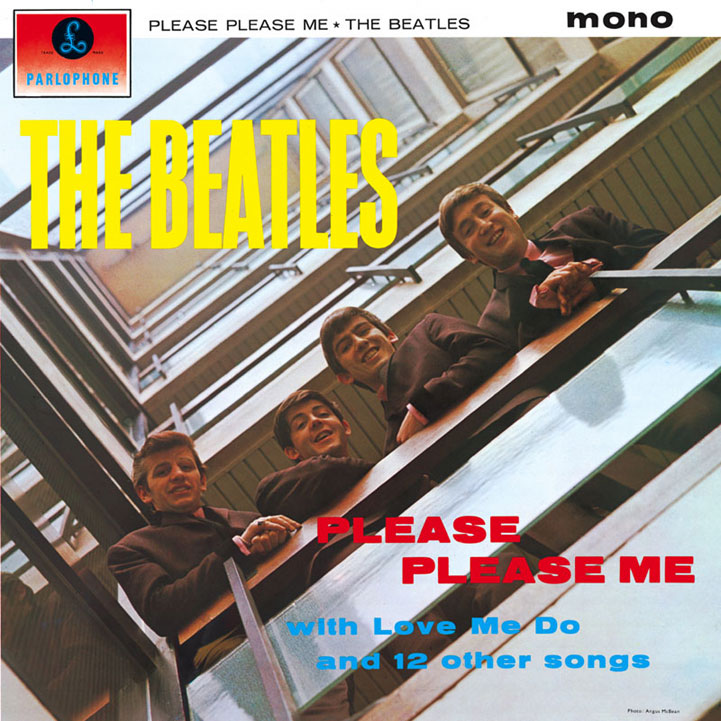
Blogging the Beatles 4: Please Please Me LP

image via discogs.com

Album: Please Please Me
Released: 22 March 1963

Let’s start with some interesting facts:

1. Photographer Angus McBean, who had previously worked on comedy record covers, took the famous picture in the stairwell of the old EMI house in Manchester Square on 5 March after an unsatisfactory session with photographer John Dove. Dove’s ideas were very typical of the day: standing on stairs, corny dance poses, arty ground-view shots. McBean’s iconic shot was quite different from the norm, especially for a debut album.

2. Four songs already recorded as singles made their presence known here, the A and B sides mirroring each other (the “Please Please Me” single in reverse order and ending Side A, the “Love Me Do” single in its right order, starting Side B). This running order is quite uncommon for the time, considering most pop albums would have the hit songs starting Side A, so the average listener would hear the hit song right off the bat.

3. The remaining ten tracks (plus an eleventh unused track, “Hold Me Tight”, which would be rerecorded and released on their second album) recorded for this album were all done on 11 February in 585 minutes (roughly ten hours, not including breaks, and not including two extraneous overdubs by George Martin), for the princely sum of four hundred pounds. And John Lennon had a heavy cold at the time.

Mind you, recording an album in a day was typical for the time, but it was quite rare for every single track to be up to snuff–more often than not, a pop singer’s album would contain two or three hit songs and the rest would truly be filler: half-baked songs and throwaways that were recorded to pad the playing time. Added to that, eight out of the fourteen tracks were written by the band themselves, with only six covers used.

Granted, even though their recorded output at this point was exactly three singles, they were by no means amateurs. The band was ridiculously busy at this point, playing shows nearly every single day for about two and a half years straight, sometimes double shows (one afternoon, one evening). This was the price they paid for wanting to be famous pop stars, and they weren’t going to be lazy about it. They wrote and jammed in between shows, on tour buses, on days off, whenever. Thanks to the unflagging loyalty and relentless work of Brian Epstein in managing their tours and recording time, the band could solely focus on what they did best: the music itself.

Side A
Track 1: I Saw Her Standing There
…and what a great way to start an album! George Martin had understood they were primarily still a live band at this time, so he’d decided to keep the excited count-in (very rare in studio tracks back then) nicked from Take 9 (which you can hear on 1995’s “Free As a Bird” single) and edited onto Take 1. The song itself, a great party rocker written by Paul and aided by John, is one hell of a great opening track for an album, especially when it’s not the big single of the moment. It’s a love song, but it’s also a love song for the excitable British youth of the era–Paul’s not meeting a girl on the street or in a quiet parlor…he’s catching a girl’s eye on a crowded dance floor and falling in love instantly. This is exactly why, when the song was released in the US as a single at the end of 1963, it would be the main catalyst for Beatlemania in America. It provided the kids exactly what they wanted to hear.

Track 2: Misery
This one’s interesting, in that they’d specifically written it for Helen Shapiro, who they’d been touring with for the last few weeks on a package deal, and was about to record a country album in Nashville. However, Shapiro’s manager nixed the idea, and the song ended up in Kenny Lynch’s hands–Lynch was a well-known actor/singer in Britain who was part of the Helen Shapiro tour (and interestingly enough, he later ended up on Paul’s Band on the Run album cover…he’s the guy right behind Paul, grabbing the shirt of the guy behind him). Lynch’s version ended up being the first Beatles song to be covered by someone else. John and Paul both admit this is a space-filler song for the album, considering it was for someone else, but they don’t waste it. The vocals have strong delivery, and the playing is tight. It’s also one of the first Beatles songs where George Martin features as a session musician, offering the piano opening.

Track 3: Anna (Go to Him)
The second song recorded during the third session of the day, and you can hear John’s voice starting to crack ever so slightly here from strain. This is pretty much a straight cover of Arthur Alexander’s original, right down to Ringo’s drumming; the single had come out in late 1962 on Dot Records, so it’s most likely that this was another in the Beatles’ recent live repertoire of obscure American singles. Despite all that, it’s a strong cover that captures the desperation of Alexander’s, right down to the the pleading middle eight.

Track 4: Chains
The first of two George-sung songs on the album. This Goffin/King composition was a hit for Little Eva’s backup singers, The Cookies. Though this is another spot-on cover and a filler, the Beatles loved it for the three-part harmony. It was covers like this that inspired harmony in future songs of their own such as “She Loves You” and “Nowhere Man”. This song seems just a touch above George’s range, as he tends to reach a bit on the higher notes and thus sounds ever so slightly flat, but for a vocal debut, it works well.

Track 5: Boys
Even Ringo was given a lead vocal now and again, often simple songs to fit his minimal range. This cover of a Shirelles b-side is definitely a live staple and a crowd pleaser (and one to let the other three rest their voices a bit). Unlike most gender-switching covers, however, the band only changed the pronouns in a few verses (from “my” to “her”) and the rest of the track is another nearly spot-on cover, with George soloing where the original’s sax solo resides.

Track 6: Ask Me Why
It’s interesting to hear this and the next few tracks within the context of the rest of this album, for a few reasons. First of all, John’s voice is obviously cold-free here and a lot stronger. And while I felt it was kind of a weak song and understandably relegated to the b-side of “Please Please Me”, it fits really well in the middle of this album. Stylistically it’s very similar to the other mid-tempo songs here like “Do You Want to Know a Secret”, and is a good segue between the raucous “Boys” and the poppy “Please Please Me”.

Track 7: Please Please Me
Again, I find it quite fascinating that the current single on the charts at the time was planted right here in the middle, and at the end of the first side. This was part of George Martin’s plan, to sequence the album as if it were a live show: don’t put the big hits at the beginning, because everyone will walk away after you play them–put the hits in the middle so they have to wait, but not for too long.

Side B
Track 1: Love Me Do
This is the re-recorded version with Ringo on tambourine and session player Andy White on drums. Again, context plays here: its sparse, countryish style is quite different from the rest of the songs on the album, but not enough for it to stand out like a sore thumb. It’s contained here mainly to say “you remember this from six months ago? Well, here they are, and they sound even better!”

Track 2: P.S. I Love You
Again, one of my favorite tracks of their early career, and one of Paul’s best early songs. Compare this track to “A Taste of Honey” and “Baby It’s You”, and you can see how deftly Paul can pick up on a musical style. And as with “Ask Me Why”, this track works okay as a single, but works even better as an album track.

Track 3: Baby It’s You
The next-to-last song recorded that day, and John’s voice is really starting to waver here. Another Shirelles cover, it’s another live staple and filler. Paul and George (with a bit of John) provides backup vocals, but it’s mainly John here, delivering a very Motown-esque vocal. Listening to these tracks in chronologically-recorded order, you can hear the band are a bit tired here (this was most likely somewhere around Hour Nine in the session), but despite that, they deliver the goods.

Track 4: Do You Want to Know a Secret
This was written primarily by John and inspired by “I’m Wishing” from Disney’s Snow White, a track John knew from his childhood. He turned it into a simple “I’m falling in love with you” track, specifically for George to sing. At the time, George was not much of a songwriter, but he was often given equal stage time for his vocal abilities. In these early days, his singing voice had a gruff tone–you can hear more of that Liverpudlian accent than with the other two. It’s not as strong as John’s or as dead-on as Paul’s, but it’s unique and it works well here.

Track 5: A Taste of Honey
The first track for the band’s afternoon session that day. The song was written originally as an instrumental for the Broadway version of the Shelagh Delaney play of the same name. It was given lyrics soon after and recorded by Lenny Welch, who released it as a single in late 1962. It was most likely this version that the Beatles knew and copied, as theirs is close to the original. There’s some lovely guitar work here from George, who calmly plucks the strings during the verses and strums the chorus. John, Paul and George get some nice harmonies in there on the title phrase (and the “doo-doo-dn-doo”). Even Ringo’s quite restrained brush playing is perfect. One of my favorite bits in any Beatles song is in the “I will return” refrains here…Martin gave Paul some heavy echo to emulate the poor soul walking away, hands stuffed in pockets and sad to be leaving, and it works brilliantly. Added to that, we’re given a tiny speck of hope at the end, when the B minor-to-F# minor riff repeats only to finally land on F# major instead. Maybe he really will return…

Track 6: There’s a Place
Though this is the next-to-last track on the album, it was the first track they’d attempted to record that day, with ten takes. John uses the harmonica sparingly here, but it’s an interesting use, with the first note of the melody being a dissonant E-flat, echoing the song’s personal sadness. It’s a John and Paul song from start to finish, sharing harmonized vocals throughout. George makes a minor vocal appearance with harmony on the chorus.

Track 7: Twist and Shout
…and how else could they end the album, but with their showstopper? Originally a throwaway dance track by Philly band The Top Notes in 1961, it was soon covered with great success by the Isley Brothers in late 1962, and the Isleys’ party-shaking performance is obviously the one that the Beatles decided to emulate. This was their live set closing number, the one to go out with a bang, and after a brief bit of debate and argument down in the Abbey Road canteen, it was decided as the last song to record. John’s voice is quite audibly in shreds at this time, so they had to get it right the first time (a second complete take was attempted but quickly aborted when it was obvious he just didn’t have any voice left). Despite the obviously painful vocal delivery, they nailed it flawlessly, and it remains one of the bands’ best known and loved songs of the early era.

*

This obviously was not your typical debut album of the early sixties. This was a band purely dedicated to their craft and a love of music. You can hear signs of their trademark sound right from the beginning–the harmonies, the boundless energy, the unique songwriting ability, even the clever way John and Paul played off each other. It was an instant hit in the UK, and stayed in the charts for weeks, where it finally got chased off by…their second album, With the Beatles.

And yet in the US…Capitol Records didn’t care for it at first. Obviously their parent distributor, EMI, thought quite well of the band, but the US were slow to catch up. For most of 1963 in America, Capitol passed on their early output, leaving Epstein to broker a deal with low-budget label Vee Jay for the album. Even then, a legal delay caused it not to be released until January 1964, one full week behind Meet the Beatles, when Capitol finally jumped on the bandwagon. And to add insult to injury, Vee Jay capitalized on their license by releasing the same album (or songs from it) under at least four different titles. Even the band’s singles before “I Saw Her Standing There” languished on small labels like Swan and Tollie. Capitol would finally buy out the license in 1965, “officially” releasing the songs under the title The Early Beatles. It wasn’t until the CD releases in 1987 that the US finally saw Please Please Me as it ought to be.

Mind you, the album wasn’t even out yet and they were already working on their next single.

Next up: “From Me to You”/”Thank You Girl” single
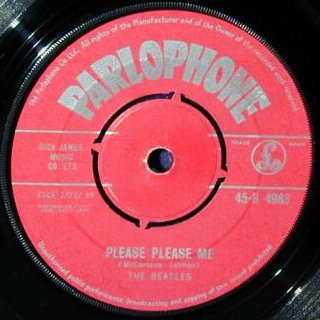
Blogging the Beatles 3: ‘Please Please Me’/’Ask Me Why’

Credit: jpgr.co.uk – The Beatles Complete UK Discography site


Single: “Please Please Me”/”Ask Me Why”
Released: 11 January 1963

So–how to follow up with your big (or in this case, somewhat modest) debut single? For George Martin, he was still adamant to have the band release “How Do You Do It”, but the Beatles stood on their principle of releasing their own songs as singles. There was a good couple of months’ worth of time between their previous session and this next one, however, and they didn’t rest on their laurels. They had an extremely busy tour schedule, not only in Liverpool but elsewhere in the country, as well as a two-week stint in Hamburg at the Star Club with Little Richard. The Beatles were no longer a bar band…they were a professional band now, playing venues and going on radio shows and keeping their name out there–thanks to manager Brian Epstein who had become their official manager just that January. They might have had only one single (technically two) out there, but they weren’t about to let these moments pass them by. They finally reconvened at Abbey Road on 26 November to record two more songs for a follow-up single.

Interestingly enough, this next single catapulted them to the number one spot on a lot of British charts, including NME’s, but–it’s not considered a true number one, because Record Retailer at that time was considered the “official” UK chart (sort of like Billboard for the US in a way), and it only hit #2 there. This would also explain why the song is not on the 1 compilation.

Side A: Please Please Me

A much more uptempo song for them, and a good thing. Sources state that the original version written by Lennon was a slow ballad not unlike Roy Orbison’s “Only the Lonely” (which he has stated was an inspiration), but after Martin’s suggestions, the pace was quickened and the mood made livelier. It’s a fun song, really–it showcases a lot of their best moves at the time. Starting off with another of John’s harmonica lines, this one is less countrified than on “Love Me Do”, and is used more as background. John and Paul deliver the main verses as a duet not unlike the Everly Brothers, John singing the main melody and Paul harmonizing up top. Then there’s a little something unexpected–a guitar and drum fill played to ‘rev’ up to the next line. Even better is that quick stop and reverse-melody guitar fill taking us into the climbing chorus. And that’s just in the first thirty seconds! And there we are, about halfway through the song: the middle eight. The Beatles were masters at the middle eight, that bridge where the melody is counterpoint to the rest of the song, where the plot of the song hangs in the balance before coming back to the familiar verse and chorus again. There’s also the different repetitions within the song–the singsong harmonica line, the wordplay of the title itself, and the the triple repeat of the final line of the chorus at the end of the song. And to top it all off–none of this is overtly noticeable. It retains its simple catchiness.

All this was of course old hat to them by then, as they’d written countless songs over the last few years, inspired by the countless bands they’d toured with and seen Hamburg and elsewhere, as well as all the American records they’d gotten their hands on. But to British ears, this was new and fresh–something so much different than the crooners and the poster boys. There were a lot of new bands out there doing this at the time (the Rolling Stones, for one), but the Beatles were one of the first to break through to major success, and this song was the first one to do it in the UK.

Side B: Ask Me Why
This one’s obviously a filler, a typical “I love you” song (they even use the phrase as the first line) inspired by the soul of Smokey Robinson and the Miracles. A relatively newer track written earlier in the year and played primarily on stage, they used this as part of their June EMI audition and used up the remaining recording time to bash out a few takes of this song. They gave it a jazzy spin, hitting all kinds of minor chords and sevenths. John and George pretty much play the same thing, yet with different styles: John plays straightforward for the backbone, while George embellishes his strumming in a cabaret sort of style. The vocals are impeccable here, John taking up the lead and Paul and George providing backup. There is a bit more experimentation in the stop-start melody trick here, something they’d use a few more times in these early releases, but again, nothing that really stands out. It’s not their most exciting song to date, but as with their work ethic at the time, they put enough dedication into it to be released as a flipside.

Next up: Please Please Me, the debut album

Blogging the Beatles 2: ‘Love Me Do’/’P.S. I Love You’

Credit: jpgr.co.uk – The Beatles Complete UK Discography site

Single: “Love Me Do”/”P.S. I Love You”
Released: 5 October 1962

Hard to believe this song is fifty years old as of last Friday. The official debut of the Beatles–official meaning this was their first release on a major label (Parlophone) and the start of a long and interesting relationship with EMI. Recorded a month previous (September 4th, fifteen takes), this song has some interesting background: the most obvious reason for recording was for the boys to get their first single out after being signed. They’d had a tryout at Abbey Road Studios with producer George Martin a few months previous (6 June), but this September session was the real thing. This was also the first recording session with their new drummer, Ringo Starr, after booting Pete Best in mid-August. And lastly, this was also the session where Martin insisted that they record a cover. Well…the Beatles had learned their chops doing covers, but they’d written numerous songs themselves by then, and weren’t about to budge.

Cover songs were actually more profitable, and more successful, back in the fifties and early sixties, it was a surefire way to get a hit, especially if you’re a band that isn’t too well known outside your hometown. And the track, “How Do You Do It”, isn’t that bad of a song, to be honest. But you can definitely tell that the boys really weren’t that into it…John’s vocal delivery is strong but uninspired, and the rest of the band don’t seem to want to put much energy into it. The track was quickly shelved, lesson learned. They focused the rest of their time and energy on the other two songs slated for that day.

Side A: Love Me Do
This track is definitely indicative of the songs John and Paul wrote from around the Quarrymen days of the late 50s to their Hamburg days (this one apparently dates back to about 1958 or 1959). It’s a playful riff on the “moon in June” rhyme scheme they knew so well–so much, they had it down to an artform. There’s nothing more obvious than the “I love you/always be true” couplet. It could be a song you’d hear anywhere on the radio at the time. But less noted is how regional the song is. It’s almost a country song, a working-class sound in a way, with its steady but unassuming beat and John’s harmonica–it’s a riff you’d hear someone play while walking the docks in Liverpool. Their hometown was considered the boonies back in the day, well north of metropolitan London, and this “Mersey Sound” (as the locals termed it) gave them a unique edge. Also different from most songs at the time is the shared vocal–after all, this wasn’t John and the Beatles or Paul and the Beatles, but The Beatles…a group, not a lead singer and his backing band. Only when the “someone to love” middle eight comes in does it waver between Paul alone and Paul and John together, as well as Paul’s solo “love me do…” when John jumps in on the harmonica again.

This first single version is nowhere near as polished as it really should have been, really. Musically, it’s as tight as they could get at the time, but considering this was their first real session for an actual release, nerves are definitely to blame for its shakiness. Martin was apparently not too impressed with Ringo’s drumming on the track and hired session musician Andy White to fill in, demoting Ringo down to tambourine. There’s also the fact that Paul’s voice is clearly not as strong in the first version–he warbles during the middle eight and his “love me do…” sounds far from perfect. The second version is much tighter both in the music and vocals, and Paul gives a much braver delivery. After the first edition of the single, this second version took its place and also made its way onto the debut album.

Side B: P.S. I Love You

Honestly, you’d think this was a track from The Music Man or one of those musicals of the time that they were so fond of covering (such as “A Taste of Honey”, which they would soon record for their first album), given the complex melody of this song, but no…it’s one of Paul’s, and one he wrote during one of their stints in Hamburg. It’s an interestingly simple melody that utilizes some pretty complex chord changes. It’s also an epistolary song, another easy and winning songwriting trick at the time. Sort of inspired by the “letter” songs about a woman waiting at home, hoping her man would return, Paul writes this as himself being the man on the road, promising he’ll be home when he can. But it’s the amazing melody he wrote that elevates it from a simple love song to a gorgeous one. There’s no slow intro here…it starts off with the letter, pen already in hand, already writing. It’s a fast love song, played uptempo with a cha-cha beat, which makes the track feel romantic and hopeful, rather than wistful. Lastly, Paul does something unconventional by singing both the call and response parts of the last round of the main verse: “As I write this letter (Oh!)/Send my love to you (You know I want you to)/Remember that I’ll always (Yeah!)/Be in love with you…” There’s so much going on in this little song that in retrospect, it’s amazing that this was the b-side to their first single. It’s a lovely track and one of my favorites of their early recordings.

All in all, it’s not a bad debut. It’s not a phenomenal single at any stretch, and perhaps it’s a bit reminiscent of every other poppy love song out there at the time, but it was unique enough for people to take notice. It only hit #17 on the British charts, but for the boys, just getting on the charts at all was enough to excite them and aim even higher.

[More on these songs when I review the Please Please Me album.]

Next up: “Please Please Me”/”Ask Me Why” single

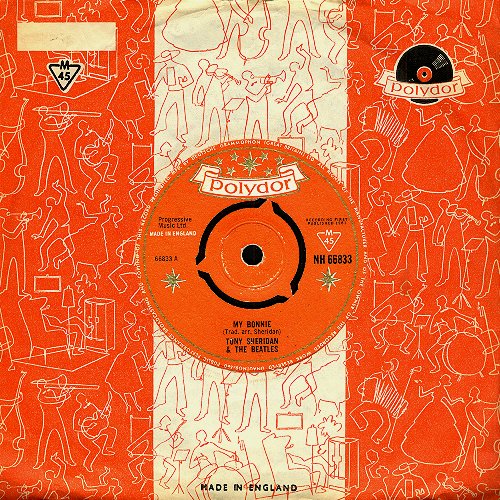
Blogging the Beatles 1: ‘My Bonnie’/’The Saints’

NOTE: Welcome to the first of many ‘Blogging the Beatles’ posts! I’ve been wanting to do this for some time now, considering I’ve been a fan of the band since I was a child. My aim is to go through all of the Beatles’ official music releases in the UK catalog, in chronological order. My approach to this series is going to be twofold: first, I’ll give some detail to the release, including any recording notes as well as what was going on in the world at the time, just to give the release some cultural background. Secondly I’ll give my own take on the release, any opinions and/or thoughts about it. Hope you enjoy this series!

*    *    *    *


Single: “My Bonnie”/”The Saints”
Released: October 1961 (Germany), 5 January 1962 (UK)

Some background is in order:

The era was the summer of 1961, and popular music was evolving at an amazing rate. Only a few years before, Elvis was singing countrified blues and Bill Haley and His Comets were playing dancy swing. The popular music of the day spanned all kinds of disparate genres by the start of the sixties, from the soul of Motown, the jazz of Brubeck, the country of Patsy Cline, and the rebellious new “rock and roll” of The Shadows and more. And with the sudden influx of youngsters grooving to these new beats, the music labels knew a cash cow when they saw one.

At this time, it was still de rigeur to have a lead singer (preferably a pin-up of some sort) backed by a band, whether it was a solo singer backed by the ubiquitous Wrecking Crew, or Cliff Richard and his Shadows. It was a holdover from the jazz orchestra days when you had So-and-So and His Band filling the dance floors. This was especially exciting in post-WWII Europe, when everyone was just about sick of hiding in their houses and wanted to get out and have fun. The historic transport hub of Hamburg, Germany became a hotspot of youth activity, especially with art and music. After a few years of playing around Liverpool, The Beatles made their way to Hamburg for two stints at various music clubs in the red light district, with two aims: learn their chops, and get famous. You could most likely call this the Beatles’ “bar band” era, since in essence, that was what they were. They didn’t get famous, but they had a regional following and they stuck with their killer schedule, playing multiple shows a night.

During the first stint, they had met a solo singer/guitarist named Tony Sheridan, a fellow Liverpudlian who played nightly at various clubs and had set a name for himself in Germany as a mid-level rock crooner. They hung out, jammed, and occasionally even played on stage together, and in the summer of 1961 Sheridan had asked the band if they wanted to be his back-up band for some of his songs. Now, considering the band’s wishes for fame, how could they resist? They recorded a small handful of songs under the name “The Beat Brothers” which were soon released in October of that year. [Rumor states that the name change was warranted because “Beatles” in a German accent sounded like “peetles” which was apparently slang for a man’s naughty bits…but I’m more inclined to think that the label (Polydor) wanted a more generic yet still catchy name for the band to make Tony’s name stand out, which was a common label move.] The above two songs were selected as a lead single.

It sold reasonably well in Germany, and the oft-told story goes that someone brought a copy of this single into a small London record/hi-fi equipment shop hidden on the upper floor of a furniture store, handed it to its manager Brian Epstein, and the rest is history. It’s not often considered part of the official Beatles canon, but it is definitely their first released recording. It’s by no means an exciting debut, but it was enough to get them noticed by the locals and give them a step towards a professional level.

Side A: My Bonnie
The song itself is a typical rock interpretation of an old standard, of course. This was a common trick in the 50s and 60s, to “update” the sound of a well-known song so the kids would love it and even the older generation would enjoy it. Tony and the band start the track off in typical showbiz fashion as a slow ballad with harmonized vocals and some well-played guitar…then BAM! A repeated G7 chord swings it into high gear, and we’re off on a wild surf ride. Paul McCartney’s voice is obvious about a minute in, singing the high end, while John Lennon hits rather comedic vocal bass notes. The guitar work is tight but not mechanic, as you can hear both Tony and George Harrison hitting some Berryesque riffs every now and again. Pete Best, here being one of the very few songs he’d record with the band, keeps the beat strong but never gets overbearing. It’s a dirty, unkempt version of the song, and Tony warbles quite a few of the notes as if he couldn’t quite hit them, but that’s part of its charm–this is the Beatles as Bar Band, cutting loose and having a bit of fun in the studio.

Side B: The Saints
Another old standard–this one an old Christian hymn from Belgium–given the rock and roll treatment. Fats Domino did it first and Bill Haley had introduced their own swing versions, but Tony and the band give it their own interpretation as a rocker. It starts off as a quiet shuffle and slowly builds until you’re not sure if it’s a lively gospel song or if it wants to do the Twist. Again, this is very typical of the time–get a song everyone knows and remodel it in a way that will get the crowd out on the dance floor. This track isn’t quite as thrilling as ‘My Bonnie’ is, and a few of the other tracks the band worked on with Tony are much stronger, but it’s a good b-side nonetheless.

Personally, I could go either way with their Sheridan-era recordings, as they’re good for historical purposes, but nothing that would hint at greatness. They were still wet behind the ears here, learning what being a professional musician was about: hard work, long days and nights, bouts of loneliness and insanity, all at a level most would have not dreamed of nor wanted. But they were stubborn enough to want it, and persevered.

NEXT: the official debut single, ‘Love Me Do’/’PS I Love You’

What do you like? What do you love?

It’s no secret that the above song, The Church’s “Under the Milky Way”, is my absolute favorite song. I’ve mentioned it countless times in previous LiveJournal posts and elsewhere. I think I’ve given various reasons why I love it so much in those same posts. Of course this begs the question…why do I love the songs that I do? I could give this a simple answer, which to some extent is true: would I go out and buy it, or just acknowledge its existence and maybe buy it at some later point if I’m still interested? But that’s too easy and too simplistic an answer, and really misses a lot of why I like and/or love a song.

I’ve often said one of the easiest ways for me to love a song is to drench it in reverb. It’s partly why I love shoegaze and Britpop so much, to be honest. Giving a song depth by way of selective echo–just enough to give it atmosphere–is an easy thing to do, even with your simple audio mixing software. I did it with a mix of one of my jeb! songs by making it sound like Bruce and I were playing on an empty stage (when in reality, it was recorded in a small room in his parents’ basement), and I consider it one of our best tracks. Reverb is also right at home with My Bloody Valentine–their signature sound, especially on “Only Shallow”, was created with a combination of heavy reverb, heavy delay, and seriously loud volume. That intense wall of guitar riff you hear in Ride’s “Leave Them All Behind”, the one that sounds like some giant machine churning out an infinite B chord, uses the same technique. Why do I like that vast, echoey sound? A lot of it has to do with my old listening habits back in the 80s, most of which was via headphones. That echo, combined with the darker mood of the ‘college rock’ I listened to, was great at stimulating my imagination at night. It was like an aural equivalent of being in the middle of a New England forest, with no one around for miles.

I also find that one of my favorite types of songs are ones that start off modestly, maybe quietly or evenly, and slowly but insistently build in volume and intensity, until it reaches its cacophonous climax. I suppose I should blame The Beatles’ “Hey Jude” and “A Day in the Life” for my love of that kind of dynamic, considering that The Beatles are what started it all for me. But there’s also Maurice Ravel’s Bolero (a piece I had the immense pleasure of seeing performed by the San Francisco Symphony this past weekend), the ultimate in “soft–>LOUD”, which I’d been familiar with since I was a kid. There are other kinds of dynamics my favorite songs can take, but this is one resonates with me, because it’s almost literary in shape. Failure’s “Daylight” is one of my favorite examples of this, starting off with what sounds like a child’s push toy and a wilted piano melody. Gradually, the vocals and the other instruments (more piano, synth and guitar) enter, building an ever-mounting tension, until BAM! You’re hit with a gigantic wall of thundering drums, wailing guitar, and heavy bass, unrelenting for the last half of the song, until it finally comes to an end, leaving you gasping for air. The first time I heard this song, my first thought was, this is the ending credits theme to my novel. It’s pretty damned epic.

But there’s also just damn fine songwriting and production, regardless of the style. It can be a simple balls to the wall blues-inspired rock song like Jet’s “Are You Gonna Be My Girl?”, which is basically your indie rock version of 60’s-era Rolling Stones, or something like Interpol’s “PDA” where underneath the simple melody lies some deceptively complex musicianship. It could be a kickass rock song with ridiculously fast and intense energy like L’arc en Ciel’s “Ready Steady Go” or something hauntingly beautiful and quiet like Porcupine Tree’s “Lips of Ashes”. They could even be ambient mood pieces like Global Communication’s “Epsilon Phase” or Samuel Barber’s Adagio for Strings.

I suppose my overall point here is that there’s not just one deciding factor in whether or not I like (or love) a song. It can be one of many things, and that is precisely why I try to keep an open mind about different genres of music. There’s not a lot I can’t stand, and tracks that do bother me are usually due to the horrible songwriting or production tricks that make me twitch. But the ones that stay with me the most are the ones that catch my attention, especially if it’s for the first time. These are the songs that stick with me, that make me stop and really concentrate on them, and the ones that impress me the most. I absolutely love that music affects me this way, and I would not want to change that one bit.

[Thanks to Wire’s “Illuminated” for this post’s title.]

Sucking in the Seventies

I was born in late January of 1971, so that makes me just a few months shy of forty-two at this point in time. I don’t feel it most days…in fact, for the most part the reminder of my age is when I think about music releases–remembering when certain songs and albums came out and were huge hits, stuff like that–and only then will I belatedly think “Oh yeah…I’m that old. Huh.” Not that it bothers me. It comes as an afterthought.

As I’d mentioned before, one of the benefits of being this age is being able to see music genres and styles come full circle, or at least warp and mutate and eventually return in some form to the original. Synthpop bands are the big thing lately, bands who might not be giving a gracious nod to the original Krautrock bands of the seventies and early eighties like D.A.F. or Kraftwerk, but are at least embracing the sound’s second generation by giving that nod to Howard Jones, Thomas Dolby, A Flock of Seagulls, Depeche Mode, and so on. Bands like Bear in Heaven, Cut Copy, M83 and so on have brought back that reverb-drenched Korg synth sound, and they’re getting some serious airplay on indie and satellite stations. They call it ‘indietronica’ now, but it’s the same as synthpop–catchy tunes backed by music that sounds futuristic, dated, sterile and exciting, all at the same time. It’s like the 80s all over again.

But what about the seventies? Sure, as a lot of critics and bloggers would like to say, the seventies were one big hellhole of bad fashion, nasty politics, and craptacular music. It was the hangover decade following the partying 60s, the time of old excesses finally coming back to bite us on the ass. And yet…the seventies did have its own saving graces. It had the punk/no-wave/post-punk/art-punk scenes of the UK, New York and elsewhere. FM became the mainstream bandwidth to listen to, and freeform was in its heyday. It had Bruce Springsteen, Led Zeppelin, and Aerosmith. And, if you’re into that kind of genre, it had some pretty damn fine prog rock like early Genesis, Rush, and ELP. And as much as we hate it and like to deride it, there was disco. It never really went away, really. We still have Scissor Sisters, Hot Chip, and countless teen pop singers. The infectious beats are still there, just under different names and better production quality.

One of the reasons I’ve been thinking about this misbegotten decade is the prevalence of pictures run through the Instagram app.

borrowed by @vikstagram at http://followgram.me/vikstagram/

This here’s a good example: a picture of downtown San Francisco at the end of a sunny day. It was taken in January of this year, but with the magic of an iPhone and the Instagram app, it suddenly looks like it was taken with a Polaroid camera sometime in 1977. There’s a slight discoloration you’re not quite sure of (maybe a little sienna from sunfade?), maybe a bit of surface scratch, maybe a bit of graininess, and definitely a lot of color oversaturation. It looks like a picture found in your family photo album that you’d forgotten about. It’s the latest app that everyone loves and uses heavily if they have iProducts. [The rest of us need to use Photoshop, but I’m not complaining.]

Having been a small kid in the 70s, this kind of imagery triggers a lot of visual memories. It brings me back to when my age was in the single digits and the boundaries of my life went as far as my cousins’ house on Paige Street a block and a half away, and the long walk downtown with my Mom (one full mile!) was an exciting afternoon trip. Of when a layer of winter’s snow seemed amazingly deep, and sliding the hills in our backyard was the best thing ever. My dad saved quite a few of these old pictures from my youth, of my older sisters and I playing in the back yard or on a vaction trip to Maine or elsewhere. Perhaps this is the allure of Instagram…those of us in our thirties and forties remember our youth as grainy and color-saturated. We remember our youth as one of those 16mm films we’d watch during recess if the weather was horrible outside.

As is typical with me, this imagery also triggers a lot of aural memories as well. When I see these Instagram pictures of autumn scenes, I think of ABBA’s “S.O.S.” and “Knowing Me, Knowing You” and listening to Arrival on the family stereo in the autumn of 1976. I see pictures of rainy days and I think of Electric Light Orchestra’s “Sweet Talkin’ Woman” and listening to Out of the Blue in the spring of 1978. Pictures of cities at night and I think of The Rolling Stones’ “Miss You” and the gang troubles in Boston in the 70s. Pictures of parks and I think of the kids’ show Jabberwocky out of Boston and its trippy theme song. Every single memory has some slight gauze, as if our young brains had some kind of lower pixel rate and couldn’t save the images any clearer than that.

These are all songs I grew up with, images that I remember from my youth. Despite all the twitch-inducing memories everyone likes to dredge up of bad fashion and excess, a lot of the mundane things in the 70s aren’t very different from what they are today. The seasons come and go, showing us their colors both bright and dark. Fashion is still questionable here and there. Politics still unites and divides. Disco is still here, just under a different name. Rock and roll is still rock and roll. We see the present without the Instagram filters, but we always see the past in that dated, grainy way. It’s even inspired the sounds of these indie bands like Chairlift, Air, Boards of Canada, and more.

Now that I’m slowly approaching forty-two, I’ve decided that perhaps it’s time for me to pull those memory filters aside. I like looking at these faux-aged pictures as art, but I find myself more impressed by the startling clarity and framework of professional photography. If I’m going to revisit the past–my own past, the sound of classic rock and AOR, the history of the country, what have you–I want to revisit it clearly, with as little outside influence or gloss as possible. That way I can understand it better, maybe even visualize the parallels, differences and similarities between the past and the present. I’ll still enjoy these Instagram pictures and listen to these retro-influenced bands, of course…there’s no harm in them if you can tell the difference between then and now.

1981: The Unguarded Moment

In doing some recent research for Walk in Silence, it dawned on me that the debut singles (or at least their first important singles after a the first few misses) of some major alternative bands–bands that would become historical in the genre–all came out within six months or so of each other in 1981. I’m sure this is common knowledge for some music journalists, but I’m fascinated by this idea nonetheless, especially in the context of the book I’m writing. This could very well be the moment in time where college radio in the US started to gel into what would later become the “college rock” sound. The late 70s and early 80s alt.rock were an interesting mix of UK synthpop, American hardcore, German krautrock (itself the inspiration for synthpop), and postpunk, but it must have been around 1980 or 1981 when it all came together and started making sense.

To wit:

(date unknown) February: Hüsker Dü, “Statues”
In the cold and snowy midwest of Minneapolis MN, while a diminutive funk singer named Prince Rogers Nelson grooved to his own brand of sexy soul, a trio of guys–one college student, one record store employee and one hanger-on–got together and started playing a fierce brand of postpunk that was nothing like anyone else had heard. It wasn’t the sloppy, breakneck speed of hardcore, and it wasn’t the regular rock and roll you’d hear anywhere else. It was a hybrid of everything–it was Ramones meets Velvet Underground meets Byrds. “Statues” was a hastily-recorded track that didn’t do too much of anything, considering it was recorded at the very start of their career, but by the following year and the years beyond, they’d record some of the best postpunk out there.

2 February: Duran Duran, “Planet Earth”
Come on, who doesn’t know Duran Duran now? They’re ridiculously famous, and they’re currently on tour supporting their All You Need Is Now album. But back then, these dandy-looking Brits had lucked out by being one of the original handful of videos playing on the fledgling music channel MTV. They were a part of the New Romantic scene in London, which mixed the surge of synthpop sound with Bowiesque glam fashion. Their debut single was an instant hit in the UK, and thanks to its rotation on MTV, they picked up a sizable fanbase here in the states. They may not exactly be the true “alternative” some fans think of, but they certainly played their part in its evolution.

20 February: Depeche Mode, “Dreaming of Me”
Basildon is a postwar hamlet very much similar to an American Leavittown in its planned creation as a “new town” for British citizens wanting to leave London, and four local guys with a love for Krautrock and owning cheap synthesizers were bored and in need of excitement. Vince Clarke rounded up his friends Martin Gore and Andy Fletcher, snagged local hanger-on Dave Gahan, and started writing music and playing local community centers. After a stretch of tightening their chops, writing poppy, danceable songs, and playing an endless run of shows, Daniel Miller, head of Mute Records, fell in love and signed them right away. The infectiously simple “Dreaming of Me” was their first single, and the rest is history.

(date unknown) February: Thomas Dolby, “Urges”
We all know him from 1982’s “She Blinded Me with Science”, but he had quite the background before that. He’d been a session musician for all kinds of bands and performers including Lene Lovich and Foreigner. This track was his first single, released a good year or so before his hit solo album The Golden Age of Wireless. Though his solo recording history is sparse, he continued to be an in-demand session musician. He just released his first solo album in nearly two decades just last year.

6 March: New Order, “Ceremony”
Joy Division was no more when their lead singer Ian Curtis took his own life in May of 1980. However, the three remaining members of the band soldiered on, adding drummer Stephen Morris’ girlfriend (later wife) Gillian Gilbert, and changing their name to New Order. Their debut single contained two songs that had originally been songs written as Joy Division tracks: “Ceremony” and “In a Lonely Place”. Both tracks hold traces of their previous incarnations (especially the low rumbling of “Lonely Place”), but also contained a much richer, more positive vibe that would become their trademark.

14 March: The Church, “The Unguarded Moment”
Well before their genre-defining hit “Under the Milky Way”, this Australian band had a small but dedicated following since the early 80s. After one single that went nowhere, this track became their first minor hit and a fan favorite. This track is indicative of their poppier origins as part of the Australian Neo-Psychedelia scene, which would be their sound until a few albums in, when after an aborted session (which became the Sing-Songs EP), they embraced their now-trademark sound of acoustics, jangly guitars and heavy reverb.

27 March: U2, “I Will Follow”
U2 had been around for a good few years, and had an album and a number of singles out in the UK, but they never quite made it stateside…that is, until a fateful run of shows at the Paradise in Boston MA, a big push by various radio stations (and an especially frenetic push by one DJ, Carter Alan), and the debut American single of “I Will Follow”. The rest is history.

(date unknown) June: Mission of Burma, Signals, Calls and Marches EP
Speaking of Boston…the collegiate town has quite the history of indie bands since the 60s, thanks to the rabid fanbase and the large number of places to play. Three guys got together and formed one of the loudest postpunk bands in the city, and in a surprisingly short amount of time (and with only one album, one EP, and a few singles in their first incarnation), became one of the most important postpunk bands in the genre. This EP contains their seminal hit “That’s When I Reach for My Revolver” (the link above goes to that track) as the first track, introducing the band to even more fans outside the Metro Boston area. They broke up soon after due to guitarist Roger Miller’s tinnitus, but have since reunited and released new albums, including one last month, Unsound.

8 July: REM, “Radio Free Europe”
Meanwhile, four guys with a love for jangly guitars and the collegiate sound of Athens GA’s nightlife (including Pylon and The B-52s), got together and started playing their own unique brand of folk rock with intellectual, perhaps even philosophical lyrics. REM released the original version of “Radio Free Europe” on local label Hib-Tone in summer of 1981, while still perfecting their chops. It would be nearly a year later when they’d drop their next release, the Chronic Town EP, and you can definitely tell they’d improved by then. The band would become critics’ darlings and have an extremely loyal fanbase well until their breakup in 2011.

7 August: The Replacements, “I’m in Trouble”
Meanwhile, on the other side of Minneapolis, four losers dropped out of school and started playing in their parents’ basements, hoping something would come out of it. Some people loved it, some people hated it–it really depended, honestly, on how much the band had to drink beforehand. But all that aside, their debut single, released around the same time as their debut album (fittingly entitled Sorry Ma, Forgot to Take Out the Trash), was a sloppy yet catchy piece of postpunk that would become their stock in trade. They’d last almost ten years before breaking up, but during their tenure they’d release a startlingly large number of genre-defining songs and albums.

Each of these bands have a decidedly different and unique sound and you would not be able to confuse one with another, which makes this bit of history all that much more fascinating–each band was traveling their own road without the influence of one another (even if they had known each other in passing or from hearing them on the radio), and yet each of the above became bands that defined the alternative rock genre, especially during the “college rock” years.

Radio BDC: The new Westinghouse model?

This past Monday, four former WFNX deejays returned to the airwaves (so to speak), premiering Radio BDC: an online-only station created by and featured on the website Boston.com. For many WFNX fans, myself included, it was like a rebirth: our favorite deejays from the late and venerated Boston area alternative rock station were back on the air and playing the new and old indie rock we know and love so much. At noon Eastern Time (I heard it at 9am out here on the west coast), they counted down to go time and celebrated with Julie Kramer’s excited “Guess what…we’re on the air!”. Champagne was served, cheers were given, and the listeners rocked. The first song, “I Want My City Back” by the Mighty Mighty Bosstones (chosen by listener poll and a very apt choice, given its lyrics) was prefaced by Dicky Barrett of the Bosstones giving the station his blessing.

It’s certainly exciting to hear Julie Kramer, Henry Santoro, Adam 12, and Paul Driscoll back on the air–I knew these four via WFNX for years, and the demise of that station hit me pretty hard. Sure, it’s just a radio station, and all radio stations come and go (and a lot go the way of buyout or sale, but that’s another post entirely), but I’d discovered that station my freshman year at Emerson College, and a goodly portion of my music collection was informed and influenced by what they played. The new station is, for all intents and purposes, the same as the old one; the same alternative rock is being played, old and new, and the deejays are well informed and lovers of the genre. They play this stuff because they’re obsessed with it, they love the fanbase, and they’re having a hell of a lot of fun. There’s no better reason for this station to exist than that. And as a fan, I’ve been listening for hours on end while working at home. I haven’t listened to a radio station, terrestrial or digital, for this long in quite some time.

It wasn’t until yesterday that it occured to me–this station is being hosted by a website originally created as the online presence for the Boston Globe newspaper. Though the Globe now has its own dedicated website, it still runs Boston.com as a regional free site for news, entertainment, and other Bay State information. Radio BDC is essentially a broadcast extension of the site. [CAVEAT: I haven’t done any serious homework on this, so I don’t know if Radio BDC is actually owned by Boston.com or if they’re merely hosting the station; that, and I’m not familiar with the current broadcasting rules for websites and/or companies owning stations. As far as I’m concerned, it doesn’t really matter; all I care about is that they got the permits and went live as quickly as they did.] So it occurs to me that this is just like the old radio stations of yore–I’m talking the birth of radio as we know it, close to a hundred years ago. Specifically, it made me think of those stations that were the broadcasting division of major manufacturing companies, such as Westinghouse. Unlike today, where stations are often owned by conglomerates and media companies (and are usually one of a number of same-genre stations in a collective), back in the day pretty much anyone with money, room for a broadcast tower, and a good business plan could start up a radio station. A number of businessmen actually came to the conclusion that having a broadcast arm of their business a great idea, especially if they were selling or manufacturing radios and radio parts. Pretty soon stations were popping up at hotels and department stores, where people could come to watch live broadcasts of orchestras, plays, and shows. This would be the norm for quite a few decades, with the addition of politicians and celebrities making the occasional visit to the station, and the birth of broadcast advertising. Even the advent of FM radio pretty much followed the same route, until it evolved and mutated into the radio field we know today.

So this got me thinking…will Radio BDC, and other online-only stations take the same route as the old Westinghouse stations? Well, probably not the exact same route, obviously. They share the same building as the Boston Globe out on Morrissey Boulevard, and they’ve had a few sports reporters popping in to talk about the Red Sox, but other than that, you wouldn’t know that this was a station connected to the Globe at all. In fact, the station is a broadcast extension of Boston.com, and that’s pretty much it. But I’ve been seeing this a lot over the past five to ten years…stations leaving terrestrial radio and going purely online. Part of it is the funding–running a radio station is expensive, and it’s not a high-revenue business. Considering that a majority of the revenue is from advertising, sometimes it’s easier and cheaper to go digital–this way your advertising can be visual pop-ups on the player and click-throughs on the website rather than intrusive thirty-second soundbites. You don’t need an expensive broadcast tower or an assigned frequency, either–you have routers and servers. There are even apps that listeners can download to their phones so they can listen in. As long as you follow the basic broadcasting rules, you’re golden. WBCN went digital-only because it was cheaper; WFNX was sold to Clear Channel for much the same reason. The stations as we once knew them are dead; their online footprint, often under new management and/or ownership, is now the norm. Le WFNX est mort, Vive le Radio BDC.

It makes me wonder if, sometime in the future, we’ll see more websites extending into the radio field like Westinghouse did so many years ago. I’m not talking about the streaming “stations”–the websites like Spotify which are generally just a giant mp3 server on a genre-defined shuffle–I’m talking about actual stations like Radio BDC…radio stations in the real sense of the term, with actual deejays, live events and the occasional commercial break. It also makes me think of regulation, but that’s another post entirely. For now, I’m curious to see if, how, and when these new versions of old radio stations might come into being via the websites that are hosting them.