Unknown's avatar

About Jon Chaisson

Author, blogger, music collector, cat wrangler. May contain trace amounts of sugar and caffeine. Books available at Smashwords!

Forty Years On? A brief overview of 1978, Part I

You knew it was going to happen sooner or later.  This is by no means complete, and I’m leaving out a LOT of great tunage primarily because it’s stuff I didn’t listen to or even know about until years later… but here’s a smidge of some of my favorite songs I heard on the radio when I was seven and my lifelong obsession was just starting out.

Electric Light Orchestra, “Mr Blue Sky” single, released January. Their fantastic Out of the Blue had been out for a few months by this time, but this became the fan favorite for years to come. Hearing it as the opening song for Guardians of the Galaxy Vol 2 made me ridiculously happy.

ABBA, “Take a Chance on Me” single, released January, My sister was a big ABBA fan and I loved listening to The Album, which had come out in December. They may be sugary pop, but they could write one hell of a great song.

Van Halen, Van Halen, released 10 February. The local rock stations LOVED this album and played most of its tracks. A staple cassette in your boombox or your car stereo at the time.

Wings, London Town, released 31 March. I always say that Yellow Submarine and the Sgt Pepper movie kickstarted my Beatles obsession, but I’m pretty sure Paul’s “With a Little Luck” single had something to do with it as well, as it got played EVERYWHERE and I remember my mom and I liking it a lot.

Hot Chocolate, Every 1’s a Winner, released April. I loved the funky groove and the wonky production of this track, and it (along with their “You Sexy Thing” remains one of my favorite 70s songs.

KISS, Double Platinum, released 2 April. One of my other sisters was a KISS fan and got this for her birthday. I was quite familiar with their songs, so this was a great entry point for all involved.

Cheap Trick, Heaven Tonight, released May. “Surrender” drops and becomes everyone’s favorite rock song for the entire summer and for decades to come. One of the best rock songs of the 70s. A and I drove down a highway towards Houston with this song blaring, the both of us singing along like happy idiots!

Coming up: More 1978 goodness!

Twenty Years On: September 1998

September 1998: It’s starting to get cooler out, the days are getting shorter. The commute home gets me there in the dark. On the occasional Wednesday I’ll do my comic book road trip across the state; while I’m enjoying buying the comics and taking the long drives, I think it’s more about me finding a new outlet to escape the frustration of living back at home with family. It’s about doing something for myself, just like my occasional drives into Boston on the weekend, or my hiding down in the basement to write. I’m pretty much finding my own unique self at this point. It’s a perfect time to do so, considering that I’ve disconnected from most everything and everyone else that had held me back a few years earlier.

Just me, my music, and my writing. I could live with that.

The House of Love, The Best of the House of Love, released ?? September 1998. I’d been a fan of this band since “I Don’t Know Why I Love You” but for some reason I never got around to buying any of their albums…! This was a perfect jumping-on point, as it’s an excellent mix of their late 80s-early 90s output.

Depeche Mode, “Only When I Lose Myself” single, released 7 September. A new teaser single to add to their upcoming greatest hits album (The Singles 86>98, which would drop on 28 September), it’s got the grim darkness of 1997’s Ultra, but it also has the tenderness of some of Martin Gore’s best balladry. It’s a lovely, relaxing song.

Mansun, Six, released 7 September. While this certainly didn’t come close to the Britpoppy goodness of their minor hit “Wide Open Space” and was resequenced and pretty much ignored in the US, it remains my favorite Mansun record for its grandiose scope. It’s a long album, but it goes in so many interesting and unexpected directions that it’s a hell of a lot of fun to listen to. Another record that got heavy rotation during my writing sessions.

Belle & Sebastian, The Boy with the Arab Strap, released 7 September. Critics loved this band since their start, but it was this album that expanded their fanbase exponentially, thanks to being signed to Matador in the US. [This is also the album that infamously received a ridiculously pompous negative review on Pitchfork, thus branding the site by some as being written by and for hipsters who only listen to obscure bands.] It’s light and poppy — and the perfect example of ‘twee’ which became the code word for them around this time — but it’s also full of great tracks including the title song. Another writing session album.

The Fireman, Rushes, released 21 September. Paul McCartney’s side project into chilled-out electronica gets a second album here, this time of completely new source samples and sounds. It’s relaxing and lovely and totally not what you would expect from Macca at all.

American Football, American Football EP, released 29 September. A band that partly inspired the late 90s-early 00s resurgence of quiet, meandering post-rock, this band had only released this EP and a single album (of the same name) the following year before breaking up (and not acrimoniously: their college years had come to an end and were now in different cities). They’re a cult favorite and well worth checking out; they’ve also reunited as of 2014 and put out a second album (yes, of the same name again) in 2016.

UNKLE, Psyence Fiction, released 29 September. I rarely embed a full-album video stream, but this is definitely an album you need to hear from start to finish, as it’s JUST THAT AMAZING. Producer/DJ James Lavelle created this group, initially with DJ Shadow, and created a ‘band’ that defies description. It’s hip-hop, electronic, soul, hard rock, industrial, and who knows what else, and melded into a semi-thematic album of aliens, space travel, mind travel, and spiritual healing. It can be dark and dense, hard and heavy, but also amusing and just plain weird. And its guests run the gamut as well: Thom Yorke (Radiohead), Mark Hollis (Talk Talk), Jason Newstead (Metallica), Kool G Rap, Badly Drawn Boy, Richard Ashcroft (The Verve), and Mike D (Beastie Boys). It’s a phenomenal album that you should definitely have in your collection. [And yes, another writing session album. I still listen to this one quite a bit to this day.]

*

Coming soon: October 1998!

Fly-By Because It’s Been That Kind of a Week, [feat. Portishead]

Been stupidly busy lately due to the Day Job, so I’m doing a fly-by here.  I’ve been thinking a bit about Portishead lately; I haven’t listened to them in a while and after happening to hear “Glory Box” on the radio, I figured it was time to bring them back into rotation.

I do dearly love that late-90s slinky, smoky trip-hop sound.

We’ll (hopefully) be back to normal next week!

Thirty Years On: September 1988

September 1988:  The beginning of senior year.  All I had to do was get through these nine months of school and I’d be escaping this small town (for good, I’d planned at the time) and moving onto bigger and better things.  The only thing keeping me back was my own damn self.  Which, considering my mindset at the time, was a pretty big fucking obstacle.  Embracing the Creative Moody Bastard was probably not the best of ideas in hindsight.  I worked damn hard on my writing, sure… but at the expense of my own emotional and mental well-being.

Strap in, folks — we have a lot of great tunage to sort through this time!

U2, “Desire” single, released 1 September. The teaser single to their big movie/album project Rattle & Hum, this was a great rock track linking Bo Diddley beats to modern rock. I loved this track when it came out, and I certainly have a soft spot for the album and film.

That Petrol Emotion, The End of the Millennium Psychosis Blues, released ?? September. I finally got into this UK band during this album, and got to see them at UMass Amherst later that year. They had a great mix of Irish folk, funky grooves and loud noise.

Front 242, “Headhunter” single, released ?? September. I became a fan of industrial through this band, specifically this song. This is their best known track, though I’d been familiar with their previous tracks like “Agressiva” and “Quite Unusual”, which got a lot of play on 120 Minutes and WAMH. One of my favorite tracks of 1988.

Laibach, “Sympathy for the Devil” single, released ?? September. I became a fan of Laibach and their brand of industrial right about the same time. I loved the fact that they were both frightening and amazing due to their distinctively Slovenian style of operatic melodies, military beats and guttural singing. You never quite knew if they were serious or merely acting.

Siouxsie & the Banshees, Peepshow, released 5 September. An amazing album of their latter period. They’d gone from twitchy post-punk to proto-dreamwave to neo-psych, and this marked the beginning of their modern rock phase. It’s filled with some of their best tracks and highly recommended.

The Psychedelic Furs, All of This and Nothing, released 6 September. Everyone knew the hits from this band from the early days of MTV, of course, and this was a fantastic collection for anyone who hadn’t gotten around to picking anything up from them. Containing both hits and deep cuts (including the original version of “Pretty in Pink”, not the movie version), it shows just how great Richard Butler and co were as songwriters.

The Feelies, Only Life, released 13 September. This got a ton of play on WMDK and other progressive/AOR stations at the time, partly because it was a welcome return for a band that had been critical darlings at the start of the decade but had remained quiet for a good couple of years. Thanks in part to director Jonathan Demme, who used their music in his movies (and featured them as a party band in 1986’s Something Wild), they remained fan favorites all the way into the early 90s, and have come back strong in the current decade as well.

Cocteau Twins, Blue Bell Knoll, released 19 September. An album that stayed with me for years, and one that influenced my bass playing style early on. I fell in love with this band with this album and went out of my way to find the rest of their discography, even if it was dubbed from someone else’s collection. One of my favorite albums of all time, and highly recommended.

Enya, Watermark, released 19 September. This was an unexpected gem that grabbed my attention, thanks to her first hit. It might have been a big hit with the adults, but I loved its gorgeous, cavernous production. I found myself listening to this one a lot when I needed to chill for a while.

They Might Be Giants, Lincoln, released 25 September, I adored the lo-fi wackiness of their debut album and loved the teaser single for this album. It took me a while to get into it, though… it wasn’t as silly and absurdist, but it was still damn catchy. It was a slow burner for me, but I grew to love it dearly.

*

Coming Up: October 1988, a month filled with albums running the gamut from incredibly noisy to quietly brittle.


More Thoughts on Mixtaping in the 21st Century

memorex dbs gif

I know, I know… they call it making a playlist now.  You grab a few tracks from Spotify and gather them together and call it done.  Where it used to take a good couple of hours to make one on a 90-minute cassette, now it only takes an hour, if that.

As I’ve explained before, my current mixtape creation process is by way of copying mp3s into a new folder, shuffling them into some semblance of order, and retagging them accordingly.  I’m keeping it old-school by having a sort-of-physical end result instead of a playlist.

I’ve noticed over the past few years that one thing hasn’t changed:  the urge to make a mixtape usually comes from hearing a specific song that I truly love.  For instance, my current obsession with Bob Moses’ “Heaven Only Knows” has inspired me to throw the next Listen in Silence mix together.  From there I’ll think a bit about what other songs caught my attention over the last few months.  They’ll just as often be tracks I’ve been hearing on Indie617 or SiriusXM as they’ll be deep cuts from newer albums I’ve downloaded.  The rest of the process is still the same, asking the same questions: what’s the best opening track?  Closing track?  Which songs segue the best?  Which ones sound awkward?  The only thing really missing is writing out the tracks on the c-card.

Do I listen to these after I’ve made them?  Sure!  I listen to them a lot, actually, just as I always have.  I listen to them during writing sessions, during the Day Job, or when I’m at the gym.  And they’re great to listen to on long flights as well.  I’ll even listen to older ones I’d made a few years previous.

I don’t share them as much as I used to, though.  Back in high school I’d give my buddy Chris the track list or make a copy of it for him.  I used to make the occasional mixtape for my then girlfriends of course, but for the most part I made them for my own enjoyment.  And that’s cool too.  Come to think of it, I should probably start posting some of them here.  I haven’t used my Spotify account in ages, so perhaps it’s time to dust it off and create some of my mixtapes for your enjoyment!

Recent Releases, August Edition

I’m actually kind of surprised I was able to come up with a sizable post for August, considering that I’ve been away for most of it!  I did manage to catch up on a lot of great late-summer tunage, though.  Enjoy!

James, Living in Extraordinary Times, released 3 August. I’m annoyed that the only song I ever hear of theirs on the radio is still “Laid” when they have so many great albums, including this new one. They’re all definitely worth checking out.

Capital Cities, Solarize, released 10 August. A mix of older singles and EP tracks and newer material, the duo’s second album is refreshing, poppy fun.

Prince, Anthology 1995-2010, released 17 August. I was rather surprised by this album. Instead of a greatest hits mix, it’s a collection of deep cuts from The Gold Experience to 20Ten. As I hadn’t listened to that era in ages, so I’d forgotten how frikkin AMAZING he truly was as a songwriter. It’s a fantastic listen and highly suggested.

Death Cab for Cutie, Thank You for Today, released 17 August. The new record is well worth the wait. Ben Gibbard and co. have hit their stride here, returning to their meandering melodies and quirky lyrics but keeping it fresh. Also, mad props for sampling/borrowing from Yoko Ono’s “Mind Train” on the first single!

Nothing, Dance on the Blacktop, released 24 August. A great follow-up to their previous record, Tired of Tomorrow. This one feels more melodic and kind of reminds me of a less blistering My Bloody Valentine.

Interpol, Marauder, released 24 August. I love this new album! It feels like a solid return to their original post-punk sound — it does kind of feel like they successfully recaptured the best parts of Turn on the Bright Lights in a way. They’ve regained a powerful sound that seems to have been missing from some of their previous albums.

Alice in Chains, Rainier Fog, released 24 August. Another album that sounds like a great return to form. AiC’s best quality has always been their distinctly swampy grunge sound, and it’s all over the place here.

Mogwai, Kin OST, released 31 August. While this isn’t their first soundtrack (they released Atomic in 2016 for a documentary of the same name), it’s their first for a Hollywood film, and I’m kind of surprised they haven’t been tapped to do more, because they’re naturals at it. It’s heavy, loud, and amazing.

*

Coming soon: September tunage!

Favorite recent find: Bob Moses

Every now and again I’ll hear a new song that will just floor me.  Recently I’ve been grooving to this new single by the band Bob Moses called “Heaven Only Knows”.

It’s got that mid-tempo, low-range electronic groove that I love for many reasons: it’s great chill-out music, it’s got a gorgeous melody, it sounds awesome in headphones, and it’s perfect for my writing sessions.

Sometimes when I like a song that much, I’ll zip online and check out the rest of their discography. As it happens, their entire output is currently available on eMusic, so I was able to download it quite cheaply and add it to my collection.

Come to find out, I already knew one of their songs already! I recognized their 2015 single “Tearing Me Up” from hearing it on the various indie rock stations, but always forgot who it was until now.

I gave their EPs and album a good listen today and I can definitely say these guys are going to get some serious play in the next few weeks. It’s really great mood music for the writing projects I’m currently working on, and it’s also great to listen to during my Day Job hours. And they’ve got a new album coming out in two weeks! Woot!

[Battle Lines will come out on Sept 14th.]

Favorite Tracks: The Boys of Summer

It’s that time of year again. The time when I get all nostalgic about the end of a season, when I talk about how the days are getting shorter, the weather’s getting cooler, and all the kids are back in school.  When I start binge-listening to Cocteau Twins and other early 4AD bands.  When I get another one of those itches to write moody poetry and song lyrics.  And of course, when I start reminiscing about all the great albums that came out in the fourth quarter during my record store years.

Well, I could go on about those things, but I think I’ve already done them enough times for the time being, so I’ll spare you those entries for now.  Heh.

On the other hand, I will say that “The Boys of Summer” is quite possibly the best end-of-summer song ever written.

It started out as an instrumental demo written by Mike Campbell (guitarist for Tom Petty & the Heartbreakers), initially for inclusion somewhere on their Southern Accents album but unused.  After hearing Don Henley needed some music, he let him listen to the demo, and almost immediately, Henley had words for it.

It’s not just a song about the passage of time, however.  It’s not a song about wondering where childhood went, although on the surface there is that theme.  It’s more about, as Henley said in a Rolling Stone interview, the idea of aging and questioning the past.

In a way, it might have a passing similarity in theme to The Motels’ “Suddenly Last Summer”, but in all honesty, it’s more similar to The The’s “Jealous of Youth” in terms of theme.  It’s not a happy song, but neither is it a sad one.  It’s about coming to terms with the age you’re presently at, and all the conflicts that come along with it.  Feeling too old to embrace the wonder of summer, but too young to let it go.  Feeling frustrated when the signs of age sneak up on you unexpectedly — even if it’s in the form of a sticker of a nonconformist band’s logo on the bumper of a high-end car.

It’s a gorgeous melody, all told.  It’s high and hopeful, yet sad and lonesome at the same time.  It’s fast and tense, yet so delicately produced that it feels fragile.  Even the punk cover done by The Ataris in 2003 retains that mood, changing only the bumper sticker to Black Flag’s, making the song all the more poignant for us Gen-Xers.

Twenty Years On: August 1998

7 August 1998:  I’ve just stopped writing The Phoenix Effect longhand, as I’m already caught up with the evening transcription, to the point where I write the final chapters of the novel straight to PC.  Finishing this draft will most likely take place around the end of the month or into early September.  I will then spend the next months working on revision and looking up various publishing houses I’d like to send it to, eventually sending it out sometime early in 1999.

These revision months are spent down in the Belfry, focusing on banging the story into shape, cleaning up the prose and making it even better.  This means that I’ll be listening to a TON of music over the next few months.  I’ll also be listening to the same albums while at the record store job to keep myself in the proper mindset.  In the process, these records become part of the Bridgetown mythos, providing me with not just a soundtrack for the book but inspiring numerous scenes and ideas.

So get comfortable, this is a long one!

LHOOQ, LHOOQ, released 3 August 1998. An import brought to my attention via a UK music mag, partly due to their Duchamp-inspired band name. [It comes from the infamous Mona-Lisa-with-a-mustache painting from 1919; it’s a French pun where you read out the letters as ‘Elle a chaud au cul’…translated to “she’s horny”.] Smooth, laid back electropop, it didn’t do much of anything anywhere, but I quite enjoy it.

Various Artists, For the Masses: A Tribute to Depeche Mode, released 4 August 1998. An amazing collection of DM cover songs, featuring Failure, Dishwalla, The Cure, The Smashing Pumpkins, Hooverphonic, and more. While most tribute albums are touch and go, most with a few stellar tracks and a lot of filler by unknown names, this one is absolutely solid and is highly recommended.

Rasputina, How We Quit the Forest, released 4 August 1998. The trio, known for their Victorian visuals and goth-with-strings sound, released a heavier, beefier-sounding second album with the help of NIN’s Chris Vrenna. It’s weird, spooky, and gorgeous at the same time. It’s probably their most accessible album, and it’s a lot of fun.

Embrace, The Good Will Out, released 6 August 1998. A favorite of the late 90 British Rock era, this album was an immediate UK hit right out of the gate with its strong songwriting and powerful sounds. I especially loved the epic punch of its main single, “All You Good Good People”.

Dishwalla, And You Think You Know What Life’s About, released 11 August 1998. I absolutely adore this album. It didn’t gain nearly as much popularity as it’s 1995 predecessor (Pet Your Friends, which had their hit “Counting Blue Cars”), but as an alt-rock record, it’s a hell of a lot stronger and heavier in sound, and contains quite a few of their best songs, including the stunning ballad “Until I Wake Up”. This one stayed in my writing session rotation for years, and I still pull it out now and again.  If you like their big hit, definitely try this one out too.

Hooverphonic, Blue Wonder Power Milk, released 11 August 1998. I love this album as well, and it’s the one that made me a huge fan of the band. It’s a major shift in sound for them — a new singer, more orchestral accompaniment, less electro beats and more pop mentality. It’s a lovely album to listen to in headphones. This too stayed in my writing session rotation for years. The single “Eden” also influenced the character that ended up being Akaina in the trilogy.

Orgy, Candyass, released 18 August 1998. One of many darkwave bands that surfaced in the late 90s, their one claim to fame might be a crunchy cover of New Order’s “Blue Monday”, but the rest of the album was equally as fun. I’d throw this one on during my Belfry sessions when I needed something loud and aggressive.

Korn, Follow the Leader, released 18 August 1998. I really wasn’t much of a Korn fan at all at the time, but there’s something about this album that clicked for me. It could be that this one captures their signature sound the best — the drop-tuning, the intricate weaving of dissonant sounds, and some of Jonathan Davis’ best songwriting. Plus I loved “Freak on a Leash”, both the song and the video.

Boards of Canada, Music Has the Right to Children, released 20 August 1998. I didn’t get into this band until their next release (2002’s Geogaddi), but I was quite aware of them via this album, which sold regularly at my store. Their name and unique sound is wrapped in childhood nostalgia — they definitely sound like those old public service/educational films you might have watched if you were a Gen-X kid in the 70s and 80s.

Bob Mould, The Last Dog and Pony Show, released 25 August 1998. I’d lost track of Mould’s output after his Sugar albums, so this was a great album for me to return to. It’s more laid back and approachable and features some lovely melodies — like most of 1989’s Workbook, his lighter, more acoustic sound has always resonated deeply with me.

Snowpony, The Slow Motion World of Snowpony, released 25 August 1998. Deb Googe from My Bloody Valentine popped up unexpectedly as a co-conspirator for this noisy alt-rock band. Not as ear-splitting as MBV, but definitely not pop, either.

Manic Street Preachers, This Is My Truth Tell Me Yours, released 25 August 1998. I was quite familiar with the Manics by this point, thanks to their numerous loyal UK fanbase, but this was the album that won me over. It can be a little preachy at times, but it’s also a fantastic record filled with excellent melodies.

*

Coming Up: September 1998, in which even more alt-rock goodness gets released and becomes a part of my permanent writing session playlist!

Inside Abbey Road

IMG_20180811_103853

A selfie of me internally squeeing with joy as I stand in Studio Two, where a majority of the Beatles’ songs were recorded.

You all know of course that I am a huge Beatles fan and music history nerd.  I’m not a fan that wishes I’d been in the deafening audiences of their live shows, no…I’m a fan that geeks out about how their sound was created.  So when our London vacation just happened to coincide with a special open house/historical presentation at Abbey Road Studios, I simply could NOT pass it up. [The presentation was by Brian Kehew and Kevin Ryan, authors of Recording the Beatles, a book about how each song was recorded in the facility.]

IMG_20180811_095100_034

The famous Abbey Road crosswalk from the other direction.  Photographer Iain Macmillan would have been standing on a stepladder right about where that car is on the right side to take the picture.

We arrived there about twenty minutes before doors-open to an already longish line, where there were a few hundred of us waiting to get in.  Once past security (which was understandably tight), we were led into the front doors and into the main entryway.  As I walked through I was immediately reminded of this particular set of Beatles interviews done on 20 December 1966 (they were heading in to work on “When I’m Sixty-Four”, and the interviews were staged specifically to combat recent ‘are they breaking up’ rumors).

Before we were let in to Studio Two, however, they let us take a doorway peek into the amazingly HUGE and cavernous Studio One, usually used for orchestras but occasionally used for Beatle work (“All You Need Is Love” and “I Am the Walrus”, and the various songs from The Beatles laid down while other members were in Two or Three working on something else).

IMG_20180811_101430

Trivia: A possible 70s renovation would have split this room into two smaller upstairs studios and the ground floor into a parking garage.  Thankfully it was nixed.

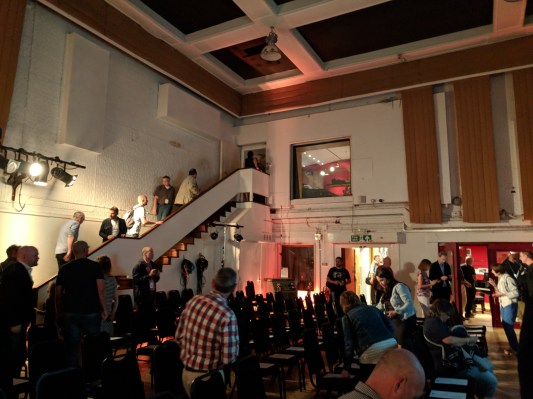
We were then led into Studio Two across the hall, another cavernous room but not quite as large.  Upon entering, you can’t help but think just how unique this studio is, considering that most modern studios are infinitely smaller.  These were created in the 30s mainly for pop and orchestral pieces (trivia: they were extensions of the smaller main mansion, built over the back gardens of two different plots).
IMG_20180811_101833

The main stairway up to the control room.  There are stories that John and Paul used to slide down the railing after popping up there to listen to a playback with George Martin.  Also of note: that small room to the right with the red wall was once the original control room and is now a practice room.

They let us walk around a bit, checking out the various instruments and equipment they had set up.  Most of these instruments were used by the Beatles and are still used by others to this day, by the way!  Including many pianos:

IMG_20180811_101945

A Steinway Vertegrand, recognizable by its bright tone.  Played on “Penny Lane”.  More on this one in a moment…

IMG_20180811_101957

The Challen piano, known for its warmer tones.  Played on “The Fool on the Hill”.

IMG_20180811_102023

The Steinway grand (which gives a lovely full sound).  Played on numerous tracks.

IMG_20180811_102145

And of course the Hammond BT3 organ, also used on numerous tracks.

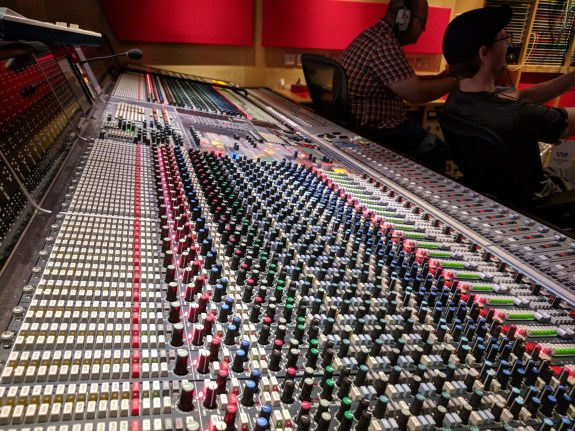
We also got to go upstairs to the main control room.  It’s a much smaller room of course, and the mixing desks have definitely changed over the years from the pots and shifters to a sea of knobs, buttons and everything else.

IMG_20180811_103118
A view from the top of the stairs.  Of note, the opposite far corner is where the Beatles used to hang out most to record, Ringo usually in the corner facing out, Paul and George to the left and John to the right — just like their live setup.
IMG_20180811_103212

The main mixing desk.  I can’t even begin to figure out how this thing would work.  They’ve indeed come a long, LONG way from four tracks in the sixties.  No picture taken, but across the room from this desk is a super-tiny room: in the 60s this was the sound effects cupboard, which was temporarily cleaned out on 13 August 1968 so the Beatles could record “Yer Blues.”

IMG_20180811_103259

Completely innocuous and unimportant, but I was tickled to have found their Secret Tea Stash hiding under one of the speakers in the control room.  It gave the otherwise highly technical room a bit of warmth and humanity.

The presentation itself lasted about ninety minutes and was a fantastic historical overview of the studio itself; Kehew and Ryan had not only done research on the Beatles recordings but on its origins.  They touched on all sorts of things such as its inaugural first recording of Elgar recording his Pomp and Circumstance marches (and its true first recording, a test run of a song by Paul Robeson!), its numerous renovations to improve the sound of each studio, and more.  Eventually they’d hit upon the Beatles’ tenure there, talking their relentless work ethic, continuous experimentation with sounds, and more.

At one point one of them got up from the stage and wandered over to the pianos and explained what they were, their differences in sound, and what they were used on.  This was really neat, as he proceeded to play certain songs on them, like the jabbing chords of “Penny Lane” and the soft taps of “The Fool on the Hill.”

Then he said, “We’d like to do something fun now.  I’d like to ask four piano players to–”

I shot my hand up.  I knew EXACTLY what he was up to.  I’d never forgive myself if I passed this by.

Let’s take a look at that Steinway Vertegrand again:

IMG_20180811_101945

See those green dots?  Yep.  They’re E chords.  One person stood next to me and hit the low octave, and I hit the two chords and held down the sustain pedal.

Three, two, one, THOOOOOMMMMMmmmmmmm.

The famous final chord of “A Day in the Life”.

The first attempt was a bit off, but OH MAN did it sound magical.  Sent shivers down my spine.  And since the face was open and the strings were right in my face, I got the full blast of sound.  I was so lost in it I forgot to lift the sustain and everyone started laughing.

The second attempt sounded even better, as we let it ring for a good twenty seconds.

I can die a happy man now.

Back down on Earth, the presentation continued, talking about the post-Beatles recordings, from Pink Floyd and The Dark Side of the Moon to the movie scores such as the Harry Potter films.  Interestingly, the other bit that gave me shivers was a brief explanation and playback on the use of sound effects, specifically on the opening to Pink Floyd’s “Time”.  They must have used remastered source tapes for that bit, as the simulated heartbeat and the delicate sound of the Shiedmayer celeste (below) almost brought me to tears, it sounded so gorgeous.

IMG_20180811_102045

They wrapped up the presentation with a brief overview of what they’re working on nowadays — numerous rock bands still record there (including Paul McCartney, who recorded his upcoming release there), and they’re one of the main go-to facility for movie scores.

I’ve always said the studio’s sound is definitely unique, in that there’s a specific warmth, fullness and resonance to it that you can always pick out.  I would totally record there if I was a professional musician, that’s for sure.  Not just because my favorite band recorded there, but because it truly is a fantastic place for sound.

One added and quite unexpected bonus:  Now that I’ve seen Studio Two with my own eyes, I realized I could now visualize where the Beatles recorded in this room, down to the space between them, and how it would sound in that room.  On the flight home I found myself listening to The Beatles and started visualizing the four of them recording the main takes of “While My Guitar Gently Weeps” (which, serendipitously, they’d started exactly fifty years to the day I listened to it!) in that big place.  Suffice it to say, I heard it in a whole new way.  And now I’m planning on relistening to the rest of their recordings for the same reason.

All in all, one of the most amazing musical experiences I’ve ever had in my life.

Oh, and we got VIP badges out of it!

IMG_20180819_121744