It occurred to me the other day that it’s been twenty years since I’d moved away from my hometown in Massachusetts. For some people that might be just another life event, but for me it was something pretty big. Until that day in March 2005 (the 6th, to be exact) I’d always lived in MA, five years of them in Boston, then spending just shy of ten years back at the family house getting my affairs, finances and creativity in some semblance of order. All of that changed near the end of 2004 when I started going out with A. in a long distance relationship, then turning that into frequent road trips down to New Jersey (a little over two hundred miles one way) to spend the weekend. It was a three hour drive but it was totally worth it.
All of that changed in early 2005 when we finally made the decision for me to move down there with her and her roommates. We both felt it was something I’d needed to do, and a long time in coming. I was ready for it, and had been looking to moving on for quite some time. The plan was to move down to NJ and eventually find a place somewhere near her workplace, but that ended up going in an altogether different direction later that summer.
It was a year of a lot of major life changes for me, so I allowed my writing to fall by the wayside for a bit. To wit: moving out of my old hometown, moving away from family, moving in with said girlfriend, springing the question and eventually marrying said girlfriend shortly after, visiting another country (that was not Canada, and which included acquiring a passport and flying on a commercial airline for the first time), doing office work instead of warehouse or retail for the Day Job, and eventually moving to the west coast where we’ve been ever since.
I made the above mixtape the night before I left, even though I dated it to the day I got in the car and drove away. I listened to it a few times on the way down to Jersey along with the other mixes I’d made around that time. The themes of the mix were moving out, moving on, escaping, feeling free, and looking toward the future. Little did I know just how much my life would change in just a few months, but I wasn’t going to complain.
I’ve been listening to a lot of music from 2000-2001 lately, and this song popped up on my playlist. Blur can be kind of odd at times, but this one’s strange even by their standards. It was a new track to sell up their Best of album that dropped on 30 October 2000, but it pretty much sounds like an extended jam session set in a single key, feedback and all. It might be filler, but it’s also infectious and demands to be cranked up.
Still, one of my favorite songs of theirs, and I absolutely love the oddball video they made for it.
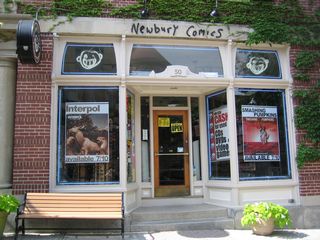
In going through the early years of ‘the Bridgetown soundtrack’ (as I’ve been calling it), specifically from 2000 onwards after I’d left HMV, I’ve been of course thinking of the Newbury Comics that used to be in downtown Amherst, just off the common and across the street from the town hall.
I’d been going there off and on since 1995 or so, but this one became my go-to on Wednesdays when I did my comic book/new music release runs after work once I started working at Yankee Candle. It became one of my favorite things to do: drive down 116 from Deerfield to the Hampshire Mall in Hadley, stop at Showcase Comics to pick up my subscriptions and check out some new titles, then drive up to Amherst Common to spend an hour or so at Newbury and pick up new releases there. I remember my old HMV boss, Tom, had become a district manager for the chain and I’d run into him every now and again. I set a weekly budget of $70 to spend there, which quite often ended up being around five CDs, given the store’s ridiculously low sale prices, often hovering around eight to nine dollars per title.
Given my work schedule by that time — 6am to 2pm — I could get this shopping out of the way and get home in time to chill for a bit, have dinner with the family, then start my nightly writing session around 6pm, where I’d work for about two hours. It was a perfect schedule for me, one I’d keep for the next several years. When I started working at my current store here in SF, I’d offered to be an opener for this exact reason: getting off shift by early afternoon provides me not only with recharge time but also enough for a productive writing session.
When I moved away from Massachusetts in March of 2005, this Newbury Comics was the last place I stopped on my way out. I figured one more time for old times’ sake was worth it. I bought cd copies of two favorite titles I’d owned on vinyl for years: Blood Sweat & Tears’ 1969 self-titled record (the one with “Spinning Wheel” on it) and Boston’s classic 1976 debut. I also bought some snacks and Pocky (that store had been my source of the addictive chocolate sticks for years) and headed out one last time on my way down to New Jersey.
The store moved to downtown Northampton a few years later if I recall, and it’s still there to this day. We’ll stop in every now and again during our visits back east, and although I don’t buy nearly as much physical music as I used to, I’ll still surf through the bins to look for interesting things.
I’ve been going through my music library for the year 2000 to revisit what I would be listening to in the Belfry, and I think I’ve figured out the point where I knew the HMV days were truly over and when the Belfry days kicked into high gear. It’s actually a surprisingly stark line that jives with when I was given the quit-or-be-fired ultimatum from my terrible boss. It’s August of 2000, and by the end of the month I’d be gone.
The Dandy Warhols, Thirteen Tales from Urban Bohemia, 1 August 2000. Although I’m almost certain I bought this in my final days at HMV and listened to it around that time, I want to say this was an album I spent more time listening to in the Belfry. I wasn’t even the biggest DW fan; by this point I’d heard their earlier hit “Not if You Were the Last Junkie On Earth” for the zillionth time on WFNX and did not like it to begin with, hearing “Godless” turned the tables for me. I remember listening to this one a lot during the summer evenings and weekends while figuring out what I wanted to do with The Phoenix Effect.
Between then and the end of the month, I did pick up a handful of CDs both from the record store and from Newbury Comics — by then my weekly comic book run had started to include a quick stop there to look for things my own store might not carry (or sell cheaper).
Goldfrapp, Felt Mountain, 11 September 2000. I’d left the record store by this point and was just starting at Yankee Candle — a westerly commute instead of an easterly one, and twenty miles shorter at that — but I really didn’t want to disconnect from my weekly accumulation of music. I could just as easily buy copies of my favorite music magazines, CMJ (College Music Journal) and ICE (an industry magazine featuring news on new releases) at Newbury Comics. I think this was one of the first that I bought there after starting the new job.
VAST, Music for People, 12 September 2000. I know I bought this one the same day as the Goldfrapp album (and the Barenaked Ladies album Maroon as well). I’d been a big fan of Jon Crosby’s first album under the VAST moniker and while this one felt slightly more upbeat and less steeped in Nine Inch Nails-esque gloom, it featured some amazing tracks that got a lot of play in the Belfry.
*
I actually wouldn’t start writing A Division of Souls for another year and a half, maybe early 2002 after the frustrations brought about by The Phoenix Effect and its sequel The Mihari, which I was writing at the time. The two books do have a lot of similarities to A Division of Souls, however, and it was simply a decision to stop work on both TPE and TM and completely start over from scratch. [Very similar to what I’d done recently with Theadia, actually.]
The music that inspired the project, however, started around this time when I switched day jobs. It wasn’t a clean switch of course, as I actually worked second shift for my first couple of months (3 – 11pm or thereabouts) and wouldn’t move to first shift until sometime in November. It would be around that time when my writing sessions would truly become more stable and frequent, as would my weekly trips to Newbury to pick up new music.
I said I was going to do it and I’m doing it now: I’m currently going through the albums and singles from 2000 onwards as a soundtrack to the Bridgetown Trilogy Remaster Project. I started the revisit on Monday afternoon on my day off with William Orbit’s remixed take on Barber’s Adagio for Strings, one of my all-time favorite classical pieces.
I know, this is sort of an arbitrary place to start and doesn’t really line up with the writing chronology. I’d started and finished The Phoenix Effect (the early ‘demo’ version, if you want to continue the music analogy) but hadn’t yet started writing its aborted sequel The Mihari (that would take place that summer if I’m not mistaken), but the actual day-one of A Division of Souls wouldn’t take place until late 2001 or early 2002.
So why start the relistening at January 2000? Partly because I knew my days were numbered at the record store by then. I still loved the job and wished I could stay there forever, but a) I could definitely see the downturn of the music industry happening in real time, and b) I wasn’t sure how much longer I could handle the store manager without eventually ragequitting. It was also a bit of a weird time musically; grunge had long given way to adult alternative which had given way to meathead alt-metal, and pop was having a huge resurgence with its sugary overproduced electronica.
A lot of music I listened to at the time felt a bit out of place. I wasn’t quite sure what I wanted to listen to, because very little of it was resonating with me at a deep level, as it once had just a few years previous. That could very well be due to personal issues and changes, and at the time I was feeling unmoored.
Still, I was willing to see where it all took me. Life changes and all.
I think it was around this time that I started running out of gas while writing The Balance of Light. [For those playing along, I’d stalled right about where Poe follows Denni and Amna up to Trisanda in Act 3. I knew how to end the book…I think I was just afraid of it this huge years-long project finally coming to an end and doing a crap job of it.] To clear my head I’d started working on the vampire novel more often.
Weirdly enough, I think I was just running out of things to listen to…? There’s this strange era between 2004 and 2007 where I’d lost interest in indie radio. It could be that I was stuck between the lingering effects of alternative metal on one end of the spectrum and indie folk that was a little too esoteric on the other, and neither were really resonating with me. That, and a lot of my favorite bands were in between albums so I wouldn’t hear from them for a while longer.
Danger Mouse & Jay-Z, The Grey Album, early April 2004. Looking at my mp3 collection, 2004 was the peak of the initial mash-up wave, and this one is bonkers fun: DM’s decision to take Jay-Z’s The Black Album and The Beatles’ white album and create something new could have been terrible but instead it’s surprisingly enjoyable and highly amusing. Allegedly both Jay-Z and Paul McCartney thought it was great!
Ambulance LTD, LP, 6 April 2004. This band sadly came and went too quickly, releasing only two EPs and a single album, but it’s all worth checking out. I played the hell out of this record in the Belfry at the time, especially the great opener “Yoga Means Union”.
tweaker, 2am wakeup call, 20 April 2004. Chris Vrenna’s second album remains one of my favorite albums of that year, and it got all sorts of play the entire summer. It features vocals from Robert Smith, Hamilton Leithauser and David Sylvian, and a hauntingly gorgeous instrumental track featuring Johnny Marr that I’ve embedded above. Highly recommended.
Prince, Musicology, 20 April 2004. In between all the funk-heavy NPG Music Club albums he’d dropped for the last couple of years, this was a surprise mainstream hit that got considerable airplay both with the title track and “Cinnamon Girl”. It felt like a record on par musically with Sign ‘o’ the Times for me.
The Beta Band, Heroes to Zeros, 4 May 2004. Their last record’s title may have hit a bit too close to home considering they were no longer indie critic darlings at the time, but that didn’t seem to bother them any with this oddball collection.
The Magnetic Fields, i, 4 May 2004. The fun thing about Stephin Merritt and his many projects is that you can never really take him all that seriously, even when he’s writing breakup songs. Between his basso profundo voice and his quirky and self-effacing lyrics, you can’t help but like him. “I Thought You Were My Boyfriend” was a college radio favorite.
Mission of Burma, ONoffON, 4 May 2004. Their first new album in multiple decades, three of the four original members come back with a loud and blistering record that successfully captures their chaotic post-punk sound that influenced so many others. The fascinating thing is that there’s also an element of quietness here as well, inspired by the members’ time in much calmer bands.
Secret Machines, Now Here Is Nowhere, 18 May 2004. This was another favorite of the year, and an album that got a ton of play during my writing sessions for its deep dive into hard rock tinged with eclectic prog and maybe even a bit of psychedelia. This one earned them a small but highly loyal fanbase that remains to this day and even spread to the side project School of Seven Bells. Highly recommended.
The Fall, 50,000 Fall Fans can’t Be Wrong: 39 Golden Greats, 8 June 2004. A near-perfect sampler of a band with a convoluted discography on several different labels and an always-shifting membership. It’s oddly missing songs from I Am Kurious Oranj however, the 1988 album that helped them gain considerably more popularity in indie circles.
My Chemical Romance, Three Cheers for Sweet Revenge, 8 June 2004. You either love this band or you hate them. For me, they were a band I disliked at first but heard “I’m Not Okay (I Promise)” and “Helena” so much on WHMP that they grew on me. Not quite goth, not quite alternative metal, not quite emo, but somewhere in between.
The Killers, Hot Fuss, 15 June 2004. I’ll be honest, I wasn’t the biggest fan of this band at first, and the breakthrough single “Somebody Told Me” just kind of bounced right off of me as too glam and too alt-rock-goes-disco for my tastes, but the more I heard the other singles the more I liked them, and finally bought it when I heard “All The Things That I’ve Done” which remains one of my favorite songs of theirs.
The Cure, The Cure, 29 June 2004. I’d mentioned this one earlier when I blogged about the band’s 2000s-era releases, and at the time I really wasn’t sure how I felt about it. I liked it, especially the darker-edged songs like “Lost” and “The End of the World”, but its sound was just so unlike them that it was a bit of a hard listen.
I often say that 2005 was the year of major change in my life (getting married and moving twice and all, among other things), but it really started in 2004. I’d met A online and by the summer we were constantly running into each other on LiveJournal. I was writing The Balance of Light at the time and having a terrible time with it, and writing a vampire novel as a way to distract myself. I’d head to my first Worldcon that autumn when it came to Boston. I’d quit buying comics cold turkey when my go-to comics store closed up shop, and I even started thinking seriously about looking to find my own apartment. Life was changing whether I was ready for it or not.
Musically I’d latched onto LAUNCHcast, a sort of proto-Spotify site where one could curate a playlist by way of a ratings system. [And given that my house was in a radio desert, I couldn’t always listen to WHMP or WFNX at the time unless I was in the car or using my stereo upstairs.] Given my music obsessions, it wasn’t long before it provided me with the kind of indie and electronic rock I enjoyed so much.
The Crystal Method, Legion of Boom, 13 January 2004. I’d completely forgotten there was an album between this one and their mega-selling Vegas (the one with “Busy Child” and “Trip Like I Do” on it), so I thought I’d try them out again. This one got a bit of play in the Belfry during my writing sessions.
Air, Talkie Walkie, 20 January 2004. This band is on the ‘I will buy anything from them’ list, and this one became a huge favorite of mine that year, getting a lot of play all around, not just during writing sessions but my occasional road trips as well. I loved that it retained the dreaminess of their Moon Safari album yet sounded futuristic.
Stereolab, Margerine Eclipse, 27 January 2004. Another band I was woefully behind on in terms of collecting at the time, I liked playing this one on the weekends when I had my hours-long writing sessions.
Yes, The Ultimate Yes: 35th Anniversary Collection, 27 January 2004. I’d always been a huge fan of this band, though everything I owned of theirs was on scratchy used vinyl, having acquired them over the years in dollar bins, heh. This was a great full discography-so-far collection that was quite a pleasure to listen to.
The Walkmen, Bows + Arrows, 3 February 2004. Long before Hamilton Leithauser showed up on indie radio with his solo and collective projects, he was the lead singer of this great indie band that got a ton of play on LAUNCHcast and college radio with the song “The Rat”. Highly recommended.
Incubus, A Crow Left of the Murder…, 4 February 2004. Sure, you hear those same two or three hit singles from this band on alternative rock radio these days. Back when this came out, the singles “Megalomaniac” and “Talk Shows on Mute” got a ton of play on alternative radio, but sadly this album tends to be forgotten for the most part. It’s one of their most tense and dense records though, and well worth checking out.
Franz Ferdinand, Franz Ferdinand, 9 February 2004. Yes, that band with that song! They’ve always been a bit of an oddball band that slid between arty post-punk and groovy glam and somehow made it not just fresh and new, but made it irresistibly catchy as well.
Junkie XL, Radio JXL: A Broadcast from the Computer Hell Cabin, 10 February 2004. One of my favorite records of the year, this is a two-cd collection of electronic rock and house mixes and a thrill to listen to. Released just a few years before Tom Holkenborg focused mostly on film scores, this one’s highly recommended.
Audio Learning Center, Cope Park, 26 February 2004. This not-quite-grunge rock band from Portland were big on the moodier pockets of the genre, leaning a bit more towards emo and post-rock in some places. They only dropped two albums (this is the second) but they’re well worth checking out. This one got a lot of play in the Belfry.
TV On the Radio, Desperate Youth, Blood Thirsty Babes, 9 March 2004. I picked this one up mainly due to the fact that every music critic out there were getting their minds blown by this record, and they weren’t wrong. I wasn’t entirely sure what to make of this band at first, considering their sound back then was a bit difficult to describe. But the track “Dreams” was just so emotionally dire that I knew then that this was a record I’d enjoy.
The Vines, Winning Days, 21 March 2004. Their second record after the critically acclaimed Highly Evolved was a bit of both ‘more of the same’ and ‘heading further into psychedelia’ and while it wasn’t as popular as their debut, it was just as enjoyable to listen to.
The Standard, Wire Post to Wire, 23 March 2004. I latched onto the track “Even Numbers” via LAUNCHcast and I picked this one up soon after I’d heard it maybe twice. They were another Portland band made out of former members of other local indie groups, and this was their third and most popular album. This one got a lot of play in the Belfry as well.
Jem, Finally Woken, 24 March 2004. This quirky British singer had a minor hit with the trippy “They” single that got a lot of play on the local indie rock stations and kind of labeling her as a one hit wonder in the process, but the rest of this album is well worth checking out. To me she was like Alison Goldfrapp only a lighter and trippier.
L’arc~en~Ciel, Smile, 31 March 2004. I’d been a fan of this band since hearing “Spirit Dreams Inside” at the tail end of the 2001 Final Fantasy movie, but alas they were always super hard to find unless I was willing to spend thirty dollars on Japanese imports. This was one of their first American releases and featured one of their best hits and their most popular, “Ready Steady Go” (which at the time was also the opening theme for the anime show Fullmetal Alchemist).
Another four years after their last studio album, the band finally dropped the unexpectedly upbeat 4:13 Dream in late 2008. It had a very interesting origin story behind it: it was supposed to be a sprawling double album swaying between light and dark, with over thirty songs prepped and nearly ready for release. However, at the last moment they’d chosen to dial it back to using only the lighter songs in a tight thirteen-track single record. Only one song breaks the five-minute barrier, the lovely opener “Underneath the Stars”.
The band chose to tease the album’s release by releasing four singles beforehand, followed by a six-track remix EP, then dropping the album in full afterwards.
The first single was the crunchy and peppy “The Only One”, which felt like a track from Wild Mood Swings. The second was the twitchy “Freakshow” which, interestingly enough, feels like it’s from The Top with its off-kilter beat and ‘I’m in an uncomfortable social situation’ theme.
The third single, on the other hand, had that polished-gloom sound of Kiss Me Kiss Me Kiss Me (it’s got the same tension as that album’s “Shiver and Shake”). “Sleep When I’m Dead” was actually an old song dating from 1985’s The Head On the Door, which makes sense here.
And finally, fourth single “The Perfect Boy” sounds the most current, very similar to something off Bloodflowers. It’s also the closest to their recognizable classic sound, though surprisingly it did not get all that much airplay at the time.
The album itself dropped in October of that year, and though it was a welcome return, the sheen had worn off, and both the critics and the fans weren’t exactly sure what to think of it. Don’t get me wrong, it’s a great record and their most mature…but it kind of lacks what made them the band that they are. The production is similar to Wild Mood Swings in that it feels a bit too polished, though thankfully the flow of the album is much tighter.
*
That said…once they released this album, did their tours and so on, they just…kept touring and stopped recording. Given Robert Smith’s penchant for announcing one thing online with the best of intentions yet never quite following through for varying reasons, we never knew if we were going to get a follow-up, a leftovers collection, or a breakup. Sometimes it was all three. As the years went on, we’d occasionally get a “we’re working on new songs” only to hear them in rough form during their endless live shows and then nothing. The deluxe reissues would continue after a long delay (with the highly awaited Disintegration in 2010, Mixed Up in 2018 and featuring brand new remixes under the name Torn Down, and a grand package for Wish in 2022. We also had a handful of live albums, like Bestival Live 2011 and the anniversary celebrating 40 Live… but that was about it.
In late 2023, we finally heard a few more brand new tracks that they were road testing in live shows, once again hinting that they might be in the studio after a decade and a half. Do we still know what’s going on here? Smith is once again furtive and playful, hinting but never quite following up. We’ll know when we know, I guess!
The second wave of Deluxe Editions surfaced a year and a half later in early August 2006 with 1984’s The Top, 1985’s The Head on the Door and 1987’s Kiss Me Kiss Me Kiss Me. This was the peak of their original 80s fame, when they’d finally broken through that indie barrier (with partial help from the 1986 singles collection Standing On a Beach). But it wasn’t a sudden rise to fame, however…they still had a few ghosts in their closet that needed purging.
I’ve always felt The Top was their psychedelic album, written and recorded deep in their mid-80s booze and drug haze. It’s certainly a head trip and full of high weirdness like the freaky opener “Shake Dog Shake” and the odd “Piggy in the Mirror”, not to mention the Salinger-influenced “Bananafishbones” and the hazy folk of the lone single “The Caterpillar”. Even the darker moments are unsettling, like the mental breakdown of “The Empty World” and the dissociation of “The Top”. It’s not the easiest listen — it’s a band barely holding itself together. Most of the extras on the deluxe edition are demos and a few live tracks, but it also includes a few great outtakes that would become bootleg favorites, “Ariel” and “Forever”.
The Head On the Door, on the other hand, is a much cleaner and stronger Cure with a revived lineup and a focus on shorter and tighter songs. The original album clocks in at just over a tight half hour of ten songs, nearly all of which could have easily been singles or radio hits. The first single “In Between Days” is brisk and swinging and fits Robert Smith’s playful side that he’d too often hide in the past. Follow-up single “Close to Me” is just as fun, trading the energy of “Days” with a light jazz (similar to “The Lovecats”, come to think of it). It helped that both tracks were made into irresistible oddball videos by director Tim Pope, who seemed to instinctively know how to capture the true spirit of the band. There are also wonderful deep cuts here as well, like the freeing “Push” or the dramatic “A Night Like This”. About the only old-school Cure track here is the closer “Sinking”. The deluxe edition features nearly all demos including several tracks that would end up as b-sides.
The double-album Kiss Me Kiss Me Kiss Me — the title taken from the first line of the first song, the epic noisefest “The Kiss” — is intriguing as it takes elements of both albums and melds it into a very kaleidoscopic record. For each pop song like “Just Like Heaven” and “The Perfect Girl” there are psychedelic moments like “The Snakepit” and “Like Cockatoos”. There are even literary moments like the Baudelaire influenced “How Beautiful You Are”, and utterly silly moments like the singles “Why Can’t I Be You?” and “Hot Hot Hot!!!” It’s a glorious mess but it’s a clean mess unlike The Top. They’re having fun with this record instead of being hedonistic with it. The deluxe edition also contains more demos and live tracks.
*
Next up: A new album (and several false rumors about more)!
After the promotion of The Cure and the Curiosa Festival had come and gone, the next phase was about to begin: a massive reissue of their early catalog. While this may not have been all that important in the UK where they’d stayed on the Fiction label for years, in the US they’d appeared on several: the indie PVC, A&M, Sire, and eventually an extended stay (complete with minor reissues) on Elektra. This would finally bring the majority of their discography together on one label, with its original packaging.
The new reissues of their back catalog began of course with their debut album Three Imaginary Boys in late 2004. Most Americans knew most of its tracks from the US collection Boys Don’t Cry or via the import. [I’d bought the original version at Al Bum’s in Amherst probably in early 1987 and much preferred this one. It flows much better and the band’s early gloom is much more prevalent here.
The bonus disc of this reissue would of course include the singles “Boys Don’t Cry” and “Jumping Someone Else’s Train”, both post-album stand-alone singles, though surprisingly it did not contain their debut single “Killing an Arab”, though that was most likely due to its questionable source material. Still, it did contain several demos and outtakes that are quite fascinating to hear.
The next three album reissues would appear all on the same day: Seventeen Seconds, Faith and Pornography, in late spring 2005. The first two had been released at different times in the US, including as a double-disc two-fer called Happily Ever After, which I owned on cassette.
Seventeen Seconds expanded on their post-punk sound and added a pastoral feel to their sound, thanks to the melodic bass lines of new members Simon Gallup and the keyboards of Matthieu Hartley. This album definitely feels like something you’d listen to alone, on headphones, sometime around 2am. It was a huge inspiration to my writing in the late 80s and got a ton of play late at night. The extra tracks on this reissue are more focused on live recordings, some of which would show up on the cassette version of the live album Concert.
Faith, on the other hand, was a much darker affair. It too is perfect late night listening, but it leans more towards isolation and loneliness. There are two faces here: the anger and tension of songs like “Primary” and “Doubt”, and the atmospheric fog of “All Cats Are Grey” and the title track. The original cassette had included the twenty-seven minute (!!) instrumental track “Carnage Visors”, which they’d recorded for an animated film that would play before their live shows. This epic is included on this reissue, along with several studio outtakes and live tracks, as well as the non-album single “Charlotte Sometimes”.
Pornography, on the other hand…is not an easy album to listen to. Hartley had left, leaving the band as a barebones trio that only added to the album’s sparseness. They took several steps further down into the bitterly cold abyss, well past the darkness of Faith. Depression, desolation and entropy abound on this record. Is it any wonder that this was in super heavy rotation on my Walkman in the late 80s, then? While it’s not as violently dismal as, say, The Downward Spiral, it could probably be seen as its goth equivalent. Interestingly enough, its closing title track (like “Hurt”, come to think of it) hints at a sense of strained hope. This too features a lot of studio demos and live tracks.
*
Are these reissues that you must have in your collection? Well, if you’re a huge fan like I am, then yes, definitely. The remastered tracks sound great, and the extras are all sorts of fun to listen to. For completists they are missing a few things here and there, such as a few single-only b-sides (which, to be fair, were easily available on the Join the Dots box set), but it’s worth checking out.
Coming Up Next: the final three reissues of the decade