Hey there! It’s been far too long since I’ve posted one of these, and I’m trying to be good and keep up this time out. There promises to be some interesting new albums coming out this year, some from new bands and some from old favorites. And now that I’m able to listen to my favorite station at work via a phone app, I’m going to try to stay on top of this again!
Here’s a few new releases worth checking out:
Stabbing Westward, Dead and Gone EP, released 3 January. Well, this was unexpected! I had no idea they’d gotten back together (their last record was their self-titled fourth album waaaaay back in 2001), but their new record is a banger. They’re still loud and noisy as hell, and that’s just how I like them.
Field Music, Making a New World, released 10 January. On the other end of the spectrum we have a band steeped in that quirky angular sound that feels and sounds very much like Eno, Belew and Byrne. A bit odd but still catchy.
Beach Slang, The Deadbeat Bang of Heartbreak City, released 10 January. Not as frenetic as their previous albums, they seem to have embraced that 80s new wave guitar group sound, and they wear it really well. I’m really digging this one a lot.
Deserta, Black Aura My Sun, released 17 January. I know I’ve posted this track earlier, but I just cannot stop listening to it! The entire album is full of that soaring guitar reverb slicing its way through tracks, gorgeous spacey passages and dreamy vocals. This one’s been getting the most play on my mp3 player lately!
Holy Fuck, Deleter, released 17 January. Another band I knew of (due to its, er, distinctive name, of course), but I hadn’t expected them to be so groovy! And bonus points for having Hot Chip’s Alexis Taylor on the vocals on this excellent track.
Wire, Mind Hive, released 24 January. I’m intrigued by the last few Wire records, as they feel like hybrids of both old and new sounds. This one in particular sounds a lot like their early 00s Read & Burn / Send output but also is quite similar to the darker melodies of 154 and Chairs Missing, and I love it. Great to see they’re still consistently amazing after all these years.
It’s been a crazy week here, trying to get all sorts of things done before the long weekend. And yes, we are in fact going to Disneyland, because it’s my birthday next Wednesday and why the hell not? I’m hoping to score a Hondo Ohnaka collectible if there are any!
Normal programming will assume next week! Also, watching the above video a) makes me feel old, and b) is quite the sterling example of 90s male fashion in the rock world. Hee!
I know I often go on about how stupidly huge my mp3 collection is (and it is), but quite often I find myself reading a music biography or hear a tune on the radio and realize…why do I not have more of this band’s music? Most embarrassingly, these are often well-known bands that I just never got around to picking up, most likely because I was too busy focusing on completing someone else’s discography, or being distracted by all the shiny new releases.
So, without further ado, I am about to embarrass myself by providing you with a bit of a selection of bands and singers whose songs I am sorely lacking from my library. I really should do something
I have exactly two Sly & the Family Stone songs — the above one and ‘Hot Fun in the Summertime’. I really need to rectify that. Especially since they’re a local band!
I’m also woefully missing out on a lot of Tamla/Motown stuff too. I grew up on a lot of this stuff playing on the radio and I love it, but I guess I’ve just been so distracted by alternative rock all these years that I keep forgetting to make good on adding it.
I have maybe five or six Byrds songs, and that’s it. They pretty much kickstarted the folk rock scene of the 60s and only now am I starting to appreciate that genre and its history.
Robert Palmer’s “Addicted to Love” was one of my favorite mid-80s pop-rock songs, and I loved his work with The Power Station…so why do I only have Riptide, a few singles, and absolutely nothing else of his?
I was far too broke to catch up on a lot of early 90s music at the time it all came out — and there was a lot I had to catch up on — so I’m sadly missing a lot of the classic riot grrl/grunge scene. [As mentioned in a previous post, I was too busy focusing on the shoegaze stuff from the same era.]
Yes, even current bands are missing from my collection! I came to appreciate bands like Against Me! only recently, so I’ve been pretty much gathering those titles when and where I can.
*
Now that I have the time and the wherewithal (and now that I’ve caught up with so many other discographies), I’ve been slowly making my way through the histories of popular music and making mental notes. Many of these are songs and albums I can stream, or find in the dollar bins at Amoeba, or borrow from the library or elsewhere.
I’ll admit, it took me years to actually grok what David Bowie’s music was all about. I was of course familiar with all the tunes you hear on classic rock radio: Rebel Rebel, Fame, Ziggy Stardust, Space Oddity, and so on… I was also familiar with his early 80s output, thanks to MTV: Let’s Dance, Modern Love, Ashes to Ashes, Fashion… all those poppy songs and weird videos. But I didn’t even own a Bowie album until high school when I found The Rise and Fall of Ziggy Stardust in a Salvation Army bin for fifty cents.
I was a huge fan of his Tin Machine project, especially since I’d felt 1987’s Never Let Me Down was, to put it bluntly, quite dull and lifeless. Tin Machine revealed a much-needed energy that was lacking in most of his 80s output.
And it really wasn’t until 1997’s Earthling that I finally decided to actively start checking out his back catalogue, and figured out why he had such a huge following.
I started picking up the Rykodisc reissues and got myself caught up. I finally figured out why the Berlin Trilogy is so revered. I was intrigued by the numerous evolutions of his style and look in the 70s. And interestingly, I found myself really liking a lot of the less famous tunes of his! Over the years I’ve finally acquired most if not all of his discography, and I’ve really come to appreciate just how creative he was.
Back in 1991, when I was at college in Boston and Nevermind was on superduper heavy rotation on WFNX alongside Soundgarden and Alice in Chains and all the other northwestern bands, I found myself shifting in the opposite direction, looking eastward over the ocean and listening to the sounds of roaring walls of wobbly guitar noise from My Bloody Valentine and Ride. There was just something about the otherworldly dreaminess of the sounds of the Creation, 4AD and Rough Trade labels. Grunge was alright and all, but it couldn’t hold a candle to my beloved shoegaze.
In 2019, having become a constant listener to Seattle’s KEXP, I realized that shoegaze wasn’t just experiencing a small comeback over the past few years. There were more bands out there embracing that wall-of-reverb sound than the previous years, and they were all releasing singles and albums that were absolutely fantastic. They weren’t just emulating the sounds of 1991…they were owning it and making it their own. And they weren’t just from the UK, either…they were from all over the world.
We have Dead Horse One from Valence in southern France…
We have Lo! Peninsula, from Imphal, India…
We have Tallies, from Toronto, Canada…
We have Pinkshinyultrablast from St Petersburg, Russia…
We have Deserta from Los Angeles, CA…
I never get sick of this sound. Sure, it’s essentially the MBV-tested equation of playing augmented guitar chords, fed through heavy reverb, turned way the fuck up high, and the extremely liberal use of the whammy bar to achieve that soaring wobble. But man, it’s that dreaminess the sound achieves that just hits all the right buttons for me.
And I love that it’s alive and well, and all over the world.
It’s a few days late, but as promised, here’s my best-of list for 2019! I have KEXP to thank for pretty much all of my listening habits these last few years…after slipping between a few online and satellite stations, I found myself returning to a station I’d listened to briefly a few years ago, and realized just how much their playlist resonated with my musical tastes. So much so that when I moved back to the office for the Day Job, I found I truly missed listening to that station. [I’ve since found that I can stream the station on my phone, which I am doing only for a few hours a day so my phone data isn’t all screwy.]
This past year’s soundtrack and purchases also showed a significant change, in that there’s a lot more in terms of inclusivity as well as flavor. So many more albums and songs in different genres, different countries, different genders. I found myself listening less in terms of “this is a great writing soundtrack” and finally returning to “this is just a damn fine album/single” enjoyment. And I haven’t had that in a long time.
So without further ado…
TOP 15 ALBUMS 15. Hot Chip, A Bath Full of Ecstasy 14. Hatchie, Keepsake 13. Honeyblood, In Plain Sight 12. Jay Som, Anak Ko 11. American Football, American Football (LP3) 10. Lamb, The Secret of Letting Go 9. Lemolo, Swansea 8. Elbow, Giants of All Sizes 7. The Beatles, Abbey Road Anniversary Edition 6. The Cinematic Orchestra, To Believe 5. Sleater-Kinney, The Center Won’t Hold 4. White Lies, Five 3. Drab Majesty, Modern Mirror 2. Coldplay, Everyday Life 1. Haelos, Any Random Kindness
TOP 15 SONGS 15. True Damage, “GIANTS” 14. Deserta, “Hide” 13. Beck, “Saw Lightning” 12. Boy Harsher, “Face the Fire” 11. Drab Majesty, “The Other Side” 10. New Age Healers, “Satellites” 9. Hatchie, “Without a Blush” 8. Jay Som, “Superbike” 7. Toro y Moi, “Freelance” 6. Silversun Pickups, “It Doesn’t Matter Why” 5. White LIes, “Tokyo” 4. Haelos, “End of World Party” 3. Trent Reznor & Atticus Ross, “Life On Mars?” 2. DJ Shadow feat. De La Soul, “Rocket Fuel” 1. The Quivers, “You’re Not Always On My Mind”
**
And of course, here’s my Singles 2019 mixtape for your pleasure…
I hate that it’s gotten to this level, but I’m putting both Walk in Silence and Welcome to Bridgetown on temporary hiatus until further notice. There are just too many frustrating IRL things going on right now and I have no idea when I’ll be able to return to them.
(All is well mentally and healthwise, if you’re concerned…the issue here is wholly related to Day Job Things that I’m not going to go into right now.)
I may pop in and post something now and again, but don’t expect it to be on any schedule. Sorry about that.
Hopefully things will be a bit more…sane, in the near future.
Series 1, Episode 3: How to Recognise Different Types of Trees from Quite a Long Way Away, originally broadcast 19 October 1969. This by far is my favorite of the early episodes. It contains so many of their best-known skits, and the humor and silliness are top notch here. And it also contains the extremely rare skit that actually contains a punchline!
The It’s Man is only on screen for about twenty seconds this time (crawling through a heavy forest, complete with wild animal sound effects in the background) before the credits hit. Then we’re immediately thrown into the first running gag of the episode: a lo-fi nature slide show indeed showing us How to Recognise Different Types of Trees from Quite a Long Way Away, with narration provided in perfect BBC deadpan by Cleese. This gag ends up being used throughout the episode for links between sketches, and always with the same exact tree image.
The first skit proper is the Courtroom Sketch, written by Cleese and Chapman but quite ably delivered by the entire troupe: a man (Idle) is brought before the court and asked his plea, and proceeds to deliver a dramatically overwrought Shakespearen response. (We’re provided the actual offense afterwards, of course.) Witnesses are brought to the stand: a Pepperpot (Chapman) delivering nonsensical rumors, a dead person in a coffin, and a Cardinal Richelieu impersonator (Palin) who is proven a fraud by a well-loved panto-singing officer from Scotland Yard (Chapman). This sketch prides itself on completely losing its intended way almost from the start. The skit ends with Cleese attempting to reprise Chapman’s song, much to everyone’s confusion (and a knight in armor boffing him with a chicken in response).
The next skit is the fantastic Jones/Palin ‘Bicycle Repairman’ skit, set in a world full of Supermen going about their day, with the humble F.G. Superman hiding the fact that he is in fact the titular repairman saving the day of trouble bicyclists. Almost all the lines are delivered with over the top American accents to pay on the whole Superman mythos. This is pure Jones/Palin, who frequently play with the ideas of ordinary folk in strange situations (they’d work together in the mid-70s in a similar vein with Ripping Yarns). As the hero walks into the distance after fixing a Superman’s bike, we’re linked by a hilarious voice-over by Cleese, whose anti-Communist lines become increasingly more outlandish and insane, until he’s interrupted by his wife.
The follow-up is another skit-gone-wrong, this time wonderfully written and delivered by Eric Idle as a pastiche of a children’s story time show that gets cut short due to the not-so-child-friendly stories he’s given to read. The story time animation returns, this time with the cute hopping bunnies getting trampled by a not-so-cute hippo.
A blink-and-you’ll-miss-it joke (“donkey rides”) link introduces my favorite of this episode, the Restaurant Sketch. A couple (Chapman and soon-to-be-regular Carol Cleveland) are about to eat at a fancy restaurant, and all seems to be going fine until Chapman reveals that he happens to have a dirty fork. The waiter apologizes profusely and brings out the maitre d’, who brings out the floor manager, who brings out the owner, until finally the cook (a hilariously over-the-top Cleese), each of them growing increasingly despondent that such a horrible thing has befallen not just their customer but their restaurant. This is one of the very few Monty Python skits that actually has a punch line — done on purpose, since their whole oeuvre is about not having them — at which point the audience actually boos them!
Another weird Gilliam animated commercial (‘Purchase a Past’) provides another link to the Seduced Milkman sketch. It’s an old-school joke that any other comedy troupe would riff on, but it’s short and its payoff is pure Python. We cut to another variation of the News Report riff, this time with robbers stealing Cleese’s completely oblivious newsreader, who is put on a lorry, driven across London and finally dumped into the ocean.
We’re brought back to the Larch link once more, surprising us by providing “And now…the horse chestnut” before going to a vox pops link with Palin, Idle and Jones as nervous school boys who eventually introduce the final sketch.
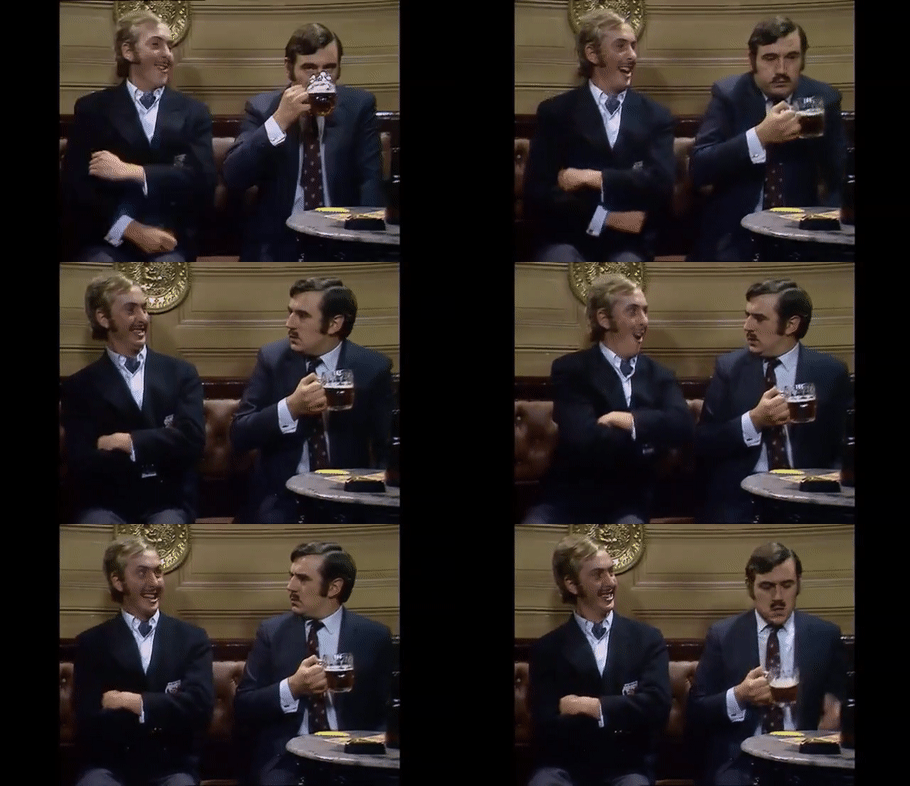
And that final sketch is one of the most famous and most quoted early skits, Candid Photography (aka Nudge Nudge), written by Idle. It’s Idle at his sleaziest and funniest, trying to get a conversation going with a fellow pub drinker about strange cryptic pastimes that are eventually revealed to be double entendres about sex. This too has a punch line of sorts, but it’s delivered as such a quick zinger that it works, almost Goon Show style. Cut to end credits, with the It’s Man re-entering the woods and allegedly getting attacked by unseen animals. And an arrow pointing to one of the trees in the shot, providing us with one last example of The Larch.
This episode was a huge favorite of my circle of friends back in high school in the 80s, when MTV played the show early in the evenings and as part of their Sunday night lineup. I’ve been known to quote quite a few lines from it (“Why not?”, “So anyway!”, “…with a melon?”, “You bastards!”, “oh, no no no…yes.”), and my band The Flying Bohemians even named one of their demo tapes after a line (“And now…No 1…The Larch”). I love this one because it’s consistently silly and brilliantly paced, and there isn’t a single skit or link that trips it up. It’s also a sign of the levels of absurdity they’ll reach in future episodes, particularly in the second series. If I had to choose one episode to explain Python to newcomers, I would most likely show them this one!
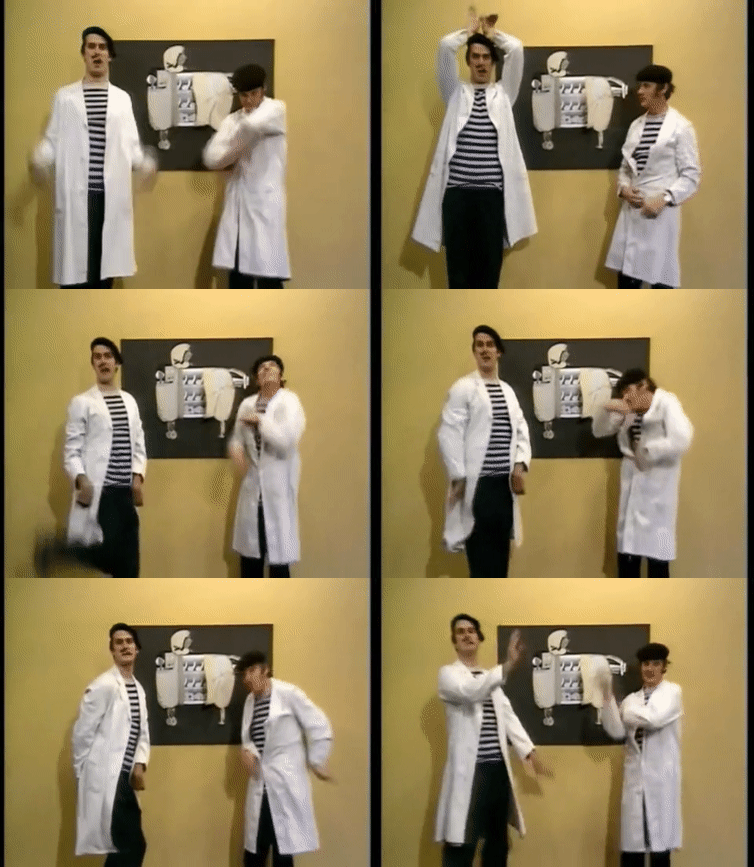
Cleese and Palin as French boffins explaining the aerodynamics of sheep.
Series 1, Episode 2: Sex & Violence, originally broadcast 12 October 1969. What I find interesting about the second episode is that it’s much funnier and more coherent (such as Pythons can be coherent) than their debut episode, but it’s actually the first one they filmed. There are quite a few memorable gems in this one.
After the It’s Man introduces the show (it takes him 33 seconds this time, crossing grassy dunes with unexpected hallway and door sound effects every time he’s out of shot) and the opening credits, a City Man (Jones) meets a surprisingly erudite Country Bumpkin (Chapman), whose sheep are ‘laboring under the misapprehension that they’re birds’ which proceed to fail to fly. It’s revealed it’s the fault of the ringleader sheep, Harold, who’s put the idea into the flock’s heads. The conversation between the two men is interrupted by two French boffins sharing a fake mustache (Cleese and Palin), explaining the possibilities of sheep aviation with increasingly outrageous gestures.
After a few linking bits (including Idle providing the very first use of their soon-to-be-famous tagline “And now for something completely different…”), Cleese interviews a man with three buttocks (Jones). The Pythons shift this simple joke wonderfully by cutting away briefly; upon return, the whole sketch is started all over again until Cleese stutters to a halt, mumbling…”wait…didn’t we just do this?” (Jones’ response is “I thought this was the continental version!”) They then shift it even further by providing a variation — a man with two noses — and then returning to the joke later in the show with a man with three noses!
Meanwhile, Palin introduces us to a man who claims he can play ‘The Bells of St Mary’ on his “mouse organ” (and proceeds to play said organ rather violently with mallets, until he’s tackled out of the shot by a cameraman), and quickly cutting away once more to the Marriage Guidance Counselor sketch. This is Eric Idle at his finest, writing a devastatingly uncomfortable-yet-hilarious sketch, completely taking advantage of Palin’s limp noodle of a man in crisis. It truly shows that while the other Pythons are adept at absurdity and silliness, Idle prefers to go straight for the jugular while still being funny. [The skit ends with another visual gag that will get repeated use: the knight in shining armor boffing someone on the head with a rubber chicken for ruining the sketch.]
After another link (a Candid Camera style filmed sequence that doesn’t quite work, and was later edited out of the US version of the episode), Idle returns in another sketch: The Working-Class Playwright. The roles are wonderfully reversed here in this kitchen sink drama pastiche, with the rebel son coming home from his honest job as a miner to his angry and jaded playwright father and socialite mother. It’s a brilliant skit and executed with pinpoint timing.
We’re then given a handful of short links that not only brings a handful of open-ended skits from this episode to a close (the man with 3 noses, an animation of Harold the Sheep being chased and shot down) but one that ties in with a skit we won’t see for quite a few episodes (Cleese as A Scotsman on a Horse). This is another Python riff – returning to the joke much later, and often unexpectedly. It’s followed by Cleese’s riff on late night TV debate, mixing the argument for the existence of God with wrestling. The bit falls a bit flat but is saved by more animated Gilliam strangeness.
The final skit is a hilarious riff on dramatic human interest documentaries (in this case, drug use) by focusing on The Mouse Problem: people who think they’re mice. Written by Cleese and Chapman, it does not hold back by continually punching upwards. This is the brilliance of their skits; when the easier approach would be punching down, say, only making fun of those with the alleged problem. But it also hits hard on the vox pops comments and the so-called experts that obviously have no empathy towards these mice people.
This second episode works so much better than the first, with much smoother segues and links and related skits. There are still a few slow moments, but they’re definitely getting there.
It’s the third episode, in my opinion where they finally hit their stride and delivered one of the best episodes of the first series.
Coming Up: Episode 1.3: How to Recognise Different Types of Trees from Quite a Long Way Away
Yes, I’ve been planning on doing this sooner or later, especially since we just celebrated the fiftieth anniversary of Monty Python’s Flying Circus, the inventive, irreverent and influential BBC comedy that most of us Gen-Xers remember as being played on PBS as a kid, and then as part of MTV’s comedy line-up in the mid to late 80s.
Most all of us can quote or act out our favorite lines from the show. And sadly some have had it quoted to them far too often enough that it’s no longer funny. But for me, it’s been far too long since I’ve sat down and watched one of my favorite shows as a teenager. I think it’s time to do a rewatch and do a bit of sort-of-liveblogging of it.
So! Without further ado…
Season 1, Episode 1: Whither Canada? Aired 5 October 1969.
We open the series with Michael Palin’s tattered and exhausted It’s Man climbing out of the bay towards the camera, to say his opening line: “It’s…” It’s a running joke used throughout the series, but what makes this particular one so wonderful is that it takes a full forty-five seconds! And cut to the opening credits.
Speaking of opening credits, I was extremely amused to discover that most of the classic paintings used as source material for Terry Gilliam’s animations can be found either in the Louvre in Paris, or at the National Gallery in London. Having visited both museums over the years, it is kind of amusing to walk into the room and think ‘oh, THAT’s the Bronzino he uses for the dropping foot!’
Post-credits, it’s clear that the theme of the show is absurdity. There are bizarre and often unexplained jokes aplenty: accidental pig deaths (followed by a line of drawn pigs being x’ed out), John Cleese as Mozart as a talk show host focusing on famous deaths (which includes Admiral Nelson being thrown out a top-story window…another visual gag they’d return to constantly over the course of the show), and so on. The Pepperpots (the classic vaudevillian men-in-drag characters) make their first appearance in a vox-pops skit about Whizzo Butter. Gilliam’s animated fills are similar to the ones he’d done for the kids’ show Do Not Adjust Your Set, bringing stodgy Victorian art and photography alive in the most bizarre ways.
One can also immediately see the comedic styles of each member of the troupe within the first few minutes of the show: the vaudevillian Palin, the experimentalist Gilliam, the satirist Eric Idle, the physical Cleese, the intellectual Graham Chapman, and the straight man Terry Jones. They work quite well off each other, mainly in that they’re aiming for a common theme here, which is to take quintessentially British mores and habits and either turn them on their head or take them to absurd extremes.
It’s also clear that they can take a one-joke theme and run with it for minutes at a time. This is often where most comedy show skits like those on Saturday Night Live can fall flat, where the joke is just repeated ad nauseam without any variance. Python understood that in order to pull this kind of long-game humor off, it needs to build constantly. The extended riff of Pablo Picasso Painting On a Bicycle only works because of its pacing as well as its increase in absurdity. It starts off seemingly as a throwaway joke by Palin in a newscast, only to return a few skits later as a live sports newscast, complete with running commentary, on the spot interviews…and the shocking revelation that Picasso isn’t the only painter working whilst biking. [This last one is brilliantly underscored by Cleese blitzing through his live feed while actual bicyclists are streaming by, and capped by the non-verbal sight gag of Toulouse-Lautrec riding by on a tricycle!] Python would return to this Breaking News theme constantly throughout their shows and it remains one of their funniest.
One can tell the Pythons are still working out exactly what they want to do with the show, as there are many funny but not necessarily memorable skits in this particular episode. It does contain, however, The Funniest Joke In the World sketch, which is a major fan favorite. What makes this particular one work is its sheer Britishness: it’s set to take place during World War II, still fresh in the minds of many, considering it had ended just a little over twenty years previous. The winner here is British ingenuity, coming up with a surefire weapon devised in secret that wins the War. [And the added payoff is that it’s obviously in nonsense German, making the sketch that much sillier. There’s also a wonderful fly-by visual joke in which it’s mentioned that “it’s better than Britain’s greatest pre-War joke”…while we see a shot of Neville Chamberlain.]
All in all, it’s a fun if kind of uneven episode. There are numerous moments where the audience isn’t quite sure if they should laugh, but they’re balanced by the lunacy of other more successful skits. It’ll only take a few more episodes until they reach their stride become more consistent.
Coming Up Next: Season 1 Episode 2: Sex & Violence!




 Walk In Silence