Thirty Years On: Slacker Central, Part II

So. Slacker Central, you say? Where did that name come from? It was a comic idea I’d come up with around this time that sadly didn’t get much love or attention. It was to come from the ashes of my previous comic idea Murph, both of which featured classic Gen-X characters trying to figure out their lives, who the hell they were, and obsessing over music, and their gathering spot was a Central Perk style coffee house based on the Trident Bookstore on Newbury Street. [And yes, the “Slacker” part of it was from the Richard Linklater movie, which remains one of my top favorites from the era.] In the end I only drew maybe four or so ‘shots’ along with writing a few pages of notes, but it would later morph into the also-trunked story Two Thousand, which I’d work on about a year later.

The point here being: my life might have been in the crapper at the time, but I certainly wasn’t about to let that distract me from creativity.

Various Artists, Caution! Hot Tips!, released February 1993. This compilation from Melody Maker somehow made its way to WERS during my last year there and was a great collection of indie bands that weren’t getting a lot of attention at the time. Hum in particular was a favorite, and would get their due a few years later with the classic “Stars”.

Sunscreem, O₃, released 2 February 1993. I may not have been fully into the early 90s electronica scene, but there were some albums and tunes that I absolutely loved, and this was one of them. “Love U More” got a lot of play on my headphones at the time as a great emotional pick-me-up. I got to see them live opening for Inspiral Carpets at the Paradise and they put on a hell of a fun show!

Belly, Star, released 2 February 1993. There were high expectations for this album and the band more than met them with a great mix of bright and cheerful indie pop and slightly odd Muses-like meanderings. Well worth picking up.

Pure, Pureafunalia, released 8 February 1993. Another freebie from WECB, I really dug the single “Blast” and had it on the station’s rotation. They were definitely part of that 90s ‘popternative’ sound (as I would later call it), easily dropped into commercial alt-rock radio which had gotten an incredibly strong foothold at this point.

Quicksand, Slip, released 9 February 1993. A sort-of alt-metal/hardcore band from NYC, I met these guys at a meet-and-greet a month or so later and found lead singer Walter to be a super nice guy. And yes, that definitely helped me enjoy this band even more!

Jellyfish, Spilt Milk, released 9 February 1993. The follow-up to the amazing 1991 debut Bellybutton was…not nearly as hearts-and-flowers cheerful or sunshine poppy, and guitarist Jason Falkner had already left. I didn’t listen to this one all that much, but after hearing it several years later on the 2015 remaster, I’ve come to enjoy it a lot more.

Dinosaur Jr, Where You Been, released 9 February 1993. A New England band that never quite left its Pioneer Valley roots, they were always popular on several local stations and especially on WFNX. They’d lightened up considerably at this point and weren’t quite the noise-punk band they once were (especially now that Lou Barlow was out of the picture), which interestingly enough let their surprisingly melodic songwriting shine through.

Depeche Mode, “I Feel You” single, released 15 February 1993. Nearly three years after their chart-topping album Violator (and an extremely long tour), the band took a hard left turn and churned out a new track that was heavier and punchier than anything they’d ever done. This wasn’t going to be the same synth band we all knew and loved, and not everyone appreciated it, and the end result would be both intriguing and divisive.

The Rosemarys, Providence, released 16 February 1993. As I’ve said before, I kept my musical options open around this time and tended to gravitate towards Britpop and indie shoegaze and dreampop like this. This was another album that popped up during my WECB tenure and “Collide” ended up on one of my rotations as well as one of my mixtapes. [Side note: there were a few Boston bands that had this sound too, including a band called Pipes that were a big favorite with the college crowd.]

Radiohead, Pablo Honey, released 22 February 1993. ….and then there’s an album that introduced the world to a British band that would change the face of alternative rock for years to come. Even then you could tell they were different: while all the big name bands were trying to reinvent themselves and discover new sounds or jumping on a bandwagon, Radiohead was classic post-punk: moody atmospherics and lyrics, simple delivery and a brutal honesty missing from the scene. And “Creep” was everywhere. I’m proud to say I was there at their first-ever US appearance at Citi on Landsdowne Street, and it was an amazing show.

Duran Duran, Duran Duran (The Wedding Album), released 23 February 1993. They’d fallen a bit from grace for a few years there, not quite hitting the heights with 1988’s Big Thing and utterly failing with 1990’s Liberty, but this was a true return to form: stunning songwriting and a serious focus on capturing what made them so damn popular in the first place. A fantastic record from start to finish.

Grant Lee Buffalo, Fuzzy, released 23 February 1993. You could probably file this band in with the ‘slowcore’ movement, though they were more of a country/folk version of it. It’s a very sad sounding record, but the title track is absolutely wonderful.

School of Fish, Human Cannonball, released 23 February 1993. Another ‘how do you follow up a huge success’ second album that unfortunately did not sell nearly as much as their 1991 self-titled debut, but It really is a great album.

Robyn Hitchcock & the Egyptians, Respect, released 23 February 1993. I fell in love with his music in the mid 80s and while I may not have been able to keep up with his releases (partly due to being so damn broke most of the time), I did of course pick this one up, and “Driving Aloud (Radio Storm)” is one of my favorites of his.

Goo Goo Dolls, Superstar Car Wash, released 23 February 1993. While 1995’s A Boy Named Goo tends to be the record that turned them from critics’ faves to rock radio mainstays, I see this record as the one that put that particular sound in place. They sounded less like early Replacements and more like latter-era Replacements — tighter, better songwriting, and maybe even a radio hit or two.

*

Next up: wrapping up one career and starting on another

Thirty Years On: Slacker Central, Part I

Going back another decade to 1993 this time? Sure, why not? It’s an era of my past that I’ve kind of glossed over for varying and personal reasons, so maybe it’s time to take a look at some of the records that kept me going at the time.

To set the mood: it was my second and last semester of my senior year at Emerson, and I was exactly where I didn’t want or need to be at. I’d just moved out — more like ragequitted — the apartment I’d lived in for a year and change after having had enough of my then roommate. Moving back to the dorms, I realized I’d lost track of several of my college friends out of my own doing, and was now hanging with several kids younger than me and feeling left behind. My grades were still less than stellar, I had no real idea what my future would be, and the last thing I wanted to do was move back to my hometown.

So yeah, I was pretty much starting from rock bottom here.

*

The Wedding Present, The Hit Parade 2, released 4 January 1993. In 1992 this British band chose to drop a single a month — an original on the A side and a cover on the reverse — and it was the covers (such as a desperate version of Julee Cruise’s “Falling” and a blistering “Pleasant Valley Sunday”) that caught my attention.

Belly, “Feed the Tree” single, released 11 January 1993. After leaving Throwing Muses, Tanya Donelly surfaced a short time later with her own band that was immediately loved by everyone in the Boston area. She’d always written the less abrasive Muses tracks but never quite got rid of the classic Muses quirkiness, and it shows here.

Stereo MCs, Connected, released 12 January 1993. “Connected” (the single) was everywhere at the time, both on alt-rock and dance stations alike. I used to play this on my show on WECB and cranked the song up loud every time. It’s a really fun dance record worth checking out.

Denis Leary, No Cure for Cancer, released 12 January 1993. I know, this is a comedy record and not alt-rock, but I put it here because a) he’s a fellow Emersonian and b) he’s also a kid from central Massachusetts like me. A lot of the humor here is definitely of its time — irreverent GenX ‘fuck it, let’s go there and a bit beyond because why the hell not’ humor that’s equally ironic, biting, and daring, but you always knew there was an unspoken level of not quite being mean-spirited.

The Tragically Hip, Fully Completely, released 19 January 1993. This was the record that introduced me to this band, and it’s a hell of a fine album. I played at least three or four tracks from this record on my WECB show at the time.

Elvis Costello & the Brodsky Quartet, The Juliet Letters, released 19 January 1993. You never quite knew what EC was going to do next back in the day, his styles changing wildly from album to album. This is probably the first classical album where I finally understood what modern orchestral music was about, and that it could work seamlessly in a semi-pop way.

The The, Dusk, released 26 January 1993. Matt Johnson always took his time between albums, often two or three years at a time, and while his previous record dropped just as I was starting college, this one was released just as I was ending it. While not as angry as 1989’s Mind Bomb, it’s just as tense. This one’s about inner pain, and it shows on many of its tracks.

Duran Duran, “Ordinary World” single, released 26 January 1993. Ooof. If there was any song that encapsulated where my mental and emotional state was at this time, this was pretty much it. My long-term/long-distance relationship with T finally at its end, my less than stellar school years limping to a close, my social connections in the crapper, and my future nowhere to be found, this song saved me from falling any deeper with its constant reminder to keep going.

Jesus Jones, Perverse, released 26 January 1993. Understandably this record didn’t quite reach the dizzying heights of 1991’s Doubt, and by the time of its release, the alt-rock universe had moved on to more organic grunge rock, but this remains one of the band’s best records in my eyes. It’s a much darker and denser record and features some of their best singles and deep cuts. I highly recommend it.

*

…so yeah, not the most spirited of beginnings of what is supposed to be an important year, yeah? But even though I was lost, hurting and feeling rudderless, I knew I had to keep going. By this time I’d realized that I could still use what I’d learned at this college, but in different ways: my film degree helped me understand how to write and tell stories. My connections with college radio may not have gotten me into that business but it certainly helped me continue my long-lasting love for music, as well as my constant drive to find new things to listen to.

I knew I was starting at the bottom and there was no way to go but up…and I also knew I was going to fuck up a lot along the way (and believe me, I did several times)…and ultimately I was the only one who was going to make me do it.

*

More to come: songs to keep me going, and an album that blew everything else out of the water!

Keep Coming Back

I mentioned over at Welcome to Bridgetown that I find myself once again returning to the 80s (surprise surprise), via an old story I started my senior year in high school and attempted to revive numerous times over the ensuing decades. This is the story that went through so many different titles, versions and mutations that it has its own report binder here in the file department of Spare Oom.

And here I am, half-seriously coming back to it. Again.

I mean, this is the same story that also inspired my much more recent nonfic book idea that shares the name of this blog, Walk in Silence. The college rock era of the late 80s will always be near and dear to my heart for many reasons.

So why bring up this old story again, you ask? To answer that, I’d need to explain why it failed so many times in the past, and it’s called roman à clef. Each time I resurrected it, I made the mistake of wanting to write it as a self-insert piece of fiction, and therein lies the problem: my life back then wasn’t nearly as exciting as I often make it out to be. A lot of silliness and a lot of gloominess and everything in between, but not enough to make it an excitable read. So what’s different now? Well, thirty years on I’ve learned a thing or two about how to write fiction and realized roman à clef is not what was needed here. I knew what I wanted to write, but real life self-inserting wasn’t the way to go.

I’m not taking this project too seriously at the moment, as I’m already focusing on a few other things, but I’m letting myself devote an hour or two a day for it anyway, making notes and revisiting mixtapes and looking at discographies and chronologies. I’m also resurrecting a writing style I haven’t used since those same 80s days: using music to inspire and influence certain scenes, Michael Mann style. The difference here is that I’m not leaning heavy on memory here. I’m taking ideas from the songs I loved and expanding on what images and thoughts they inspire and evoke in me. Sure, there’ll be a few self-inserts in there — there always are in my books — but it won’t be as obvious this time out. And I’m making an expanded mixtape that’ll have both the obvious (say, “Under the Milky Way”) and the deep cut (such as the below Love Tractor song). That, of course, is the most fun part of this project so far.

I have no deadline for this particular story, but I am looking forward to spending more time on it if and when I can!

Walk in Silence – Beginnings

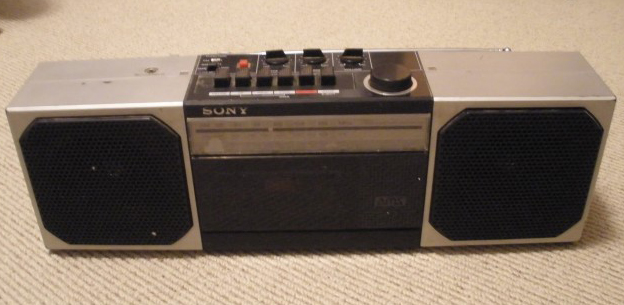
The first Walk in Silence mixtape, made October 1988 at the start of my senior year, and the Sony CFS-300 boombox (aka the Jonzbox) it was made with.

Walk in Silence, the mixtape series I’d started in 1988, was not the first mix I’d created (that goes to an unnamed multi-cassette collection from late 1982, taping songs off the radio and MTV), nor is it the first of the thematic mixes (that would be the noisy Stentorian Music from May 1988), but it’s the first one I’d made specifically to fit the mood I’d found myself in at the time. It was sort of a sibling thematic mix to the Listen in Silence mix I’d made in August, which was essentially “my favorite college radio tunes of the moment”. Walk in Silence, named of course after the first line in Joy Division’s “Atmosphere”, was meant to be more about dealing with my darker side. I was still feeling the sting of nearly all my closest friends having escaped our small town for college and the bigger world out there, and I’d made this to deal with that.

College radio was indeed my oasis during my senior year, alongside those Sunday episodes of 120 Minutes. I was doing my damnedest to deal with the frustration of still being stuck in a small town. The sources of these mixtapes were equally from the records I’d bought from Main Street Music and Al Bum’s, vinyl borrowed from the local radio station I’d worked at, taped off WAMH 89.3 (Amherst College), or second-hand dubs of albums I’d borrowed from that same group of friends. I wanted to start making more of these mixtapes, now that I understood how to create a smooth mix, and more importantly, fit as many songs onto each side of a 90-minute tape with minimal leftover blank space.

I still remember opening up a new cassette from its wrapper and smelling that fresh slightly plastic scent. I was super careful with the boxes they came in and would buy empties whenever I found them. I treated these tapes just like I treated my purchased albums: I made sure they were wound correctly, had a readable label, and didn’t get worn out or erased. I rarely bought the fancy expensive hi-def brands — I usually stuck with the affordable and reliable Memorex dBS 90s — because I didn’t care so much about the quality as much as I just wanted the music itself as part of my growing library.

I cataloged these mixes in notebooks primarily so my friends could see what was on them if they wanted to borrow them. It’s only because of this that I was able to successfully recreate nearly 99% of my mixtape library digitally, missing maybe only four or five lost and unavailable songs total. I used the Walk in Silence theme off and on, and currently I make at least two of them a year alongside two Listen in Silence and end-of-year mixes.

I bring this up to personally thank Lou Ottens, who helped invent the compact cassette tape, who recently passed away at age 94. I used so many blank tapes over the years for so many things: mixtapes, recordings of jam sessions for jeb! and The Flying Bohemians, live shows, soundtracks for my novels, dubbed albums, and maybe even a few class lectures now and again. I completed then hard-to-find discographies of favorite bands. I will totally admit to spending food and lunch money on blank tapes. I’ve put scotch tape over those holes on the top to use actual albums nobody wanted as fresh blanks. I came across a blank or two recently while cleaning out and rearranging things here in Spare Oom. I have a storage box full of my mixtapes, a few I’d remade around 2000 but many of them still the originals.

And now I see that cassettes are making a comeback, believe it or not. Indie bands are selling them on Bandcamp. And Amoeba Records has a nifty little corner full of cassettes new and old.

Thanks, Lou. Your invention was a huge and important part of my life.

Around the Dial

You know already that I have music playing nearly 24/7 in my life.  While I’m working, while I’m writing, even when we’re in bed reading and falling asleep. My life has a soundtrack and I wouldn’t have it any other way.

So, what do I listen to, anyway?   Good question!   I’m always open to listening to stations from different parts of the globe if they’re available online, and I’ve found some really interesting stations while on vacations.  Here, though, are my usual haunts!

Internet Stations

It depends on what I’m in the mood for.  Lately I’ve been listening to Sirius XM, specifically the 1st Wave (80s alternative), Lithium (90s alternative), XMU (more obscure indie rock) and Alt Nation (current indie) stations.  These channels tend to be a bit more adventurous with their playlist, though they do tend to stick with certain heavy rotation tracks as well.

Or I might listen to RadioBDC, an internet station run by former WFNX deejays and hosted by Boston.com.  They’ve retained the commercial alternative sound that ‘FNX was known for, but they also infuse their playlist with a lot of local sounds.


College Stations

Yes, even after all this time, I’m still a college radio listener.  I tend to switch from one to the other to keep things interesting, as some stations are more obscure with their playlist than others.  Sadly my favorite college station of my youth, WAMH, has pretty much become an NPR feed station…but there are numerous other stations I still listen to.

KSCU out of Santa Clara University is my go-to for the local college radio sound.  [Santa Clara, as you probably know from our NFL team’s recent move, is down near San Jose.]  They keep a somewhat thin deejay schedule, but they do have some great shows (the 80s Underground is a great Wednesday afternoon treat, and they post their show as a two-part podcast later that day).  Their ‘robo-deejay’ plays an interesting mix as well when no one’s on the air.

UC Berkeley’s KALX is quite eclectic in its schedule, but there’s always something interesting playing.  Same with Stanford University’s KZSU.  I still connect with Boston College’s WZBC every now and again, for the same reason.


Local Sounds

Our commercial stations here in the Bay Area can sometimes be a bit thin on the excitement and thick on the heavy rotation, but that doesn’t keep me from tuning in while driving.  A number of stations have changed over the last decade since we’ve been here, but a lot of them are still fun to listen to.

Radio Alice is our Adult Alternative station, where the playlist is a bit laid back — it’s something you’d probably have playing quietly in the background at work, natch — but it’s just alternative enough that it keeps my interest.  KFOG is a bit more alternapop (and their newest deejay is a recent transplant, one Matt Pinfield) and tends to be our go-to station.  Live 105 is our most commercial alternative station, complete with nutty morning chat (which I can do with or without) but a very cool playlist.


Night Music

Since we moved out here, nearly every night we put on the local classical station, KDFC, and listen to a symphony or two as we read and eventually nod off.  The night deejay tends to have a bit of a silly sense of humor, as he’ll often have a theme for his show.  One night he played all string quartets and called it “there’s always room for cello”.  They also do replays of live recordings of our local symphony — sometimes playing events that we’d been at just a few days previous!  And each Christmas they’ll play SF Ballet’s wonderful performance of Tchaikovsky’s The Nutcracker.


And of course, there’s my mp3 collection, which is still expanding on a somewhat weekly basis.  But that’s another post entirely…

This is how my mind works.

jonzbox

The Jonzbox, acquired Christmas 1983, last used…2004?

So I’m listening to KSCU online this morning, and one of the deejays is playing stuff that’s catching my interest.  I have a few titles written down for further research and possible downloading.

And I’m thinking…back in the day, I used to have a blank tape at the ready inside that mini boombox you see above there, Record and Play already down, the Pause button ready to be hit as soon as a cool song comes on.  I have a good handful of tapes full of stuff I’ve taped off of college radio shows from the 1988-1989 semesters.  One or two of those tapes are almost complete shows.

So after that show finishes, I’m thinking…it’s all fine and dandy that I can write down the songs that I like and download them, but what if I want more than that?  What if I want to retain that bit of college radio atmosphere, some deejay patter, and so on?  How would I go about doing that?  I mean, aside from downloading questionable software that may or many not even work?

So it occurs to me: I could set up a tape deck, just like the old days…plug some wires into the Audio In jack in the back, plug the other end into the speaker jack or the headphone jack of the PC. I think I still have a few blank tapes kicking around, and I know I can still find new blanks if take the time to look for them.  And then I can use my audio software to convert the tapes to mp3 later on.

An extremely Rube Goldbergian setup to be sure, but I would actually go that far if I really wanted to.  Because I’m that much of a music nerd to go THAT old school to tape stuff off the radio.


[As an aside, there’s one show on KSCU, The 80s Underground, where the deejay records his entire show, patter and all, and puts it up as a podcast later in the day.  He’s got excellent taste, knows his obscurities, and it’s well worth checking out.]

Walk in Silence 0

PROLOGUE:

I’ve been listening to college radio and alternative rock for thirty years as of this week.

Currently, I’m kind of cheating and switching between the XMU station on SiriusXM, RadioBDC, and a host of college stations via their streaming feed, but the point remains — the singer here (Paul Westerberg at his alcoholic best/worst on Let It Be) is barely making it through the song without stumbling.  You can hear the liquor in his voice.  It’s a classic song of generational discontent, as Wikipedia points out.  I heard the same thing back then, in my bedroom, late at night, and I felt the same thing: who the hell let him close to the mike?

But truly, that was exactly what endeared me to the alternative rock genre, and still does to this day.  The fact that studio time was given to a musician of middling proficiency and questionable talent amused me then, and impresses me now.  Well — at this point, anyone with a laptop, a few microphones and some cheap recording and mixing software can lay down their own music.  And thanks to the internet, they no longer need to jockey for position at the local radio station or bar; they can upload their latest song on Bandcamp hours after making the final mix, and let their small tribe of listeners know it’s out there.

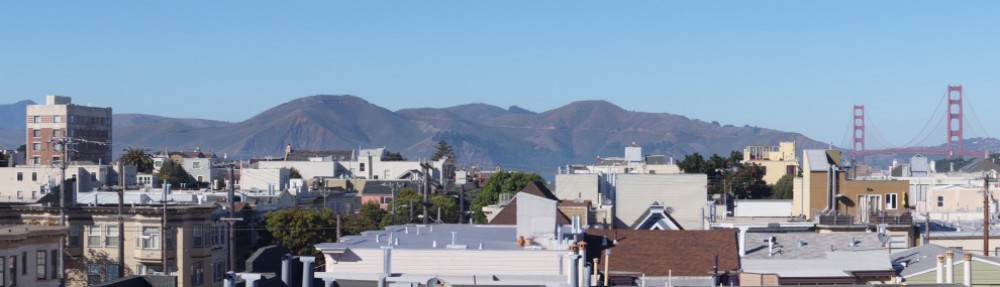
There’s a lot of excellent indie rock out there if one chooses to actively look for it.  Some listeners like myself spend far too much time and money on it, but we love it just the same.  Again with the internet: many college stations stream their shows on their website, so someone like myself, now living in San Francisco, just over a mile from the Pacific Ocean and a view of the Golden Gate Bridge just outside my window, can listen to the broadcast of Boston College’s WZBC.

The only thing missing, in my mind, is having a blank cassette at the ready, in case one of my favorite songs comes on.

That’s one of the original facets of alternative/indie rock, really…the ability to look in the face of popular culture and loudly and proudly profess that you’re not going to play that game, at least not by those rules anyway.  One of the whole points of the genre, harking back to the original UK punk wave of the late 70s (and much further back, depending on which rock genre you’re thinking about), was to make sounds under one’s own rules.

It was about a certain style of anarchy –a personal anarchy, wherein one fully embraces who they are and what they want to be, where one stops trying to fit in where they obviously don’t belong, where they find their own path without outside influence.  Be what you want to be, and fuck ’em if they can’t deal with it.

*

Every music fan has that story:  where did you first hear that new song, that favorite band, discover that new genre?  Every fan has a story where they heard a song or found a new radio station or a new genre for the first time where it just clicks: YES!  This is the thing that has pierced my soul, has connected with me in such a deeply personal way that I will never hear it the same way again!

Okay, maybe not in so many words: often it starts out with a distraction.  Yeah, I kind of dig this track.  It makes you stop and notice it.  You may not know exactly why just yet, but you’re not going to dwell on that right now.  But its primary job has been fulfilled: it’s gotten your attention.  You may be intrigued for the moment but forget it a half hour later, or it may stay with you for much longer, so much that you’ll end up looking for it the next time you’re at the local music shop.

Or, if you were like me in the middle of the 80s, you’d have a small ever-circulating pile of half-used blank tapes near your tape deck, and if you liked the song that much, you’d slam down the play and record buttons and let ‘er rip.

This is the story of how I got from there to here.

*

 Let me start with this: I was part of the inaugural MTV generation.  I was ten going on eleven.  I remember when I first saw the channel when it was offered on our newly-minted Time Warner Cable system, the first cable service in my hometown.  I remember the beige-colored box with the light brown label on top, listening all the channels we’d be getting.  I remember seeing MTV for the first time.  [For the record: my first MTV video was .38 Special’s “Hold On Loosely”.]  And most of all, I remember it was channel 24.  Even before we got cable, I’d already made plans to park my butt in front of the television and soak in the musical goodness.  Any music I heard from about 1982 onwards was considered Something Awesome in my book, especially if it had a video.  But even if it didn’t, that one network opened up something within me that turned music from a passing interest into an obsession.

Around the same time, I had pilfered the radio that had been gathering dust in the kitchen (an old model I believe must have been purchased at one of the local department stores a few decades earlier), and it was now at my desk.  I’d made little marks on the dial where my favorite stations were.  I’d fallen in love with rock radio.

Was it different from the sort-of-occasional listenings of records from our family collection, or the albums we’d take out from the library, or whatever was playing on the car stereo during family roadtrips?  In a way, yes.  Even then I’d gotten into the habit of listening to certain radio stations, but not to such an obsessive extent.  I’d gone from ‘now and again’ to ‘every single morning’ to ‘pretty much all day long’.  Other boys my ages were probably watching sports or playing outside or whatever it was we supposed to do, but I was perfectly happy sitting right next to the radio and enjoying each new song that came on.

The obsession with countdowns started around this time.  That was the fault of one of my older sisters who’d taped various songs off the radio at the turn of the decade, and had recorded part of the year-end countdown on the rock station we all enjoyed, WAQY 102.1 out of East Longmeadow.  A year or so later the torch was passed to me (well, more like I snagged it as she headed off to college).  WAQY had a contest in which, if you sent in the correct countdown list, they’d pick a random winner and give away every album that was on it.  Who was I to turn that down?  With an insane amount of focus and intent for a preteen, I wrote each artist, song on lined paper and duly mailed it in.  Never won, of coure, but that didn’t stop me from listening with rapt attention.

Thinking back, that’s probably what fueled my music obsession the most — between the countdowns and MTV, as well as radio in particular, I was glued to my desk or the living room couch, wondering what song or video would come next.

That went on for most of that decade, really.  From about 1981 or so onwards, I would always have a radio on, or I’d watch a good hour or so of MTV, just soaking everything in.  I really wasn’t too choosy about what songs came up, as long as they caught my interest.  That was partly due to listening to whatever my sisters were listening to in the 70s.  I could take Chicago’s easy-listening comeback albums the grandiose prog rock of Rush, and the guitar jangle of early REM.  A lot of the rock stations back then were more adventurous in their playlist, mixing past and present genres without a second thought.  Within the span of an hour I could hear the Beatles, Led Zeppelin, Dire Straits, Van Halen, and maybe even an Ozzy or an AC/DC track.  In the early days of FM radio, there was always some element of free-form.

I was given a massive playlist to choose from, and I devoured pretty much all of it.

Why can’t you see, you’re fighting a million and me

God’s Favorite, “(Hurry Hurry) Sunday”
(not to be confused with God’s Favorite Band…different group entirely!)

Well, this is certainly a surprise!  This has been hiding on YouTube for almost a year and I never noticed until just this moment when I was doing a bit of Walk in Silence research.  This little gem of a track was the first song I ever taped off a college radio station (WMUA 91.1 at UMass Amherst) — the same taping session on 11 November 1986 that introduced me to The Go Betweens, Felt, and This Mortal Coil.

I listened to that tape so many times I pretty much wore it out, and it wasn’t until about a year ago that I had Jeff Shelton play it on his KSCU show The 80s Underground and finally heard it again after what seemed like decades.  I downloaded that particular podcast just so I could finally have the track in my collection again.  I was never able to find the vinyl anywhere when it was out, and as I currently do not have a turntable (yes, I am a heretic!), I can’t go on Amazon and buy it.

I remember hearing this track and thinking the vocals were a little too earnest (in that 80s indie way we’ve all come to love in retrospect), but there was that gently sweeping melody that kind of reminded me of early REM, who I was getting into at the time.  It also hinted at that pastoral walking-through-the-woods-in-autumn mood that I would get from a lot of the college rock I loved then.

Flying Bohemians Trivia:  This song is one of three that inspired me to write “Lift Your Heart Up (In Your Hands)” in 1991 (the others being Love and Rockets’ “Welcome Tomorrow” and Robyn Hitchcock & the Egyptians’ “Swirling”).

[WiS] I started something…

https://youtu.be/lLOvorEcrqg

About a year and a half ago, I’d decided to take a few days off writing to get all my writing (and other things hiding away in file boxes) sorted and arranged.  It took much longer than usual, I think I kicked up enough dust to give me allergies, and I was sore afterwards.  But I had a much more organized bookshelf and filing cabinet in the process.

The best part?  On Saturday when I was looking for all the printouts, outtakes and notes for Walk in Silence (and pretty much every other project related to it dating back to 1988 or so), it took me all of a half hour.  Boom, done.  Which gave me even more time to actually sit down and read through some of these things this weekend.  Bonus!

I’m also returning to my beloved 80s album collection again.  As you can probably guess, I’m listening to the Smiths’ Strangeways, Here We Come from 1987 as I write this.  I always found it kind of sadly amusing that I finally got into the band just as they were breaking up.  Also, I’m enjoying the weekly radio show The 80s Underground (which I listen to via KSCU.com, but is also available via podcast) which plays on Wednesday afternoons.  It’s a great show because the DJ does what he can to play the less-familiar tracks from great bands instead of the same ‘hits of yesteryear’.  Worth checking out.

You might have guessed that I’m looking forward to getting this project done, even despite all the other writing projects I have surrounding it.  I have all the resources at my fingertips now, and most other things I can easily find online, so it’s mostly just a matter of keeping focused and knowing the trail I need to follow.  It’ll be tricky, but I think I can do it.

More to come!

On College Radio vs Progressive Radio in Massachusetts in the late 80s

I’ve been thinking about this subject lately, partly due to the way I’ve decided to frame the text of Walk in Silence in book form.  I did not want to write just a memoir, nor did I want to write a simple book about alternative rock. I decided to make it a hybrid of both, and in the process I wanted to do a bit of research on radio history in general.  I not only want to go over some of the highlights of great alternative rock of the time and talk about my favorite songs and albums, but I want to explain the genre itself–how it formed, how it got there, and how it related to other music (and points in history) at that particular time.  It’s not just enough for me to say why “Under the Milky Way” is my all-time favorite song; I wanted to explain that the Church’s Starfish album was make-or-break for them after years of not-quite-success.  There’s also the fact that in the 80s, the lines between pop music, rock, and “new wave” were a hell of a lot more defined then.

On a more professional note, however, there were two different kinds of stations playing this kind of music at the time as well, and that’s what I want to speak about here.

There was the college radio station: the longtime home to the alternative, the free-form, and the not-quite-professional.  Ratings didn’t matter to college radio, only that they had the funding from wherever it happen to come from, be it fund drives or grants or the listening audience.  For most college stations, especially for colleges where it was more of an extracurricular position rather than part of the curriculum, the student disc jockeys may have at the least been instructed to vary their playlist or play a few core tracks, and at most been given stern reminders of FCC rules and regulations.  Other than that, you could get away with playing whatever you liked.  For the most part, the quality and style depended on whose shift you were listening to.  Some disc jockeys would play hardcore punk or EBM (Electronic body music, a danceable subgenre of industrial rock and championed by many European groups like Front 242), or maybe even that new post-punk influenced rock stuff coming from the UK, like the Smiths and the Cure.

On the other hand–or should I say, up a little higher on the dial–there were the professional radio stations.  Short version: by the early to mid 1980s, there seemed to be a shift in popular radio, and a lot of stations were starting to feel the crunch.  Slightly longer version: considering that popular FM radio was pretty much still in its teens at this time (it sounds weird, but it’s true: popular FM radio as we know it today really didn’t come into wide popularity well until the mid to late 70s), the FM stations that tried to cater to all sounds and styles were beginning to flounder.  Listening habits changed and people wanted to hear more of their favorite styles rather than a wide and often weird mishmash.  The wildly successful pop stations of AM yesteryear were now the wildly successful pop stations of FM now.  The rock stations did well, but they were also splintering, often due to their listenership; some like Worcester’s WAAF 107.3FM with its younger fanbase continued to follow trends to play the latest hard rock, while others like East Longmeadow’s WAQY 102.1FM began to drift with its older fanbase towards classic rock.

Of the latter, a newer subgenre emerged.  Partly inspired by the more adventurous free-form sounds of 70s FM radio, the arrival of Album-Oriented Radio (AOR) in the late 70s and early 80s catered more towards the connoisseur radio listener, the avid music listener who wanted more than just the throwaway pop or the mindless party rock.  True to its name, its playlist prided itself on featuring non-single album tracks, providing the listener with a much wider experience.  As the 80s wore on however, it was found that while AOR had its diehard fans, it was not a moneymaker.  A number of stations reverted back to a rock format, or were sold and completely changed formats.  Those who stayed were often extremely localized, such as Turners Falls’ WRSI 95.3FM (sold in 1996 and moving to Northampton at 93.9) and Peterborough NH’s WMDK 92.1FM, and placed in small but artistic-minded communities.  They may have been small, but they had the upper hand–they were run by music fans who knew their stock in trade, and knew how to sell it locally.

These two local stations never really sold themselves as “AOR” but more as “progressive radio”.  This term may have confused some, considering the word ‘progressive’ often went hand in hand with ‘rock’, and together ‘progressive rock’ often meant twenty-minute hyperbolic workouts from bands like Yes, early Genesis, and ELP.  But by the 80s, ‘progressive radio’ actually meant something different–it was almost a taunt, a term that said ‘we’re better than you–we play music for smart people’, and in its own way it was true.  The passive radio listener just wants background noise, but the active radio listener wants something that will stimulate the brain.  And it just so happened that post-punk sounds coming out of the UK and the collegiate sounds emerging in the US fit the bill at that point in time.  If there were no college radio stations nearby, or none with the wattage strength to reach long distances (especially over hilly central Massachusetts), these progressive stations would offer up the most radio-friendly of it.

And for a good couple of years, probably from around 1984 or 1985 up to 1988, these stations could get away with playing the not-quite-commercial rock.  These bands weren’t being played anywhere else except on college and progressive radio stations.
While college radio was much more open-minded and adventurous in its available playlist, it had its own shortcomings as well.  Part of the whole alternative music scene in parts of the US was its exclusiveness–it was music for the nerds and the geeks and the people on the fringes of society who didn’t belong in the popular cliques.  Morrissey may have sung and the music that they constantly play / it says nothing to me about my life / hang the blessed DJ in response to a UK radio personality who tastelessly followed up coverage of the Chernobyl disaster with Wham!’s “I’m Your Man”, but in the US it took on a slightly different meaning.  For those of us here in the States, it was simply a rebellion against the tired, creatively vacant mainstream.

But what was mainstream, anyway? Especially in the last few years of the decade when more ‘modern rock’ songs were showing up on the Top 40 charts? What was there to rebel against when the keys to our rebellion were now becoming mainstream?  By the early 90s, many college radio stations were refusing to play anything by the Cure or Morrissey or Depeche Mode or REM, simply because they were being played on commercial radio.  They would need to start looking elsewhere for their alternative fix.

On the other hand, progressive radio could still get away with it.  Perhaps it was that, as professional stations, they had to constantly keep an eye on shifting tastes.  Progressive radio is where I first started hearing Britpop, back in 1989 with Happy Mondays and the Stone Roses, well before a lot of other stations played it.  They also kept an eye on other subgenres of rock that fit into their playlist, like the folk rock sound of Tracy Chapman, Tanita Tikaram and Indigo Girls, the blues rock of Jeff Healey, or the new funk of Lenny Kravitz.  They were able to balance the commercial with the alternative, and that kept their stations alive much longer.  It also kept the alternative sound in the spotlight, making way for newer “adult alternative rock” stations such as WXRV (The River) 92.5FM in Haverhill.  It also helped usher in more “new alternative” sounds–bands that may lean towards the mainstream, but are decidedly not intellectually vacant pop.

 *

Over two decades later, I’ve been noticing a slow but significant return to departmentalizing the different genres of rock on FM radio.  It’s partly due to the advent of the internet, and it’s also due, as it always has been, to the shifting tastes of its listeners.  For a brief time in the 90s, alternative rock became so polarizing that on the one hand we had all-commercial rock radio on one end and very anti-commercial rock radio on the other.  Now, however, we’re starting to see specific subgenres again, and they’re being played on both college radio and on indie rock stations, sometimes within the same hour.  We’ll hear the bizarro tUnE-yArDs alongside the catchy pop of Capital Cities alongside the folk rock anthems of Frank Turner.  Listeners can access the sounds not just on FM radio but on satellite stations, online-only stations, streaming sites and even playing their mp3 library set to “random”.  But thanks to these same things, we can set our listening preferences so we’re only listening to weird left-field rock or synthpop or folk rock.  We’re not just bound to the FM dial anymore, but we can bound ourselves to just how wide or how narrow we want our music to be.  Radio may continually shift in its never-ending search for new sounds and higher earnings, but as always, it comes around and settles in new and more interesting ways for us to listen.