Revisiting music from the trilogy

I said I was going to do it and I’m doing it now: I’m currently going through the albums and singles from 2000 onwards as a soundtrack to the Bridgetown Trilogy Remaster Project. I started the revisit on Monday afternoon on my day off with William Orbit’s remixed take on Barber’s Adagio for Strings, one of my all-time favorite classical pieces.

I know, this is sort of an arbitrary place to start and doesn’t really line up with the writing chronology. I’d started and finished The Phoenix Effect (the early ‘demo’ version, if you want to continue the music analogy) but hadn’t yet started writing its aborted sequel The Mihari (that would take place that summer if I’m not mistaken), but the actual day-one of A Division of Souls wouldn’t take place until late 2001 or early 2002.

So why start the relistening at January 2000? Partly because I knew my days were numbered at the record store by then. I still loved the job and wished I could stay there forever, but a) I could definitely see the downturn of the music industry happening in real time, and b) I wasn’t sure how much longer I could handle the store manager without eventually ragequitting. It was also a bit of a weird time musically; grunge had long given way to adult alternative which had given way to meathead alt-metal, and pop was having a huge resurgence with its sugary overproduced electronica.

A lot of music I listened to at the time felt a bit out of place. I wasn’t quite sure what I wanted to listen to, because very little of it was resonating with me at a deep level, as it once had just a few years previous. That could very well be due to personal issues and changes, and at the time I was feeling unmoored.

Still, I was willing to see where it all took me. Life changes and all.

All this talk about Bridgetown…

…has given me a hankering to listen to some tunes from the HMV years when I wrote The Phoenix Effect. I’ve mentioned numerous times before that a lot of the music I listened to around that time heavily influenced and/or inspired many of its scenes. But it was also when I had a lot of positive things going on in my life for the first time in ages.

So now the trick is to find some current tunage that can take its place as the writing soundtrack for MU4….I do have a few in mind that have been on frequent rotation here in Spare Oom!

Favorite songs: Isolation

Every now and again I think about this EP, and how it’s affected me over the years. It’s Mark Pritchard of Global Communication and Kirsty Hawkshaw (formerly of Opus III, you know her from two covers: Jane’s “It’s a Fine Day” King Crimson’s “I Talk to the Wind“). I first discovered them on a quirky seasonal compilation called Invocation — the same album that introduced me to Jocelyn Pook. I listened to that album constantly during the final months of 1997 and into 1998, using it as a soundtrack to my writing at the time.

The song itself (Part 1 lasts a bit over eleven minutes, and Part 2 a bit over eight) is what I imagined as the best example of ambient electronic music: there was melody, but there was also mood and atmosphere. It was like the culmination of everything I loved about 4AD bands like Cocteau Twins and Dead Can Dance. It also felt widescreen in my mind. Cinematic in its own way, telling a story with its weavings of highs, lows, bursts and quietness. There was something about it that somehow hit me viscerally, and it felt almost like…a spiritual leaving.

I used that feeling some years later when I wrote a pivotal scene in The Balance of Light with the final moments between Denni and Saisshalé.

This track was actually what got me into Global Communication soon after, picking up both their brilliant 76:14 (highly recommended) and their album of Chapterhouse remixes, Pentamerous Metamorphosis, both of which had recently been reissued in the US. Those two albums, along with Invocation, became some of my favorite go-to albums when writing the Bridgetown Trilogy, especially when I needed something deeply atmospheric.

Twenty-five years ago…

I’ve been going through some music from 1999 the last couple of days and finding a bunch of albums and songs I used to listen to quite a bit then that I haven’t listened to in ages, and some I’ve even completely forgotten about. This was during the back half of my tenure at HMV, and by this time I’d been tasked with ordering the imports and, if I could get away with it, some of the obscure indie titles that I figured someone aside from me might like. A lot of these got considerable play down in the Belfry during my writing sessions.

Medal, Drop Your Weapon, 24 May 1999. This Oxford quintet’s music had that sort of epic moodiness that was at odds with a lot of what was big at the time, but their sound was perfect for my writing sessions, especially the slow groove of “Possibility”. Well worth checking out if you can find it.

Arab Strap, Cherubs EP, 1 September 1999. I kind of liked the lead track off this, but it was the slow and sludgy “Pulled” that drew my interest. Sure, it’s seven-plus minutes long and takes its own sweet time getting somewhere (and even then the tempo subtly shifts all over the place), but it’s the two-minute wall of noise coda that makes the entire song. Considering that I’m a huge fan of the quiet/LOUD style, this fit perfectly in my wheelhouse.

Days of the New, Days of the New II, 31 August 1999. Remember this guy, Travis Meeks? Promising musician with a growly semi-acoustic grunge sound? They had a minor hit with “Touch Peel and Stand” from the first album but the second record kind of got passed over. Thing is, this second record was absolutely amazing. Really tight musicianship and songwriting, and definitely more adventurous. Sadly his group imploded (apparently his backing band quit in frustration and started their own group, Tantric, who had a few minor hits in the early 00s. I listened to this one a hell of a lot that summer.

Tin Star, The Thrill Kisser, 9 February 1999. How the heck did I latch onto this…? I think the BMG rep handed a promo to me and thought I’d like it, and yes, like it I did! Not quite electronica, not quite indie, but a hybrid of both with a heaping dollop of British eccentricity added into the mix, it’s cool, funky, and a really great record. This got a ton of play in the Belfry for a good couple of years.

Kill Holiday, Somewhere Between the Wrong Is Right, 23 February 1999. I’d heard “In Closing (Memorial Day)” on The River one night driving home from work and immediately ordered the album on my following shift! Y’all know how much I do love an epic final track with a slow build (and again with the quiet/LOUD thing). One of my favorite indie releases of that year.

Trashmonk, Mona Lisa Overdrive, 25 March 1999. Ever wonder what Nick Laird-Clowes did after The Dream Academy? Well, he dropped this one really weird album named after a William Gibson book that sounded nothing like his former band. Sometimes experimental, sometimes groovy, sometimes hauntingly beautiful, it’s definitely worth checking out if you can find it.

Lamb, Fear of Fours, 17 May 1999. More experimental and much darker than their debut (and nearly all the songs contain quirky time signatures outside of 4/4), it’s the one that captured my attention to the point that they became one of my favorite bands of the late 90s/early 00s.

Rico, Sanctuary Medicines, 16 August 1999. This Glaswegian industrial musician could probably be compared to Nine Inch Nails but without the dire levels of nihilism. I don’t even remember how I came across this one aside from the fact that I really dug the whole industrial metal sound and that it wasn’t trying so damn hard to fit into the goth stereotypes like some other bands.

Handsome Boy Modeling School, So…How’s Your Girl?, 19 October 1999. Only Prince Paul and Dan the Automator could get away with naming their band after an episode-long joke from Chris Elliott’s bonkers TV show Get a Life…and loosely basing AN ENTIRE ALBUM on said episode. But it’s a damn fine record and one of the best of the year on many critics’ lists. It’s a super fun record worth owning.

The All Seeing I, Pickled Eggs & Sherbet, 20 September 1999. Another ‘where the heck did I hear about this’ import and the only album from this electronica collective, though this sounds more like a quirky British indie band instead if you didn’t know their background. It’s extremely eccentric and I have no idea what they were trying to prove with it, but it’s a fascinating listen.

Mixtape: Untitled VIII

This one’s a long one…a three-taper made in late Spring 1998 in the middle of my stint at HMV Records. This was kind of a transitional time for me — purging old personal drama, starting a brand new science fiction novel and writing more songs and poems, working down in the Belfry at night, going on long road trips, learning how to get rid of all that negativity from the first half of the decade. I stopped hiding and started living again, especially now that I could once again afford to do so.

This mixtape got a lot of play in my first car — a 1992 Chevy Cavalier I’d named the Mach V, in which I’d recently had a tape deck installed — and contains a mix from two sources: the current playlist of WFNX which I’d listened to constantly to and from work, and the extreme expansion of promotional copies of cds that I’d begun to acquire at work. Some songs are alt-rock radio standards today (Flagpole Sitta, The Way) while others are loved deep cuts (Playboys, Fall On Tears), Belfry regulars (God Lives Underwater, Superdrag) and soundtrack songs (mostly from Great Expectations, which I listened to on the regular).

Out of most of the multi-tape mixes, I think this one holds up as one of the best. It’s consistent with only one or two filler tracks, and it contains quite a few of my favorite late 90s tracks.

[Only one track missing and not available on Spotify: Foo Fighters’ cover of Gerry Rafferty’s “Baker Street”, placed between Goldfinger’s “This Lonely Place” and Tonic’s “If You Could Only See”.]

Fly-by: Twenty years on interlude

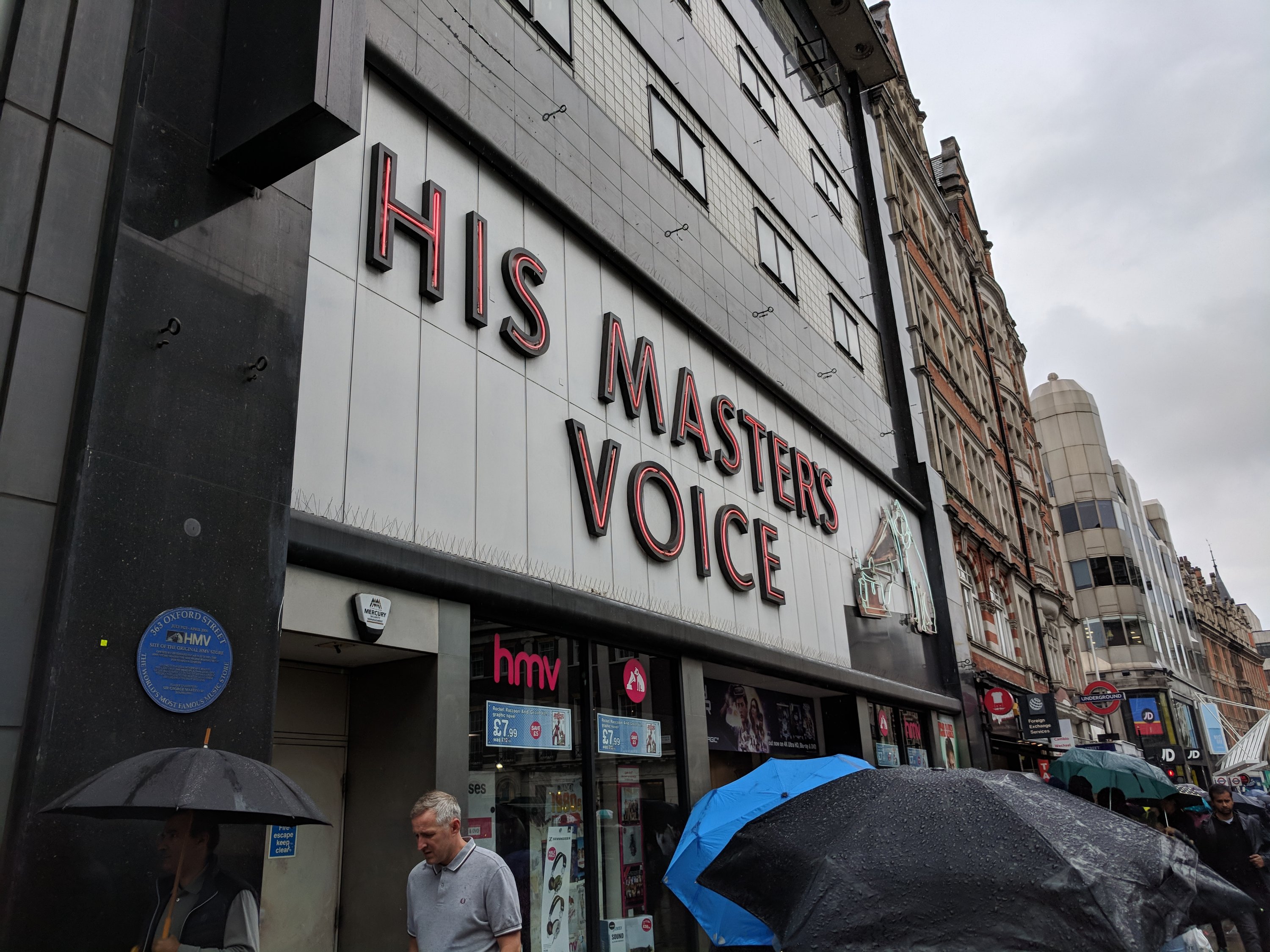
Hello from a very rainy Oxford Street in London! I have come full circle and stepped foot into an HMV for the first time since probably 2001, when its US stores started closing up. This particular shop I believe is connected to the original first one, if it isn’t THE first one.

I’m glad to say the selection is still fantastic and the prices are great. Found everything I was looking for (which is often a rarity) and the service was aces.

So yeah — glad to be able to hit an HMV one more time for old times sake. 😁

Platinum Records

If you haven’t seen my recent post over at Welcome to Bridgetown, I’m currently celebrating the platinum anniversary of my starting a novel (The Phoenix Effect) that would end up morphing into my Bridgetown trilogy.  All this month I will be posting fun things related to the original as well as the trilogy, and I thought I’d do the same over here.

Twenty years ago I was a few months in on my relatively new job as the lone shipper/receiver at HMV Records.  Even though I was one of the oldest hires there (I’m pretty sure I was closer to my manager Tom’s age than the young’uns I worked alongside), I was still feeling my way around.

The biggest change from the years previous was that I had a much closer connection to the music I was listening to.  I was listening to a lot of radio at the time but didn’t have that much money to spend on new releases, but this job let me listen to a lot more stuff (and yes, I may have dubbed a number of cds onto blank cassettes while in the back room, heh!).

But the sounds were changing as well.  The bright bounciness of Britpop was suffering from hangovers and bloating (see: Oasis’ Be Here Now, a solid but WAY overworked album); the American grunge was kind of losing its way (not to mention some of its lead singers to overdoses), and let’s face it: the college rock I knew of then was essentially the commercial rock of now.

That’s not to say the quality (or quantity) of alternative rock was declining…it was merely evolving with the times.  In fact, 1997 featured some fantastic, solid releases from bands both old and new, taking the genre in new and interesting directions.

On a personal level this was a positive and much-needed evolution for me, as I’d been in dire need of a change in my life and outlook.  I’d been broke, angry and depressed for about three years straight, gone through some personal issues that were Not Fun At All, and needed a positive change ASAP.

Not only that, this change in mood is reflected in my writing.  I’d essentially started a new project resurrected from the ashes of one that I had to close down for personal reasons.  And let’s be brutally honest:  back then, I’d had a collegiate view of being a writer.  I was a special snowflake with the Powers of Story [insert sprinkly *whoosh* sfx here] and I wrote Important Life Allegories™.  In reality, however…my writing was crap, I knew it was crap, no one was going to take it seriously, and I was going to need to be a shit ton better than the level I was currently at if was going to get anywhere with it.

So that meant dispensing with the mindset of Writing as Superpower and take it seriously.  Making it a daily process instead of a casual one.  Relearning the basics of story construction.  (This included doing a hell of a lot more reading than before; not just the how-to writing books, but the different genres of fiction and nonfiction I was interested in.  This plan kick-started my habit of visiting book stores on the weekends and, thankfully, a love of reading.)

Music has always been a part of my writing process, and this time it was no different.  This time out I’d be making mixtapes of tracks that would inspire my writing (the four-volume Songs from the Eden Cycle from 1997-8, the sort-of sequels in the early 2000s, and the recent Eden Cycle Sessions mp3 playlists).  Certain albums released during this time would get heavy rotation play on my cd player down in my basement writing nook.  And I’d listen to a hell of a lot of stuff on my fifty-mile commute, which was always a perfect time for me to brainstorm.

I’d made a decision to be a writer quite early in my life, but 1997 was when I decided to take that decision seriously.

Favorite Albums: Failure, Fantastic Planet

Credit: discogs.com

Credit: discogs.com

Say hello to the rug’s topography / it holds quite a lot of interest with your face down on it…

I distinctly remember hearing Failure for the first time; their debut Comfort had been released just as I started my senior year in college, and our FM station, WERS, had received a promotional copy, which I soon found in the freebie bins outside the studio (aka the “here, this sucks and/or is too commercial-sounding and we won’t play it” bins, given the station at the time).  I’d heard a lot of great things about the band and the album, even despite the incessant and often misguided comparisons to the ubiquitous Nirvana.  I can see where they’d get that, if you think loud guitars + quirky chord changes + odd lyrics = Nirvana or one of its clones, but I always felt that was a cop-out, a weak and lazy way to pigeonhole a newly-popular subgenre.

I played “Submission” and “Pro-Catastrophe” from that first album on my radio show on our AM station, WECB, where I was the music director that semester, and I thought they were well worth checking out and sharing with others.  My enthusiasm didn’t get too far, of course, considering WECB’s low-watt reach was ridiculously sketchy, not to mention by that time, the alternative rock purists were refusing to listening to anything remotely commercial, and that WFNX was playing Nirvana, Soundgarden and Pearl Jam every fifteen minutes or so.  Failure unfortunately could not sneak in edgewise into anyone’s playlist.  I don’t blame the band for that at all; in fact, I have to give them mad props for remaining true to the sounds they wanted to create.  They weren’t as Led-Zep as most grunge bands were, they weren’t as hard as any metal bands out there, but they also weren’t deliberately outsider anti-commercial either.

They released a second album, Magnified, in early 1994, which I unfortunately never picked up at the time, as that was during my broke years in Boston, but I did eventually pick it up a few years later while working at HMV.

That was where I fell in love with the band again.

In August of 1996, about a month before I started working at the record store, the band released the video for the single “Stuck on You”, a brilliant and almost shot-for-shot takeoff of the opening credits to the James Bond flick The Spy Who Loved Meand I was immediately hooked.  I mean, listen to that crunch–it’s drop-tuned a half-step to give it a powerful low end, and balanced with a high end distorted riff.  The whole thing just punches you in the face from the first few seconds, and doesn’t relent until the last few.  Lead singer and songwriter Ken Andrews delivers great vocals here too, drifting lazily through the verses (which, interestingly enough, are about getting a song stuck in your head) but belting them out during the choruses.

One of the first promotional freebies I got from the record store was a copy of this single, a two-track cd shaped like the head of the spaceman on the album’s cover and featuring the album version and the radio edit of the track.  Suffice it to say this track got a lot of play in the back storage room at the time.  Fantastic Planet was one of my first purchases when I first started working at HMV.  As the lone shipping/receiving clerk for the store, I often hung out up back, pricing and security-tagging and processing them into the stock database, but during all that time I’d have a radio going.  That was one of the first things I did when I started the job, actually–I got a hold of a cheap boombox at WalMart and brought it in specifically for backroom listening.  [It wasn’t just for my own entertainment, either…I did that because I knew the label reps would want us to sample some of their wares during their visits.  That worked quite to our advantage, actually.]

I knew I’d love it even before I heard any other tracks from it–the fact that they named it after the 1973 animated French film of the same name (a movie I’d taped years before off USA Network’s Night Flight and watched repeatedly) was definitely a selling point, but I’d heard a hell of a lot of positive reviews as well.  I even snagged a promotional album flat for it as well and had it posted prominently for pretty much the entire time I was at the store.   And yes, I played the hell out of that album for years to come.


The history behind the album is quite interesting, as Ken Andrews and bassist Greg Edwards explain in this recent interview as well as in this promo for the album’s 2010 vinyl reissue both point out that it was recorded during their most tumultuous times as a band.  Come 1995 they’d had issues not just with the label (Slash Records) not quite knowing how to sell the band, and drugs and personal issues were also causing fractures.  And yet, they retained a crystal clear idea of what they wanted the album to sound like, and took delicate care with each and every track before considering it done.  This included the production as a whole–they took care to ensure the running order was perfect as well.  The album also both starts and ends with the same trinkety sound effect loop, but it could be taken two ways: the album is either an unending cycle, or they’re a prologue and epilogue to gauge just how much the cycle has changed from one end to the other.

It’s hard to say exactly what the album may be about, really…while there is a theme of space in the science fiction sense–thus the title–it’s also about emotional space and one’s self within it.  There are songs about drug addiction and psychological breakdowns, but there are also songs about redemption and clarity as well.  Even the opening track, “Saturday Savior”, could be taken more than one way–either a throwaway relationship, or addiction denial.  The album almost has a similar lyrical and musical feel as Pink Floyd’s The Wall, where we don’t quite notice until a few songs in that things are starting to get dark and desperate.  It’s not until “Smoking Umbrellas” that the imagery becomes trippier, the chords of the song drifting in unexpected directions.  The frantic “Pillowhead” follows it up, and the narrator knows full well that he’s deep in addiction now.  By “Dirty Blue Balloons”, he’s at his “Comfortably Numb” phase, wasted beyond help, and at “Pitiful” he’s hit rock bottom.  We’ve hit the halfway point in the album, and we’re not sure where he can go from here.

And that’s when “Leo” arrives–a moment of clarity, where he’s finally able to see himself, and he doesn’t like what he sees and feels.  There’s pain, a misplaced hunger, a sense of paranoia that he can’t quite place.  There’s no real resolution, at least not yet.  The first step is a cleansing, in the form of “The Nurse Who Loved Me”.  A brilliant, beautiful angelic song (which puts A Perfect Circle’s cover to shame) that’s not just about the narrator’s coming clean physically but emotionally as well.  It’s one of the best tracks on the album, deliberately constructed to build tension both in sound and pace, right up until the last second…and ending with a breath of exhaustion and relief.  And by “Another Space Song” and “Stuck On You”, he’s back on the mend.  There’s still addiction–emotional addiction this time–that needs stopping and healing.  He faces it head on on “Heliotropic”, one of the heaviest and angriest tracks on the album.  He’s forcing himself to admit guilt and turn away from the temptations once and for all.  Redemption and relief finally come to him in the epic closer “Daylight”–he’s gone through hell physically and emotionally, most of it his own doing, and he’s made peace with it…now it’s time to make peace with himself.


When I first heard this album, I did pick up on the addiction references, but I also chose to see past them for the overall mood of the album, just as I had back in my teens with The Wall–it wasn’t so much about the actual story being told that intrigued me as it was about the way it was told.  I don’t really pay too much attention to the literal meaning of the lyrics; instead I see the peaks and the valleys in this album as if they’re part of a novel or a movie, with its sequencing taking us on a deep spiritual and emotional journey.  It tells a story, and it tells it without flinching.  It’s because of this that it fell into heavy rotation during my writing sessions for the Bridgetown Trilogy, and helped inspire the ending scene in A Division of Souls.  It’s remained one of my top ten favorite albums, and still gets heavy play–I even have it on the mp3 player I use at the gym.