The ‘William It Was Really Nothing’ single, released 24 Aug 1984. British pop perfection.
One of the most common things I hear from many British bands in interviews is how surprised they often are when they’re told of their success in America. I mean, as a writer, I get it; once your art is out there, you only see the response of those who actually connect with you, but you have no idea of the bigger picture. Quite often, the musicians will respond with a bit of embarrassed surprise that they had no idea how inspiring or influential they are or were. They’ve only seen it from their point of view as a working, touring musician. They see the audience and maybe the sales numbers, but that’s about it.
I’m going to be seeing a conversation with Johnny Marr (guitarist extraordinaire of the Smiths and solo, natch) at the Jewish Community Center here in town tonight, and of course I’m trying to think of a good question to ask if there’s a Q & A at the end of the talk. My first thought, of course, was ‘How does it feel to have written one of the most recognized, beloved, and imitated riffs of the 80s?’ but that seems a bit silly. On the other side of the spectrum I could go full-on Matt Pinfield and ask about The Smiths being an insanely influential band on US college radio in the 80s. Or I could just ask him how he tunes his guitars because I can’t figure out how the hell he plays half his licks.
I paid a little extra for my ticket so I get his new autobiography, Set the Boy Free, as well. And perhaps I may get it signed if he’s going to be doing so.
Last time I did this was a few years back when I saw Peter Hook (bassist of Joy Division and New Order) at the same place. I ended up not asking any dorky questions, but I did get to tell him his playing style was deeply influential in my own over the years. [He followed that up with a big smile and asked if I was currently in a band! Come to find out he’s just as big a music geek as I am and loves meeting other musicians of all levels.]
I was a huge fan of Zebra when I was in junior high. I remember hearing “Who’s Behind the Door?” on WAAF — and seeing the video on MTV — and being totally blown away by the music. I loved the sound of synthesizers back then, especially if they used the strings setting. [I’d later get into Giuffria a year or so later for the same reason.] I even got to see them live, when they opened up for Loverboy at the Worcester Centrum — my very first big arena concert.
I bought the cassette of the self-titled debut album right about the same time, and I nearly wore it out within a year.
Decades later, and I’m listening to it on mp3, and it suddenly dawns on me — this album sounds almost exactly like a Porcupine Tree album.
Think about it: both lead singers are guitar virtuosos who write beautiful and complex melodies. Sure, one sings in falsetto half the time, but never mind. Plus the keyboards play a strong and vital part in the music, giving it a darker ambience. There are a few shorter pop songs here and there, but there are also some lengthy prog-jam pieces in there as well. It’s no wonder that I became such a huge PT fan in the late 90s.
I still pull out this album every now and again and give it a listen. I’ll listen to album two, No Tellin’ Lies, every now and again as well, but this first album will always be a particular favorite of mine.
Others have commented: it’s going to be the Beatles’ solo years next! This one’s gonna be a long series, so I’m pretty sure I’ll be featuring it on specific days…maybe offering it every other Wednesday or something. We shall see. This may take some time for me to build up a backlog, as there are quite a few releases to plow through — and I’m not going to include the multiple reissues that have taken place over the years. One last note: I’ve already decided this is going to be chronological, just like the previous series, so this means we’ll be visiting all four solo discographies at the same time. I will also be featuring multiple releases per post, or else I’ll be posting until 2019!
Until then, I’ll be providing the usual music posts on Tuesdays and Thursdays.
The always excellent Johnny Marr, who I’ll be seeing in October!
I’ve been tempted to do another “blogging a band” series like I did with the Beatles a while back. The original one was a lot of fun, as I was not only able to give the songs and albums a good solid listen, I was able to better understand their place in musical history — both their own, and within the larger scene. And as a bonus, I was also able to learn a lot of new songs on my guitar!
I probably don’t know any band nearly as well as I know the Beatles, but I do own a lot of complete (or nearly complete) discographies of plenty of bands, or they’re easily available for streaming somewhere if I don’t. I’ll be relearning their oeuvre right alongside you!
So, what do you think? Here’s a shortlist so far of favorite 80s/90s bands I could possibly do:
Somehow I fell down another retro rabbit hole and have been listening to the Sirius XM Classic Rock Party station over the last few days. I’m fifteen again and listening to WAAF and WAQY in my messy bedroom, cranking up the 80s stylings of Twisted Sister, Billy Idol and Whitesnake alongside the classic 60s/70s hits of the Stones, Yes, and BROOOCE.
This was the music I grew up with. I was too young to understand punk and post-punk back in the early 80s (at least not until that fateful evening in early 1986), and as much as I enjoyed the pop of American Top 40 and American Bandstand, it was the music of rock stations that stuck with me most. I was a nerdy, spotty kid that was completely obsessed with music and radio and would be just as happy sitting alone in front of my boombox as I would be outside roaming the neighborhood on my BMX with my buddies. This was Diver Down and Pyromania playing on my sister’s boombox while we played touch football in the backyard. This was me completely blown away by 90125 and Synchronicity and So. This was my growing obsessions with other bands aside from the Beatles. This was our state capital’s own honored rockers in the forms of Aerosmith, the J Geils Band and Boston. This was where I learned to appreciate bands before my time like Jimi Hendrix and Cream and The Rolling Stones.
Decades later and here I am, hitting middle age and living on the opposite coast, listening to the still-epic “Born to Run”, still impressed by the guitar solo freakout of the back half of “Freebird”, still feel that “Layla” is a decent song but is about 3 minutes too long. Living in a city where Janis and Jerry lived, where Steve Miller recorded the sound of the foghorn going past the Marina for the opening of his Sailor album, where the classic Frampton Comes Alive! was recorded just three miles away at a long-departed ballroom in Japantown. Where Journey the Doobies and the Dead and the Airplane lived and recorded and became local heroes.
The playlist has its moments of amusing embarrassment. All that LA glam metal of the 80s is still goofy, doofy, simplistic fun, just like I remember it. All the prog rock of the 70s is still full of nerdy math and fantastical imagery. All the arena rock bands are still full of that bombast. Some of it’s kind of corny now, but you can’t help but have fun listening to it. The playlist is also going to be a lot of the same heavy-rotation classics that you can’t escape, even after all these years. It may even have its share of “oh, that song!” moments.
Sure, most of it’s a good three or four decades old now, but it’s still a hell of a lot of fun to listen to.
The next release from Depeche Mode in the 90s was a much darker affair…
But first, I’d like to make a little side trip to late 1991 and Wim Wenders’ fantastic epic, Until the End of the World. One of my top ten favorite films, it’s a road movie about a woman whose presence changes the fate of nearly everyone around her, while she herself is trying to figure out her own. It takes place at on New Years’ Eve, as 1999 changes over to 2000 — not just the end of the year, but the century and the millennium as well. For the soundtrack, Wenders reached out to numerous bands and musicians and asked them to write a song in the style they believe they’d have eight years from then.
DM’s donation was a religiously-tinged blues ballad called “Death’s Door” that hints at the prodigal son returning (much like William Hurt’s character in the film). It’s a great soundtrack worth picking up, and if you can find a copy of the film (it’s available for streaming on Amazon), it’s well worth checking out.
After that, the band remained quiet for some time until February 1993, when the new single “I Feel You” was released. Upon first listen, it sounded like the band had retained their fuller, stronger sounds and melodies, but had continued with their darker themes and moods. Like many previous pre-album singles (like “Strangelove” and “Personal Jesus”, it sounded vastly different than anyone had expected, right down to the opening screech of feedback.
Also gone was Dave Gahan’s perky goofball image; he was now grungy and longhaired with a dangerous sex swagger. [It was revealed sometime later that this partly due to his worsening drug addiction.] In fact, within the first minute of the video, we no longer see the band on banks of keyboards; only Andy Fletcher was behind the keys. Alan Wilder was now drumming, and Martin Gore was playing a Cash-like twang that would become the motif of the entire track.
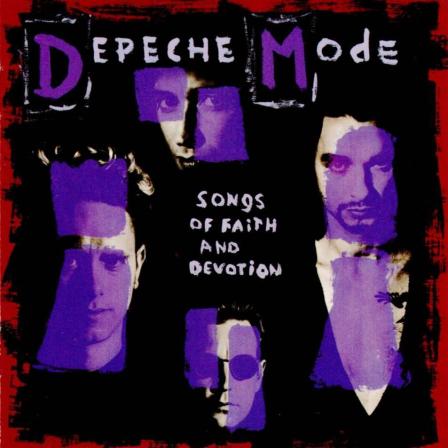
Songs of Faith and Devotion arrived not six months later but almost exactly one month after that first single. There’s a rough tension throughout the album, not unlike listening to The Beatles’ white album (a description given to it by Alan Wilder himself)…the music is full of powerful anger, and Gahan’s singing has taken on an irritated growl (inspired by the LA alternative bands he’d been hanging with by that time). There are more organic samples here — live drums and guitars laid down and sequenced — and hardly a clanging pipe or popping firework anywhere at all. And tensions within the band had grown to such a degree that Wilder would quit the band at the end of the supporting tour.
It’s a very apt title, as religious themes pop up all over the place. It’s not an album about praise, though…it’s about the limits of faith and devotion, both in life and in spirituality. The critical response to the album was highly positive, however, and though its singles are rarely chosen for airplay nowadays, it’s an incredibly solid and deeply emotional album worth checking out.
Second single “Walking in My Shoes” is the track that would get the most airplay, as it’s the most melodic and most typical of the band’s sound. That’s not to say it was written to sell units, however, far from it. It’s a bleak song using the ‘walk a mile in my shoes’ metaphor as only Gore and DM can do it: don’t you dare judge me until you feel what I’ve gone through.
Third single “Condemnation,” however, was a completely leftfield hit on both sides of the Atlantic. While “Death’s Door” hinted at a hymnal, this one is purely gospel choir, and it’s a deeply moving and lovely track.
Fourth and final single “In Your Room” featured the band venturing even further from their digital sound as well as their previous image: the video features numerous visual cues from their previous videos made with Anton Corbijn, twisted just that little bit to hint at a wish to be freed of them. Even the mix used here (the Zephyr Mix) is almost all analogue, showing DM as an almost purely rock band now instead of a synth band.
Even the album tracks like the gospel-by-way-of-Led-Zeppelin “Get Right with Me” and the turbulent irritation of “Rush” feature a band going all out in spirit and emotion. Taken as a whole, the album definitely mirrors the real-life tensions the band had been dealing with during the writing and recording, as well as the expectations laid upon them to recreate something as phenomenal as Violator. It would nearly break them. Wilder would depart at the end of the album’s tour, and once the tour was over that December, they would go their separate ways. Dave Gahan would attempt suicide in late 1995 and nearly die from a drug overdose in spring 1996. Gahan survived and persevered, recovering from his heroin addiction and turning his life around.
By early 1997, they were back with a new, even stronger and more cohesive album, Ultra.
You’ve heard me talk about this before: the best music releases of the year are quite often released within the fourth quarter — specifically, between late August and late November. This is so prevalent that you can set your watch to it. We’ll have a few strong spring releases, usually bands that already have a long-lasting cred; summer will be full of chart-worthy pop; late summer will be kind of skint, but may also contain some unexpected gems. But from September to just after Thanksgiving? You’re gonna see a crapton of releases.
Why? Simple: Christmas shopping!
It works on multiple levels. The spring releases are usually slow-burners and tried-and-true names that guarantee a sale. The summer releases are the impulse buys to celebrate vacation time. The end of summer is usually quiet because the kids are too busy purchasing things for school or college. But by the time September rolls around, there’s money in hand once more. And secondly: as much as we hate to admit it, a lot of us really do start our Christmas shopping hella early. And the music business knows this, so they’ll keep the guaranteed high-sale titles for when the shopping is at its highest.
So what do we have on tap in the rock universe, anyway? What’s coming out that’s going to take my hard-earned money?
September 2:
–The Wedding Present, Going, Going…
September 9:
–Bastille, Wild World —The Beatles, Live at the Hollywood Bowl reissue
—The Head and the Heart, Signs of Light
–Local Natives, Sunlit Youth
–MIA, AIM
–Nick Cave & the Bad Seeds, Skeleton Tree
–Wilco, Schmilco
September 16:
–Against Me!, Shape Shift with Me
—Steven Wilson, Transience
September 23:
–Warpaint, Heads Up
September 30:
–Banks, The Altar –Big Jesus, Oneiric
–Pixies, Head Carrier
—Regina Spektor, Remember Us to Life
–Yello, Toy
October 7:
–Kaiser Chiefs, Stay Together —Green Day, Revolution Radio
–Melissa Etheridge, MEmphis Rock and Soul –Phantogram, Three
—Placebo, A Place for Us to Dream
October 14:
–The Orb, Chill Out, World
October 21:
–Beck, (title TBA)
–Korn, The Serenity of Suffering
Ocboter 28:
–Empire of the Sun, Two Vines
—Madness, Can’t Catch Us Now
…and that’s just what’s been announced over the past few months that I’m interested in hearing. By late September we’ll start seeing more titles from all kinds of groups and across all the genres. We’ll start seeing more box sets and major reissues (An expansive box from Pink Floyd, and Fleetwood Mac’s Mirage, for instance). Mixes and greatest hits packages will start popping up. And somewhere in there, probably mid-October and early November, we’ll start seeing new and repackaged Christmas albums as well.
It’s the most wonderful time of the year indeed, especially if you’re a music nerd like I am.
So yeah, I’ve still been contemplating expanding the Walk in Silence series to include the 90s. I’ve started listening to the decade chronologically, much as I did with the original series and going through the 80s, and once again it’s been an interesting ride.
Presently I’m listening to Living Colour’s sophomore album Time’s Up, which came out in late August 1990. It was the back end of summer, and I’d chosen to take the last two weeks off between my summer job (second year at the DPW) and starting my sophomore year at Emerson. Chris and I got together to reform the Flying Bohemians as a duo, and recorded a few tracks in my parents’ garage.
I spent those last two weeks doing not much of anything: made a pretty decent compilation that I still listen to in 2016, did a bit of poetry, lyric and journal writing, a lot of Solitaire playing, and met up with all my friends who’d come home for a brief time. For the most part, most of them had taken root in their college towns and gotten local summer jobs or were taking summer classes, so there was only a narrow window of time that we could meet up.
Me? The only reason I’d come back home for the summer was that I hadn’t prepared myself for any summer position or an apartment to sublet for a few months. It had crossed my mind, of course, but I hadn’t the time or the money to plan it out sufficiently. I figured the summer of 1991 would be when I’d stick around.
That, and I’d wanted to spend more time with T, as well as distance myself from the frustration of freshman year. Summer 1990 was time to start over again.
I don’t use the Sirius XM radio on my own PC as much as I should, so today I thought I’d put it on. I chose the Lithium channel, primarily because the song playing at the time was Nine Inch Nails’ “Down In It”. And now I’ve been listening to the 90s all morning.
Yes, I know! Me, the guy who’s posted about 80s college rock for far too long, finally moving forward in time? Heh.
Seriously, the 90s was an interesting decade, looking back on it now. I tend to think of it as a decade where we crossed a lot of lines that had drawn in the sand for so long that we kind of forgot why they were there in the first place. A lot of interesting chances were taken in the creative world; some fell flat, but some were welcomed and became the norm. College radio became modern rock became alternative rock became chart-topping rock. It didn’t help that the 80s chart rock had become a sad caricature of itself, full of hair metal spandex and arpeggios, and bar bands with very few actual hits. Something had to take over eventually, and alt.rock had been waiting in the wings since the early 80s.
The music of the 90s for me felt sort of like a light was finally turned on. More to the point, it felt like I’d exited the dark cave of my bedroom and its 4AD/Cure gloom and entered the sunshine of the wider world beyond. I could easily say that Nirvana’s “Smells Like Teen Spirit” was in fact the point of change, as it probably was for many others. It wasn’t the first alt.rock song that broke through to chart radio (I’d like to think that honor actually belongs to Love and Rockets’ “So Alive”, which hit #3 on the Billboard Hot 100 chart two years earlier), but it was the most important one. Rock radio wasn’t the same afterwards.
Yeah, sure, there were also the bands that weren’t grunge, weren’t Britpop, and didn’t quite fit into the already-standard ‘alternative’ format. In retrospect they were chart rock’s New Breed. They were melodic, catchy, and just mainstream enough to be played on pretty much any commercial rock station without scaring the parents. They were just edgy enough that the kids loved them anyway. You probably wouldn’t hear them on college radio (that avenue was being filled at that time with No Depression, math rock, slowcore, and the other decidedly noncommercial subgenres), but you’d hear them on the burgeoning Modern Rock and AOR stations.
These are the songs you’ll hear on Adult Alternative stations nowadays, tracks by Collective Soul and Tonic rubbing shoulders with James Bay and Elle King. The slightly harder stuff will pop up on the alt.rock stations that have survived this long, sneaking in as ‘classic tracks’ next to new tracks by other 90s bands that have miraculously stayed together this long (Weezer, Red Hot Chili Peppers, Blink-182).
*
I can pretty much divide the 90s into two distinct personal eras: the college/Boston years (1990-95) and the HMV years (1996-2000), with the yearlong entr’acte of ennui and deadend jobs of 1995-6. Despite the personal ups and downs I was contending with at the time, I rarely missed an opportunity to follow the latest trends. I may not have had the money to buy it all at the time, but that didn’t stop me from making radio tapes, dubbing cds from friends, or keeping my boombox set to the local alternative stations.
Or spending most of my hard-earned pay at the record store I worked at, for that matter.
Despite my personal and emotional ups and downs in that decade, I found it to be a lot more enjoyable than the previous decade when I was dealing with my gawkish teenage self. My twenties certainly had their extremely frustrating moments, and I did make a lot of really stupid decisions, but by the back end of that decade, I had my shit together and knew exactly what I wanted to do. That’s when I knew for a fact that I’d be a writer. It’s also when I knew that this infatuation with music was going to be a lifelong thing and I was perfectly fine with that.
I’d tweeted earlier this week that one of my favorite things about vacationing in London is hearing some of my favorite songs in their original context. By that, I mean hearing songs that were big and important hits in the UK that may not have been even a blip on the US radar.
A year or so ago we were at a bar near Smithfield Market meeting with a friend of ours when Manic Street Preachers’ “Everything Must Go” popped up on the jukebox. It was a top-ten hit in the UK and signaled a new direction for the band after the strange disappearance of their former lead singer months previous.
David Bowie was of course a worldwide success, and his title theme for the movie Absolute Beginners was a very minor hit in the US (hitting #55 on the Billboard chart) but hit #2 in the UK. The movie itself is somewhat based on the British novel of the same name written by Colin MacInnes — a well-loved coming of age novel set in the hip London of the late 50s. Heard this one in a coffee shop just outside of St. Paul’s Cathedral one rainy morning.
The Divine Comedy is well known in the UK as an ‘orchestral pop’ band in the vein of Scott Walker (another musician quite familiar there but not in the US), and they wrote a song about the oversize tour buses one sees all around London. This track would pop into my head every time I saw one of them go by.
I love doing this kind of thing wherever I go, come to think of it. It’s partly to get the feel of the local sound, and partly because I’m just a sucker for rock music history. Whether it’s getting in touch with with Britain’s quirky rock (most of which became alternative rock here in the states), or Boston’s unique mix of collegiate and blue-collar, or San Francisco’s purposely weird sounds, I love being able to not only connect with the music itself, but the context in which it was written and recorded. It brings me closer to the real lives behind the music…it lets me understand why the song exists.